Natural Acne Care: What Helps, What Harms and When to Treat
Natural does not automatically mean safe or effective for acne. Build a gentle evidence-first routine and treat botanicals as optional adjuncts.
In this guide
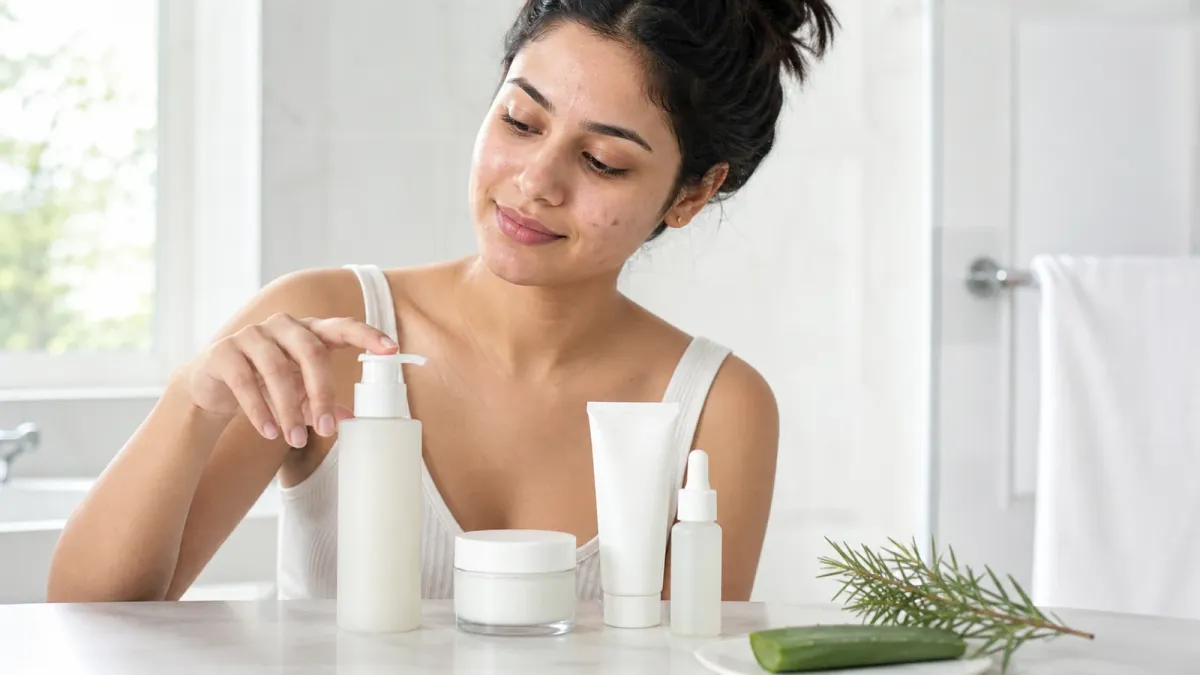
Use natural acne care as a preference for gentle, simple products, not as proof that a remedy works. Start with a mild cleanser, non-comedogenic moisturizer, broad-spectrum SPF 30+ and one evidence-based active such as benzoyl peroxide, adapalene, salicylic acid or azelaic acid.
Tea tree has limited evidence and can irritate; aloe, honey and witch hazel are optional adjuncts, while lemon, baking soda, toothpaste, undiluted essential oils and abrasive scrubs should be avoided.
Quick Summary
- Natural is a sourcing claim, not a safety or efficacy standard.
- Build the routine around gentle basics and one proven acne active.
- Tea tree has limited evidence; aloe, honey and witch hazel are not cures.
- Avoid kitchen acids, alkaline pastes, undiluted oils, scrubs and picking.
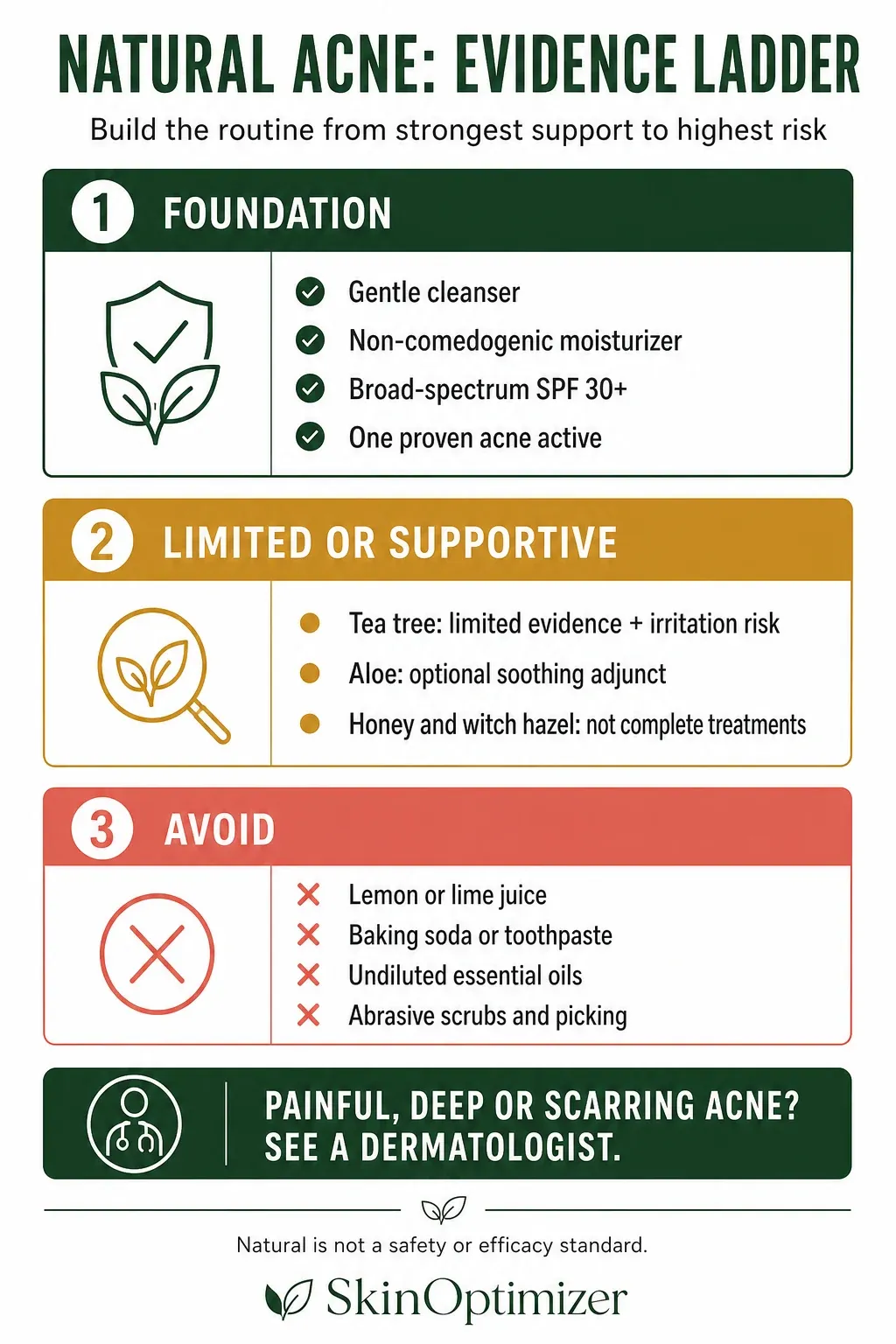
Natural acne advice is crowded with pantry masks and essential-oil claims that ignore follicle biology and irritation risk. This guide ranks options by evidence, preserves a preference for simple products and sets a clear boundary for nodules, cysts, scarring and persistent acne.
What Natural Acne Care Can Realistically Mean
Natural acne care can mean a preference for fewer ingredients, fragrance-free products or selected botanical formulas. It does not prove that a product is safer, non-comedogenic or effective.
Acne is an inflammatory follicular condition, so treatment should still target clogged pores, inflammation and acne-associated bacteria.
The 2024 AAD acne guideline supports benzoyl peroxide and topical retinoids strongly, with recommendations also including salicylic acid and azelaic acid. A preference for plant-derived care is a constraint to discuss, not a reason to hide better-supported options.
Results matter more than label language.
A useful natural routine is gentle, non-comedogenic, simple and measurable. It avoids kitchen acids, abrasive powders and undiluted essential oils.
It also has a clear point at which persistent or scarring acne moves from self-care to professional treatment.
| Approach | Evidence position | Main caution |
|---|---|---|
| Gentle cleanser, moisturizer and SPF | Strong supportive routine | Does not replace acne treatment |
| Tea tree finished product | Limited possible benefit | Irritation and allergy; never swallow |
| Aloe vera | Soothing potential, weak acne-treatment evidence | Fragrance and contact reactions |
| Honey mask | Not established for acne | Kitchen honey is not sterile medical honey |
| Witch hazel toner | No strong acne-clearance evidence | Alcohol and fragrance may irritate |
| Lemon, baking soda, toothpaste | No recommended role | Burns, barrier damage and dark marks |
Build a Three-Step Acne-Safe Base
Use a gentle non-abrasive cleanser, a non-comedogenic moisturizer and broad-spectrum SPF 30+ in the morning. Cleanse up to twice daily and after sweating when needed, not every time shine appears.
Scrubbing does not remove acne from inside the follicle.
The AAD acne skin-care tips recommend fingertips, gentle products, treatment consistency, no picking and sun protection. These habits are compatible with a natural-product preference.
They also reduce irritation that can leave dark marks.
Use the acne-prone routine guide to set morning and night order. Do not change cleanser, moisturizer and treatment in the same week.
A stable base makes it possible to judge one active product.
Start With Evidence Before Botanicals
Benzoyl peroxide reduces acne-associated bacteria and helps inflammatory lesions. Adapalene and other retinoids normalize clogged pores and reduce inflammation.
Salicylic acid helps comedonal acne, while azelaic acid can address acne and post-inflammatory color.
The benzoyl peroxide guide, retinoid guide and salicylic acid guide explain how to start slowly. Choosing one evidence-based active is usually more effective than layering several botanical spot treatments.
Natural and conventional are not mutually exclusive. A fragrance-free plant-derived moisturizer can support adapalene, or azelaic acid can fit a routine that otherwise uses simple botanical-free products.
Judge each formula by role, evidence and tolerance.
Tea Tree Oil: Limited Evidence, Real Irritation Risk
Tea tree oil has some small clinical studies for mild acne, but the evidence base is limited and heterogeneous. The NCCIH safety summary states that more research is needed and that redness or irritation can occur.
Tea tree oil should never be swallowed.
A 2023 systematic review of randomized tea tree trials rated the overall evidence poor to modest and noted more adverse effects at higher concentrations. That is not a basis for applying undiluted essential oil to inflamed skin.
Oxidized old oil may be especially irritating.
If you choose tea tree, use a finished cosmetic product with a disclosed ingredient list rather than a home dilution. Patch test for seven to ten days, then introduce on one acne-prone zone.
Stop for burning, itch, swelling or a spreading rash.
Aloe Vera: A Soothing Adjunct, Not a Complete Acne Treatment
Aloe gel can feel cooling and may support comfort after irritation, but evidence does not establish plain aloe as a reliable standalone acne treatment. Commercial gels vary widely and can include alcohol, fragrance, dyes and preservatives.
The plant name does not describe the finished formula.
The aloe vera skincare guide explains how to compare products and patch test. Use aloe as optional soothing support after a compatible active, not as a reason to delay care for nodules or scarring acne.
Do not apply a freshly cut leaf to broken pustules. Home processing does not control contamination or irritating latex components near the rind.
A stable cosmetic formula is easier to evaluate.
Honey: Wound-Care Evidence Does Not Equal Acne Evidence
Medical-grade honey is sterilized, standardized and used in selected wound-care settings. Kitchen honey is a food, not a sterile acne medication.
Antimicrobial activity in a laboratory does not prove that a sticky facial mask clears clogged follicles.
The honey skincare evidence guide separates medical products, cosmetics and pantry masks. Honey can also cause allergy or irritation.
Avoid it if there is a bee-product allergy and stop if itching or swelling develops.
A honey mask may temporarily soften dry surface scale, but that does not treat comedones or prevent new inflammatory lesions. Do not combine it with lemon juice, cinnamon or abrasive sugar.
Those additions increase risk without solving acne biology.
Witch Hazel: Temporary Tightness Is Not Pore Treatment
Witch hazel can remove surface oil and feel astringent. There is no strong clinical evidence that it permanently shrinks pores or clears acne.
Alcohol-rich or fragranced toners can increase dryness and reduce tolerance for effective treatment.
The witch hazel evidence guide compares limited redness data with acne marketing. If a toner stings, leaves tight shine or increases flaking, remove it.
Toner is optional in every acne routine.
Do not use astringency as a progress measure. Comfortable skin that tolerates treatment is a better target than a squeaky finish.
Excessive degreasing can create a cycle of irritation and product switching.
Essential Oils and Fragrance
Essential oils are concentrated aromatic mixtures, not nourishing carrier oils. Lavender, citrus, peppermint and oregano oils can irritate or sensitize skin.
A product can be natural and still trigger allergic contact dermatitis.
The essential-oil safety guide explains dilution limits and why facial acne is a poor testing ground for strong DIY blends. Never use essential oils near eyes or swallow them.
Keep them away from children and pets.
Fragrance-free is usually a better target for reactive acne than choosing a different scent source. "Unscented" may contain masking fragrance.
Check the full ingredient list rather than the front label.
Carrier Oils and "Non-Comedogenic" Claims
Coconut, olive, rosehip and jojoba oils differ in fatty-acid profile and texture, but no universal comedogenic chart predicts every person. A pure oil also lacks the water and humectants found in a balanced moisturizer.
Acne-prone skin may tolerate one formula and break out from another.
Use the facial oils and breakouts guide before adding oil. Test one small zone and monitor for several weeks.
Stop if closed comedones or inflammatory lesions increase in the treated area.
Do not use oil to dissolve active acne medication or mix it into sunscreen. Product order and film formation matter.
A light non-comedogenic lotion often supports acne treatment more predictably than a dropper oil.
DIY Ingredients to Avoid
Lemon and lime juice contain acids and photosensitizing compounds with unpredictable concentration. They can burn skin and worsen dark marks.
Baking soda is strongly alkaline relative to skin and can disrupt the barrier.
Toothpaste is formulated for teeth, not facial leave-on use; flavoring, detergents and whitening agents can irritate. Rubbing alcohol and hydrogen peroxide damage surface cells and do not provide a sustainable acne plan.
Garlic, cinnamon and undiluted apple cider vinegar can also cause burns or dermatitis.
Abrasive sugar, salt, coffee and walnut scrubs add friction to inflamed lesions. Popping and needle extraction push the problem deeper and increase scar risk.
The safest DIY action is often to stop manipulating the lesion and use a proven treatment consistently.
Food, Supplements and "Detox" Claims
No tea, juice cleanse or supplement detoxes acne from the skin. Acne has hormonal, genetic, follicular and inflammatory drivers.
Diet can influence acne for some people, but it is not evidence that one food caused every breakout.
The diet and acne guide reviews glycemic load, dairy signals and the limits of observational data. Track a repeatable pattern before eliminating major food groups.
A registered dietitian can protect nutritional adequacy.
High-dose supplements can cause harm or interact with medication. A review of supplement-associated acne describes links involving vitamins B6/B12, iodine, whey, and some muscle-building supplements.
Tell a clinician everything you take, including herbs and powders. A supplement list is more useful than assuming every breakout comes from food.
How to Patch Test a Natural Acne Product
For a new cosmetic, the AAD recommends a small test spot twice daily for seven to ten days. Use intact skin near the elbow or underside of the arm, following rinse-off directions when applicable.
Wash off and stop if a reaction develops. A tolerated home trial does not rule out every later reaction and is not diagnostic allergy patch testing; acne medications still require their own label or prescriber instructions.
Then use the product on one acne-prone zone for two weeks while keeping the rest of the routine stable. Photograph in the same light.
Track burning, itch, rash, closed bumps and inflammatory lesions separately.
Introduce only one new product at a time. The slow skincare method gives a simple schedule.
If several products change together, you lose the ability to identify benefit or harm.
A Four-Week Evidence-First Routine
| Time | Morning | Night and decision rule |
|---|---|---|
| Week 1 | Gentle cleanse, moisturizer, SPF | Same base; stop scrubs, oils and toners |
| Week 2 | Maintain the base | Add one proven active slowly |
| Week 3 | Monitor dryness and dark marks | Increase only if skin remains comfortable |
| Week 4 | Compare standardized photos | Continue, reduce or seek care based on response |
| Any time | Protect from sun | Stop for swelling, raw skin or severe burning |
Choosing One Active by Acne Type
Blackheads and whiteheads usually need a comedolytic strategy such as adapalene or salicylic acid. Inflamed papules and pustules often benefit from benzoyl peroxide, sometimes combined with a retinoid.
Azelaic acid can be useful when post-acne color is a major concern.
Start at a tolerable frequency and moisturize. Do not stack salicylic acid cleanser, exfoliating toner, retinoid and tea tree spot oil on the same night.
Irritation can make acne look worse and increase PIH risk.
The acne cleanser guide helps decide whether an active belongs in the wash step or leave-on treatment. A cleanser has short contact time and should not be expected to treat cysts or hormonal drivers alone.
Acne and Darker Skin Tones
Inflammation can leave persistent dark marks in any skin tone and often lasts longer in melanin-rich skin. Irritation from DIY acids, harsh scrubs and picking adds another inflammatory event.
Treating acne gently is also pigment prevention.
The AAD guidance for acne in darker skin recommends non-comedogenic products and warns that cocoa butter does not even skin tone and may contribute to acne. Traditional popularity is not proof of pigment benefit.
Use daily sunscreen that fits the skin tone and routine. The acne-prone sunscreen guide includes lightweight and tinted options.
Stop any active that causes persistent burning or new darkening.
When Natural Care Is Not Enough
See a dermatologist for deep painful nodules, cysts, rapidly forming scars, widespread chest or back acne or significant emotional distress. Also seek care when a consistent over-the-counter plan has not improved acne after six to eight weeks.
Prescription treatment can prevent permanent change.
Sudden adult acne, irregular periods, unwanted hair growth or medication-related changes may need broader assessment. Itchy uniform bumps can be folliculitis rather than acne.
A correct diagnosis prevents months of ineffective natural remedies.
Pregnancy and breastfeeding change which acne medications are appropriate. Do not assume a botanical is safe because it is sold without a prescription.
Review all treatments with an obstetric or dermatology clinician.
How to Read a Natural Acne Product Label
Start with the product role: cleanser, moisturizer, sunscreen or treatment. Then check whether the active ingredient and concentration are disclosed.
Vague phrases such as detoxifying, pore-purging and balancing do not explain mechanism.
Look for fragrance, essential oils, denatured alcohol and multiple plant extracts when skin is reactive. A long list is not automatically bad, but it creates more variables.
Non-comedogenic is helpful, not a guarantee.
Check packaging, expiration and storage. Oxidized essential oils and contaminated jars increase reaction risk.
Discard a product that changes smell, color or texture rather than trying to use it up on inflamed skin.
The Bottom Line
Natural acne care is most useful when it means gentle, simple and transparent rather than unproven kitchen treatment. Build the routine around non-comedogenic basics and one evidence-based active.
Botanicals can be optional adjuncts only when the exact formula is tolerated.
Tea tree has limited evidence and real irritation risk; aloe, honey and witch hazel are not complete acne treatments. Avoid corrosive DIY ingredients and do not delay care for painful or scarring acne.
Clearer skin comes from targeting acne biology consistently, not from the natural label.
Frequently Asked Questions About Natural Acne Care
What is the best natural treatment for acne?
No botanical is universally best. A gentle cleanser, non-comedogenic moisturizer, sunscreen and one proven active provide a more reliable base than a rotating set of masks.
Does tea tree oil clear acne?
Limited evidence suggests some finished tea tree products may help mild acne, but studies are small and irritation can occur. Never apply undiluted oil or swallow it.
Can honey or aloe replace acne medication?
No. They may feel soothing in selected formulas, but neither reliably treats clogged follicles, nodules or cysts. Use them only as optional adjuncts if tolerated.
Which DIY acne ingredients should I avoid?
Avoid lemon or lime juice, baking soda, toothpaste, rubbing alcohol, hydrogen peroxide, undiluted essential oils and abrasive salt or sugar scrubs.
When should I see a dermatologist for acne?
Seek care for deep painful lesions, scars, widespread acne, sudden adult changes, significant distress or no improvement after six to eight weeks of consistent over-the-counter care.
This article is for informational purposes only and does not replace professional dermatological advice.