Aloe Vera for Skincare: Benefits, Limits, and How to Use It
Unlock radiant skin with our ultimate guide to aloe vera! Discover tips, benefits, and DIY recipes for glowing skin.
In this guide
Quick Answer: Is Aloe Vera Good for Your Skin?
Aloe vera for skincare is an optional soothing ingredient, not a cure for acne, pigmentation, or damaged skin. Choose a finished formula you tolerate, try it on a small area first, and keep your moisturizer and sun protection.
Stop if it burns, itches, or causes a rash. A cooling sensation does not prove healing, and more gel does not mean a better result.
Quick Summary
- Best role: an optional comfort step within a simple routine.
- Not interchangeable: cosmetic gel, raw leaf, and oral aloe products are different.
- Dry or tight afterward? Reassess the formula and your moisturizer rather than applying thicker layers.
- Keep the essentials: appropriate treatment, gentle care, and sunscreen still matter.
Aloe Vera for Skincare: Start With the Job, Not the Hype
Aloe vera for skincare is easy to oversell because one familiar plant appears in so many products. A clear gel, a rich lotion, and a bottle of aloe juice can share a name while serving very different purposes.
My editorial starting point is simple: decide what you want the product to do before deciding whether aloe belongs in your routine. Temporary comfort is a different goal from treating recurring acne, investigating a rash, or managing persistent discoloration.
That distinction also makes shopping easier. You do not need the highest percentage, the greenest gel, or the longest list of botanical ingredients to make a sensible choice.
Aloe can be a pleasant extra when its finished formula suits you. It can also be an unnecessary layer when your current cleanser, moisturizer, and sunscreen already leave your skin comfortable.
The useful question is not whether everyone should use it. It is whether this particular product solves a clearly defined problem without creating another one, such as stickiness, irritation, or confusion about which step is helping.
This guide focuses on topical cosmetic use on intact skin. It does not offer a recipe for treating wounds, an oral supplement regimen, or a reason to delay professional care when symptoms are persistent or worsening.
What Aloe Can—and Cannot—Do
The NCCIH evidence summary describes small studies of aloe alongside other acne treatments. That is not evidence that a supermarket gel can independently clear breakouts or replace a prescription.
For burns and wounds, DermNet highlights limitations in the research. A promising result in a particular study does not establish that every aloe product is appropriate for every injury.
| Your goal | Reasonable expectation | Important boundary |
|---|---|---|
| Everyday comfort | A tolerated formula may feel pleasant. | Comfort is not proof of barrier repair. |
| Sunburn discomfort | An aloe-containing moisturizer may soothe. | It does not reverse UV damage or provide sunscreen protection. |
| Acne treatment | Limited research involves combination treatment. | Do not replace an effective acne plan with aloe alone. |
| Dark spots or wrinkles | Do not assume an aloe gel will correct them. | Ingredient stories are not proof of visible treatment results. |
For sunburn: comfort is not faster healing
The American Academy of Dermatology suggests an aloe- or soy-containing moisturizer to soothe sunburn. Cool baths or showers, hydration, and protecting burned skin from further sun exposure also matter.
Soothing discomfort is not the same as demonstrating faster healing of sunburn. Do not use a pleasant after-sun sensation as permission to return to strong sunlight.
Blistering, extensive burns, fever, or feeling unwell warrant medical advice. For a broader care plan, see our guide to responding to sunburn.
For acne, marks, and recurring irritation
Do not set an “aloe until clear” deadline. If breakouts keep returning, treatment selection matters more than adding another soothing layer; our natural skincare and acne guide provides related context.
Redness, brown marks, and indented scars are not the same target. Start by understanding post-acne redness rather than expecting one botanical ingredient to address every change left after a spot.
Gel, Raw Leaf, and Oral Aloe Are Different
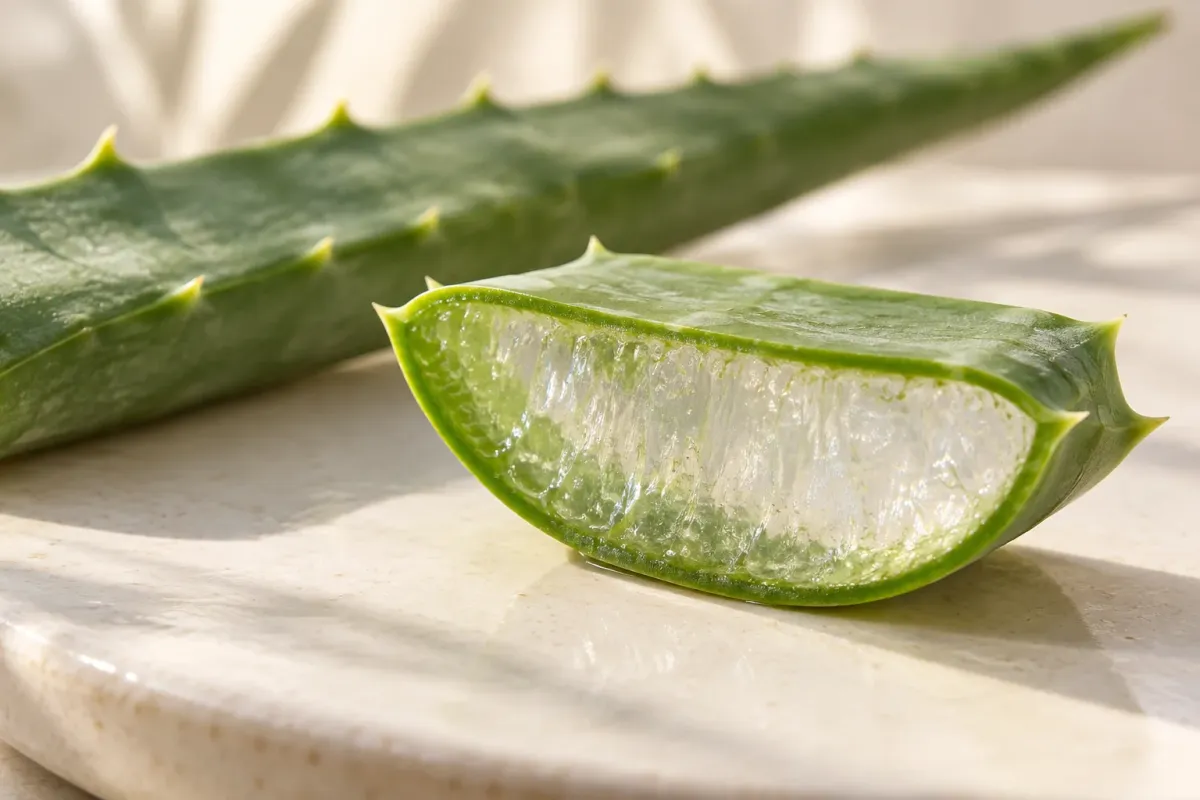
The clear inner-leaf gel is different from the yellow latex near the leaf's outer layers. NCCIH separates these preparations because their uses and safety considerations are not interchangeable.
Likewise, an ingredient called aloe leaf juice within a cosmetic is not an instruction to drink that product. Keep topical products for their labeled use, and do not repurpose a beverage as facial skincare.
- Finished cosmetic: assess the complete ingredient list and application directions.
- Raw leaf: do not assume home preparation establishes purity, preservation, or suitability.
- Oral preparation: treat it as a separate health decision, not a shortcut to clearer skin.
The NIEHS aloe overview also distinguishes oral whole-leaf research from topical use. Animal findings involving ingested preparations should not be retold as proof that ordinary cosmetic gel causes skin cancer.
My practical preference for routine facial use is a clearly labeled finished formula rather than a kitchen preparation. That is a choice about traceability and instructions, not a guarantee that any packaged product will agree with every person.
Before buying anything, check the products you already own. Aloe may already appear in your moisturizer, so a second bottle could duplicate an ingredient without filling a genuine gap.
Why Aloe Gel May Not Replace Your Moisturizer
A product can feel wet when applied yet leave your skin uncomfortable later. That experience is a reason to reassess the routine, not evidence that the product is “drawing out toxins” or that tightness means it is working.
DermNet explains that moisturizers can combine humectants, emollients, and occlusives. These roles involve attracting water, smoothing skin, and reducing water loss; a lightweight gel is not automatically equivalent to a cream.
Check what the actual formula is designed to do. An aloe-containing moisturizer and a mostly watery aloe gel may behave differently even when both emphasize aloe on the front label.
- Dry skin: prioritize a comfortable moisturizing routine before experimenting with extra gel.
- Oily skin: choose by comfort and formulation, not a blanket assumption that all creams are unsuitable.
- Already comfortable: skipping aloe is a valid option; no step is mandatory just because it is popular.
Use our dry-skin routine or oily-skin routine to organize the essentials. Add aloe only if you can describe what you want it to improve.
How to Use Aloe Vera on Your Face
Test your aloe vera skincare formula before wider use
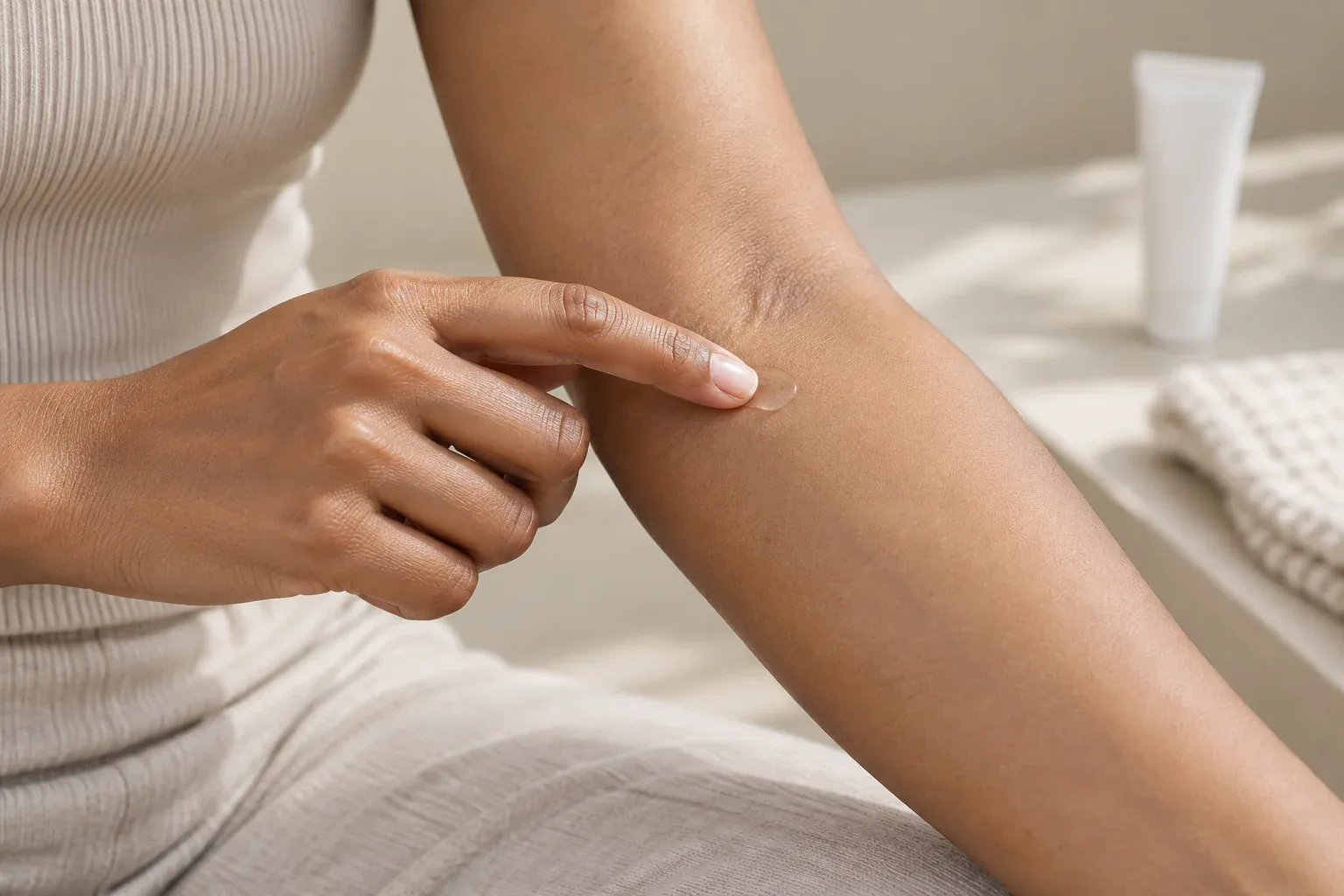
The AAD's home product-testing guidance recommends a small spot, twice daily for seven to ten days. Follow the product's directions, including rinsing if it is a rinse-off formula.
If irritation develops, wash it off and stop using it. Passing a home trial does not rule out every later reaction, and this is not the diagnostic patch testing a dermatologist uses to investigate allergy.
Keep the first full application simple
Choose a time when you can notice how your skin feels. Starting immediately before bed makes it harder to observe early discomfort, especially when several other products are new.
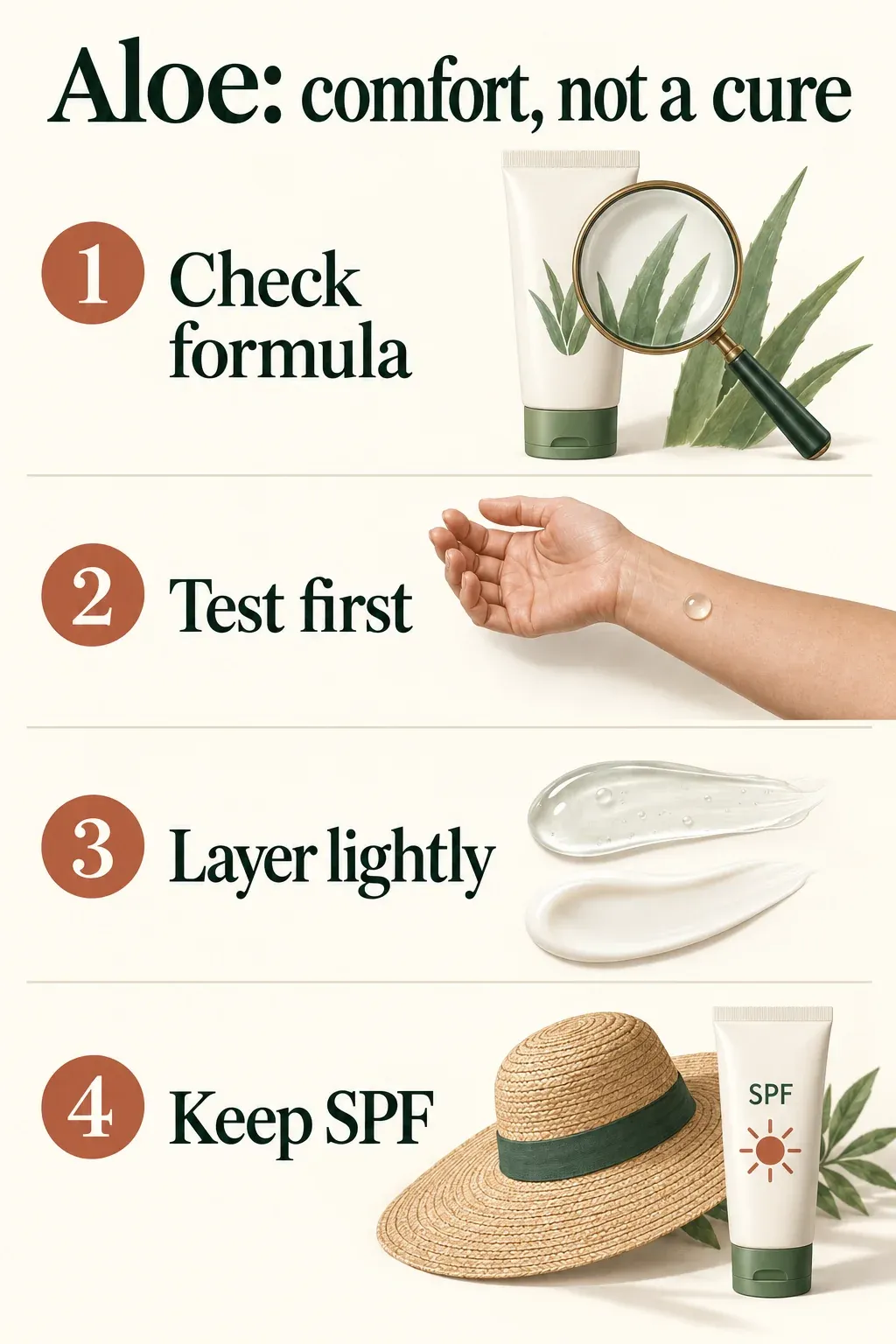
- Check the label: confirm that facial and leave-on use are appropriate.
- Use a light layer: follow the manufacturer's amount rather than building a thick mask.
- Keep familiar steps: use your usual tolerated moisturizer if needed.
- Leave treatment instructions intact: do not change a prescription routine to accommodate aloe.
There is no universal aloe waiting time that makes every skincare combination work. If products roll up or feel tacky, use our skincare pilling troubleshooting guide to simplify the layers instead of inventing a longer ritual.
For example, if you introduce a cleanser, aloe gel, and an exfoliant together, a new rash leaves several possible explanations. Keeping familiar products unchanged makes the history clearer when you describe it to a clinician.
Where it fits morning and evening
For an optional lightweight gel, a practical sequence is cleansing, aloe if wanted, then moisturizer as needed. An aloe-containing cream may already be your moisturizing step; follow its own directions.
In the morning, keep sunscreen as a separate step and apply it according to its label. Do not mix aloe into sunscreen or reduce the amount of sunscreen to make room for gel.
At night, a tolerated leave-on formula does not need an invented rinse-off deadline. A rinse-off product does; the product type and your skin response matter more than an internet rule about fifteen minutes.
Read the Label Without Chasing “Purity”
A high aloe percentage is not a complete quality assessment. The remaining ingredients, packaging, directions, and your own tolerance still determine whether a product is a sensible fit.
Similarly, a long ingredient name does not automatically identify a harmful ingredient. “Natural,” “organic,” and a green color are not substitutes for useful labeling or a product that feels comfortable on your skin.
| Check | Useful information | Do not assume |
|---|---|---|
| Intended use | Face or body; leave-on or rinse-off. | Every aloe product belongs on the face. |
| Whole formula | Ingredients, fragrance information, and directions. | A large percentage proves better results. |
| Packaging | Readable batch, storage, and opening guidance. | A homemade jar is more trustworthy. |
| Your goal | A clearly defined comfort or moisturizing role. | One gel replaces treatment and sunscreen. |
For sensitive skin, the AAD advises choosing fragrance-free products; “unscented” is not necessarily equivalent. Even then, introduce the finished formula cautiously rather than treating the label as a promise of zero reactions.
Preservation is not the enemy
The FDA explains that cosmetic contamination can involve raw materials, ineffective preservation, packaging, storage, and consumer handling. Adding water can introduce microorganisms and dilute a product's preservative system.
Follow storage directions, keep containers clean, and use clean hands. Do not top up a bottle with raw gel, tea, or water; the resulting mixture is no longer the formula described on its label.
Our editorial recommendation is to skip improvised aloe mixtures with essential oils, lemon juice, or powdered actives. A recipe's popularity does not establish its concentration, compatibility, or suitability for your face.
Keep a photograph of the packaging before throwing it away. Directions and the exact product name are more useful for a later review than remembering only that the bottle said “soothing aloe.”
What to Do When Aloe Does Not Feel Right
NCCIH reports occasional burning, itching, rash, and eczema with topical aloe. Do not push through these signs because a product is described as soothing.
A home observation cannot identify whether aloe itself, another ingredient, or an existing condition caused the problem. Keep the ingredient list and note the timing if you need help investigating a reaction.
| What you notice | First response | Avoid |
|---|---|---|
| Burning, itching, or rash | Wash off and stop; seek advice if symptoms persist or worsen. | Waiting for skin to “get used to it.” |
| Tight feeling after drying | Reassess the gel and moisturizing step. | Assuming tightness proves firming. |
| Pilling under other products | Simplify the optional layers. | Scrubbing the rolls off your face. |
| No useful difference | Leave the optional step out. | Escalating application to chase a result. |
If many products suddenly sting, consider the broader pattern rather than collecting more soothing ingredients. Our skin-barrier warning-sign guide explains why irritation can need more than a new gel.
- Get urgent help: trouble breathing or significant swelling after a product needs urgent medical attention.
- Seek clinical advice: spreading redness, increasing pain, suspected infection, or a persistent rash should not become a DIY project.
- Respect aftercare: follow your clinician's instructions after procedures rather than adding aloe independently.
The Bottom Line
Aloe earns a place in your routine only if the particular formula is useful and comfortable for you. You do not need it to build a good routine, and you do not need a stronger claim than modest comfort to enjoy it.
Keep the decision small: choose carefully, introduce cautiously, and leave it out if it adds irritation or complexity. For recurring skin problems, an accurate assessment is more valuable than another botanical promise.
Frequently Asked Questions About Aloe Vera for Skincare
Questions were informed by discussions about aloe in everyday routines and raw aloe overnight. Community posts identify uncertainties, not evidence; authoritative sources support the guidance above.
Can aloe vera replace moisturizer if it makes my skin feel tight?
Not automatically. The whole formula matters, and a watery gel may not provide the same combination of moisturizing functions as a cream.
If your skin feels tight, reassess the gel and use a tolerated moisturizer as needed. Stop if the sensation is burning, itching, or irritation.
Can I leave aloe vera on my face overnight?
A tolerated cosmetic designed for leave-on use can be used according to its label, including at night. Rinse-off products should be rinsed as directed.
Do not make overnight use your first test, and do not assume raw leaf follows the same rules as a formulated product.
Is raw aloe from a leaf better than a packaged gel?
Not necessarily. Raw preparation does not establish purity or preservation, while packaged products still require ingredient and tolerance checks.
For routine facial use, our practical preference is a clearly labeled finished formula. Soaking a leaf is not a verified substitute for formulation and safety assessment.
Does aloe vera clear acne?
It is not established as a standalone acne treatment. Small studies described by NCCIH involved aloe alongside other treatments, so their results cannot be applied to any aloe gel used alone.
Keep an appropriate acne plan and seek help for persistent or scarring breakouts.
Does aloe vera fade dark spots?
Do not rely on an ordinary aloe gel to fade dark spots. A soothing effect is different from demonstrated pigment treatment.
Identify the cause of the discoloration, maintain sun protection, and choose targeted care with professional guidance when needed.
This article is for informational purposes only and does not replace professional dermatological advice.