Benzoyl Peroxide for Acne: Strength, Safety and Routine Guide
Benzoyl peroxide is an evidence-based acne treatment. Learn which acne it fits, how to start, what irritation means and how current FDA recall guidance applies.
In this guide
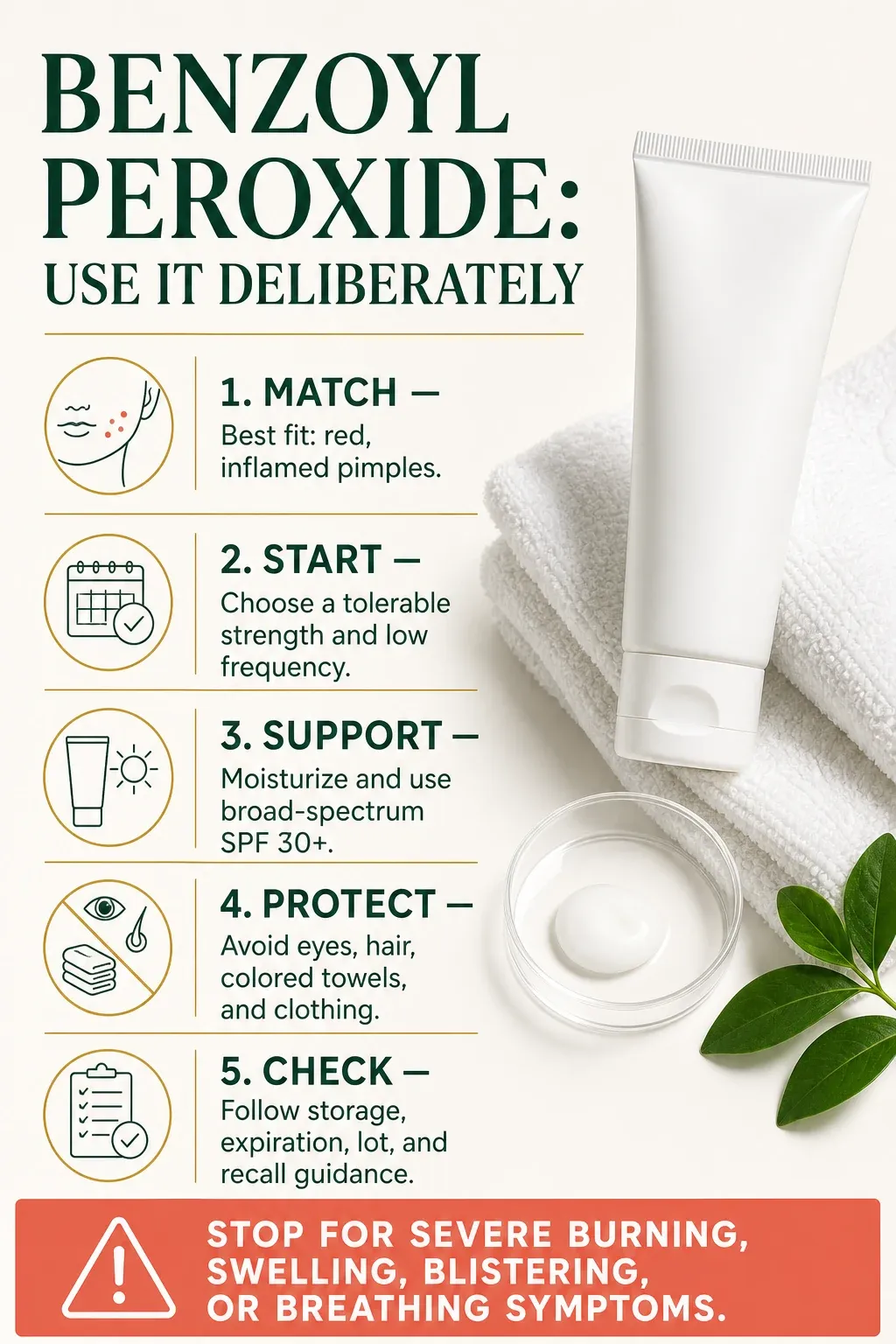
Benzoyl peroxide is an evidence-based treatment for red inflammatory acne because it reduces acne-related bacteria and inflammation. Start with a tolerable strength such as 2.5% leave-on or a low-frequency wash, apply a thin layer as directed, moisturize and protect fabric from bleaching. Check current FDA recalls and store the product away from heat; limited recalls do not mean every benzoyl-peroxide product is unsafe.
Quick Summary
- Benzoyl peroxide fits inflammatory pimples better than blackheads alone.
- Higher percentages are not automatically better for facial acne.
- Introduce slowly, moisturize and avoid stacking new irritating actives.
- Check lot recalls, storage and expiration instead of abandoning the category.
Benzoyl peroxide is one of the most established over-the-counter acne treatments, yet it is often used at unnecessary strength or rejected because recall headlines are misunderstood. This guide explains lesion fit, format, schedule, fabric bleaching, irritation and the current FDA benzene context without minimizing either benefit or uncertainty.
How Benzoyl Peroxide Treats Acne
Benzoyl peroxide reduces acne-related bacteria and inflammation and can help unclog pores. It is especially useful for red inflammatory pimples and is often combined with a retinoid or topical antibiotic. It is not a bleach for skin, but it can bleach hair, towels and clothing.
The 2024 American Academy of Dermatology acne guideline update strongly recommends topical benzoyl peroxide. Combining different mechanisms can improve results and helps avoid antibiotic monotherapy.
Benzoyl peroxide does not treat every bump. Blackheads may respond better to salicylic acid or a retinoid, while deep nodules often need prescription care. The teen breakout guide helps identify the treatment lane.
| Acne pattern | Benzoyl peroxide fit | Important note |
|---|---|---|
| Red inflamed pimples | Strong fit | Use over the acne-prone area as directed |
| Blackheads only | Possible but not first choice | Salicylic acid or retinoid may fit better |
| Deep nodules or cysts | Supportive, usually insufficient | Seek medical treatment early |
| Back or chest acne | Wash formats can be useful | Rinse well; protect fabrics |
| Sensitive or eczema-prone skin | Higher irritation risk | Start low or ask a clinician |
Choosing Strength and Format
Over-the-counter products often range from 2.5% to 10%. A higher percentage is not automatically more effective for the face and can be more irritating. Many people can start with 2.5% or a low-frequency 4% wash.
A wash limits contact time and can suit larger body areas. A leave-on gel or cream provides longer exposure but may cause more dryness. Choose by lesion location, sensitivity and ability to use the product consistently.
Check the Drug Facts panel for active percentage and directions. Do not assume two products with different brand names are different treatments. The active cleanser guide compares benzoyl-peroxide washes with salicylic and gentle cleansers.
How to Start Without Burning the Barrier
Patch test as the label directs. Begin every other day or two to three times weekly if skin is sensitive, then increase only when comfortable and within package directions. Use a thin layer rather than a thick opaque coating.
Cleanse gently and let skin dry. Apply benzoyl peroxide to the acne-prone area when directed, avoiding eyes, lips and corners of the nose. Follow with a non-comedogenic moisturizer.
The FDA labeling warns that irritation and dryness are more likely when another topical acne medication is used at the same time. Introduce one change at a time with the slow-start method.
Morning or Night Routine Placement
Benzoyl peroxide can be used morning or night depending on the product and the rest of the plan. Some people use it in the morning and a retinoid at night to separate irritation. Others use a wash in the shower for back or chest acne.
A simple morning routine is gentle cleanser, benzoyl peroxide as directed, moisturizer and broad-spectrum SPF 30 or higher. At night, cleanse, use the prescribed or chosen active and moisturize. Do not mix benzoyl peroxide into moisturizer because that changes application consistency.
Modern adapalene can be used with benzoyl peroxide and is sold in fixed combinations, but personal tolerance matters. Prescription tretinoin instructions can vary by formulation. Follow the clinician or label rather than a universal social-media rule.
Using Benzoyl Peroxide With Antibiotics
Dermatology guidelines recommend combining topical or oral antibiotics with benzoyl peroxide to reduce the risk of antibiotic resistance. Antibiotics should not be the only long-term acne mechanism. The exact combination and duration need clinical direction.
Do not use leftover oral antibiotics or share prescriptions. Acne dosing, pregnancy considerations, interactions and duration require medical assessment. Finish or stop medication according to the prescriber's instructions.
If a topical antibiotic is prescribed, ask whether a fixed combination or separate benzoyl peroxide product is intended. Duplicating products can increase irritation without improving the plan.
Expected Dryness Versus a Stop Signal
Mild dryness, tightness or small flakes can occur during introduction. Reduce frequency, use a gentle cleanser and add moisturizer. Do not scrub off flakes or add an acid toner.
Stop and seek advice for severe burning, swelling, blistering or a spreading rash. Rare allergic reactions can include throat tightness, trouble breathing, faintness or facial swelling and need urgent medical help. The product label contains the applicable warning.
The barrier recovery guide can help with mild over-treatment. Persistent reactions or eczema-prone skin need clinician input before restarting.
Benzene Questions, FDA Testing and Recalls
In March 2025, the FDA reported testing 95 benzoyl-peroxide acne products. More than 90% had undetectable or extremely low benzene, while six products had elevated levels and were voluntarily recalled at retail level.
This finding does not mean every benzoyl-peroxide product is unsafe. Check the current FDA recall notice and the lot in your possession. Do not use an expired, overheated or recalled product.
The AAD benzoyl-peroxide FAQ notes that current evidence has not linked regular use to higher blood benzene or increased cancer risk, while research continues. It advises storage at room temperature or cooler and replacement every 10 to 12 weeks if concerned.
Storage and Fabric Protection
Keep the cap closed and store according to the label, away from heat and direct sun. A hot car or steamy windowsill is not appropriate. Write the opening date on the package.
Use white towels and pillowcases or fabrics you can tolerate bleaching. Let a leave-on product dry before dressing or going to bed. Wash hands after application and keep it away from brows and hairline when possible.
Bleached fabric is a product-contact issue, not evidence that skin was bleached. Benzoyl peroxide is not intended to lighten the complexion or post-acne marks.
A Four-Week Tolerance Plan
| Week | Frequency example | Decision |
|---|---|---|
| 1 | Two or three applications | Check burning, swelling and dryness |
| 2 | Every other day if calm | Maintain moisturizer and SPF |
| 3 | Continue or follow label increase | Do not add another active |
| 4 | Stable schedule | Assess new inflammatory lesions |
| 6 to 8 | Consistent tolerated use | Judge early treatment response |
Common Benzoyl Peroxide Mistakes
- Starting at maximum strength: irritation can erase adherence.
- Using only on visible spots: area treatment may prevent new lesions when directed.
- Skipping moisturizer: dryness is a predictable management issue.
- Stacking with acids immediately: overlap obscures the cause of burning.
- Ignoring fabric bleaching: protect towels, collars and bedding.
- Keeping an old hot tube: follow storage, expiry and recall information.
When Benzoyl Peroxide Is Not Enough
Deep nodules, cysts, scars and widespread acne need medical treatment. Benzoyl peroxide may remain one component, but it cannot replace a complete plan. The acne treatment options guide explains when prescription escalation matters.
If there is no early improvement after six to eight weeks of correct, tolerated use, review diagnosis, adherence and combination therapy. Conditions such as folliculitis, perioral dermatitis or rosacea can resemble acne and need different care.
Pregnancy, breastfeeding, prescription retinoids and complex skin disease warrant a clinician conversation. Do not infer safety for an individual from an over-the-counter label alone.
Wash Versus Leave-On: Make the Tradeoff Explicit
A wash is applied and rinsed, which limits contact time and can be easier on sensitive skin. It is convenient for the chest, shoulders and back. Let it contact the area only as long as the label directs, then rinse thoroughly.
A leave-on gel or cream maintains longer contact and may suit facial inflammatory acne. Begin with a small amount spread thinly over the affected zone. Thick layers increase residue and irritation rather than guaranteeing more bacterial reduction.
Combination products can include clindamycin or adapalene. Treat them as one coordinated medication, not as permission to add separate duplicates. Review the active percentages across every wash, gel and spot treatment.
Body Acne Needs a Practical Shower Plan
Use the wash on affected skin rather than the entire body unless directed. Rinse before drying with a white towel and wear light-colored sleepwear during introduction. Colored gym clothing and bedding can bleach from incomplete rinsing.
Shower after sweating when practical, but avoid abrasive body brushes. Friction from backpacks, sports pads and tight clothing can worsen lesions. The back acne guide combines treatment with gear and shower changes.
Do not apply benzoyl peroxide to broken, freshly waxed or severely irritated skin. Large painful nodules or scars on the trunk often need oral or prescription therapy. A wash alone may not reach the required treatment depth.
Benzoyl Peroxide and Sunscreen
The FDA label advises avoiding unnecessary sun exposure and using sunscreen. Irritated acne treatment skin can also be less comfortable outdoors. Apply a broad-spectrum, water-resistant SPF 30 or higher as the final morning skincare step.
Choose a sunscreen by texture and treatment fit rather than searching for a benzoyl-peroxide-specific product. The acne-prone sunscreen guide compares non-comedogenic, mineral and organic-filter options.
If sunscreen stings after starting benzoyl peroxide, first reduce irritation and simplify the base routine. Do not stop sun protection and continue the same harsh schedule. A bland moisturizer underneath may improve tolerance.
Spot Treatment Versus Area Treatment
A spot treatment can reduce one visible inflamed lesion, but it does not address nearby follicles that are beginning to clog. If the product directions support area use, spread a thin film over the acne-prone region. Avoid unaffected sensitive zones.
Hydrocolloid patches can protect a picked or draining surface lesion, but benzoyl peroxide should not be trapped under an occlusive patch unless the label or clinician directs it. Occlusion can increase penetration and irritation.
The spot-treatment comparison shows when benzoyl peroxide, salicylic acid or a patch matches the lesion. Deep cysts are not flattened safely by applying several spot products together.
Special Situations to Discuss Professionally
People with eczema, very sensitive skin or prior benzoyl-peroxide allergy need tailored advice. The FDA label warns not to use it on very sensitive skin or with known sensitivity. A lower-contact wash is not automatically safe after an allergy.
Pregnancy and breastfeeding require medication review even when a product is available over the counter. Ask which site, amount and frequency are appropriate. Keep products away from an infant's direct skin contact.
Skin of color can experience long-lasting dark marks after irritation. Start conservatively and control inflammation without creating rawness. Persistent marks may need a coordinated acne-and-pigment plan.
What Current Guidance Does and Does Not Establish
The AAD clinical guideline supports benzoyl peroxide as a core topical acne treatment. That recommendation reflects efficacy and established use, while individual side effects and formulation quality still matter.
The 2025 FDA product testing identified limited lots for recall, not a class-wide removal. A recall is specific to product, lot and distribution information. Check official sources rather than screenshots that omit the lot.
Research can change storage or formulation guidance. Keep the package, record the lot and replace old product. Report unexpected quality or adverse events through the applicable FDA process and contact a clinician for medical symptoms.
Buy from a seller that provides intact packaging, a readable lot and normal storage conditions. Extremely old clearance stock or a tube that arrived swollen, leaking or heat damaged should not be used. Product quality is part of treatment safety.
When traveling, keep benzoyl peroxide in the labeled container and out of a hot vehicle. Pack it separately from colored clothing. A smaller fresh tube is often more practical than transferring medication into an unlabeled jar.
The Bottom Line
Benzoyl peroxide is an evidence-based treatment for inflammatory acne. Use a tolerable strength, apply it correctly, support the barrier and give it enough time. More concentration and more friction are not shortcuts.
Current FDA testing supports checking recalled lots and proper storage, not abandoning every benzoyl-peroxide product. Painful, scarring or treatment-resistant acne needs professional care.
Frequently Asked Questions About Benzoyl Peroxide for Acne
What acne does benzoyl peroxide treat?
It is best suited to red inflammatory pimples and can support face or body acne routines. Blackheads alone may respond better to salicylic acid or a retinoid.
What benzoyl peroxide strength should a beginner use?
Many people can start with 2.5% leave-on or a lower-frequency wash. Higher percentages are not automatically more effective for the face and may irritate more.
Can benzoyl peroxide be used every day?
Yes, if the product directions allow it and skin tolerates it. Sensitive skin can start every other day or a few times weekly and increase gradually.
Does benzoyl peroxide cause cancer?
Current evidence has not linked regular use to increased cancer risk. FDA testing prompted limited recalls for elevated benzene in specific products, so check lots and store products correctly.
Can benzoyl peroxide and adapalene be used together?
They can be combined and are available in fixed prescription or over-the-counter routines, but irritation can increase. Introduce carefully and follow label or clinician guidance.
This article is for informational purposes only and does not replace professional dermatological advice.