Honey for Skin: Evidence, DIY Safety and Medical-Grade Limits
Medical-grade honey has a limited wound-care role, but kitchen honey is not an acne cure or sterile treatment. Learn what evidence can and cannot support.
In this guide
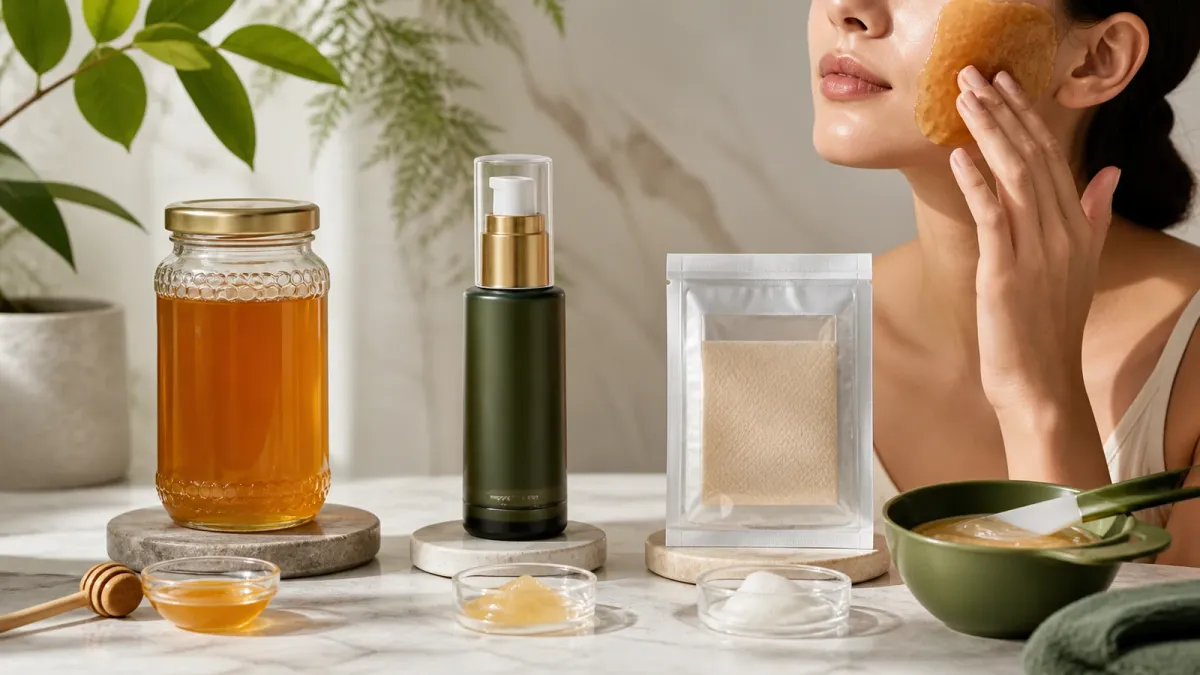
Food honey, cosmetic honey extract and sterile medical-grade honey are not interchangeable.
Medical honey may support selected wounds under clinical protocols, but that evidence does not prove a kitchen honey mask treats acne, fades dark spots or reverses aging.
On calm intact skin, a brief clean single-use mask may provide temporary softness; patch test first and never place food honey on open, infected or severely inflamed skin.
Content substantially revised: . Originally published October 19, 2024 (UTC). This date reflects the documented content revision, not a new article.
Quick Summary
- Do not transfer medical wound evidence to kitchen face masks.
- Honey is not a first-line treatment for acne, eczema or dark spots.
- Use only a clean single-use portion on calm intact skin after patch testing.
- Avoid honey and propolis when bee-product allergy or contact reaction is possible.
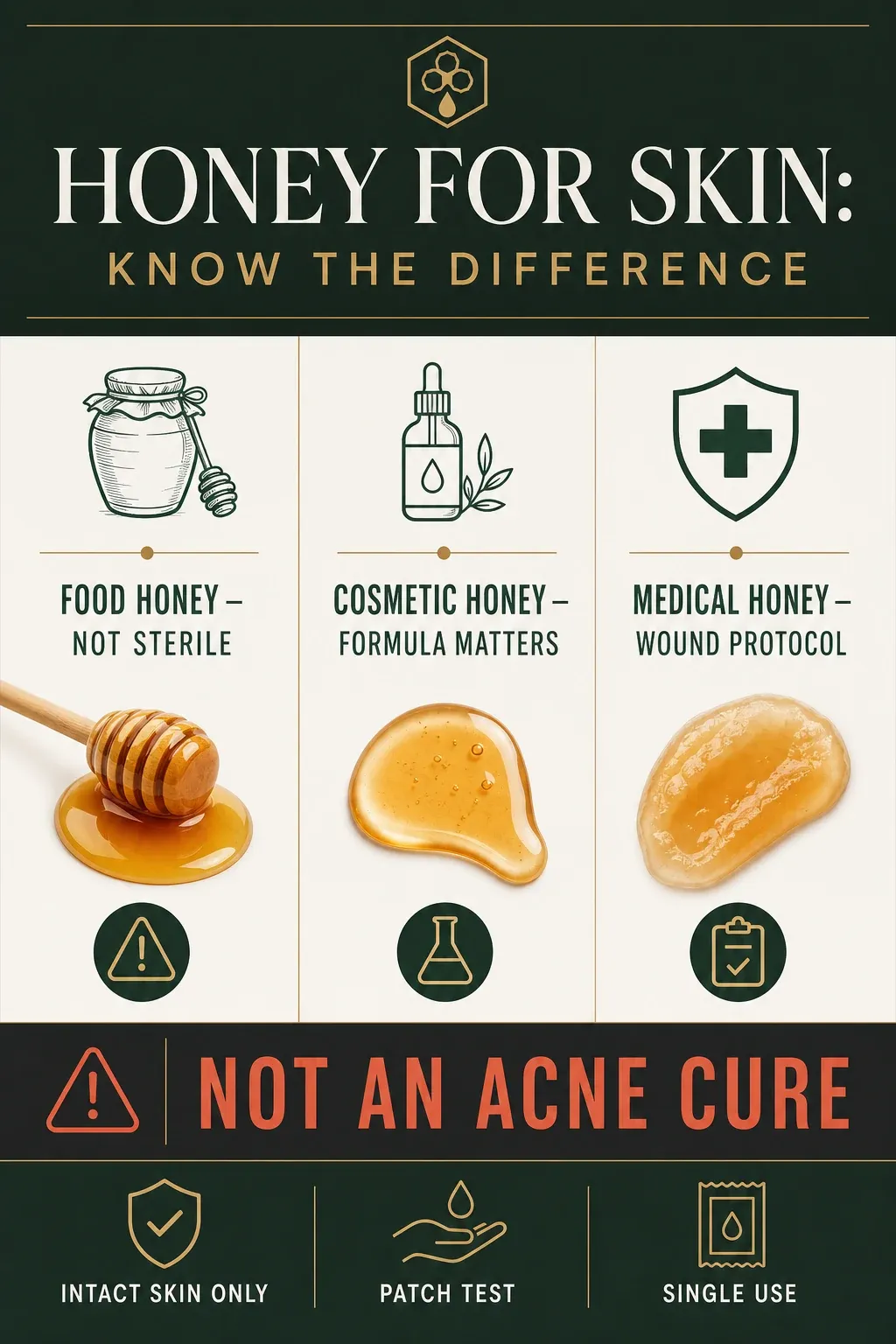
Honey skincare claims often combine laboratory antimicrobial activity, medical wound dressings and homemade masks as if they were one body of evidence. They are not.
This guide matches each claim to the exact product and clinical context, then gives conservative rules for readers who still want a cosmetic trial on intact skin.
Food Honey and Medical-Grade Honey Are Not Equivalent
Honey is not one standardized skincare ingredient. Food honey varies by plant source, processing, water content and storage. Medical-grade honey is selected, treated, tested and packaged for clinical wound products; it is not the same as opening a kitchen jar.
Medical honey can create an osmotic environment and has antimicrobial properties relevant to some wound-care contexts. Those mechanisms do not prove that food honey clears acne, fades pigmentation or reverses aging. Product sterility and clinical indication are part of the evidence.
A 2024 systematic review of honey dressings for chronic wounds reported possible benefits but rated the evidence very low quality. A broader Cochrane wound review found condition-specific and uncertain conclusions. Neither review tested kitchen face masks.
| Honey use | Evidence context | Responsible conclusion |
|---|---|---|
| Medical wound dressing | Sterile product under clinical protocols | May fit selected wounds with professional care |
| Cosmetic cleanser or mask | Limited direct clinical evidence | Possible sensory hydration, not treatment |
| Acne spot treatment | Not established | Use evidence-based acne therapy |
| Dark-spot lightener | Not established | Prevent irritation and use targeted care |
| Open or infected lesion | Kitchen honey is inappropriate | Seek wound or medical advice |
What Honey May Do on Intact Skin
Honey is humectant and sticky, so it may make intact skin feel temporarily softer after a brief rinse-off application. This is a cosmetic feel outcome. It does not establish deeper hydration, collagen remodeling or disease treatment.
Laboratory antimicrobial activity depends on concentration, acidity, peroxide activity and botanical source. Skin, sebum and contact time change that environment. A petri-dish result cannot be translated directly into an acne recommendation.
Some cosmetic formulas use honey extract alongside glycerin, emollients and preservatives. The complete formulation may be more predictable than raw honey. Read the full ingredient list and judge the product rather than attributing every effect to the headline ingredient.
Honey Is Not a Standalone Acne Treatment
Acne involves follicular plugging, sebum, inflammation and Cutibacterium acnes. Current guidelines support benzoyl peroxide, retinoids and other treatments with clinical evidence. Honey is not a first-line substitute.
Sticky spot applications can attract touching, delay a stable routine and irritate when scrubbed off. They also cannot reach every developing lesion in an acne-prone zone. The acne prevention guide explains area treatment and six-week evaluation.
For inflamed pimples, use the benzoyl peroxide guide or seek professional advice. Deep, painful or scarring acne needs early care. Do not place food honey into picked or draining lesions.
If You Still Want to Try a Honey Mask
Use only on intact, calm skin and treat it as an optional cosmetic experiment. Apply a very thin layer from a clean single-use portion for five to ten minutes, then rinse gently with lukewarm water.
Do not combine it with lemon, cinnamon, baking soda or essential oils.
Keep the mixture away from eyes, lips, hairline and broken skin. Do not return used utensils to the food jar. Discard the portion and clean the bowl immediately.
Moisturize afterward if needed and use sunscreen in the morning. Repeat no more than once weekly until tolerance is clear. The DIY face mask safety guide gives a full decision process.
Patch Testing and Allergy Risk
Honey, pollen, propolis and bee-derived ingredients can cause allergic contact reactions in susceptible people. A history of eating honey without symptoms does not guarantee that prolonged skin contact will be tolerated. Cosmetic propolis allergy is a separate concern.
Test the exact product on a small area for several days before facial use. The AAD product-testing method uses twice-daily application for seven to ten days. Stop for itch, swelling, hives or a delayed rash.
Breathing difficulty, throat tightness, faintness or rapid facial swelling requires emergency care. Wash off the product and keep its packaging. Do not test another bee-derived ingredient to identify the cause yourself.
Honey for Eczema or Sensitive Skin
Eczema is a chronic inflammatory barrier condition with different severities and triggers. A food mask is not a substitute for fragrance-free moisturizer, prescribed anti-inflammatory treatment or infection management. Oozing or crusting requires assessment.
Even when honey feels soothing, rubbing during removal can worsen reactive skin. Botanicals, propolis and added fragrance in packaged products can also trigger contact dermatitis. The barrier recovery guide provides a lower-variable reset.
Use a bland cream or ointment on slightly damp skin as the default. If a dermatologist recommends a medical honey product for a wound, follow the specific product and dressing instructions. Do not substitute food honey.
Honey for Dark Spots and "Brightening"
There is no strong clinical evidence that a DIY honey mask fades post-inflammatory hyperpigmentation or melasma. Immediate glow can come from hydration and surface reflection. It should not be described as melanin reduction.
Dark marks improve by preventing new inflammation, using broad-spectrum sunscreen and selecting targeted ingredients with tolerable evidence. Irritation from a recipe can create new post-inflammatory pigment, especially in melanin-rich skin.
The post-acne redness guide and dark-spot routine separate redness, pigment and scar texture. Correct classification prevents wasted remedies.
Honey for Wounds and Burns
Do not place grocery honey on a burn, surgical wound, ulcer or infected lesion. Medical-grade products are manufactured and packaged for wound use. Wound type, circulation, infection risk and dressing choice require clinical judgment.
The wound literature is not uniformly positive and evidence quality varies. Some conditions may benefit while others remain uncertain. "Honey heals wounds" is too broad to guide self-treatment.
Seek urgent care for deep burns, spreading redness, fever, pus, severe pain, loss of sensation or wounds in people with diabetes or poor circulation. Delayed care can be dangerous. A beauty routine should never override wound assessment.
Manuka Ratings and Marketing Claims
Manuka grading systems describe chemical markers or antibacterial activity within specific commercial standards. A higher number does not turn food honey into a sterile wound dressing or prove better facial outcomes. Cosmetic benefit cannot be inferred from price.
Look for a defined product purpose, complete ingredient list, preservation and realistic claim. "Medical grade" should refer to a regulated wound product, not a loose marketing phrase on a face mask. Verify the manufacturer and instructions.
Expensive honey also cannot replace sunscreen, moisturizer or acne treatment. Use the natural skincare myths guide to evaluate pathway and purity language.
A Safe Decision Ladder
| Question | If yes | If no |
|---|---|---|
| Is the skin intact and calm? | Continue to allergy review | Skip DIY use and treat the condition |
| Is the goal temporary softness? | A short cosmetic trial may fit | Choose a targeted evidence-based tool |
| Is there bee-product allergy? | Avoid honey and propolis | Patch test still matters |
| Is this a wound or infection? | Use professional care only | Keep use brief and rinse-off |
| Did the first test stay comfortable? | Evaluate once weekly | Stop and simplify |
Common Honey Skincare Myths
- "Antibacterial means acne cure": lab activity does not equal clinical lesion clearance.
- "Raw is more effective": unprocessed does not mean standardized or sterile.
- "Manuka rating predicts glow": grading does not establish cosmetic outcomes.
- "Honey lightens skin": there is no adequate evidence for targeted pigment reduction.
- "Food allergy is the only risk": contact allergy and added ingredients also matter.
- "Wound studies prove face-mask benefits": the product and clinical context are different.
When to Stop or Seek Care
Stop for persistent burning, itching, swelling, hives, worsening acne or a delayed rash. Rinse gently and return to a familiar cleanser and moisturizer. Do not add acids or essential oils to "balance" the reaction.
See a clinician for infected-looking skin, non-healing wounds, severe eczema, deep acne or persistent pigment change. Medical honey, when appropriate, is chosen for a specific wound and protocol. Food honey should not bridge the gap while waiting.
Emergency symptoms include trouble breathing, throat tightness, faintness and rapid facial swelling. Follow local emergency guidance. Keep the exact product and ingredient list available.
Medical-Grade Honey in Clinical Context
Medical honey dressings are manufactured for wound contact, often with defined honey type, sterilization and dressing format. Clinicians also assess wound depth, blood supply, infection, pressure and systemic disease. The honey product is one part of that plan.
Evidence differs by wound type, comparator and outcome. Faster healing in one setting does not prove benefit for surgical wounds, burns, diabetic ulcers and cosmetic facial use alike. Review quality and certainty before repeating a broad conclusion.
A review of medical-grade honey for skin infection and wounds discusses standardized clinical products, not pantry jars. Readers should keep that product distinction visible in every sentence.
Propolis, Royal Jelly and Bee Venom Are Different Ingredients
Propolis is a resinous bee product, royal jelly is a glandular secretion and bee venom contains peptides with different risks. Evidence or allergy for one should not be silently transferred to another. "Bee-powered" is a marketing category, not a standardized ingredient.
Propolis is a recognized contact allergen and can appear in natural balms, creams and oral products. A honey mask may also contain pollen traces or added botanicals. Review the exact label and stop the entire product when a reaction occurs.
People with asthma, severe allergy history or prior bee-product reactions should not perform casual face experiments. Ask an allergist or dermatologist when exposure questions matter. Home patch testing does not make a known allergy safe.
Preservation and Contamination in Honey Mixtures
Undiluted honey has properties that limit some microbial growth, but adding water, aloe, yogurt or fruit changes the environment. Hands, utensils and bathroom storage add contamination opportunities. A mixture can become unsafe without visible mold.
Prepare one application in a clean bowl and discard the rest. Do not add water and store it in a jar. Do not dip a used brush back into food honey that will later be eaten.
Cosmetic products containing honey extract should use an appropriate preservation system. "Preservative free" is not automatically safer for a water-containing formula. The natural ingredient safety guide helps identify supporting ingredients.
How to Measure a Cosmetic Honey Trial
Define one short-term outcome such as morning tightness or visible flaking. Keep cleanser, moisturizer and active treatment stable. Use the mask once weekly for no more than three tolerated uses before deciding whether it adds value.
Photograph in the same light and record delayed itch, new bumps and removal friction. Do not credit honey for acne changes occurring alongside a retinoid or benzoyl peroxide. Attribution requires a stable comparison.
If plain moisturizer produces equal softness, choose the easier option. The hydration guide explains why a humectant feel still needs barrier support. Optional rituals should not obscure effective daily care.
Contact Dermatitis From Natural Products
The AAD explains that contact dermatitis can follow personal-care exposure and may develop after repeated use. Redness, itch, swelling and a spreading rash are more important than the product's natural label.
Stop the suspected product, rinse gently and use a familiar bland moisturizer. Do not keep testing related bee ingredients. Persistent reactions can require medical patch testing to identify propolis, fragrance or another allergen.
Keep the packaging, recipe and timeline. A clinician cannot infer every ingredient from "raw honey mask." Complete exposure information improves diagnosis and future avoidance.
The Bottom Line
Honey has interesting laboratory properties and a legitimate but condition-specific role in some medical wound products. That evidence does not validate food honey as an acne cure, brightener or anti-aging mask. Sterility, standardization and clinical context are essential.
On calm intact skin, a brief honey mask may provide temporary softness for someone without allergy, but it remains optional. Use a clean single-use portion, patch test and rinse gently. Choose proven treatment for acne, pigment disorders, eczema and wounds.
Frequently Asked Questions About Honey for Skin
Is honey good for your face?
A brief honey mask may make intact skin feel temporarily softer, but direct clinical evidence for acne, pigment or anti-aging outcomes is limited. It is optional, not essential care.
Can honey treat acne?
Honey is not an established first-line acne treatment. Laboratory antimicrobial activity and wound use do not prove that a kitchen spot treatment clears acne lesions.
Is Manuka honey better for skin?
Manuka ratings describe specific chemical or activity markers, not proven cosmetic outcomes. Food-grade Manuka honey is still not a sterile medical wound dressing.
Can honey be put on an open wound?
Do not use grocery honey on open, infected or non-healing wounds. Medical-grade honey products are selected for specific wound-care protocols under professional guidance.
How do I patch test honey for skincare?
Apply the exact product to a small area twice daily for seven to ten days. Stop for itch, redness, swelling, hives or delayed rash, especially with bee-product or propolis allergy.
This article is for informational purposes only and does not replace professional dermatological advice.