Witch Hazel for Skin: Benefits, Limits and Irritation Risks
Witch hazel has limited evidence for modest calming, not acne treatment or permanent pore shrinkage. The complete toner formula determines whether it fits.

In this guide

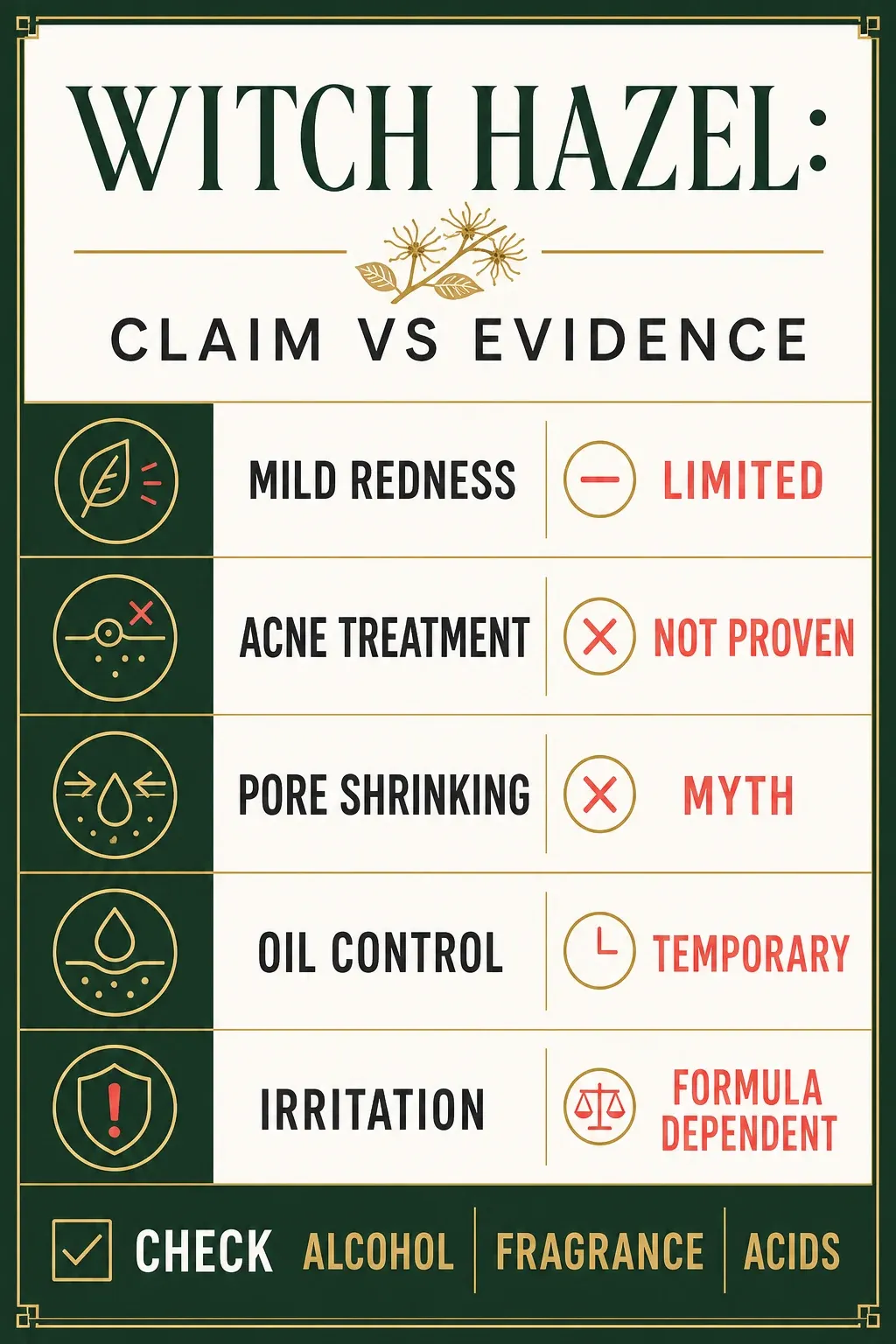
Witch hazel may provide modest short-term calming in some formulas, but current evidence does not establish it as an acne treatment, permanent pore shrinker or long-term oil regulator.
Check the entire ingredient list because alcohol, fragrance and acids can make products drying or irritating.
Patch test for seven to ten days and stop if skin becomes tight, itchy, swollen or persistently red.
Content substantially revised: . Originally published October 19, 2024 (UTC). This date reflects the documented content revision, not a new article.
Quick Summary
- Small redness studies do not prove acne clearance or pore shrinkage.
- Witch hazel distillate, extract and alcohol-based toners are not interchangeable.
- Choose the formula for a defined job and avoid duplicate drying actives.
- Sensitive, rosacea-prone or eczema-prone skin should prioritize comfort.
Witch hazel sits between traditional remedy and modern toner marketing. Limited studies support a modest effect on experimental redness, while online claims expand that finding into acne cures and permanently smaller pores.
This guide keeps those evidence levels separate and evaluates the product readers actually buy rather than the plant name alone.
What the Evidence Actually Shows
Witch hazel is a plant extract used in toners, aftershaves and soothing products. Small human erythema studies suggest modest short-term anti-inflammatory activity, while laboratory studies describe effects on inflammatory pathways.
Those findings do not establish witch hazel as an acne treatment, pore shrinker or long-term oil-control ingredient.
An older randomized vehicle-controlled study found that hamamelis distillate reduced experimentally induced skin redness to a limited degree. Another UV erythema comparison found weaker anti-inflammatory effects than hydrocortisone. Experimental redness is not the same outcome as acne clearance or rosacea control.
A 2022 keratinocyte study reported acne-related anti-inflammatory signals but explicitly noted the lack of acne data. Cell experiments can help generate hypotheses; they cannot tell readers how many pimples a toner prevents. Marketing often skips that distinction.
| Claim | Evidence status | Practical conclusion |
|---|---|---|
| Temporarily calms mild redness | Limited small-study support | Possible formula benefit, not guaranteed |
| Treats acne | Not established | Use proven acne actives instead |
| Shrinks pores | Biologically misleading | Pores may look temporarily less oily |
| Controls oil all day | Insufficient evidence | Astringency is not sebum regulation |
| Safe because natural | False assumption | Alcohol, fragrance and allergy still matter |
Witch Hazel Is Not One Standard Formula
Hamamelis virginiana may appear as distillate, water, extract or bark and leaf components. Distillation and extraction change which compounds remain. A bottle can also include denatured alcohol, ethanol, fragrance, acids, humectants and preservatives.
Read the complete INCI list and not only the front label. An alcohol-free witch hazel toner may feel very different from an astringent containing a high amount of alcohol. Neither label proves that the product fits sensitive or acne-prone skin.
Product pH, concentration and the supporting formula influence tolerance. A soothing humectant-rich toner may owe much of its effect to glycerin or panthenol rather than witch hazel. Multi-ingredient studies cannot isolate the botanical.
Does Witch Hazel Help Acne?
Witch hazel is not included among first-line acne treatments in modern dermatology guidelines. The AAD acne guideline update supports treatments such as benzoyl peroxide, topical retinoids and combinations with established clinical evidence. Astringency does not address every mechanism that creates acne.
A systematic review of externally applied herbal acne treatments found signals for some interventions but substantial heterogeneity and limitations. It does not make witch hazel equivalent to benzoyl peroxide or adapalene. Use the acne-prevention guide to match treatment to lesion type.
Witch hazel can also make an acne routine harder to tolerate when combined with alcohol, acids or several drying actives. Tightness after application does not mean oil production has been corrected. It may simply mean surface water and lipids were removed.
How to Decide Whether a Product Fits
Start with the job. For hydration, choose a fragrance-free hydrating toner or simply moisturize; for acne control, use a proven active. If the goal is a refreshing sensory step, decide whether that benefit justifies another potential irritant.
Prefer alcohol-free and fragrance-free formulas when skin is dry, reactive, eczema-prone or already treated with a retinoid. Check for acids or exfoliating ingredients that may duplicate the routine. The slow skincare guide helps introduce one variable.
Do not use witch hazel to disinfect cuts, treat infection or replace wound care. Avoid the eyelids, lips and broken skin. A cosmetic toner is not a sterile medical product.
Alcohol-Containing Versus Alcohol-Free Toners
Ethanol can create fast evaporation and a degreased finish. In a well-designed formula and limited use, some people tolerate it. In dry or treated skin, repeated exposure may increase tightness, stinging and barrier symptoms.
Alcohol-free does not mean irritation-free. Fragrance, essential oils, acids and botanical mixtures can still trigger irritant or allergic contact dermatitis. The exact formula matters more than one exclusion claim.
If a product leaves cheeks tight while the T-zone remains oily, do not interpret that as balance. Reduce frequency or stop. A gentle cleanser and targeted treatment are more controllable than repeated whole-face degreasing.
Witch Hazel for Oily Skin and Visible Pores
Oily skin may enjoy a temporary matte finish, but sebaceous glands continue to produce oil. Use blotting paper, a light moisturizer and sunscreen textures that suit the finish you prefer. Do not keep layering toner every time shine returns.
For clogged pores, salicylic acid can enter oily follicles and has a clearer acne role. For texture related to sun damage, sunscreen and a retinoid may matter more. The visible-pore guide explains realistic options.
Over-cleansing and astringents can make the routine uncomfortable without causing glands to "compensate" in a simple on-off mechanism. The practical problem is irritation and inconsistent treatment. Comfort supports adherence.
Witch Hazel for Sensitive Skin, Rosacea or Eczema
Reactive skin needs fewer variables and fragrance-free products. The AAD advises people with rosacea to avoid products that sting, burn or dry their skin. A cooling or tightening sensation should not be accepted as necessary.
Eczema-prone skin can develop irritant or allergic contact dermatitis from personal-care products. Persistent itch, swelling or recurrent facial rash may require clinician patch testing. Use the barrier guide rather than trying to tone through a flare.
A product that worked before can still become a problem later. Allergic contact dermatitis can develop after repeated exposure. Stop the entire suspected formula rather than blaming only witch hazel or only alcohol.
A Controlled Introduction Plan
Test the exact product on a small area twice daily for seven to ten days, following the AAD product-testing approach. Use the same contact time and amount intended for the face. Do not test several new products together.
If comfortable, use it once every second or third day after cleansing. Apply moisturizer afterward when needed. Keep acne medications and exfoliants unchanged so a reaction can be traced.
Stop for persistent burning, increased dryness, itch, swelling or a spreading rash. Mild immediate evaporation is not the same as good tolerance over a week. Judge the condition the next morning as well as the first minute.
| Time | Action | Continue only if |
|---|---|---|
| Days 1 to 7 | Small-area test | No redness, itch, swelling or delayed rash |
| Week 2 | Use once every third day | Skin remains comfortable the next morning |
| Week 3 | Maintain; do not stack actives | A clear benefit is visible |
| Week 4 | Compare with baseline | Benefit exceeds dryness or complexity |
| Any time | Stop and simplify | Required for burning, rash or swelling |
Where It Fits in a Routine
If you keep the product, use it after cleansing and before moisturizer. It does not need to be used morning and night. Sunscreen remains the final morning step.
Do not use it as makeup remover, cleanser and treatment simultaneously unless the product is specifically formulated and labeled for those roles. The acne cleanser guide can simplify the first step.
Separate it from exfoliation nights if the formula contains alcohol or acids and skin is reactive. A toner is optional; skipping it does not leave the routine incomplete. Cleanser, treatment, moisturizer and sunscreen can function without one.
Common Witch Hazel Claims to Reject
- "Closes pores": temporary surface effects do not permanently alter follicles.
- "Detoxes skin": toner does not remove systemic toxins.
- "Kills acne overnight": there is no adequate clinical basis for that promise.
- "Balances pH": a well-tolerated routine does not require a special balancing step.
- "Natural means gentle": botanical allergy and formula irritants remain possible.
- "Tightness means clean": it may reflect dehydration or lipid removal.
When Professional Care Is Better
Persistent inflammatory acne, deep lesions, scars or widespread post-acne marks need evidence-based treatment. Repeatedly drying the surface can delay effective care. The benzoyl peroxide guide covers one established option.
Recurrent facial rash, eyelid swelling or product reactions may need medical patch testing. Severe swelling, breathing difficulty or widespread blistering requires urgent care. Bring the ingredient list and timeline.
Rosacea, perioral dermatitis, folliculitis and eczema can resemble acne. Astringent toner may worsen several of these. Diagnosis should come before another active when the pattern is uncertain.
Reading a Witch Hazel Ingredient List
Ingredients are listed in descending order until roughly the one-percent region, after which exact rank becomes less informative. Witch hazel water near the top does not reveal its concentration or extraction method. Alcohol high on the list signals a different experience from a humectant-led toner.
Look for glycerin, panthenol or beta-glucan when hydration is the goal. Check salicylic, glycolic or lactic acid when exfoliation is mentioned. Fragrance can appear as parfum or through aromatic botanical components.
The natural ingredient safety guide helps translate marketing names into routine roles. When the manufacturer does not disclose a full list, skip the product. Transparency is part of safe comparison.
What the Redness Studies Cannot Tell Us
Experimental erythema studies expose small areas under controlled conditions and measure redness over a short period. They do not establish daily facial use across acne, rosacea and eczema. Older formulations may also differ from current retail toners.
The comparator matters: a modest improvement versus vehicle can coexist with weaker activity than a medical anti-inflammatory. It does not support replacing prescribed treatment. Duration also matters because short-term calming cannot prove long-term barrier safety.
Laboratory work on keratinocytes identifies possible pathways, not a recommended dose or clinical response rate. A newer witch hazel formula study itself notes that barrier and chronic-inflammation efficacy needs more investigation. That uncertainty belongs in the buying decision.
Witch Hazel After Shaving
Shaving creates friction and can leave small barrier disruptions. An alcohol-heavy astringent may sting and increase dryness, while a bland fragrance-free moisturizer can reduce tightness. Stinging is not disinfection evidence.
For razor bumps, review technique, blade hygiene and whether hairs are becoming ingrown. Salicylic or glycolic acid may be used in some routines, but not immediately on raw skin. The sensitive-skin routine guide helps prevent aftershave irritation from becoming another treatment problem.
Stop shaving over inflamed or infected-looking bumps and seek care when pustules spread or scars develop. Witch hazel cannot distinguish acne from folliculitis. Avoid sharing products that touch the skin directly.
A Better Comparison Test
Use the product on one defined area and keep cleanser, moisturizer and treatment stable. Photograph at baseline and after four weeks in the same lighting. Track oil comfort, stinging, flakes and inflammatory lesions separately.
Do not judge by the first dry minute. Compare how much moisturizer is needed, whether treatment nights remain tolerable and whether visible outcomes persist. Stop early for a delayed rash or worsening sensitivity.
If the toner provides no measurable benefit after four weeks, remove it. The routine does not need a replacement step. A shorter routine can improve both adherence and cause tracking.
Storage and Application Details
Keep the cap closed and store the toner according to its label, away from heat and direct sun. Do not dilute it with water in the original bottle because that changes preservation. Discard products with an altered smell, color or texture.
Apply with clean hands to reduce rubbing; a cotton pad is optional, not required. Avoid repeated passes intended to make the pad look clean. Residue on cotton does not prove that cleanser failed or toxins remained.
Do not share applicators or decant the toner into an unclean travel bottle. Mark the opening date when the package gives a period-after-opening symbol. Product hygiene cannot create efficacy, but it prevents avoidable complications during a fair trial.
The Bottom Line
Witch hazel has limited evidence for modest short-term anti-inflammatory effects, but that is not proof of acne clearance, permanent pore reduction or long-term oil control. The product formula and personal tolerance matter more than the botanical headline.
Use it only when it adds a clear benefit without drying or complicating the routine. For acne, rosacea, eczema or persistent redness, choose treatments supported for that condition and seek diagnosis when the pattern is unclear.
Frequently Asked Questions About Witch Hazel for Skin
Is witch hazel good for acne?
Witch hazel is not an established first-line acne treatment. It may feel temporarily less oily, but proven actives such as benzoyl peroxide, retinoids or salicylic acid fit acne mechanisms more directly.
Does witch hazel shrink pores?
No product permanently opens or closes pores. Removing surface oil may make pores look temporarily less visible, but it does not change the underlying follicle.
Is alcohol-free witch hazel safe for sensitive skin?
Alcohol-free may reduce one source of dryness, but fragrance, acids, preservatives and botanical allergy still matter. Patch test the complete formula and stop if it stings or tightens.
Can witch hazel be used every day?
Some people tolerate daily use, but it is not required. Start every second or third day and continue only when there is a clear benefit without dryness or irritation.
Can witch hazel replace toner or cleanser?
Toner itself is optional, and witch hazel does not replace a properly formulated cleanser or acne treatment. Use it only for a specific benefit that the rest of the routine does not provide.
This article is for informational purposes only and does not replace professional dermatological advice.