Mastering Your Skin: The Ultimate AM and PM Skincare Routine for Radiant Skin
Unlock radiant skin with our fun AM and PM skincare routine tips tailored for every skin type!

In this guide

Quick Answer
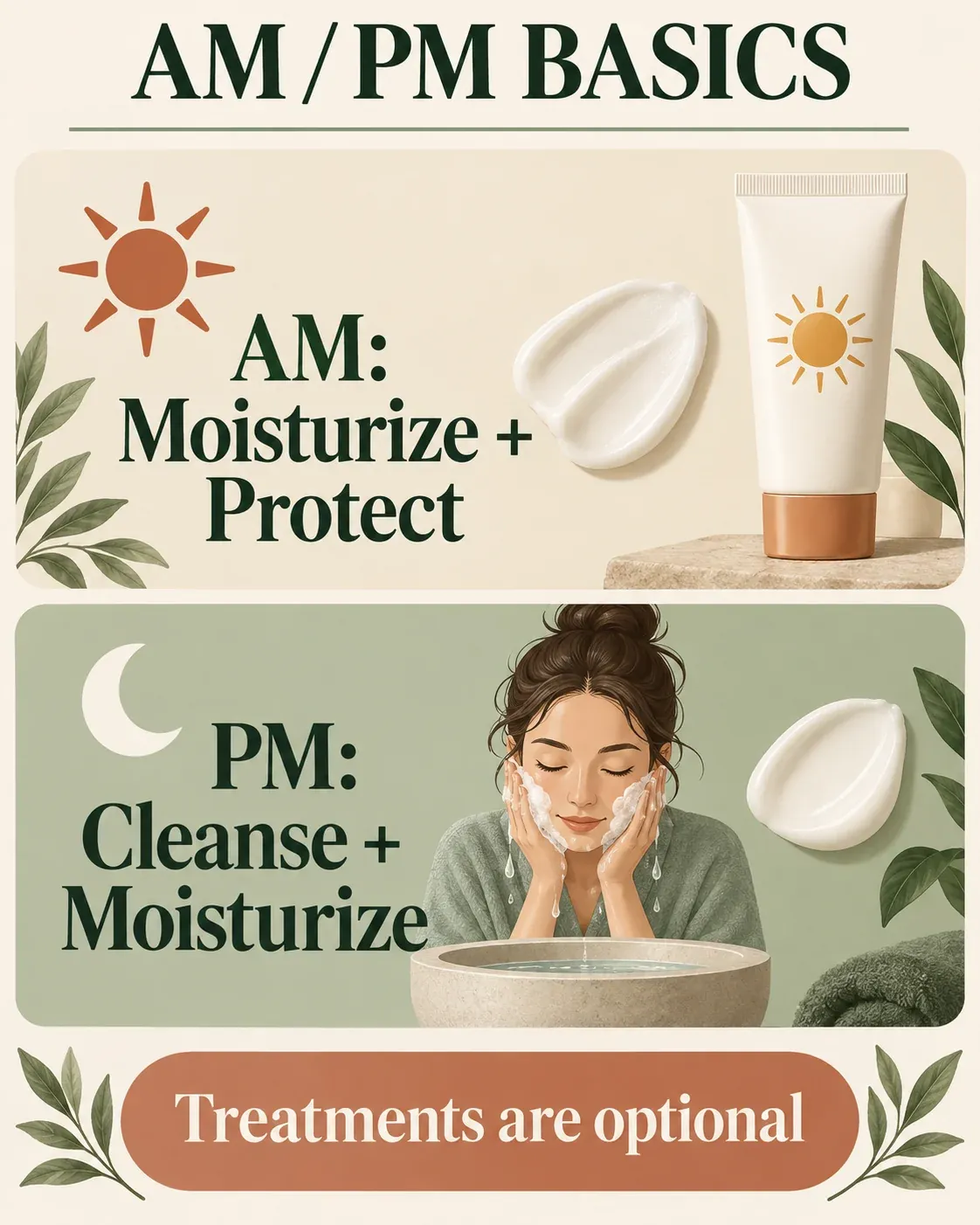
A practical AM and PM skincare routine uses the same comfortable basics for different jobs. In the morning, cleanse as appropriate, moisturize if needed, and apply sunscreen before daytime exposure; makeup follows sunscreen.
At night, remove makeup and sunscreen, cleanse gently, and moisturize. A treatment is optional unless it belongs to your existing medical plan, and its specific instructions take priority over generic layering diagrams.
You do not need a separate product for every step or an elaborate weekly rotation. Begin with a routine you can repeat, then change one thing at a time if there is a clear reason.
Quick Summary
- AM priority: prepare for your actual day, including sun protection.
- PM priority: remove the day's products without scrubbing, then support comfort.
- Keep familiar basics: the same cleanser or moisturizer can work at both times.
- Add selectively: toner, eye cream, exfoliant, and antioxidant serum are not universal requirements.
Editorial note: SkinOptimizer is an editorial resource, not a medical practice. This guide combines dermatology guidance with practical routine planning; we do not claim clinical testing or a personalized diagnosis.
Updated September 13, 2026: substantially revised for clearer decisions, source links, and readable paragraphs. Originally published November 17, 2024. Existing metadata and the supplementary video are retained.
An AM and PM skincare routine should solve ordinary problems: what goes on first, what needs washing off, and what you can leave out. It should not make a rushed morning feel like a failed beauty exam.
Our approach starts with jobs rather than bottles. A product might do more than one job, while two differently named products might repeat the same one.
First, write down what you already use and tolerate. That gives you a useful starting point without buying a complete replacement set or assuming your current routine is wrong.
The Skin Insider
“Morning” and “night” describe useful routines, not magical windows when skin suddenly accepts different ingredients. Exposure, product directions, and comfort are more useful guides than a rigid clock.
If you work nights, plan cleansing around what is on your face and sun protection around daylight exposure. Do not apply sunscreen before sleeping in a dark room simply because the clock says morning.
The difference between AM and PM skincare
The American Academy of Dermatology's product-order guidance starts with cleansing, then medication or treatment, then moisturizer and/or sunscreen. Makeup comes afterward.
That is a starting sequence, not permission to ignore a medicine's label. Some treatments have specific dry-skin, timing, or moisturizer instructions that require a different plan.
| Job | Morning decision | Evening decision |
|---|---|---|
| Cleanse | Use a gentle approach appropriate to oil, sweat, and comfort. | Remove the day's sunscreen, makeup, and residue. |
| Treat | Use only if needed and directed for this time. | Follow the selected treatment's instructions. |
| Moisturize | Choose a comfortable layer beneath sunscreen if needed. | Use enough for comfort; richer is optional. |
| Protect | Plan sunscreen and other protection for daylight exposure. | No SPF is needed solely for sleeping in darkness. |
If you are completely new to skincare, our beginner routine guide helps identify a manageable starting point. You can add complexity later; there is no reward for introducing it immediately.
AM skincare routine: prepare, moisturize, protect
1. Decide how much morning cleansing you need
Look at what is actually present: sweat from exercise, an oily feel, or residue from the night before. A gentle cleanser may be useful, but a squeaky-clean feeling is not a target to chase.
If your skin is dry and a second daily cleanse consistently leaves it uncomfortable, discuss a gentler approach or try simplifying that morning step. Do not automatically add another wash because a routine chart contains a cleanser icon.
Persistent discomfort deserves attention rather than a stronger wash. Keep prescribed cleansing instructions separate from this general cosmetic advice, especially during treatment for a skin condition.
- Use gentle hands instead of a scrubbing brush.
- Choose lukewarm rather than very hot water.
- Pat with a soft towel rather than rubbing repeatedly.
- After a sweaty workout, reassess cleansing rather than layering over the sweat.
2. Keep the moisturizing step proportionate
The AAD's simple, budget-conscious routine centers cleansing, moisturizing, and protection rather than a long product list. It also notes that a suitable sunscreen moisturizer can combine two jobs.
If your sunscreen already leaves skin comfortable, you may not need a separate cream underneath. If the combination feels tight or dry, a familiar moisturizer may make the morning routine easier to wear.
Do not compensate for a heavy base by applying less sunscreen. Instead, adjust the optional layers beneath it while keeping sunscreen use consistent with its label.
Our moisturizer selection guide helps compare textures by comfort and use. A lighter texture is a preference, not proof that it is medically better for every oily face.
3. Make sunscreen a real application step
The AAD's sunscreen instructions recommend broad-spectrum SPF 30 or higher, water resistance, and application before going outdoors. Cover exposed areas rather than only the center of your face.
Follow the product label for quantity, timing, and reapplication. When outdoors, renew protection about every two hours and after swimming or sweating as directed; a morning application is not an all-day guarantee.
Use shade and protective clothing too. For a day involving a walk, driving, or time near a sunny window, account for exposure instead of assuming that “mostly indoors” means none.
If you wear makeup, apply it after sunscreen and let the sunscreen settle according to its directions. There is no universal waiting time that makes every pairing work identically.
For practical follow-through, see how to reapply sunscreen. Choose a method you can realistically use during your day, not just a perfect first application at home.
PM skincare routine: remove, cleanse, moisturize
1. Remove what you wore
Start by considering the day's products. Long-wear makeup and some water-resistant sunscreens may need a suitable remover or cleansing oil before your familiar cleanser.
That does not make double cleansing compulsory every evening. If one gentle product removes what you wore comfortably, adding a second wash is not automatically an improvement.
Follow the remover's directions, including rinsing if required. Avoid repeatedly dragging cotton pads across stubborn areas; choose an appropriate remover instead of trying to scrub the product off.

Our cleanser versus face wash guide explains common format labels. The useful question is whether the product performs your cleansing job without leaving persistent discomfort.
2. Place treatment according to its instructions
If a clinician has prescribed a treatment, keep that plan authoritative. Do not move it to another time or dilute it into moisturizer simply to match a social-media routine.
For a cosmetic serum, read whether it belongs on dry or damp skin and whether it has frequency limits. “Thin to thick” can organize some cosmetic layers, but it is not a universal medicine rule.
If a bottle says ampoule, essence, or booster, examine what it contains and how to use it. Our ampoule guide helps separate marketing names from an actual routine role.
3. Finish with comfortable moisture
You can use the same moisturizer morning and night if it suits both routines. A separate night cream is optional; its label alone does not prove greater repair or a better outcome.
If your morning cream contains SPF, a familiar non-SPF moisturizer is a simpler bedtime choice. If you want more comfort on dry cheeks, adjust that area rather than assuming the whole face needs a heavier layer.
Do not apply thick extra layers automatically over every treatment. Ask about compatibility when a prescription or an easily irritating active is involved.
For the ordinary serum-and-cream decision, see our layering guide and its exceptions. It is better to understand two steps than repeatedly rearrange six.
The Optimizer's Edge
Before buying anything, draw two short columns: “used today” and “needed today.” Remove the mismatch first, such as an unnecessary extra cleanser or a serum you use only because it came in a set.
This is an editorial planning tool, not a clinical score. Its purpose is to make each step understandable and make your next change easier to evaluate.
Which routine steps can you skip?
You do not need every optional category to have a complete routine. Choose extras by a specific goal and realistic tolerance, not by whether a shelf photograph looks balanced.
| Extra step | Consider it when | Skip or postpone when |
|---|---|---|
| Hydrating serum | A familiar moisturizer alone does not provide the comfort you want. | You cannot identify what it adds. |
| Antioxidant serum | You have a clear cosmetic goal and a stable baseline. | Sun protection is still inconsistent. |
| Eye cream | You need an eye-area formula for a particular concern. | Your suitable basic moisturizer already meets that need. |
| Exfoliant | There is a specific reason and the product suits your skin. | Skin is irritated or other actives are still being introduced. |
A toner is not a mandatory bridge between cleanser and moisturizer. If you enjoy one and tolerate it, that can be a preference; enjoyment does not make it a medical requirement.
The same principle applies to masks and facial oils. Decide what they contribute before giving them a permanent place, and do not treat an unfamiliar DIY mixture as inherently gentler than a labeled cosmetic.
If you are comparing vitamin C options, our vitamin C serum guide is a separate product decision. Do not add it alongside several new actives and expect to identify which change caused a reaction.
Retinoids and exfoliation: avoid an automatic weekly schedule
The AAD's retinoid guidance emphasizes suitability and irritation considerations, including caution for sensitive skin and avoidance during pregnancy. Retinoids are not compulsory simply because a routine includes a PM column.
When appropriate, use the actual product or clinician's instructions for timing and frequency. A beginner should not copy a fixed three-retinoid-night schedule without knowing the formulation or its directions.
Similarly, exfoliating two or three times weekly is not a universal baseline. Frequency depends on the product and your other steps; it may be inappropriate while skin is uncomfortable or another active is being introduced.
- Read across the routine: an exfoliating cleanser counts even if you do not call it a treatment.
- Change one variable: avoid adding a new acid and retinoid together.
- Keep rest days simple: do not fill every empty night with another active.
- Respect medical plans: ask before changing prescribed treatment.
If you are pregnant, planning pregnancy, breastfeeding, or managing a skin condition, obtain individual advice about treatment ingredients. An adult cosmetic routine is not a universal plan for these circumstances or for children.
Adapt to your skin without rebuilding everything
Think in terms of the issue you notice today. Oily areas, dry areas, and product sensitivity can overlap; a single skin-type label does not settle every decision.
For example, comfortable cheeks and a shiny forehead do not automatically require two different cleansers. You might adjust moisturizer placement or texture while leaving the cleansing step alone.
In colder weather, review comfort before replacing the whole routine. A targeted change to moisturizer may be enough, while sunscreen remains relevant during daytime exposure.
| Problem | First review | Not the default fix |
|---|---|---|
| Tight after washing | Cleanser, water temperature, and unnecessary repeated washing. | More exfoliation. |
| Layers roll into crumbs | Optional layers and application technique. | Reducing sunscreen below its directions. |
| New stinging or rash | Stop the suspected new cosmetic and seek advice if needed. | Pushing through a reaction. |
| Routine takes too long | Remove optional steps with no clear job. | Buying a more complicated set. |
For rolling or balling products, our skincare pilling guide provides a focused test process. For persistent irritation, use a qualified clinician rather than trying endless combinations from a routine chart.
Introduce changes with a short observation plan
The AAD recommends testing a new product on a small area for seven to ten days before wider use. Keep contact time and frequency within the product's own directions.
A tolerated home test does not guarantee that a reaction cannot develop later. If a product causes redness, itching, or swelling, stop and wash it off gently; substantial or persistent symptoms need medical advice.
Keep the record brief enough to use. You are looking for a connection between a change and your skin's response, not producing a research paper about your bathroom shelf.
- List your familiar cleanser, moisturizer, and sunscreen.
- Name one reason for the proposed extra step.
- Test and introduce that product without other simultaneous changes.
- Record comfort and decide whether the step earns its place.
Do not judge every ingredient by the same deadline. Comfort, makeup compatibility, acne control, and pigmentation changes are different outcomes with different expectations.
Ask for help when persistent breakouts, rash, pain, or an unexplained changing spot exceed a routine-planning question. Seek urgent care for severe swelling or breathing difficulty rather than waiting for a cosmetic adjustment.
Previously embedded video retained for continuity. It is supplementary; product directions, medical advice, and the written qualifications in this guide take priority.
Your Clear Skin Checklist
- Give every AM and PM step a clear job.
- Keep familiar basics when they still work comfortably.
- Plan sunscreen around exposure and follow its label.
- Introduce only one optional change at a time.
- Stop concerning reactions and ask for help when needed.
Frequently Asked Questions About an AM and PM Skincare Routine
Reviewed community discussions about overcomplicated routines and morning cleansing helped identify practical questions. They are question-discovery sources, not clinical evidence; answers use the dermatology guidance and bounded editorial reasoning above.
Do I need to wash my face every morning?
Choose according to sweat, oil, comfort, and any treatment instructions. A gentle morning cleanse suits many routines, but repeated washing that leaves dry skin uncomfortable is a reason to reassess rather than intensify cleansing.
Is double cleansing required to remove sunscreen?
No, it is not a universal requirement. Some sunscreen or makeup combinations need a suitable remover before cleansing, while others come off comfortably with one appropriate product; follow directions and avoid repeated scrubbing.
Can moisturizer go before sunscreen?
Yes, a separate moisturizer can go beneath sunscreen when needed, with makeup afterward. If a sunscreen moisturizer already provides comfortable moisture, another cream may be unnecessary; still apply sunscreen in the amount its directions require.
Can I use the same moisturizer morning and night?
Yes, if it is suitable and comfortable in both routines. A separate night cream is optional, though a non-SPF moisturizer is a simpler bedtime choice than using sunscreen solely for sleep.
Do I need a retinoid and an exfoliant in my PM routine?
No. They are optional or treatment-specific steps, not requirements for every adult; use them only when appropriate and directed, and do not introduce both at once just to fill a weekly schedule.
Keep the useful steps and let the rest earn their place
The best routine is one you understand well enough to adjust without guessing. Morning protection and evening cleansing do not require separate wardrobes of products.
Preserve what feels comfortable, make selective changes, and seek professional guidance when the question is medical rather than cosmetic. Consistency should make skincare easier, not turn it into a rigid obligation.
This article is for informational purposes only and does not replace professional dermatological advice.


