Facial Exercises for Anti-Aging: What the Evidence Really Shows
An evidence-first guide to face yoga, facial exercises and massage, with realistic benefits, limitations and a low-risk trial plan.

In this guide
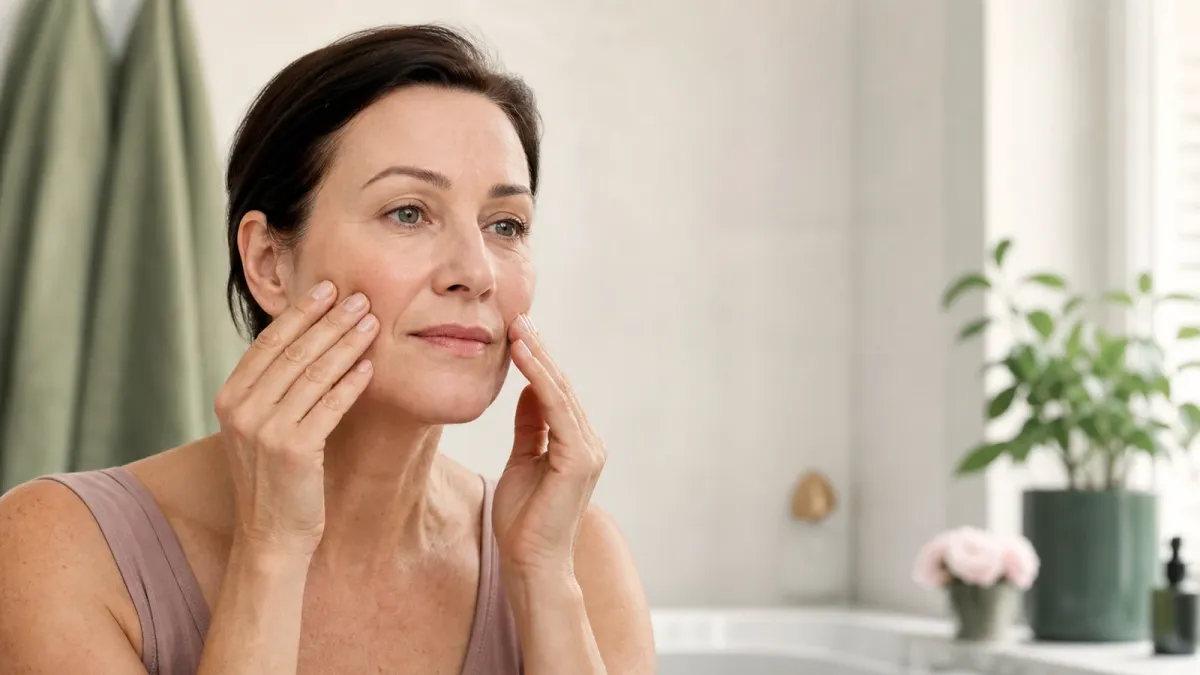
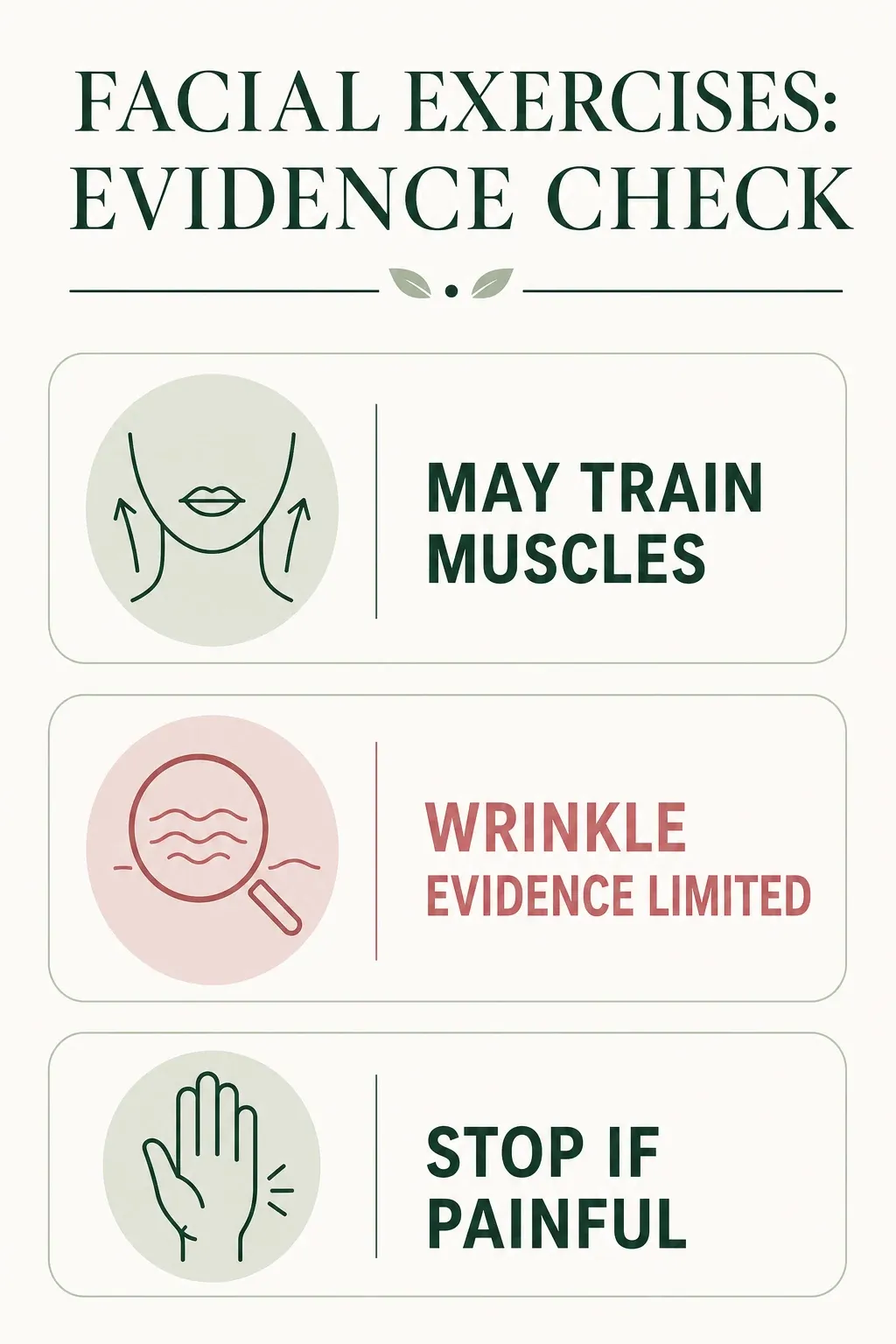
Facial exercises may train some facial muscles and could modestly change fullness in specific areas, but they are not proven to erase wrinkles, lift sagging skin or rebuild collagen. The best current reviews describe small, varied studies with limited controls. If you enjoy face yoga, treat it as an optional wellness habit, use gentle movement, stop if it hurts and keep sunscreen, moisturizer and evidence-based treatment as the core anti-aging plan.
Not every facial line comes from muscle movement. The side-sleeping wrinkle guide explains how pillow compression differs from expression lines and where the human evidence remains uncertain.
Quick Summary
- The strongest facial-exercise claim is possible localized muscle or fullness change, not skin tightening.
- The widely cited 2018 study had 16 completers, no untreated control group and a demanding 20-week routine.
- Massage can temporarily reduce puffiness or feel relaxing, but that is not the same as reversing wrinkles.
- Use a short, gentle trial and stop with pain, jaw symptoms, headache, dizziness or persistent skin irritation.
What Facial Exercises Can Plausibly Change
Facial exercise, face yoga and facial toning describe repeated movements or resistance work for the muscles that create expression. That is different from skincare. A moisturizer acts mainly at the surface, a retinoid changes skin-cell behavior over time, and sunscreen reduces additional ultraviolet exposure. Exercise primarily loads muscle and movement patterns.
That distinction matters because facial aging is not caused by one weak muscle. Bone structure changes, fat compartments shift, skin becomes thinner, collagen and elastic fibers change, and years of ultraviolet exposure accumulate. A movement routine cannot address every layer at once.
It is biologically plausible that repeated resistance could alter a facial muscle or create more fullness over it. It is much less certain that this would tighten loose skin or improve every wrinkle. Some expression lines are produced by repeated muscle contraction, so increasing movement is not automatically helpful for each concern.
| Claim | What evidence suggests | Practical verdict |
|---|---|---|
| Build facial muscle | Possible in localized regions | Plausible, but protocols are not standardized |
| Fill hollow cheeks | Small studies report modest cheek fullness | Possible for some people, not predictable |
| Erase wrinkles | No strong controlled evidence | Do not expect a wrinkle treatment effect |
| Lift sagging tissue | Not established | Exercise is not a nonsurgical facelift |
| Improve circulation | Short-term blood-flow changes are plausible | Temporary glow is not structural rejuvenation |
A 2014 systematic review found nine reports, but none used both a control group and randomization; many outcomes were subjective. A newer 2025 systematic review included 12 studies and 321 women. It found localized signals in areas such as the cheeks, jawline and around the eyes, while concluding that small samples, varied methods and limited generalizability prevent confident efficacy claims.
This is not evidence that facial exercise never helps. It is evidence that the size, location and durability of any benefit remain uncertain. A useful article should keep that uncertainty visible rather than converting a small signal into a universal promise.
Why Before-and-After Photos Are Easy to Misread
Facial photographs change with light direction, camera distance, head angle, expression, hydration and time of day. A small smile can raise the cheeks. A closer lens can change apparent proportions. Side lighting can deepen lines that disappear in flat window light.
Massage adds another variable. Moving fluid away from a puffy area can temporarily sharpen a contour. That can be a real short-term change without representing fat loss, collagen rebuilding or permanent lifting. The same applies to moisturizer, which can soften dehydration lines by improving surface water.
If you want to evaluate a routine, take neutral photographs in the same location, at the same time, with the same camera distance and relaxed expression. Do not compare a tired evening image with a bright morning image after massage. Our guide to skincare for fine lines explains how dehydration, expression and photoaging produce different visual patterns.
Face Yoga, Massage and Gua Sha Are Not the Same
| Method | Primary action | Most realistic benefit |
|---|---|---|
| Facial exercise | Repeated muscle contraction or resistance | Possible localized muscle or fullness change |
| Facial massage | Manual pressure and gliding | Relaxation and temporary puffiness change |
| Gua sha | Tool-assisted gliding over lubricated skin | Massage experience; evidence for anti-aging is limited |
| Microcurrent device | Electrical stimulation | Device-specific, temporary or modest effects may occur |
| Skincare | Topical barrier support or active treatment | Hydration, prevention and formula-specific treatment |
These methods are often bundled together online, but they should be evaluated separately. A cooling tool may feel soothing. A massage may reduce morning puffiness. A resistance movement may train a muscle. None of those observations proves that a device rebuilds dermal collagen.
Tools are optional. Fingers can provide light, controlled contact without the cost or hygiene demands of a stone or roller. If a tool encourages hard scraping, repeated bruising or use over inflamed skin, it is working against the goal of a calm routine. Compare device claims with our anti-aging skincare device guide.
A Conservative Four-Week Facial Exercise Trial
A short personal trial cannot prove medical efficacy, but it can tell you whether the habit is comfortable, realistic and enjoyable. Keep the movements gentle and simple. You should not need expensive accessories, pain or thirty minutes a day to learn whether the routine fits your life.
Week 1
Choose two gentle movements for cheeks or jaw relaxation. Practice five minutes on three non-consecutive days.
Week 2
Keep the same movements. Check for jaw fatigue, headache, neck tension, skin irritation or increased clenching.
Weeks 3-4
Continue only if comfortable. Compare neutral photos and decide whether the habit feels useful enough to keep.
Use clean hands on clean skin. Avoid pulling dry skin. A small amount of plain moisturizer can reduce friction for massage, but slippery product should not turn a controlled movement into forceful stretching. Do not perform exercises over a fresh procedure, active infection, open wound, severe acne cyst or painful rash.
People with temporomandibular joint pain, facial nerve symptoms, recent facial surgery, injectable treatment or a condition affecting muscle function should ask the treating clinician before beginning. Exercise is not a substitute for rehabilitation prescribed for facial weakness or swallowing and speech problems.
Can Facial Exercises Make Wrinkles Worse?
The answer is not established. Repetitive expressions contribute to dynamic lines over many years, but a short gentle exercise program has not been shown to create major new wrinkles. At the same time, there is no good reason to repeatedly crease one area as hard as possible when the target concern is a movement line in that exact location.
Choose movements that emphasize controlled resistance or relaxation instead of extreme scrunching. Avoid dragging the eyelid area, where skin is thin and easily irritated. If the routine makes you squint, clench or hold your breath, reduce the effort.
Skin irritation is a more immediate risk than new structural wrinkles. Aggressive rubbing, fragrant massage oils and unclean tools can cause redness or breakouts. Review our guide to skin barrier repair for sensitive skin if even basic products sting.
What Works Better for Common Anti-Aging Goals
Facial exercise can be an optional layer, but it should not displace the habits with stronger evidence. Daily sun protection has randomized-trial evidence for reducing photoaging progression. Moisturizer improves dryness and temporarily softens shallow lines. Retinoids have controlled evidence for mild wrinkles and photoaged texture.
| Your goal | Best first step | Where exercise fits |
|---|---|---|
| Prevent UV-related wrinkles | Broad-spectrum SPF 30+, shade and clothing | No substitute |
| Soften dehydration lines | Gentle cleanser and moisturizer | Optional relaxation only |
| Treat mild photoaged texture | Retinoid if appropriate | Not the primary treatment |
| Address visible sagging | Realistic skincare plus professional consultation | Unproven for lifting |
| Reduce morning puffiness | Sleep, allergy context and gentle massage | May be part of a temporary routine |
For prevention, start with our guide on how to prevent wrinkles. For treatment choices, compare retinol for anti-aging with the retinol versus bakuchiol guide. The right plan depends on tolerance, pregnancy context, current irritation and the type of change you want to address.
Visible sagging involves deeper structures that skincare and exercise cannot simply reposition. The sagging-skin guide separates surface quality improvements from actual lifting. That distinction protects readers from spending heavily on a cream, tool or exercise course with the wrong job.
Build a Better Daily Anti-Aging Base
In the morning, cleanse gently or rinse with water, apply moisturizer as needed and finish with broad-spectrum SPF 30 or higher. Use enough product to cover exposed skin and add shade, a hat and sunglasses. Facial exercise cannot compensate for repeated unprotected ultraviolet exposure.
At night, remove sunscreen and makeup without scrubbing. Apply moisturizer. If a retinoid is appropriate, start on one night weekly and increase slowly. Do not perform a forceful massage over freshly applied retinoid or acid when the skin is already sensitive.
Keep the routine stable for several weeks before judging another variable. Our slow skincare routine shows how to add one product at a time, while the essential routine for aging skin provides a complete morning and evening framework.
How to Choose a Facial Exercise Program
A responsible program should define the exact movements, schedule, intended outcome and reasons to stop. It should distinguish cosmetic exercise from rehabilitation and avoid promising to treat facial paralysis, swallowing problems, temporomandibular disorders or medical asymmetry. Those concerns require appropriately trained care.
Be cautious when the seller uses one dramatic transformation as the main evidence, claims every face needs the same sequence or blames a lack of results on insufficient effort. A transparent program should admit that anatomy, age, skin quality and baseline fullness differ. It should also disclose whether the instructor sells tools, subscriptions or procedures connected to the recommendation.
Cost should match uncertainty. A free five-minute routine and a costly multi-month course do not have different evidence simply because one includes more videos. Do not buy resistance devices that create pain or require force near the eyes. Check the return terms before paying for an app or recurring membership.
What a Useful Result Would Look Like
Define success before starting. It might be enjoying a short relaxation habit, noticing less habitual jaw tension or seeing a small, repeatable change in cheek fullness. “Look younger” is too vague and is easily influenced by mood, lighting and expectation.
Also define non-success. No neutral-photo change after twelve to twenty weeks, an uncomfortable time burden, worsening jaw symptoms or repeated skin irritation are valid reasons to stop. Continuing forever does not turn an uncertain intervention into a proven one.
Keep other variables stable during the comparison period. Do not begin face yoga, a retinoid, weight loss and a new device in the same week, then credit one routine for every change. Weight change in particular can alter facial fullness enough to overwhelm a subtle exercise effect.
Facial Exercise and Mental Wellbeing
A gentle ritual can feel calming, improve body awareness or create a moment away from a screen. Those benefits are legitimate even when wrinkle evidence is weak. They should be described as relaxation or habit benefits, not hidden inside a medical-sounding rejuvenation claim.
Stop if the routine increases appearance checking or anxiety. Daily magnified inspection can make normal asymmetry and texture feel like treatment failures. Reduce photographs, remove the program from the routine and speak with a qualified professional when concern about appearance becomes persistent or disruptive.
The Bottom Line
Facial exercises may be a pleasant, low-cost habit and may produce localized muscle or fullness changes for some people. Current research does not justify calling them a proven wrinkle treatment, collagen booster or nonsurgical facelift. The most responsible approach is a gentle, time-limited trial with realistic expectations.
Keep the proven foundation in place: ultraviolet protection, a comfortable moisturizer and a retinoid when appropriate. If sagging, asymmetry, jaw pain or sudden facial weakness concerns you, ask a qualified professional. A routine should support your skin and wellbeing, not make you work through pain for an uncertain cosmetic promise.
Frequently Asked Questions About Facial Exercises for Anti-Aging
Do facial exercises really make you look younger?
Small studies report localized changes such as cheek fullness, but current reviews find the evidence too limited and inconsistent to promise a younger appearance.
How long do facial exercises take to work?
The best-known pilot used a demanding 20-week program. There is no validated universal timeline, and any visible change should be judged with standardized photos and realistic expectations.
Can face yoga remove wrinkles?
Face yoga is not proven to remove wrinkles. Sunscreen, moisturizer and retinoids when appropriate have stronger support for prevention or mild photoaged lines.
Can facial exercises make sagging worse?
This has not been established. Avoid forceful pulling and stop with pain or irritation; facial exercise is also not proven to lift structurally sagging tissue.
Do I need a gua sha tool for facial exercise?
No. A tool is optional and mainly changes the massage experience. Clean hands and gentle pressure are sufficient for a conservative trial.