Best Skincare for Fine Lines: A Routine That Actually Helps
Learn which skincare steps help fine lines, how to tell dehydration from photoaging and when a cream is unlikely to be enough.

In this guide

The best skincare for fine lines starts with broad-spectrum SPF 30+ every morning, a moisturizer that prevents persistent dryness and a retinoid introduced slowly at night when appropriate. Hydration can soften dehydration lines quickly, while retinoids and sun protection work over months on visible photoaging. No cream can erase every expression line or replace a procedure for deeper wrinkles.
For a deeper ingredient breakdown, see what collagen-supporting skincare can and cannot do.
Quick Summary
- First identify whether the line changes with hydration, facial movement or time.
- Use sunscreen and moisturizer consistently before adding several treatment serums.
- Introduce one retinoid night weekly, then increase only when skin remains comfortable.
- Judge treatment over eight to twelve weeks, not after one application.
First, Identify the Type of Fine Line
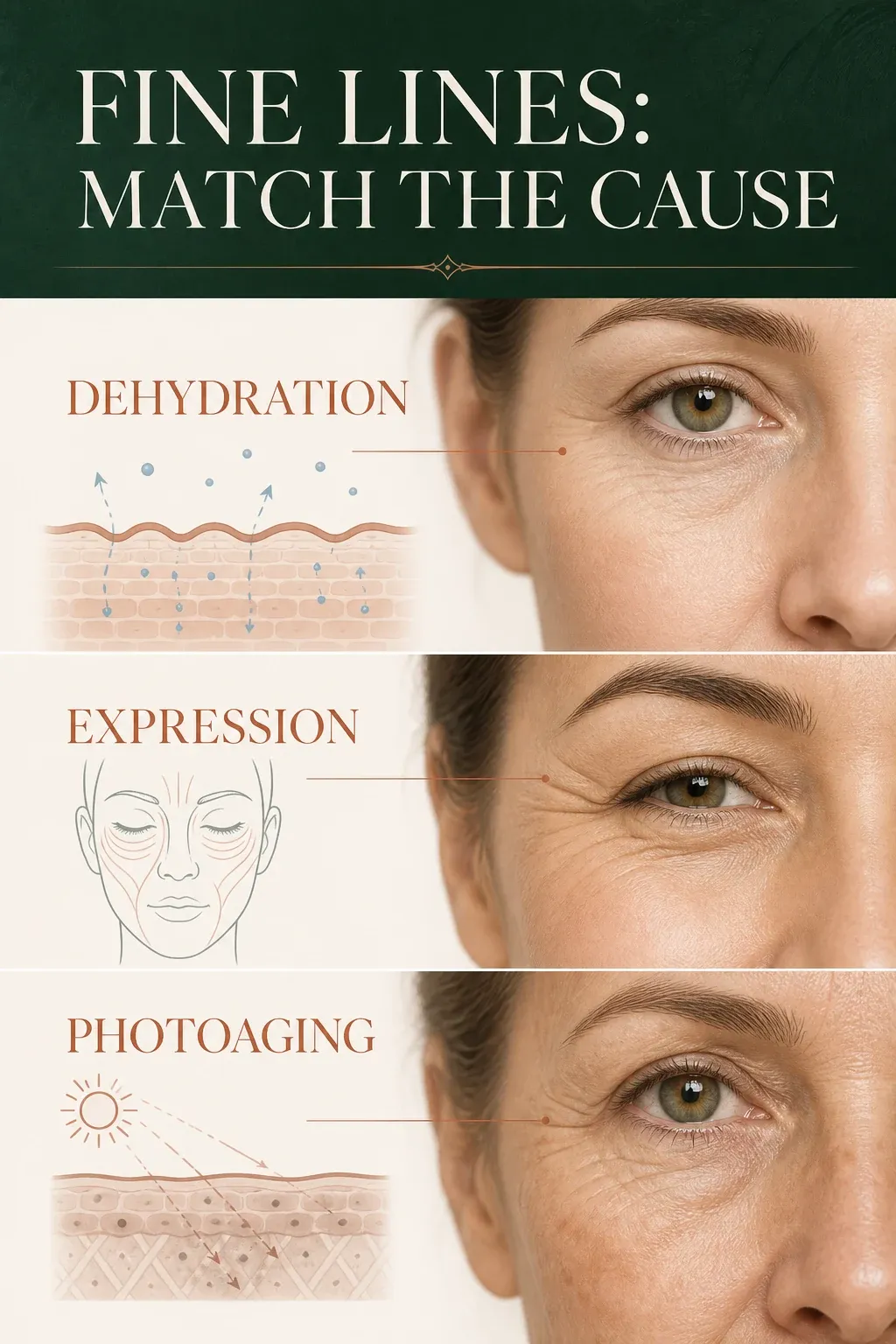
Fine lines are not one single problem. A line that appears when the skin is dry behaves differently from a crease created by repeated movement, and both differ from a line that remains visible at rest after years of sun exposure. Product labels rarely make this distinction because one broad promise is easier to sell than three different expectations.
Start by observing the line in neutral light after a normal night of sleep. Do not stretch the skin or inspect it under a magnifying mirror. Notice whether it is shallow and widespread, follows a predictable expression pattern or remains etched when the face is relaxed. The goal is not self-diagnosis. It is to avoid buying a collagen cream for a temporary dehydration line or expecting moisturizer to stop muscle movement.
| What you notice | Likely driver | Best first move |
|---|---|---|
| Many shallow lines that improve after moisturizer | Surface dehydration | Repair the basic cleanser and moisturizer routine |
| Lines appear mainly with smiling or frowning | Repeated expression | Use prevention and realistic expectations |
| Lines remain visible when the face rests | Photoaging plus structural change | Daily SPF and a gradual retinoid plan |
| Sudden texture change with redness or scaling | Irritation or another skin condition | Pause new actives and seek advice if persistent |
The Best Daily Routine for Fine Lines
A useful routine protects against avoidable damage in the morning and creates one predictable treatment slot at night. The same structure works for most skin types, but the cleanser texture, moisturizer richness and retinoid frequency should change with tolerance.
Morning: protect and prevent
Cleanse only as much as necessary. A mild cleanser removes oil and residue without producing the tight, squeaky finish that can make dehydration lines more obvious. Dry or mature skin may need only a water rinse in the morning, while oilier skin may prefer a gentle gel cleanser.
Apply moisturizer while the skin is slightly damp. Glycerin, hyaluronic acid, ceramides, squalane and dimethicone can all support hydration, but the finished formula matters more than a single highlighted ingredient. Choose a texture that remains comfortable under sunscreen rather than layering three hydrating serums that pill.
Finish with broad-spectrum SPF 30 or higher over the face, ears and exposed neck. The anti-aging sunscreen guide compares wearable formats. Shade, hats and clothing remain useful because no sunscreen blocks every ray and under-application is common.
Evening: treat without destabilizing the barrier
Remove makeup and resistant sunscreen gently. Double cleansing is optional, not a requirement. Follow with one retinoid night each week if retinoids fit your health context. Use the product amount and directions on the label, keep it away from the eyelids and lip corners at first, and moisturize afterward.
Increase to two non-consecutive nights only after the skin remains comfortable for several weeks. Redness, painful peeling and persistent burning are not proof of faster collagen change. They are signs that the current schedule may be too aggressive. The slow skincare method gives a controlled introduction schedule.
Ingredients Ranked by Their Real Job
Ingredient lists become easier to compare when each ingredient has one primary job. A moisturizer can make lines look softer within hours by improving surface hydration. A retinoid works more slowly on texture and photoaging. Sunscreen prevents additional UV exposure. Those benefits can coexist, but they should not be described as identical.
| Ingredient | Best use | Timeline | Main limitation |
|---|---|---|---|
| Retinoid | Fine lines, texture and uneven tone | Eight to twelve weeks and longer | Can irritate; avoid during pregnancy |
| Moisturizer | Dehydration lines and barrier comfort | Hours to two weeks | Plumping is temporary |
| Niacinamide | Barrier support, tone and mild texture concerns | Eight to twelve weeks | Not a substitute for sunscreen |
| Vitamin C | Morning antioxidant and uneven tone support | Several months | Stability and stinging vary by formula |
| Peptides | Optional hydration and supportive care | Product dependent | Claims often exceed formula-specific evidence |
| Exfoliating acid | Dull surface texture | Several uses | Overuse can make lines look worse |
Retinoids have the clearest topical role for mild fine lines and photoaging, but stronger is not automatically better. Prescription tretinoin has deeper evidence and greater irritation potential; over-the-counter retinol is often easier to start but varies between formulas. The retinol guide explains the difference without treating every vitamin A derivative as equivalent.
Niacinamide has small controlled studies showing improvements in fine lines, texture and uneven tone, but many studies evaluate a specific complete formula. That means a result from one 5% moisturizer does not prove that every high-strength niacinamide serum will behave the same way. Use it when the whole formula fits your skin, not because a larger percentage looks more clinical.
Peptides are a broad family rather than one proven ingredient. Some formula-specific trials are promising, while many retail claims rely on laboratory mechanisms instead of visible outcomes in a finished product. A peptide product can be reasonable for someone who cannot tolerate retinoids, but it should be framed as an optional supportive step.
Fine Lines Around the Eyes and Mouth
The eye area has thin skin and moves constantly. It also becomes irritated quickly. Apply a bland moisturizer first and keep facial retinoids outside the orbital rim unless the product is specifically directed for closer use. More product near the eyes is not a shortcut; migration, dryness and rubbing can make lines look more pronounced.
Eye cream is optional. A separate formula earns its place when it is more comfortable, less mobile or better tolerated than the face moisturizer. The anti-aging eye cream guide compares product roles and limitations. Persistent eyelid rash, swelling or eye irritation needs professional assessment rather than another cosmetic layer.
Lines around the mouth combine movement, UV exposure, dryness and structural change. Avoid repeated lip licking and aggressive scrubs. Moisturizer and petrolatum can improve dryness, while sunscreen protects the surrounding skin. Deep vertical lines usually exceed what a cosmetic cream can substantially change.
How to Use Retinol Without Making Lines Look Worse
Week 1-2
Use one night weekly over moisturizer if needed. Keep acids and scrubs out of the same routine.
Week 3-6
Move to two non-consecutive nights only if there is no persistent burning, rawness or peeling.
Week 8-12
Compare photographs in similar light. Continue the same frequency if results and tolerance are moving in the right direction.
Temporary dryness can exaggerate surface lines, especially around the eyes and mouth. Reduce frequency before adding more exfoliation. If the product repeatedly causes a painful reaction, stop and ask a dermatologist about another vehicle, strength or treatment. Retinoids are avoided during pregnancy; discuss trying to conceive or breastfeeding with a qualified clinician.
Adapt the Plan to Your Current Skin Condition
Dry skin usually needs a creamy cleanser, richer moisturizer and fewer treatment nights. Apply moisturizer before the retinoid when direct application repeatedly causes tightness. The goal is not to surround an intolerable product with six soothing layers; it is to find the lowest useful frequency that leaves the skin comfortable.
Oily skin can still be dehydrated. If the forehead shines while the cheeks sting and show shallow lines, reduce harsh cleansing before choosing a stronger mattifying treatment. A lightweight lotion can provide hydration without the heavy finish of a balm. The oily-skin routine explains how to separate sebum from dehydration.
Sensitive skin needs fewer variables. Use fragrance-free basics, patch test the retinoid and hold one frequency for several weeks. If retinol remains uncomfortable, the answer may be a different formula, a clinician-guided option or a retinoid-free routine. The sensitive-skin barrier guide gives a reset plan for persistent stinging.
Acne-prone skin may benefit from a retinoid, but occlusive eye creams and heavy balms can feel congesting. Choose one retinoid job rather than pairing an acne retinoid with a separate wrinkle retinol. Deep acne, scarring and fine-line treatment should be coordinated with a dermatologist when the products repeatedly compete.
One Retinol Example for a Controlled Start
This product is an example, not a universal winner. It fits a reader who has already stabilized cleanser, moisturizer and sunscreen and wants one clearly defined retinol step.
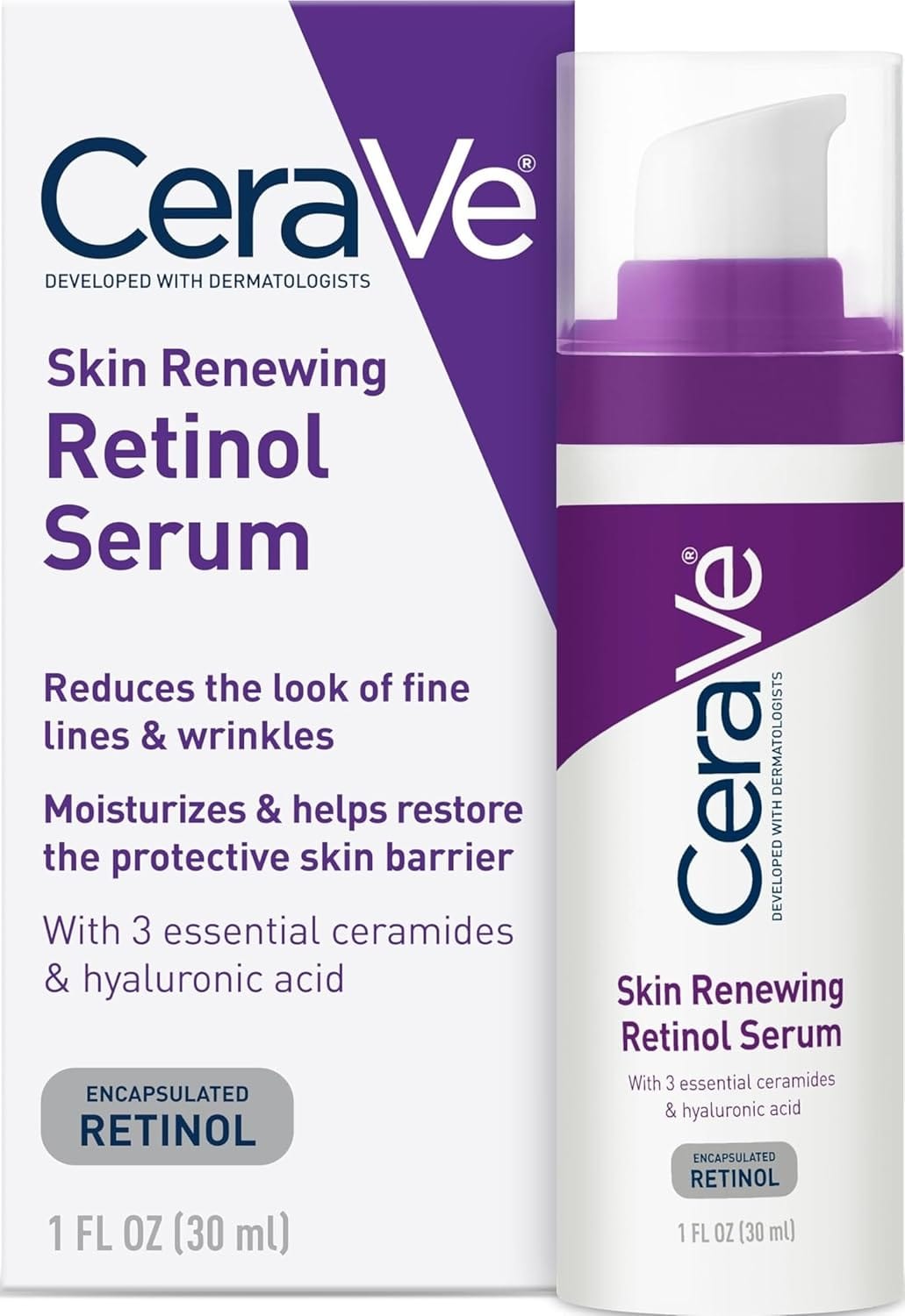
CeraVe Skin Renewing Retinol Serum
A retinol beginner with normal-to-dry skin who wants a fragrance-free serum format.
It combines cosmetic retinol with ceramides and a moisturizing base, making its role easy to understand.
Watch-out: Retinol can still cause irritation. Start slowly, verify the current ingredient list and avoid retinoids during pregnancy.
View on AmazonAs an Amazon Associate, SkinOptimizer may earn from qualifying purchases. Prices, sellers and availability can change.
What Common Fine-Line Mistakes Cost You
- Starting nightly retinol immediately: irritation can interrupt treatment before it has time to work.
- Using an acid to remove every flake: exfoliation can deepen the cycle of dryness and visible texture.
- Relying on SPF makeup alone: most people do not apply enough makeup to reach the labeled sunscreen protection.
- Buying collagen cream for structural replacement: topical collagen mainly behaves as a moisturizing ingredient.
- Changing several products together: improvement and irritation become impossible to trace.
- Judging in different lighting: side light can make the same line look dramatically deeper.
For a broader routine, use the simple aging-skin routine. If dryness is the dominant concern, the dry-skin routine is a better starting point than adding another active.
Measure Progress Without Letting Lighting Decide
Take one baseline photograph with the face relaxed, the camera at eye level and soft front-facing daylight. Repeat it every four weeks in the same room and at roughly the same time. Side light, a smiling expression and a closer camera distance can make unchanged lines look dramatically different.
Track comfort separately from appearance. Record tightness, flaking and treatment frequency alongside the photograph. A routine that creates a small visible change but leaves the skin painful is not automatically a better result than a slower, comfortable schedule.
What the Evidence Supports
The American Academy of Dermatology places sunscreen and moisturizer at the foundation of anti-aging care. Its retinoid guidance describes retinol as an option for mild fine lines while emphasizing gradual use and sun protection.
A 2024 randomized trial indexed by PubMed found modest wrinkle improvement after twelve weeks with both a retinol comparator and the tested adapinoid. A controlled niacinamide study also reported improvements in fine lines and several other visible endpoints, although it evaluated a specific formula and included a limited participant group.
When Skincare Is Not Enough
See a dermatologist when a line is accompanied by a changing spot, bleeding, persistent scale, pain or a lesion that does not heal. Seek care for severe irritation, facial swelling or blistering after a product. A cosmetic routine cannot diagnose skin cancer, dermatitis or another medical condition.
Deeper static wrinkles may respond more visibly to procedures such as neuromodulators, resurfacing, microneedling or lasers, depending on the concern and skin tone. Each option has risks, downtime and cost. A qualified clinician should explain realistic outcomes and whether the provider has experience treating your skin type.
The Bottom Line
Fine-line skincare works best when it separates fast hydration from slow treatment. Moisturizer can soften dehydration lines quickly. Sunscreen helps prevent additional photoaging. A tolerable retinoid can gradually improve mild lines and texture. None of those steps freezes facial movement or lifts deeper tissue, and the routine becomes less effective when irritation prevents consistency.
Frequently Asked Questions
What is the best skincare ingredient for fine lines?
Retinoids have the strongest topical role for mild fine lines and photoaging, while sunscreen helps prevent additional damage. Moisturizer is the best first step when lines are mainly caused by dehydration.
For the prevention side of the routine, see how to prevent premature wrinkles with UV protection, moisturizer and a controlled retinoid plan.
Can fine lines disappear with moisturizer?
Dehydration lines can become much less visible when the outer skin layer is well hydrated. Expression lines and static photoaging lines may soften but usually do not disappear from moisturizer alone.
How long does retinol take to improve fine lines?
Use a consistent, tolerable routine for at least eight to twelve weeks before comparing early changes. More meaningful improvement often takes several months.
Should I use vitamin C or retinol for fine lines?
They serve different roles. Vitamin C is usually an optional morning antioxidant and tone-support step. Retinoids have stronger evidence for texture and mild fine lines. Daily sunscreen matters with either.
For a product-format comparison, the evidence-based anti-aging serum guide separates morning antioxidant support from night retinoid treatment.
Can I use retinol around my eyes?
Use only as directed. The eye area irritates easily, so keep standard facial retinol outside the orbital rim at first and consider a dedicated eye formula or dermatologist guidance.