Turmeric for Skin: Benefits, Evidence and Safety Limits
Turmeric is promising in selected dermatology research, but it is not a proven cure for acne, dark spots or aging. Compare topical and supplement risks.
In this guide
Turmeric and curcumin have anti-inflammatory and antioxidant activity, and small clinical trials suggest possible benefit for selected skin conditions. Evidence is not strong enough to call turmeric a general acne, dark-spot or anti-aging treatment. Topical products can irritate or stain, while concentrated supplements can cause gastrointestinal effects, interact with care and have been linked to liver injury in some enhanced-bioavailability formulas.
Quick Summary
- Promising laboratory activity does not prove a kitchen mask improves human skin.
- Clinical evidence is condition- and formulation-specific and remains limited.
- Choose preserved topical formulas and patch test instead of storing DIY mixtures.
- Treat concentrated supplements as a health decision, not a beauty shortcut.
Turmeric has moved from spice rack to serum, supplement and DIY mask, often with claims that one ingredient can calm acne, erase spots and restore glow. The research is more specific: different curcumin preparations have been studied for different conditions, and the results do not transfer automatically to kitchen powder. This guide separates human evidence from mechanism, explains topical and supplement risks, and gives a conservative way to evaluate a product.
For food use rather than topical or supplement use, see our food-first guide to turmeric and nine other culinary herbs and spices.
What Turmeric Can and Cannot Do for Skin
Turmeric is a culinary spice from Curcuma longa, while curcumin is one group of compounds isolated from it. Laboratory work describes antioxidant and anti-inflammatory actions, but a mechanism in a dish or test tube is not proof that a face mask, serum or supplement improves human skin.
Clinical research has tested different extracts, doses, delivery systems and combinations across unrelated conditions. That makes "turmeric for skin" too broad to treat as one intervention. A product studied for psoriasis cannot automatically be recommended for acne, dark spots or wrinkles.
A 2023 systematic review of randomized curcumin trials identified 18 trials across psoriasis, radiation dermatitis, oral lichen planus, itching, vitiligo, tinea capitis, redness and scarring. The authors found moderate support for only a few uses and called for larger studies and standardized dosing.
| Claim | What the evidence supports | Practical interpretation |
|---|---|---|
| Reduces inflammation | Biologically plausible; limited human trials in selected conditions | Not a substitute for diagnosis or prescribed treatment |
| Clears acne | Insufficient direct evidence for turmeric alone | Use established acne care first |
| Fades dark spots | No dependable home-remedy evidence | Prevent irritation and use daily sunscreen |
| Brightens instantly | Yellow pigment can change appearance temporarily | Color on skin is not reduced pigmentation |
| Prevents aging | No proof of broad wrinkle prevention from kitchen turmeric | Photoprotection has much stronger support |
| Detoxifies skin | No defined clinical endpoint or mechanism | Treat as marketing language |
Topical Turmeric: Formulation Matters
Curcumin has poor water solubility and limited stability, which is why researchers use carriers, extracts or engineered delivery systems. Mixing culinary powder with water, yogurt, lemon or honey does not reproduce those systems. It creates an unstandardized mixture with unknown concentration, pH and contamination control.
A review of clinical studies on topical curcumin found relatively few human studies compared with oral research. Products, conditions and outcomes differed, so there is no universal concentration or application schedule for healthy facial skin.
Commercial formulas may include curcumin derivatives for color, antioxidant positioning or soothing claims. Judge the complete ingredient list, packaging and instructions rather than the turmeric headline. Fragrance, essential oils or exfoliating acids can determine tolerability more than the featured botanical.
Why kitchen turmeric is a poor facial test
Culinary powder can stain skin, nails, towels and porous surfaces. Staining can make redness or uneven tone harder to evaluate and may tempt aggressive scrubbing afterward. Scrubbing adds irritation without proving that the ingredient worked.
Raw mixtures also lack a validated preservative system. If water is added and leftovers are stored, microorganisms can grow even when the mixture looks and smells normal. Use a properly formulated product rather than keeping a wet DIY jar in a warm bathroom.
The FDA cosmetic microbiology guidance explains that water, raw materials, poor storage and finger dipping can introduce contamination. "Natural" does not provide preservation.
Irritation, Allergy and Supplement Safety
Turmeric can cause itching, hives or contact dermatitis. A review describing curcumin as a contact allergen collected reports that matter precisely because the ingredient is often assumed to be harmless. Stop use for persistent burning, swelling, blistering or a spreading rash.
Patch testing a cosmetic on a small area can reduce surprise, but it does not guarantee that a full-face application will be tolerated. The AAD recommends testing a new skincare product twice daily on a small area for seven to ten days. Follow the exact product directions and do not patch test a recipe containing lemon juice or other known irritants.
Use the slow-start skincare guide before adding a turmeric serum. If the skin barrier already stings with bland moisturizer, use the barrier repair guide and postpone experiments.
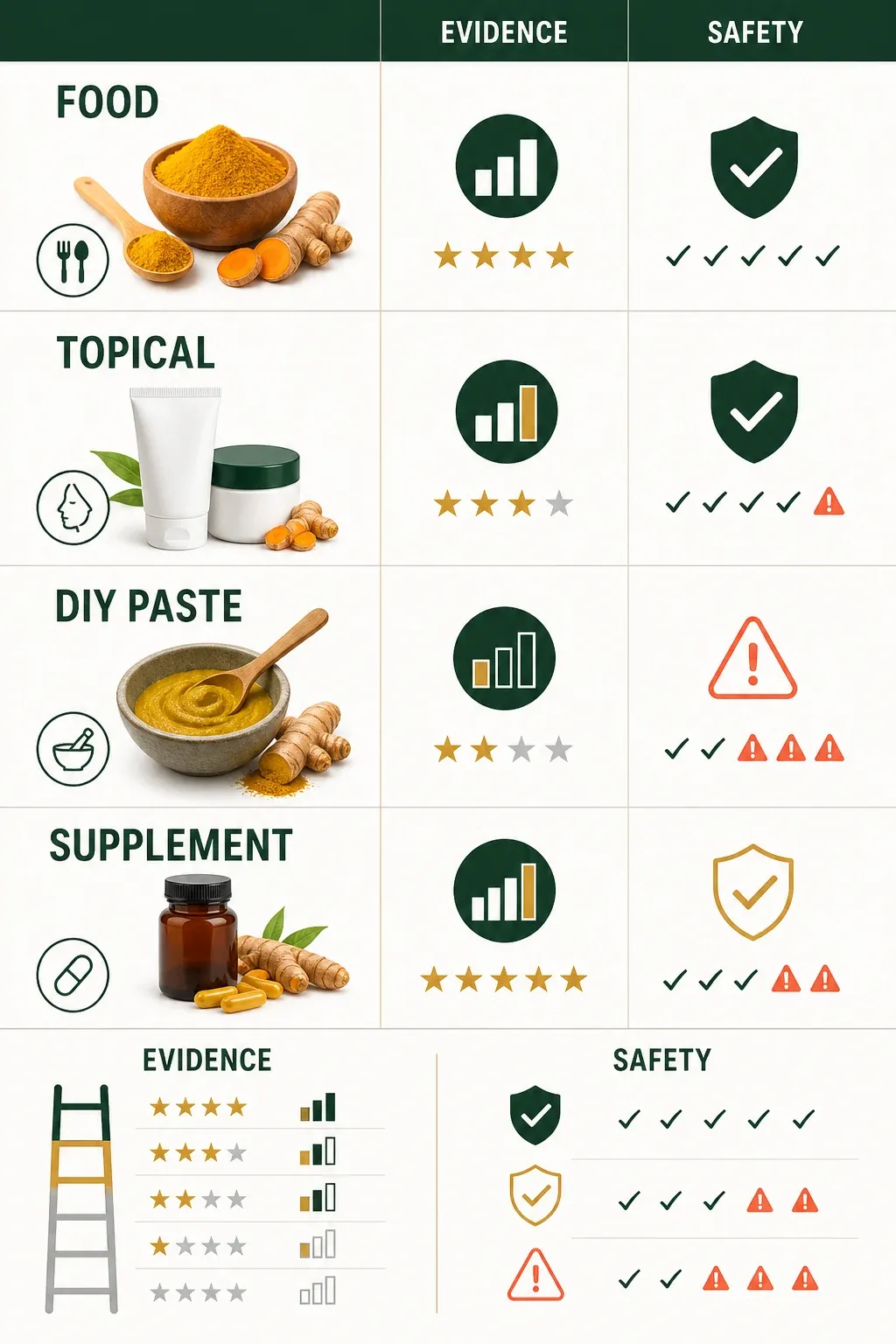
| Turmeric format | Main limitation | Safer decision |
|---|---|---|
| Spice in food | Not a therapeutic skin dose | Enjoy as food without promising a skin result |
| DIY paste | Staining, irritation and no preservation | Skip or use a tested rinse-off cosmetic |
| Topical cosmetic | Complete formula determines tolerance | Patch test and follow label timing |
| Standard supplement | GI effects and drug interactions may matter | Review with a clinician or pharmacist |
| Enhanced-bioavailability supplement | Some products linked to liver injury | Avoid casual high-dose beauty use |
| Condition-specific treatment | Evidence may not transfer to another diagnosis | Discuss with a dermatologist |
The NCCIH turmeric safety summary notes nausea, reflux, stomach upset, diarrhea or constipation with oral products. It also reports liver injury in some users of enhanced-bioavailability formulations and cautions about supplement use in pregnancy.
A concentrated supplement is not simply more of a safe spice. Bioavailability enhancers change exposure, and medicines or medical conditions can change risk. Tell a clinician or pharmacist about all supplements, especially before surgery or when taking anticoagulants, diabetes drugs or other prescriptions.
Turmeric for Acne and Oily Skin
Acne involves follicular plugging, sebum, inflammation and microbial activity. Turmeric's laboratory antimicrobial or anti-inflammatory properties do not establish it as an effective leave-on acne drug. The updated AAD guideline supports treatments such as benzoyl peroxide, topical retinoids, salicylic acid and azelaic acid, not kitchen turmeric.
For a practical starting point, compare the best cleansers for acne-prone skin and the benzoyl peroxide guide. Introduce one change at a time so irritation is not mistaken for purging or detoxification.
Turmeric staining can also make inflamed lesions look temporarily different without changing lesion count. Photograph acne in the same lighting weekly and judge comedones, papules and pustules over eight to twelve weeks. A one-night glow is not an acne outcome.
Turmeric for Dark Spots and Uneven Tone
Post-inflammatory hyperpigmentation improves when new inflammation is controlled and ultraviolet plus visible-light exposure is reduced. Irritating DIY masks can create more inflammation and therefore more pigment, especially in melanin-rich skin. Lemon juice, baking soda and vigorous scrubs increase that risk.
Use the hyperpigmentation routine guide to compare azelaic acid, retinoids, vitamin C and professional options. The acne-friendly sunscreen guide helps protect progress without adding a harsh cleansing cycle.
If a mark is changing shape, bleeding, painful or not clearly linked to a healed spot, do not self-treat it as hyperpigmentation. A dermatologist should confirm the diagnosis before brightening products are layered.
Turmeric for Eczema, Psoriasis and Redness
Some curcumin trials involve inflammatory diseases, but the evidence does not support replacing established treatment. Eczema and psoriasis have different barrier and immune mechanisms, and untreated disease can become infected or extensive. A cosmetic ingredient cannot diagnose which condition is present.
People with eczema or fragrance allergy may be more vulnerable to contact dermatitis from a complex botanical formula. Choose fragrance-free products, test cautiously and stop if itching spreads beyond the application area. See the barrier-first moisturizing guide for a lower-risk baseline.
Persistent facial redness can be rosacea, dermatitis, acne, infection or irritation. The redness and rosacea routine guide explains why heat, rubbing and active overlap may matter more than adding another antioxidant.
How to Evaluate a Turmeric Skincare Product
- Define the goal: soothing, pigment, acne or general moisturization require different evidence.
- Read the full INCI list: fragrance, acids and essential oils can dominate tolerability.
- Check packaging: a stable preserved formula should be protected from contamination and light as needed.
- Find the instructions: frequency and contact time should be specific.
- Ignore detox language: it is not a measurable cosmetic endpoint.
- Compare alternatives: established ingredients may have stronger evidence and clearer dosing.
Do not assume a high percentage is better. Curcumin concentration on a label may refer to a raw material, extract or blend, and percentages do not reveal delivery to skin. A lower-dose, well-formulated product can be more usable than a concentrated paste.
A Conservative Four-Week Test
Keep cleanser, moisturizer and sunscreen stable for two weeks before starting. Patch test the product, then use it at the lowest labeled frequency on intact skin. Do not add an exfoliant, retinoid or second botanical during the same test.
Choose one measurable outcome such as less stinging, fewer inflamed lesions or a consistent pigment score. Take weekly photographs in the same light. Stop for persistent burning, swelling, hives, blistering or worsening acne.
If there is no meaningful improvement after the product's reasonable trial period, do not increase frequency indefinitely. Return to a simpler routine and choose a better-supported ingredient for the actual concern.
How to Read Turmeric Research Without Being Misled
Start with the intervention. A standardized curcumin capsule, a nanoparticle delivery system, a cream containing several actives and raw spice powder are different products. If the formula used in the trial is unavailable or poorly described, the result cannot guide a home routine precisely.
Next check the diagnosis and comparator. Improvement in physician-scored psoriasis plaques does not prove brighter healthy skin, and improvement versus baseline is weaker than improvement versus placebo or established treatment. A statistically significant score can also be too small to matter to the person using the product.
Sample size and duration affect confidence. A short pilot can reveal a signal and justify a larger trial, but it rarely defines long-term safety, recurrence or the best dose. Look for repeated findings from independent groups rather than one attractive headline.
Watch for combination-product attribution
Many botanical products contain niacinamide, glycerin, sunscreen filters or exfoliating acids. If the finished formula improves hydration or tone, turmeric may not be the main reason. A marketing page that credits the fashionable ingredient while ignoring the proven supporting ingredients is simplifying the result.
Oral trials can be equally difficult to interpret when curcumin is combined with piperine, other herbs or dietary changes. Enhanced absorption may improve exposure but also changes the safety profile. The exact product and adverse-event reporting belong in the conclusion.
A Better Routine Before Adding Turmeric
For acne, establish a gentle cleanser, moisturizer, sunscreen and one evidence-based active. For pigment, prevent new inflammation and protect from ultraviolet exposure. For dryness or redness, stabilize the barrier before testing any optional botanical.
This foundation gives the turmeric product a fair test and protects against attribution errors. If the baseline routine already improves the concern, the optional product must add a noticeable benefit without extra irritation, cost or complexity.
Record the product name, lot, start date, frequency and photographs. If a reaction occurs, this information helps identify whether a preservative, fragrance or botanical may be responsible. Keep the packaging until the trial is complete.
Common Turmeric Skincare Mistakes
- Calling laboratory antioxidant activity a clinical result: human outcomes require human trials.
- Using lemon to "activate" a mask: acidity and plant compounds can irritate and increase pigment.
- Storing a wet DIY mixture: preservation has not been validated.
- Taking a high-dose supplement for glow: concentrated exposure adds systemic risk.
- Layering with every active: irritation hides whether turmeric helped.
- Treating disease without diagnosis: redness and scaling have many causes.
The Bottom Line
Turmeric and curcumin are scientifically interesting, and selected dermatology trials justify further research. They are not proven universal treatments for acne, dark spots, wrinkles or "detox," and results from specialized formulations cannot be transferred to a kitchen paste.
If you try a topical product, choose a preserved formula, patch test it and measure one realistic outcome. Use established acne, pigment and barrier care as the foundation, and treat concentrated supplements as a health decision rather than a beauty shortcut.
Frequently Asked Questions About Turmeric for Skin
Can turmeric clear acne?
There is not enough direct clinical evidence to recommend turmeric alone as an acne treatment. Proven options such as topical retinoids, benzoyl peroxide, salicylic acid and azelaic acid have clearer roles.
Is a DIY turmeric face mask safe?
Kitchen turmeric can stain and irritate, and a water-based mixture has no validated preservation. A properly formulated cosmetic with clear directions is a safer test than a stored DIY paste.
Can turmeric fade dark spots?
Evidence for DIY turmeric fading hyperpigmentation is weak. Controlling inflammation and using daily broad-spectrum sunscreen are more important, because irritation can create additional pigment.
Can turmeric supplements improve skin?
Selected studies have tested oral curcumin for specific conditions, but formulations and doses vary. Supplements can cause gastrointestinal effects, interact with care and, in some enhanced-bioavailability formulas, have been linked to liver injury.
Can turmeric cause an allergic skin reaction?
Yes. Curcumin and turmeric have caused contact dermatitis, itching and hives in some people. Patch test a formulated product and stop for persistent burning, swelling, blistering or a spreading rash.
This article is for informational purposes only and does not replace professional dermatological advice.