PDRN Skincare: What the Topical Evidence Shows and How to Choose
In this guide
Quick Answer
PDRN skincare uses DNA-fragment materials in cosmetic formulas. Small human studies now suggest benefits from certain topical preparations, but that does not prove every PDRN serum works or reproduces the effects of an injected treatment.
Choose by the exact material, finished formula and route of use. Treat a retail serum as an optional cosmetic, and keep sunscreen, moisturizer and any prescribed care ahead of the trend.
Quick Summary
- Topical evidence exists, but remains preliminary. Recent studies tested particular eye-cream and peony-derived preparations.
- Injection research answers another question. Wound studies cannot establish results from a cosmetic on intact facial skin.
- Source and formula matter. Salmon-derived, plant-derived and branded blends are not automatically interchangeable.
- Higher numbers do not establish better results. A percentage or ppm figure needs a clear definition.
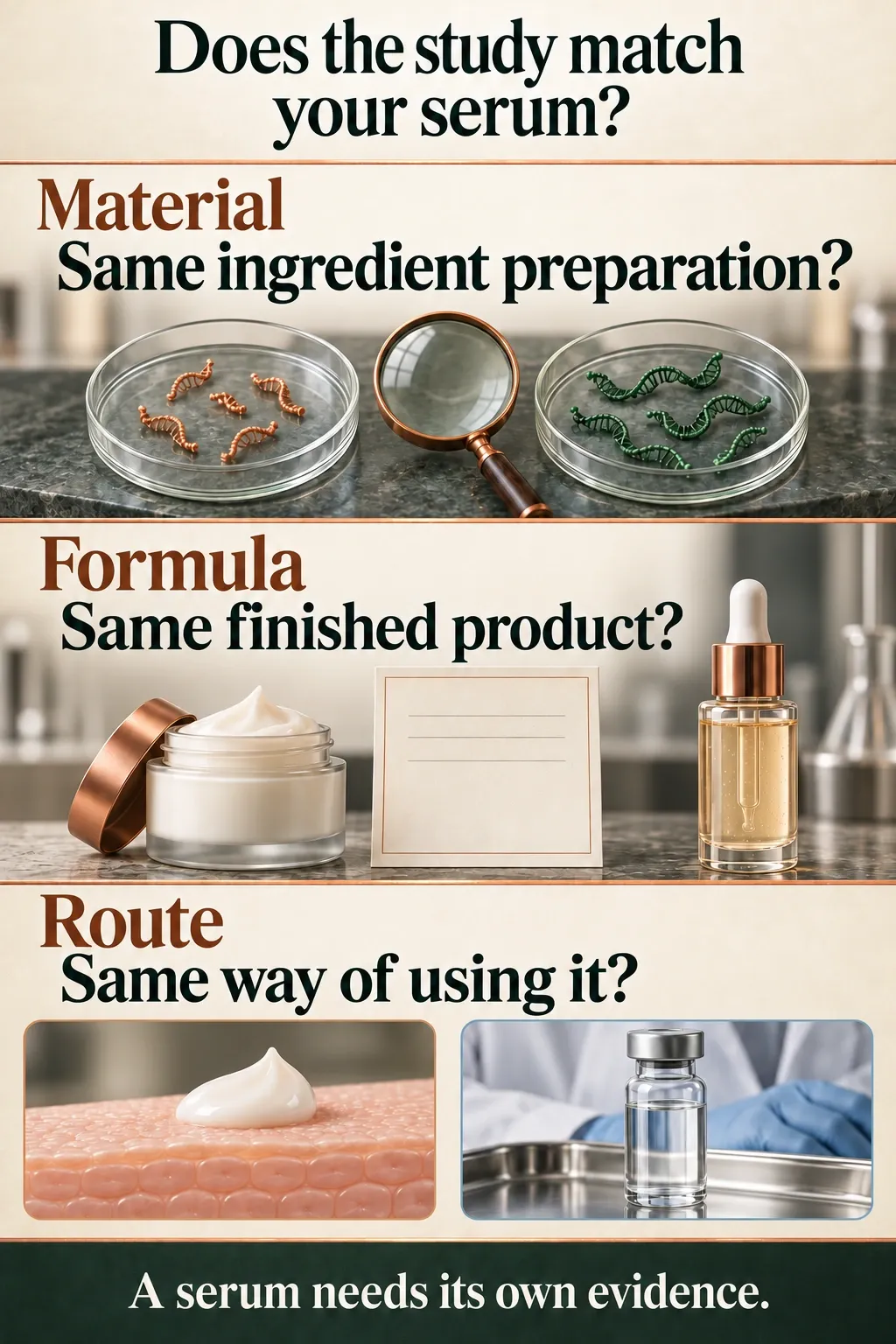
Three checks before choosing a PDRN serum
Editorial Note
SkinOptimizer reviews published studies, current product information and medical guidance. This guide assesses published evidence and does not replace individual medical advice.
PDRN skincare raises a reasonable question: does a cream containing DNA fragments do something useful, or does the name mainly make a familiar moisturizer sound new? We think the answer needs more care than either a blanket endorsement or a dismissal.
The research has changed enough that saying “there are no human topical studies” is now too broad. Yet the studies do not give every bottle with PDRN on its label a clinical stamp of approval.
The important distinctions are easy to lose when a product description moves from wound healing to collagen to “glass skin” in a few sentences. Each claim may come from a different material, method of delivery and study population.
This guide keeps those parts separate so you can judge an optional cosmetic on its own terms. You do not need to master cell signaling to ask whether the evidence actually matches the product you are buying.
The Skin Insider
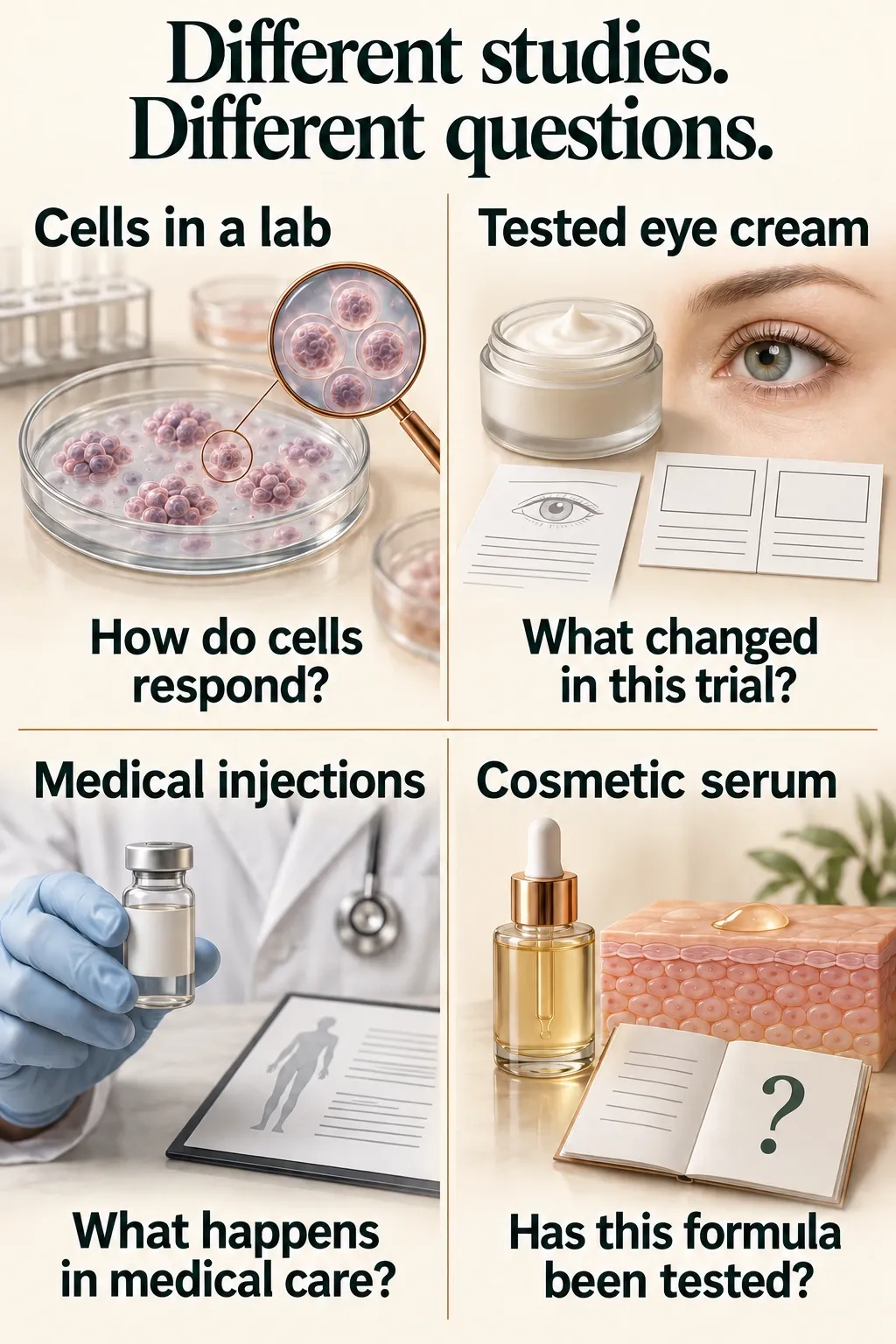
A study of an injected material, a cell experiment and a trial of a finished eye cream answer different questions. The useful question is not simply “Has PDRN been studied?” but “Does this study test a comparable material, formula and way of using it?”
What is PDRN skincare?
PDRN stands for polydeoxyribonucleotide, a term used for preparations containing DNA fragments. Many medical and cosmetic materials are derived from salmon or trout DNA, while other sources are also being investigated.
The familiar “salmon sperm” phrase describes a source used to obtain and purify DNA. It does not mean a finished serum contains raw sperm, living cells or a treatment that changes your genetic identity.
However, purification is not a reason to assume every product is identical or allergy-free. The source material, processing, fragment characteristics and full ingredient list still matter.
PDRN is different from a peptide, which is a chain of amino acids. Our peptides in skincare guide explains that separate ingredient family and why shared anti-aging language is not shared evidence.
You may also see polynucleotide, or PN, used alongside PDRN. Terminology is not consistent across scientific, clinical and commercial sources, so do not infer identical composition or performance from either abbreviation alone.
What does “vegan PDRN” mean?
It usually signals that the advertised material is not fish-derived. It does not tell you whether the source is peony, ginseng, another plant or a different process without further information from the manufacturer.
A study of one characterized plant-derived preparation does not validate every vegan product. Nor does fish origin establish that a material is more effective than a botanical one.
Ask what the brand actually means by the term and whether the finished formula has relevant evidence. Treat source preference as one purchasing consideration, rather than a substitute for performance and tolerance information.
Why the route of use changes the evidence
Skin is a barrier, and applying a cosmetic to its surface is different from delivering material beneath it. This distinction matters more than whether two treatments share a fashionable ingredient name.
Medical studies can involve wounds, injections, specialist aftercare or other conditions very different from an everyday serum routine. Results from those settings should not be carried across to intact facial skin without suitable research.
| Study or product context | What is different | What a reader should infer |
|---|---|---|
| Cosmetic applied to intact skin | The finished formula must work through or at the skin surface. | Look for evidence from comparable topical use. |
| Professional procedure or aftercare | The skin condition and treatment plan may differ substantially. | Follow the treating professional's exact instructions. |
| Injected medical preparation | Delivery bypasses the outer barrier and may target a medical condition. | Do not assume an OTC serum produces the same effects. |
A randomized trial in 216 patients with diabetic foot ulcers investigated PDRN given through intramuscular and perilesional routes over eight weeks. It is useful medical background, but it does not test a cosmetic serum, healthy facial skin or acne scars.
This article does not provide injection instructions or recommend a cosmetic procedure. Products intended for ordinary surface application should stay within that intended use.
What the topical PDRN studies actually show
Two recent lines of human research are worth knowing about. Both involve defined preparations and small study groups, so they support cautious interest rather than a broad verdict on retail PDRN products.
A 2026 study of a specific PDRN eye cream
A July 2026 PLOS One study compared a 0.1% PDRN-850K eye cream with an identical-base 0.1% retinol cream. The 31 Chinese women, aged 35 to 55 with questionnaire-defined sensitive skin, applied them twice daily for 28 days.
Selected instrumental measures favored PDRN, but the short, small trial lacked a vehicle-only arm. Hydration may contribute; lasting remodeling or superiority over retinoids was not established.
Authors included cosmetics-company affiliates; no conflicts or specific funding were declared. The result concerns that preparation, not every retail serum.
A small study of peony-derived material
A paper published in December 2025 investigated a characterized low-molecular-weight PDRN preparation derived from peony. Its small human component included a 1% experimental cream and comparison cream without that material, with periorbital elasticity assessed over four weeks in ten healthy Korean participants.
The research also assessed water loss in an experimentally irritated-skin model. These findings are early evidence for that specific preparation, rather than proof that plant-derived PDRN broadly repairs damaged skin.
The small sample, short follow-up, lack of an active comparator and developer-company employment of the authors limit confidence and generalization. A ginseng-derived essence or a differently processed ingredient should not borrow the peony formula's result.
| Evidence | Useful finding | What remains uncertain |
|---|---|---|
| Finished-formula comparison | Results for the tested preparation and conditions | Long-term effects, broader populations and other finished formulas |
| Small peony-derived formula study | Early human observations alongside laboratory work | Replication, longer follow-up and equivalence to other botanical materials |
| Medical wound and laboratory research | Reasons to investigate biological activity | Whether ordinary intact-skin cosmetic use reproduces those effects |
These studies are also why “PDRN never works topically” goes further than the evidence allows. The more accurate conclusion is that some defined topical preparations have preliminary support, while broad product claims remain ahead of what has been established.
When comparing a PDRN formula with established options, consider the goal rather than only the ingredient trend. Our anti-aging ingredient guide provides a broader starting point.
Can PDRN penetrate skin?
This remains a formulation question, not a yes-or-no answer for every product. DNA-fragment materials can be large, and passage through the outer skin barrier is a real challenge.
The study examined reconstructed epidermis, porcine skin and one human forearm. Raman signals suggested superficial viable-epidermal distribution, but could not conclusively separate applied PDRN from natural skin nucleic acids.
This is not proof that retail serums reach the human dermis.
You therefore cannot settle performance from a molecular-size slogan alone. Nor should “nano,” “low molecular weight” or “advanced delivery” be accepted as proof of useful penetration in a particular finished cosmetic.
Our explanation of the skin barrier is useful context. A barrier's job is not to let every active through, and trying to bypass it at home creates a different safety problem.
What about DNA repair and regeneration claims?
Researchers investigate PDRN-related effects on cell signaling and repair processes. That does not mean a cosmetic serum repairs your DNA, reverses aging or rebuilds damaged tissue in the way its advertising may imply.
Changes in cultured cells are not the same outcome as a visible, lasting benefit in a person. Laboratory studies help generate and test explanations; appropriate human studies are still needed to establish clinical relevance.
It is reasonable to be interested in this research without making it a reason to buy another product. A mechanism explains what scientists are investigating, not how much improvement you should expect from a bottle.
The Optimizer's Edge
Keep the claim attached to the exact evidence. Identify the tested material, finished formula and route before accepting a result. If they do not match your product, treat the study as background rather than proof of its performance.
How to read a PDRN label before buying
Start with the full ingredient list and intended use. Depending on the formula, names such as Sodium DNA may appear, but an ingredient name alone does not specify fragment size, purity or a clinical outcome.
Ask the manufacturer for clarification if the headline material or percentage is unclear. If the answer is unavailable, treat that as missing information rather than filling the gap with an assumption from a different product's study.
| Check | Useful question | Common shortcut to avoid |
|---|---|---|
| Material and source | What source, ingredient identity and characterization are disclosed? | Assuming all salmon or vegan materials are equivalent |
| Concentration claim | Does the number refer to purified material or an ingredient blend? | Reading every ppm figure as a pure-DNA dose |
| Finished-formula evidence | Was this product tested, and under what conditions? | Borrowing an injection or unrelated ingredient result |
Percentage and parts-per-million figures can describe different things in marketing materials. A blend may include carriers or other components, so comparing headline numbers without their definitions can be misleading.
Even a clearly defined higher concentration is not automatically more effective or better tolerated. Without an appropriate comparison, it is simply a different amount, not an established reason to pay more.
Read the rest of the formula too. Humectants, emollients, fragrance, preservatives and other active ingredients influence comfort and appearance, regardless of which ingredient gets the largest print on the front.
Labels such as “medical grade” do not resolve the evidence question. Our medical-grade skincare explainer discusses why product category and substantiated claims matter more than a prestige phrase.
Where PDRN could fit in a routine
If you want to try a topical PDRN product, treat it as one optional cosmetic step. Follow its instructions and add it separately from other new products so that reactions are easier to identify.
A serum or essence may fit after cleansing and before moisturizer when its label recommends that order. The exact sequence depends on texture and formulation, not a universal PDRN rule.
Do not replace a moisturizer that keeps your skin comfortable simply because a serum promises regeneration. Our barrier-supporting ingredient guide explains more familiar options and their practical uses.
A simple trial plan
- Check the full formula, intended use and manufacturer directions.
- Keep the rest of your routine reasonably stable.
- Add one optional product, using it only as directed.
- Stop if burning, rash or persistent irritation develops.
- Review comfort, usefulness and cost before repurchasing.
There is no established universal requirement to alternate all PDRN products with vitamin C or retinol. There is also no reason to assume every combination is suitable; read the exact labels and respect prescription instructions.
If your priority is fine lines, compare the wider evidence in our retinol guide. If uneven tone is the main concern, the vitamin C guide may address your decision more directly.
For a routine that is already reactive, simplicity comes first. Our sensitive-skin routine can help you reduce unnecessary variables before testing a trend ingredient.
Fish allergy, pregnancy and freshly treated skin
Fish origin deserves attention if you have a fish allergy. Do not assume purification removes every concern; ask a qualified clinician and the manufacturer about the exact product before use.
A home patch test does not establish safety for a known food allergy. It can help identify some local irritation, but it is not a substitute for appropriate allergy advice.
Pregnancy and breastfeeding also need a full-formula assessment. The 31-person eye-cream trial excluded pregnant and lactating participants, so it cannot establish safety in those groups.
Ask your clinician about a product if you are pregnant, breastfeeding, managing a skin condition or following a treatment plan. “Natural,” “vegan” and “DNA-derived” are not safety conclusions.
After microneedling, laser treatment or a peel, follow the treating professional's aftercare instructions. Do not use an ordinary cosmetic to deliver ingredients into fresh channels or assume a PDRN label means the product is sterile.
The FDA states that microneedling devices are not approved to deliver cosmetics or topical products into skin. A serum intended for surface application should not become a home injection or needling treatment.
Is a PDRN product worth buying?
It may be worth trying if you enjoy the finished formula, tolerate it and can afford an optional step. That is different from buying it because an unrelated medical study promises a transformation.
This guide does not rank retail serums or attach a study result to an untested product. If you are exploring Korean formulas more broadly, use our Korean skincare selection guide to compare choices by need rather than trend status.
Consider trying it if
- Your basic routine is already comfortable and consistent.
- The full formula fits your skin and preferences.
- You accept limited, formula-specific evidence.
- You can judge its value without expecting injectable-style results.
Consider skipping it if
- Your skin is currently irritated or freshly treated without clinician clearance.
- You need a treatment for wounds, eczema or another medical condition.
- You are paying mainly for a concentration claim you cannot verify.
- You would sacrifice useful moisturizer or sunscreen to afford it.
Keep your personal assessment modest too. A comfortable, hydrating finish can be worthwhile, but it cannot show whether PDRN rather than the base formula caused the change.
Lighting, expression, makeup and hydration can alter casual photographs. Do not interpret a different-looking selfie as proof of new collagen, DNA repair or permanent tissue change.
Your Clear Skin Checklist
- Match material, formula and route before accepting a claim.
- Read topical studies with their sample size and duration in view.
- Ask what the source and concentration labels actually describe.
- Keep optional cosmetics separate from medical or post-procedure treatment.
- Stop irritation and protect the basics of your routine.
Frequently Asked Questions About PDRN Skincare
Community discussions about topical evidence, source and route differences and realistic expectations helped identify these questions. Anecdotes are not used as proof; the answers follow the evidence and limitations above.
Does topical PDRN work without injections?
Some small human studies report encouraging results for defined topical preparations. That supports further investigation, but does not establish equal benefits from every PDRN serum or make a cosmetic equivalent to an injected treatment.
Can PDRN penetrate the skin?
Delivery depends on the material and finished formula. Evidence from one preparation cannot establish delivery by another retail formula.
Is vegan PDRN the same as salmon-derived PDRN?
Not automatically. Sources, processing and material characteristics can differ, and a small study of peony-derived material cannot validate every ginseng-derived or other vegan formula.
Can I use PDRN with retinol or vitamin C?
Check the exact product instructions and respect any prescription plan. There is no universal mixing rule for every PDRN formula, so introduce products separately and stop combinations that cause irritation.
Is PDRN skincare safe if I have a fish allergy?
Do not assume a fish-derived product is safe because its DNA material was purified. Ask your clinician and the manufacturer about the exact formula; a home patch test cannot establish safety for a known fish allergy.
A reasonable place for an emerging ingredient
PDRN research is worth following, especially as topical studies become more specific. For now, the useful position is cautious interest in defined formulas, with clear limits on what a retail cosmetic can claim.
Keep a suitable moisturizer and daily sun protection in place. A new ingredient earns a place in your routine through comfort and practical value, rather than the excitement surrounding its name.
This article is for informational purposes only and does not replace professional dermatological advice.