Skincare Routine for Dark Circles: A Gentle AM and PM Plan
Build a gentle skincare routine for dark circles with morning and evening steps, realistic ingredient advice, and clear signs to seek medical care.

In this guide

Quick Answer
A skincare routine for dark circles should start with gentle cleansing, a comfortable moisturizer and daily sun protection. These steps support the surrounding skin, but creams cannot fill under-eye hollows or guarantee that inherited darkness disappears.
In the morning, cleanse gently, moisturize if needed, then use broad-spectrum SPF 30 or higher according to its label, plus sunglasses and shade. At night, remove makeup carefully, cleanse and moisturize; add an eye treatment only if it has a clear purpose.
Burning, itching, scaling or swelling calls for a different plan: stop the irritating product and seek advice if symptoms persist. Eye pain, vision changes, or an eyelid that is swollen and red, hot or painful need prompt medical assessment.
Quick Summary
- Keep the morning and evening routine short. A separate eye cream is optional when a suitable moisturizer already feels comfortable.
- Sun protection helps protect exposed skin; it does not remove a shadow caused by the shape of your under-eye area.
- Caffeine and vitamin C findings are limited and formula-specific. A higher percentage is not a reliable shortcut to better results.
- Stop products that burn or cause a rash. Avoid rubbing, homemade acids and strong facial treatments on delicate eyelids.
A gentle eye routine in 12 seconds
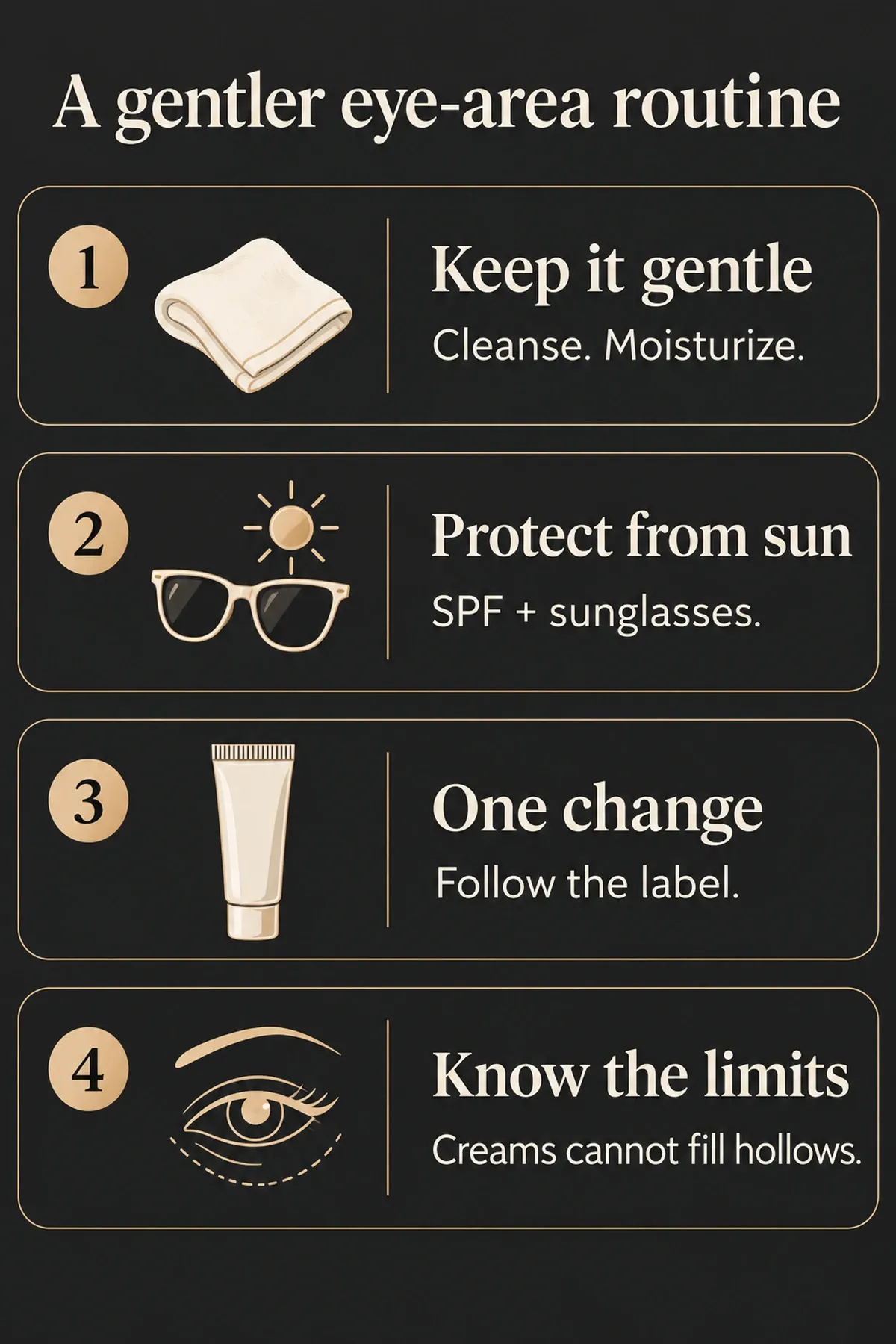
Editorial note: SkinOptimizer provides skincare education, not medical diagnosis. This guide draws on medical guidance, original studies and current product information; we have not conducted a product trial or appointed a medical reviewer.
Updated: . Originally published October 16, 2024. Routine advice, evidence limits and the optional product's current formula reviewed.
Choose a goal you can judge, such as comfortable skin or makeup removal without rubbing. A routine may meet those goals while under-eye shadows remain.
If several creams have done little, check whether they were trying to solve the right problem. Another serum can add cost and irritation while leaving a structural shadow unchanged.
The Skin Insider
Moisturizing dry skin and replacing lost volume are different jobs. An eye cream may make dry texture look smoother while the underlying hollow remains visible.
You can keep a comfortable routine even when darkness persists. Persistent cosmetic concerns can be assessed without buying a stronger product first.
What a skincare routine for dark circles can change
DermNet's overview of dark circles describes several possible contributors, including pigmentation, thin skin, puffiness and shadows from under-eye anatomy. More than one can be present.
Color alone cannot reliably tell you which explanation applies. Lighting, skin tone and camera settings can change how the same area looks; avoid pulling or stretching your eyelid to choose a treatment.
| Your concern | Reasonable first step | Important limit |
|---|---|---|
| Dry or rough-feeling skin | Gentle cleansing and a tolerated moisturizer. | Hydration does not replace missing volume. |
| Itchy, burning or flaky eyelids | Stop irritating products and arrange advice if symptoms persist. | Brightening treatments can add irritation. |
| Long-standing under-eye darkness | Sun protection and realistic assessment of your goal. | A cream may have little effect on structural shadows. |
| Occasional puffiness | A comfortable cool cloth may offer temporary relief. | New or painful swelling needs assessment. |
Sleep and other everyday factors can influence appearance, but getting enough sleep does not rule out pigment or anatomy. You do not need to treat visible under-eyes as proof that you have failed at sleep, hydration or skincare.
Cleveland Clinic's dark-circle guidance explains these overlapping causes. Dark circles alone do not diagnose anemia; ask a clinician about other symptoms instead of starting iron supplements on that basis.
Morning routine for dark circles
1. Cleanse without scrubbing
Use a gentle cleanser when needed, lukewarm water and your fingertips. Rinse carefully and pat dry with a clean towel; skip brushes and repeated wiping around the eye.
The AAD's face-washing guidance supports a gentle approach. If your cleanser leaves the surrounding skin tight or uncomfortable, review that step before buying a brightening serum.
Our cleanser guide for dry and sensitive skin can help you compare the wider routine. Keep ordinary facial cleansers out of your eyes and follow any eye-area restrictions.
2. Moisturize only as much as you need
Use a moisturizer you tolerate and that is suitable for the area, following its directions. Smooth gently without tugging; keep it out of the eye and away from the lash line.
You may already own a suitable option. A separate eye cream is useful when its texture or intended use solves a problem, such as a face cream that feels too heavy or contains an unsuitable active.
Compare the complete formula and label in our eye cream versus face cream guide. A product name or a high price cannot guarantee comfort.
3. Protect exposed skin from the sun
Choose broad-spectrum SPF 30 or higher and use it according to the label, keeping it out of your eyes. Add UV-protective sunglasses, a hat and shade rather than depending on sunscreen alone.
The AAD's sunscreen guidance also calls for water resistance when swimming or sweating. A regular eye moisturizer without SPF does not perform this step.
If sunscreen stings your eyes, review the formula and application rather than leaving sun protection out entirely. Our sensitive-skin sunscreen guide offers options to compare; individual tolerance still varies.
Reapply outdoors at least every two hours and after swimming or sweating as directed. Use our sunscreen reapplication guide when makeup or a long day outdoors makes that step difficult.
4. Keep makeup optional and easy to remove
Concealer can camouflage darkness if you want an immediate cosmetic change. Let skincare settle as its directions require, then use eye-area makeup you tolerate; avoid working repeated layers into irritated skin.
If makeup pills, try fewer overlapping products before adding another primer or eye cream. Removing a redundant layer is an easier experiment to understand than changing every product at once.
When an eye moisturizer is worth considering
If your current moisturizer works comfortably around the outer eye area, you can keep it. The example below is for a specific hydration need, not a claim that everyone with dark circles needs eye cream.
CeraVe Eye Repair Cream, 0.5 oz single tube

This is a fragrance-free moisturizing option with ceramides, niacinamide and sodium hyaluronate. We would consider it when a dedicated eye moisturizer fills a gap in your routine.
- Intended role: moisture for surrounding eye-area skin.
- No SPF: keep your sun-protection step.
- Limits: no promise to fill hollows or remove every type of darkness.
Buy it if: you want a separate fragrance-free eye moisturizer and its current ingredient list suits you.
Skip it if: your existing suitable moisturizer works, you expect a hollow to fill, or you have a known reaction to an ingredient.
The current CeraVe directions say to apply small dots and smooth gently, once or twice daily. Follow your package; keep the product out of your eyes.
The current US ingredient list includes sweet almond oil and botanical extracts. Fragrance-free and testing claims cannot guarantee that an individual will avoid irritation.
Check CeraVe Eye Repair Cream on AmazonAs an Amazon Associate, we earn from qualifying purchases. This is a label-based suggestion, not a product we have tested; check the current variant and package ingredients before buying.
To compare textures or ingredient exclusions, our guide to eye creams for sensitive eyes is a separate shopping resource. Recurring eyelid dermatitis needs assessment before another product trial.
Nighttime routine for dark circles
- Remove eye makeup carefully. Use a remover labeled for eye makeup and follow its instructions. Give stubborn makeup time to loosen instead of scrubbing it away.
- Cleanse gently. Rinse off the day's sunscreen and residue with a suitable cleanser. Use clean hands and pat the surrounding skin dry.
- Apply a tolerated moisturizer. Follow its eye-area directions and avoid the lash line. Use the amount directed on the label.
- Keep optional treatment separate. Introduce only one suitable, label-directed eye product at a time. Leave it out when skin is already irritated.
A basic evening does not require a toner, exfoliating pad, serum, patch and cream. Each extra layer creates another possible source of discomfort and makes a reaction harder to trace.
For waterproof makeup, choose the removal method specified by that product. Avoid repeatedly rubbing with a nearly dry cotton pad just because it looks like a gentler tool.
Eye patches are optional. Their directions differ: pre-soaked patches and reusable silicone covers do not automatically belong at the same stage, as our eye-mask order guide explains.

The Optimizer's Edge
Change one product at a time and keep a note of its name, start date and any symptoms. This makes a reaction easier to discuss than a list of five products started together.
Burning is a reason to stop and reassess. Do not treat it as evidence that a dark-circle product is working.
What the ingredient evidence allows
Check what was studied before choosing an ingredient. A result from one finished formula does not establish the same benefit for every product containing that ingredient.
| Ingredient or step | Useful role to consider | Limit to remember |
|---|---|---|
| Moisturizing formula | Comfort and smoother-looking dry texture. | Does not replace volume or diagnose the cause. |
| Caffeine | Optional cosmetic experiment for puffiness. | Standalone benefit remains uncertain; no universal percentage or timeline. |
| Vitamin C | Some specific formulas have been studied. | Results cannot be transferred between derivatives and products. |
| Retinoids | A separate, cautious discussion for suitable adults. | Irritation risk; avoid during pregnancy and do not improvise eyelid use. |
A 2011 randomized caffeine-gel study involved 34 Thai adults aged 19 to 24 after one sleepless night. It compared a 3% caffeine gel with its matching base over three hours.
The groups did not differ significantly overall. That narrow puffiness experiment does not prove that a retail caffeine serum will improve chronic dark circles, and its authors considered cooling an important explanation for the observed changes.
A small vitamin C study followed 14 participants for six months using particular vitamin C derivative lotions. Outcomes differed between the derivatives; it does not establish that every vitamin C eye cream will fade pigment.
For a first routine, we would keep strong facial exfoliants and retinoids away from delicate eyelids unless specifically directed by a clinician. An eye-area label still needs to be read carefully; it is not permission to use a product on irritated skin.
Read our eye-area retinol precautions before considering that separate step. Persistent darkness alone is not a reason to add retinol.
AAD pregnancy guidance advises avoiding retinoids, including retinol, during pregnancy. If pregnant, trying to conceive or breastfeeding, review optional treatments with your clinician; our pregnancy routine guide covers broader changes.
When irritation changes the plan
Itchy, scaly or burning eyelids need attention before brightening. DermNet's eyelid dermatitis guidance explains that irritants and allergens can come from eye products or be transferred by hands, nail products and hair products.
A product you have used before can still become a problem. Fragrance-free helps with one possible exposure, but it does not make a formula allergy-proof.
- Stop the suspected irritating product and avoid rubbing or scratching.
- Leave out strong actives, fragrance and essential oils around irritated eyelids.
- Avoid lemon juice, potato juice, homemade acids and other food-based eye treatments.
- Get advice for persistent or recurring symptoms; do not prescribe yourself an eyelid steroid course.
Bring a list of skincare, makeup, nail and hair products to the appointment. A clinician may consider formal patch testing; a home tolerance check cannot diagnose contact allergy or guarantee safe use.
Get prompt help for eye symptoms
Seek urgent medical assessment for eye pain, vision changes, light sensitivity, or an eyelid that is swollen and red, hot or painful. Sudden loss of vision or a serious eye injury needs emergency care.
The NHS eyelid guidance describes warning signs. New persistent one-sided darkness or swelling also warrants a clinician's assessment rather than a stronger cream.
Judge comfort before color
Set a modest first goal: the routine feels comfortable, makeup comes off without rubbing, and dry texture is easier to manage. Keep those observations separate from whether a shadow looks lighter.
If you take comparison photos, use the same room, lighting, distance and time of day. Avoid filters and comparing a harsh overhead light with soft window light; those photographs cannot show a reliable product effect.
| What you notice | What to record | Next step |
|---|---|---|
| Comfortable skin, unchanged darkness | Which steps are useful and easy to keep. | Keep the basics; reassess the cosmetic goal before buying more. |
| Burning, itching or a rash | Product names, timing and symptoms. | Stop the irritating product and seek advice if persistent. |
| New swelling or other eye symptoms | Onset, one or both eyes, pain and vision changes. | Use the medical-assessment branch; urgent signs need prompt help. |
For occasional puffiness, Mayo Clinic suggests a cool compress. Use a clean cloth with comfortably cool water for a few minutes, without pressing on the eyeball; avoid direct ice or frozen tools.
Any temporary cooling effect does not establish pigment removal. If allergy symptoms recur, discuss their management with a qualified professional instead of relying on an eye cream to treat them.
You can review the routine after several weeks to decide whether each purchase earns its place. There is no universal four-week deadline when dark circles should disappear, and persistent concerns can be assessed sooner.
Watch an additional eye-care perspective
The video from Dr Sam Bunting offers another perspective on eye care. It is separate from SkinOptimizer's editorial review; product suggestions in the video are optional and do not replace the precautions above.
Community questions: Discussions about caffeine eye creams, persistent darkness and hollows, and reactions to eye serum helped identify the questions below. Community anecdotes are not evidence; medical guidance and the studies linked above support the answers.
Frequently Asked Questions About Skincare Routine for Dark Circles
Can skincare remove genetic dark circles or fill hollows?
Skincare may help dry texture or some contributors to discoloration, but it cannot replace missing volume. Inherited features and structural shadows can remain despite a comfortable routine; ask a qualified clinician if you want to understand the cause and realistic options.
Does caffeine help dark circles?
Its standalone benefit is uncertain. The small placebo-controlled gel trial discussed above did not find a significant overall advantage for caffeine, and findings from one formula cannot be applied to every serum or every cause of darkness.
What should I do if eye cream burns?
Stop using it and keep it out of your eyes. Persistent irritation, rash or swelling needs advice; eye pain or vision changes need prompt assessment. Do not continue because you assume burning means the treatment is working.
Do I need a separate eye cream?
Often you can use a suitable, tolerated moisturizer according to its directions. A separate eye cream can make sense when its texture or formula suits the area better; it is optional if your current product already does the job comfortably.
When should dark circles or swelling be checked?
Arrange assessment for new persistent one-sided changes or concerns that continue despite simple care. Seek urgent help for eye pain, vision changes, or an eyelid that is swollen and red, hot or painful; sudden vision loss needs emergency care.
Your Clear Skin Checklist
- My morning routine includes gentle care and sun protection.
- I remove makeup without scrubbing and keep products out of my eyes.
- Every optional treatment has a purpose and suitable directions.
- I stop products that cause burning, rash or swelling.
- I judge comfort separately from shadows and know when to seek care.
This article is for informational purposes only and does not replace professional dermatological advice.