Eye Masks Before or After Skincare? The Correct Order
A label-first guide to the correct order for hydrogel, reusable, rinse-off, and overnight eye masks—plus realistic results and eye-area safety.

In this guide

Quick Answer
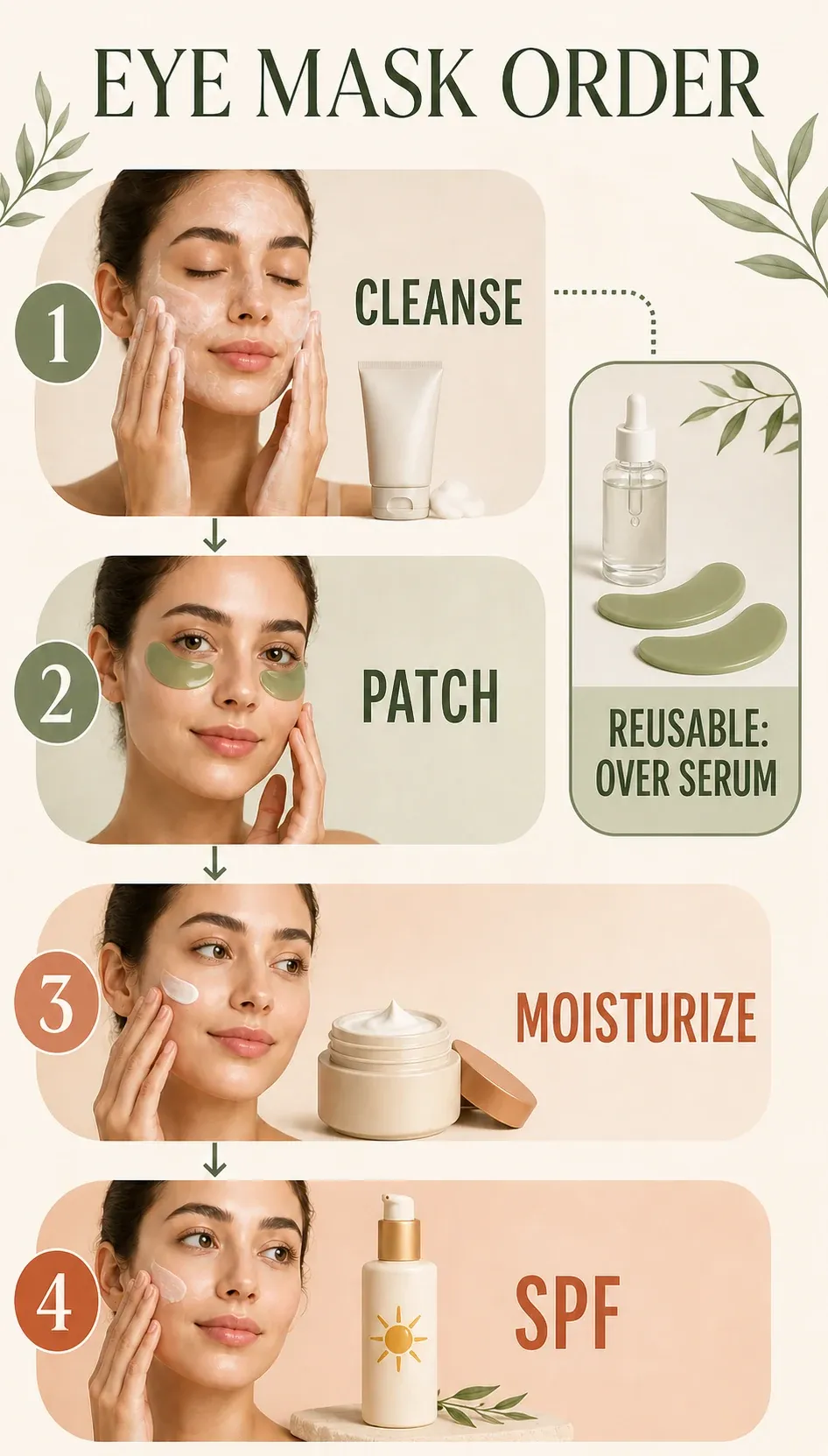
For most pre-soaked hydrogel under-eye patches, use them after cleansing and before moisturizer. Apply them to clean, dry skin for the time stated on the label, remove them, gently pat in any residue, then use moisturizer and morning sunscreen. The important exception is a reusable silicone eye mask: many are designed to sit over a very thin layer of eye serum or eye cream. Overnight and leave-on eye masks may be the last step. The product directions—not a universal TikTok rule—decide the final order.
Quick Summary
- Default order: cleanse, hydrogel eye patches, moisturizer, then SPF in the morning.
- Reusable exception: apply a small amount of compatible serum or eye cream first, then place the clean silicone patches on top if the label says so.
- Set realistic expectations: patches can make the area feel hydrated and look temporarily smoother or less puffy, but they do not permanently erase genetic dark circles, bags, or wrinkles.
- Protect the eye area: keep patches below the lash line, use clean hands, and stop if the skin burns, stings, swells, or becomes very red.
Editorial Note
SkinOptimizer is an editorial skincare resource. We reviewed current guidance from the American Academy of Dermatology and FDA, plus current manufacturer directions for both pre-soaked hydrogel and reusable silicone patches. We do not claim medical credentials or hands-on testing. Product labels can change, so check the instructions on the package you own.
At SkinOptimizer, we see the same eye-mask question answered with two opposite rules: put patches on completely bare skin, or layer serum underneath so the patch can “push it in.” Both answers can be correct—and both can be wrong—because “eye mask” describes several different products.
A jar of serum-soaked hydrogel patches already contains its treatment liquid. It often needs clean, relatively dry skin so it can stay in place.
A reusable silicone patch contains no serum at all. Its job is to cover a thin layer of a compatible product. A rinse-off cream mask and an overnight leave-on formula create two more sequences.
This guide gives you a label-first decision system instead of pretending every patch works the same way. We will separate application order, realistic results, ingredient choices, makeup timing, and eye-area safety.
That matters because the skin is delicate, the product sits close to the eye, and more layers do not automatically mean a better result.
Eye masks before or after skincare: let the product type decide
The safest default is simple: identify what is doing the work. Is the patch already saturated with serum? Is it a reusable silicone cover? Must the formula be rinsed away? Is it specifically labeled as an overnight treatment?
The American Academy of Dermatology's general product-order guidance places cleansing first, treatments next, and moisturizer or sunscreen afterward. Eye patches are not named as a single category, so the package directions remain essential.
| Eye mask type | Best starting order | What comes next |
|---|---|---|
| Pre-soaked hydrogel or sheet patches | Usually after cleansing, on clean and dry skin | Pat in residue, then moisturizer and morning SPF |
| Reusable silicone patches | Usually over a small amount of compatible eye serum or cream | Remove, wash the patches, then finish the routine |
| Rinse-off cream or gel eye mask | After cleansing and before leave-on skincare | Rinse as directed, then use moisturizer |
| Leave-on or overnight eye mask | Usually a late or final evening step | Leave on only as the label instructs |
Do not classify a product from its shape alone. Two crescent patches can require different routines.
The directions for Pixi's pre-soaked patches start with cleansing, while Dieux's reusable silicone design is placed over a small amount of eye product. That difference is the central answer to this entire question.
How to use pre-soaked hydrogel eye patches correctly
Most readers asking whether eye masks go before or after moisturizer mean pre-soaked hydrogel patches. For this category, the clean-skin sequence is a reliable starting point when it matches the label.
Cleanse and dry gently
Remove makeup and sunscreen. Pat rather than rub. The under-eye area should not be wet enough to make the patch slide.
Place below the lash line
Use clean hands or the included spatula. Keep the patch on the orbital area, not against the eye or waterline.
Use the labeled time
Ten to twenty minutes is common, but the product you own is the authority. Longer is not automatically better.
Remove, pat, and seal
Pat in remaining serum if the label says not to rinse. Follow with moisturizer, then sunscreen in the morning.
You do not need a separate face serum under every pre-soaked patch. If the brand says clean skin, use clean skin. If it specifically says to layer a product first, follow that instruction instead. This prevents one-size-fits-all advice from overriding a tested application method.
If you also use eye cream, apply it after the patch unless the directions say otherwise. Our guide to eye cream versus face cream around the eyes can help you decide whether a separate eye product is necessary.
The five-minute morning sequence
Morning is often the most practical time for cooling patches because temporary hydration and cooling can make dry texture or puffiness look less obvious before concealer. Keep the routine light so makeup does not pill.
- Cleanse or rinse as appropriate for your skin. Remove any heavy overnight residue where the patches will sit.
- Apply pre-soaked patches for the labeled time. You can moisturize the rest of your face while waiting, but leave the patch area free.
- Pat in residue. Wait briefly until the surface feels comfortable rather than very wet.
- Add a thin moisturizer only if needed. Too many rich layers can make concealer move.
- Finish with broad-spectrum sunscreen. Do not place hydrogel patches on top of sunscreen and then expect even protection afterward.
If makeup creases easily, let each layer settle and use less product. Our comparison of the best sunscreen textures under makeup explains why compatibility matters more than piling on extra steps.
The calm evening sequence
At night, cleanse first and use the patches before a rich moisturizer. If your face feels dry while you wait, moisturize everywhere except the patch area. After removal, pat in the residue and finish the rest of your routine.
Be cautious about combining an occlusive patch with retinoids or exfoliating acids near the eyes. The AAD warns that using overlapping irritating ingredients can trigger dryness or irritation.
If you use a dedicated retinal or retinol eye product, follow its own instructions and see our beginner-safe guide to retinol around the eyes.
A label-verified hydrogel example
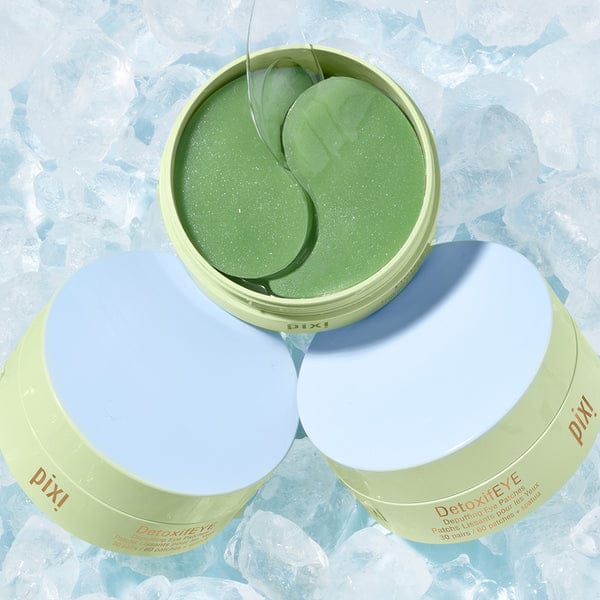
Pixi DetoxifEYE, 30 pairs
Who it is for: readers who want a pre-soaked, cooling hydrogel patch and a clear clean-skin routine.
Why it fits this guide: the current manufacturer directions say to cleanse first, leave the patches on for about ten minutes, remove them, and pat in remaining serum without rinsing.
Watch out: it is a cosmetic hydration and refreshing step, not a permanent treatment for structural bags or genetic dark circles. Check the current ingredient list if you have known sensitivities.
Manufacturer directions · Product image: Pixi Beauty. As an Amazon Associate, we earn from qualifying purchases.
We selected one example rather than filling an informational article with a large product list. The value here is the verifiable application method. Price, seller, stock, packaging, and ingredients can change, so compare the exact listing and package before purchase.
When reusable silicone eye masks go after serum
A reusable silicone eye mask is not a pre-soaked treatment. It is a washable cover designed to sit over a very small amount of a compatible leave-on product. In that case, “serum first” is not a contradiction—it is the intended method.
For example, the current Dieux Forever Eye Mask directions tell users to apply eye serum, let it become slightly tacky, wear the silicone patches for ten to twenty minutes, then wash and dry the patches.
The brand also advises avoiding exfoliating acids or potentially irritating retinol formulas underneath.
Reusable-patch routine
Rinse-off and overnight eye masks follow different rules
Cream eye masks that must be rinsed away behave more like small facial masks. Apply after cleansing, avoid the mobile eyelid unless the label allows it, rinse at the stated time, and then continue with leave-on skincare.
An overnight eye mask is usually a leave-on product rather than a physical patch. It often goes late in the evening routine.
Do not sleep in ordinary hydrogel patches simply because another product says “overnight.” A dry, slipping patch can rub the skin or move too close to the eye.
| If the label says… | Do this | Avoid this assumption |
|---|---|---|
| “Apply to cleansed skin” | Use before moisturizer on clean skin | Do not add serum underneath without a reason |
| “Apply over eye serum/cream” | Use a thin compatible layer first | Do not treat a reusable patch like a pre-soaked one |
| “Rinse after 10 minutes” | Rinse, then moisturize | Do not pat a rinse-off formula into the eye area |
| “Leave on overnight” | Use as the late or final evening step | Do not transfer that instruction to other patches |
What under-eye patches can—and cannot—realistically do
Eye patches are best understood as a short cosmetic boost. Hydrating formulas can increase water at the skin surface, and a cool patch can make the area feel refreshed.
The result may make fine dry lines look softer for a while and can improve how makeup sits.
Those effects do not prove that a patch rebuilt collagen, removed fat pads, changed bone structure, cured allergies, or permanently erased pigmentation. Under-eye darkness can reflect pigment, visible vessels, shadow from hollows, lifestyle factors, or several causes at once. Puffiness can also have different triggers.
Between optional patch sessions, follow a simple AM and PM routine for dark circles with clear sun-protection and irritation precautions.
If puffiness is your main concern, compare the role of short-term cooling with longer-term routine choices in our guide to eye creams for puffiness. If you are considering caffeine, our caffeine eye cream explainer separates temporary appearance changes from stronger promises.
A realistic decision rule
Fine lines around the eyes also need context. Dehydration can make surface lines more visible, but hydration is not the same as changing established wrinkles. Our guide to eye wrinkles beyond eye cream explains the limits of cosmetics without pretending one patch solves every cause.
Choose ingredients by tolerance, not by the loudest claim
A long ingredient list is not automatically a better patch. Start with the job you want the product to do, then screen for ingredients you know you avoid. The eye area is a poor place to chase maximum intensity.
| Your goal | A sensible first look | Watch out for |
|---|---|---|
| Temporary hydration | Glycerin, hyaluronic acid, soothing gel bases | Fragrance or a formula that has stung before |
| Cooling and morning puffiness | A refrigerated product if the label permits; caffeine may be included | Confusing a temporary refreshed look with permanent change |
| Sensitive or reactive skin | A short, fragrance-free formula and patch testing | Essential oils, duplicate acids, or too many new products together |
| Reusable routine | Plain silicone patches plus a familiar gentle eye product | Retinoids or exfoliating acids trapped underneath |
The AAD notes that masks can complement a routine but do not replace it. Its current facial-mask guidance recommends following the label, avoiding redundant irritating ingredients, and removing a mask if itching, burning, or stinging develops.
If your skin reacts easily, simplify the surrounding routine. Our sensitive-skin routine guide can help you separate a calm baseline from optional extras. For the difference between adding water and reducing water loss, see hydration versus moisturization.
Eight common eye-mask mistakes
- Ignoring the label. Product type changes the order. The instructions on the package beat a generic routine chart.
- Applying hydrogel patches over moisturizer. They may slide and make the experience messy. This is mainly an adhesion problem, not proof of a dramatic “absorption barrier.”
- Using too much serum under reusable patches. A thin layer is usually enough. More can increase slipping and irritation.
- Leaving patches on longer than directed. Extra time does not guarantee extra benefit. Remove them at the stated time.
- Placing them too close to the eye. Keep them below the lash line and stop if liquid moves into the eye.
- Combining too many actives. Do not trap an exfoliating acid or retinoid under a patch just to make it feel “stronger.”
- Reusing single-use patches. If the product is disposable, discard it. Wash only products specifically designed for reuse.
- Expecting a permanent fix. Judge patches as cosmetic support, not as treatment for persistent swelling, disease, or structural shadows.
Eye-area hygiene and warning signs
Eye-area skincare deserves stricter hygiene than an ordinary face mask. The FDA's eye-cosmetic safety advice says to wash hands before applying products, stop using a cosmetic if it causes irritation, and avoid eye cosmetics when the eye is infected or the surrounding skin is inflamed.
Stop and remove the patches if you notice
Rinse the eye with clean water if product enters it, follow the package advice, and seek prompt medical help for severe or persistent eye symptoms. Do not place cosmetic patches over broken skin, an active rash, a stye, or an infected area.
How often should you use eye patches?
Frequency is formula-specific. Some gentle hydrogel products are labeled for daily use; others are intended a few times per week. A reusable silicone patch may be used more frequently with a familiar gentle product, but it still needs cleaning after each use.
Start less often if your skin is sensitive or the formula is new. Change one variable at a time.
If a patch feels pleasant at first but causes dryness or redness after repeated use, reduce the frequency or stop rather than assuming your skin must “adjust.”
Patch-test new formulas as directed, especially if you have a history of reactions. The under-eye is not the ideal place for the first full application of an unfamiliar active blend.
The bottom line
Most pre-soaked eye masks go after cleansing and before moisturizer. Remove them at the labeled time, pat in remaining serum if directed, then finish with moisturizer and morning sunscreen. That is the clearest default answer.
Reusable silicone patches are the main exception: they usually go over a small amount of serum or eye cream. Rinse-off and overnight formulas create their own sequences. Once you identify the product type, the apparent contradiction disappears.
The best routine is not the one with the most layers. It is the one that follows the label, respects the eye area, and keeps the result in perspective.
Frequently Asked Questions About Eye Masks Before or After Skincare
Do eye masks go before or after serum?
Pre-soaked hydrogel patches often go on clean skin before a separate serum, especially when the label says to cleanse first.
Reusable silicone patches usually go over a thin layer of serum or eye cream. Check the instructions for the exact product rather than applying one rule to both types.
Should I apply eye masks before or after moisturizer?
Use most serum-soaked hydrogel eye patches before moisturizer. A rich cream can make them slide. After removal, pat in any residue as directed and add moisturizer. A leave-on overnight eye mask may be a late or final step instead.
Can I use under-eye patches every day?
Only if the label supports daily use and your skin stays comfortable. Start less often with a new formula or sensitive skin. Stop or reduce frequency if you develop stinging, redness, swelling, or dryness.
Do I wash my face after eye patches?
Do not rinse pre-soaked patches when the instructions say to pat in the remaining serum. Rinse-off cream masks are different and should be removed as directed. If a product causes burning or gets into the eye, remove it and rinse promptly.
Can I wear eye patches overnight?
Only when the exact product is labeled for overnight use. Ordinary hydrogel patches and reusable silicone patches usually have a shorter wear time. Do not extend the time because another eye mask uses different directions.
This article is for informational purposes only and does not replace professional dermatological advice.