Serum or Moisturizer First? Correct Layering by Routine
Serum usually goes before moisturizer, but treatment directions and retinoid buffering can change the order. Fix pilling without under-applying sunscreen.

In this guide

Apply serum before moisturizer by default: cleanse, use prescribed or targeted treatment, moisturize, then apply sunscreen as the final morning skincare step. Exceptions include formula-specific instructions and moisturizer-first buffering when a retinoid is too irritating. Thin-to-thick is a convenience rule, while medication directions, tolerance and an even sunscreen film matter more.
Quick Summary
- Default order is cleanser, treatment or serum, moisturizer, then morning sunscreen.
- Moisturizer can go first to buffer a retinoid when directions allow.
- Pilling usually improves with less product and fewer layers, not long timers.
- Never under-apply sunscreen to accommodate an overloaded routine.
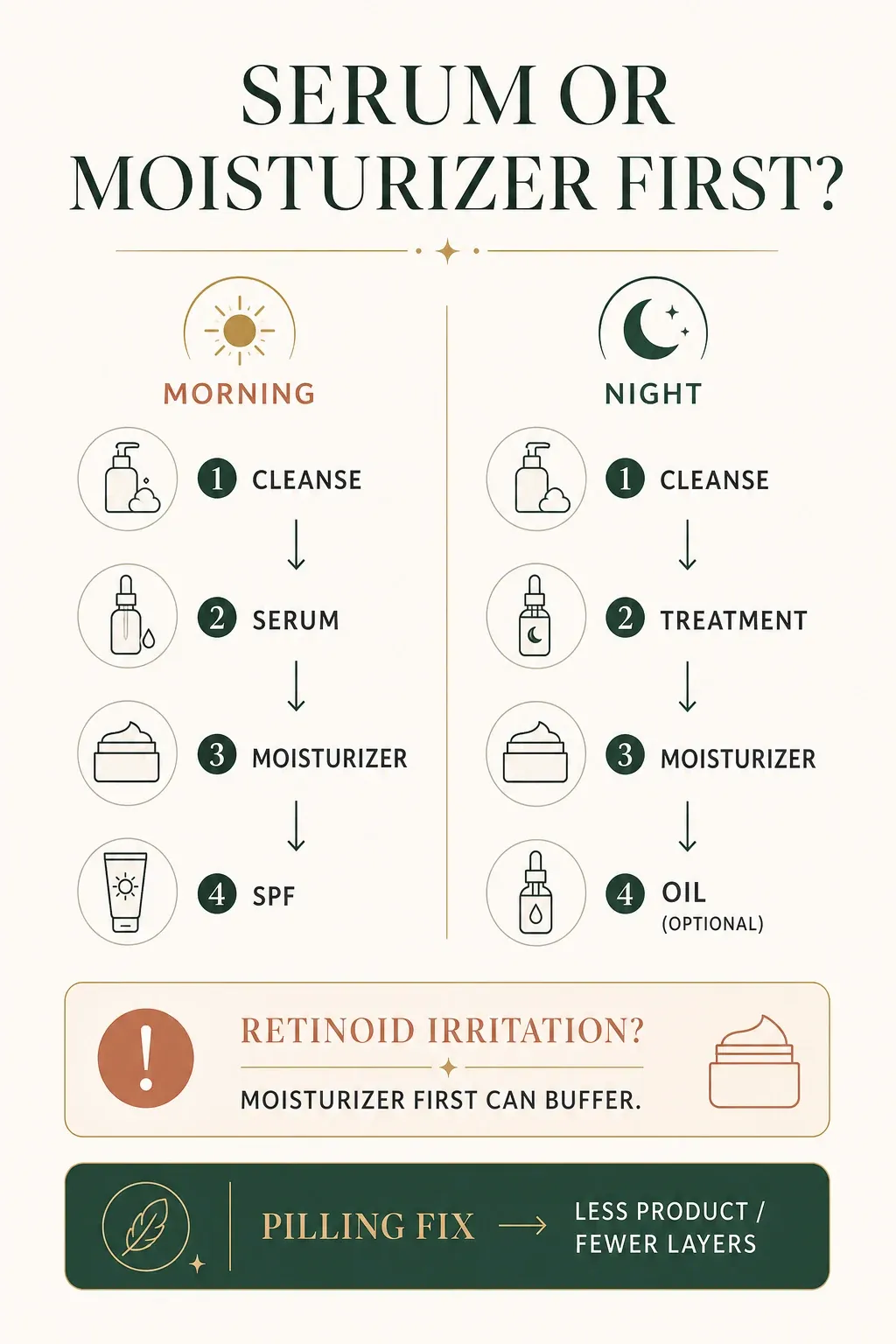
Skincare layering advice is often reduced to thin-to-thick and long waiting times. That rule can organize simple cosmetics, but it does not account for prescriptions, retinoid irritation, formula interactions or sunscreen film formation. This guide gives a safe default order, explains the useful exceptions and fixes pilling by simplifying the routine rather than shrinking the sunscreen dose.
Serum First, Moisturizer Second Is the Default
After cleansing, apply a treatment serum to clean skin, then use moisturizer, and finish with sunscreen in the morning. This order gives the targeted product direct contact while the moisturizer supports comfort and reduces water loss. It is a default, not a law for every prescription or formula.
The American Academy of Dermatology recommends cleansing, applying medication or treatment, then moisturizer and/or sunscreen. Product directions and a prescriber's instructions override generic advice.
Texture can help organize optional cosmetics: lighter water-based products usually precede creams and oils. Yet thin-to-thick is only a convenience rule. The active, vehicle and treatment plan matter more than visual viscosity.
| Step | Default position | Important exception |
|---|---|---|
| Cleanser | First | Rinsing with water may be enough for some mornings |
| Prescription or treatment serum | After cleansing | Follow medication directions |
| Hydrating serum | Before moisturizer | Can be skipped if moisturizer already meets the need |
| Moisturizer | After serum | May be used before retinoid to buffer irritation |
| Face oil | After moisturizer | Some oil-containing treatment formulas follow their own directions |
| Sunscreen | Last skincare step in the morning | Apply before makeup and allow an even film |
Why Moisturizer Usually Goes After Serum
Serums are often designed to deliver a concentrated treatment or hydration step in a relatively light vehicle. Applying them first avoids placing a richer film between the product and skin. Moisturizer then adds emollients and occlusives that improve comfort and reduce surface water loss.
This does not mean moisturizer permanently seals every ingredient underneath. Skin is not plastic wrap, and vehicles interact in more complex ways. An in-vitro penetration study found that moisturizer use can alter penetration of a subsequently applied topical compound, with effects depending on formulation and timing.
That study does not create one universal wait time for cosmetics. It shows why medication instructions and formula-specific testing matter. Avoid making confident compatibility claims from texture alone.
When Moisturizer Can Go First
Moisturizer-first application can buffer a retinoid for people whose main limitation is dryness or irritation. The AAD's routine guidance for people in their 20s notes that moisturizer can be applied first when a retinoid is too drying. This is a tolerance strategy, not proof that every active should be buffered.
A clinician may also direct moisturizer around topical medication to protect sensitive areas or improve adherence. Follow that plan. Do not use a generic social-media layering chart to change prescription dosing.
If a serum is primarily oil-based or packaged as an emulsion, it may behave more like a treatment lotion. Follow the manufacturer's directions and observe pilling. Product category names do not reveal the full vehicle.
The retinoid sandwich
The moisturizer-retinoid-moisturizer method can reduce irritation for some beginners. Use a small amount of each layer and avoid adding exfoliating acids on the same night initially. The goal is consistent tolerance, not maximum penetration on day one.
The retinol versus bakuchiol guide explains evidence and sensitivity tradeoffs. Prescription retinoids require their own directions, and pregnancy or pregnancy planning changes the decision.
Why Products Pill and How to Fix It
Pilling creates small rolls or flakes as layers are rubbed together. It can come from film-forming polymers, silicones, gums, powder, too much product, repeated rubbing or incompatible application. It does not automatically mean the ingredients are unsafe or chemically cancelling each other.
A study involving 528 women examined self-reported cosmetic pilling and associated product-use factors. Pilling is common enough to affect satisfaction and adherence, which makes application technique a practical issue rather than a trivial cosmetic complaint.
Use less product, spread each layer evenly and press rather than repeatedly rub. Remove an unnecessary serum before adding long wait times. If pilling happens only under one sunscreen, test a simpler moisturizer beneath it.
| Pilling pattern | Likely contributor | First fix |
|---|---|---|
| Rolls immediately | Too much product or rubbing | Use half the amount and spread once |
| Pills under sunscreen | Film-former interaction | Simplify serum/moisturizer beneath SPF |
| Pills under makeup | Too many skincare and primer layers | Remove duplicate silicone or powder steps |
| Flakes with retinoid | True dryness may mix with product film | Repair barrier and reduce frequency |
| Only one combination pills | Formula incompatibility | Keep the better product and replace the other |
| Every combination pills | Application amount or rubbing | Reset to cleanser, moisturizer and SPF |
How Long Should You Wait Between Layers?
Most cosmetic routines do not need a stopwatch. Allow a product to spread and settle enough that the next layer does not move it around, often a minute or less. Longer waiting can help with pilling or a medication direction, but it is not universally required for absorption.
Sunscreen needs an even, adequate film. Apply it as the last skincare step and before makeup. If the layer streaks, balls up or leaves gaps, simplify what sits underneath rather than using less sunscreen.
Waiting does not repair an overloaded routine. Three compatible layers can work better than six products separated by ten minutes. Time is not a substitute for formula fit.
Morning Layering Routine
Cleanse only as much as your skin needs. Apply a prescribed morning treatment or antioxidant serum, then moisturizer if needed, and finish with broad-spectrum sunscreen. Makeup follows after the sunscreen film has set evenly.
Vitamin C is commonly placed after cleansing and before moisturizer or sunscreen. Stability, pH and tolerance vary by formula. The AAD guidance cited above uses this general sequence but does not require every person to add a vitamin C serum.
If sunscreen alone is moisturizing enough, a separate cream may be optional for oily skin. If treatment or weather creates tightness, keep the moisturizer. The day versus night moisturizer guide helps decide by function rather than marketing.
Night Layering Routine
Remove makeup and sunscreen with a gentle cleanse. Apply the prescribed or targeted treatment according to directions, then moisturizer. An optional face oil usually goes last because it mainly adds emollience and reduces water loss.
Do not stack retinoid, exfoliating acid and benzoyl peroxide merely because each is a serum or gel. Product category does not determine compatibility. The slow skincare guide provides a safer introduction schedule.
The nighttime routine guide shows how to alternate actives across the week. Recovery nights are part of the plan, not missed opportunities.
Hydrating Serum and Moisturizer
Apply a hydrating serum to slightly damp or comfortable skin, then moisturizer before it fully dries if that improves comfort. Humectants attract water, while the moisturizer's emollient and occlusive components help reduce loss. In very dry air, a humectant serum alone may feel insufficient.
The AAD recommends applying moisturizer to damp skin, including for people whose acne treatments cause dryness. Its acne moisturizer guidance also explains that oil-free or non-comedogenic products can support treatment tolerance.
If the moisturizer already contains glycerin, hyaluronic acid or similar humectants, a separate hydrating serum may duplicate the job. Test the routine without it for two weeks. Fewer layers can reduce pilling without reducing hydration.
Niacinamide Serum and Moisturizer
Niacinamide serum usually goes before moisturizer. Choose a concentration and formula that remain comfortable; more is not automatically better. Stinging can come from the complete formula, another active or a damaged barrier.
Many moisturizers already contain niacinamide. Check the ingredient list before adding a separate serum. Duplicate exposure may add cost and pilling without a clearer result.
Track one outcome such as oiliness, redness or tolerance over four to eight weeks. Do not attribute every change to niacinamide when the moisturizer, sunscreen and weather changed at the same time.
Exfoliating Acid Serum and Moisturizer
Apply the acid according to its directions, usually after cleansing and before moisturizer. Start less often than daily and avoid irritated or freshly shaved skin. The moisturizer can reduce tightness but does not make excessive exfoliation safe.
Do not chase burning with additional layers. Stop the acid if water or bland moisturizer stings, then use the barrier repair routine. Persistent pain, swelling or rash needs assessment.
A rinse-off acid cleanser and leave-on serum both count toward exfoliation. The label serum does not make the second active invisible. Audit total weekly exposure.
Face Oil, Moisturizer and Serum
Most face oils go after water-based serum and moisturizer. Oil can soften the surface and reduce water loss but does not replace every moisturizer because it lacks the same balance of water, humectants and emulsified ingredients. A few drops are usually enough.
The face oil guide explains oil type, acne risk and realistic use. If oil causes pilling under sunscreen, reserve it for night or mix one drop into a compatible moisturizer only when the manufacturer permits.
Oil-first application may reduce contact of a water-based treatment and make spreading uneven. Exceptions include oil-soluble treatment products with explicit instructions. Follow the exact formula rather than a universal social rule.
Layering for Acne-Prone Skin
Use a gentle cleanser, one main acne treatment, moisturizer and sunscreen. A moisturizer can improve comfort and help people continue benzoyl peroxide or retinoid treatment. It does not clog every acne-prone face merely because it is applied after a serum.
Choose the active by lesion type and tolerance. The acne cleanser guide shows when a treatment wash may already fill the active role. Avoid adding a leave-on acid without counting that exposure.
Photograph active lesions weekly in consistent light. Pilling, dryness and skipped doses are adherence outcomes worth tracking. A simpler sequence can improve the real treatment result.
Layering for Sensitive or Rosacea-Prone Skin
Start with cleanser, fragrance-free moisturizer and sunscreen. Add a treatment only when the baseline is comfortable. Moisturizer-first buffering may help selected prescriptions, but clinician directions remain primary.
Use the redness and rosacea routine to reduce heat, rubbing and fragrance exposure. A long serum stack can create more uncertainty than benefit when skin is reactive.
Stop for persistent burning, hives, swelling or a spreading rash. Patch testing can reveal some reactions but does not guarantee full-face tolerance. Keep product packaging in case ingredient review is needed.
How to Test a New Layer
Keep the existing routine stable for one to two weeks. Add one product at the intended place and lowest practical frequency. Record application amount, pilling, comfort and the target outcome.
Do not test a new serum on the same week as a moisturizer, cleanser and sunscreen replacement. If a reaction occurs, too many variables make the cause difficult to identify. Return to the last comfortable routine.
After four to eight weeks, decide whether the layer adds enough value to keep. Hydration and feel may change quickly, while acne, pigment and fine lines need longer. Define the timeline before buying a replacement.
Common Layering Mistakes
- Following thin-to-thick blindly: medication directions matter more than texture.
- Using too much product: excess increases pilling without guaranteeing benefit.
- Waiting by stopwatch: most routines need settling, not long rituals.
- Stacking duplicate actives: serum names can hide total exposure.
- Applying oil before water-based treatment: the film may reduce even contact.
- Reducing sunscreen to stop pilling: simplify layers underneath instead.
The Bottom Line
Serum usually goes before moisturizer, with sunscreen last in the morning. The main exceptions are formula-specific directions and moisturizer-first buffering when a retinoid or prescribed treatment is otherwise too irritating.
Use less product, remove duplicate layers and let each step settle only as needed. A short routine that remains comfortable and protects adequate sunscreen use every day is more effective than a complex sequence built around rigid waiting rules.
Frequently Asked Questions About Serum or Moisturizer First? Correct Layering by Routine
Do I apply serum or moisturizer first?
Apply serum first and moisturizer second by default. Use treatment directions first, and put sunscreen after moisturizer as the final morning skincare step.
Can I apply moisturizer before retinol?
Yes, when buffering is needed and the product or clinician directions allow it. Moisturizer first can reduce dryness and help beginners use a retinoid consistently.
How long should I wait between serum and moisturizer?
Most cosmetic routines need only enough time for the first layer to spread and settle, often a minute or less. Wait longer only when directions or pilling make it useful.
Why do serum and moisturizer pill?
Pilling can result from too much product, rubbing, film-forming ingredients, powders or incompatible layers. Use less, press instead of rubbing and remove the least necessary layer.
Does face oil go before or after moisturizer?
Most face oils go after moisturizer because they mainly add emollience and reduce water loss. Follow formula-specific directions when the oil is itself a treatment product.
This article is for informational purposes only and does not replace professional dermatological advice.