Skincare for Asian Skin: Concerns, Myths & Routine
An inclusive, concern-first guide to skincare for Asian skin tones—covering acne marks, sensitivity, sun protection, K-beauty myths, and a simple routine.
In this guide
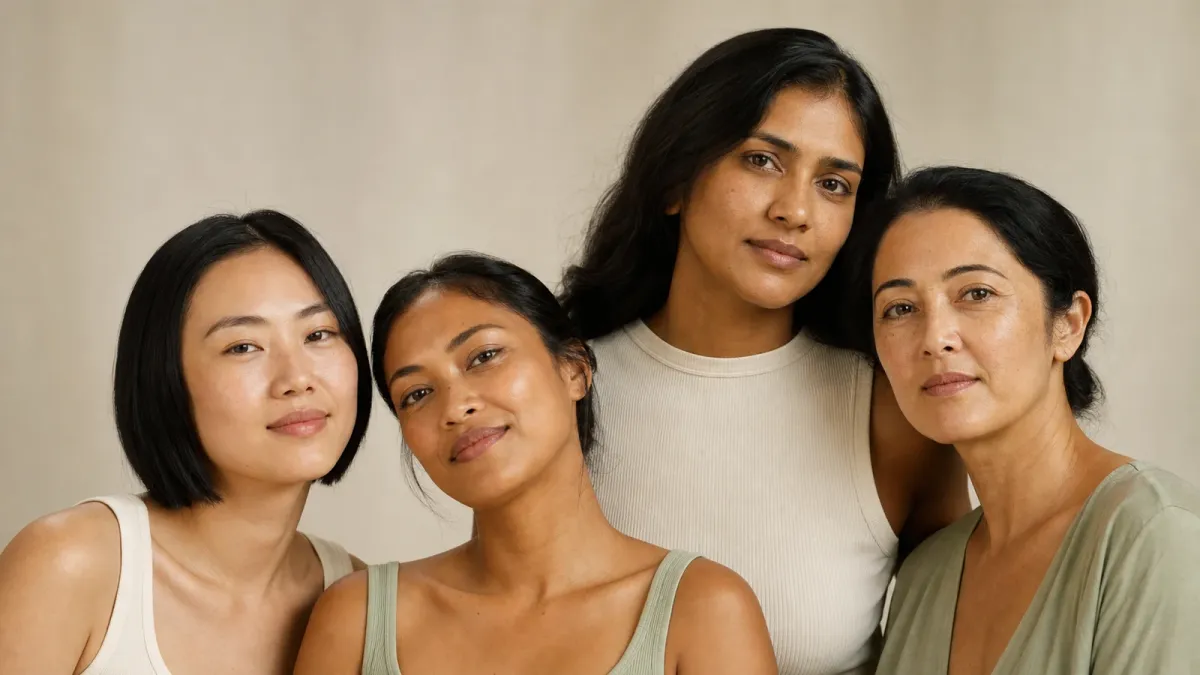
There is no single “Asian skin type.” Asian identity includes billions of people across East, Southeast, South, Central, and West Asia, with skin tones from very light to deep and every combination of oily, dry, acne-prone, and sensitive skin. Build a routine from your actual concern: gentle cleanser, one targeted treatment if needed, moisturizer, and broad-spectrum SPF 30 or higher every morning. Post-inflammatory dark marks can be especially noticeable in more melanated skin, but ethnicity alone cannot tell you which cleanser, active, or sunscreen will work.
- Start with skin behavior: oiliness, dryness, sensitivity, acne, and pigment response matter more than an ethnic label.
- Keep the base simple: cleanser, moisturizer, and sunscreen; add one concern-specific treatment at a time.
- Prevent dark marks: control the acne or irritation causing them and use consistent sun protection.
- K-beauty is not an ethnicity prescription: its gentle, hydrating principles can suit anyone; ten steps are optional.
- Avoid colorism and unsafe lighteners: aim to treat a defined pigment concern, not change your natural skin tone.
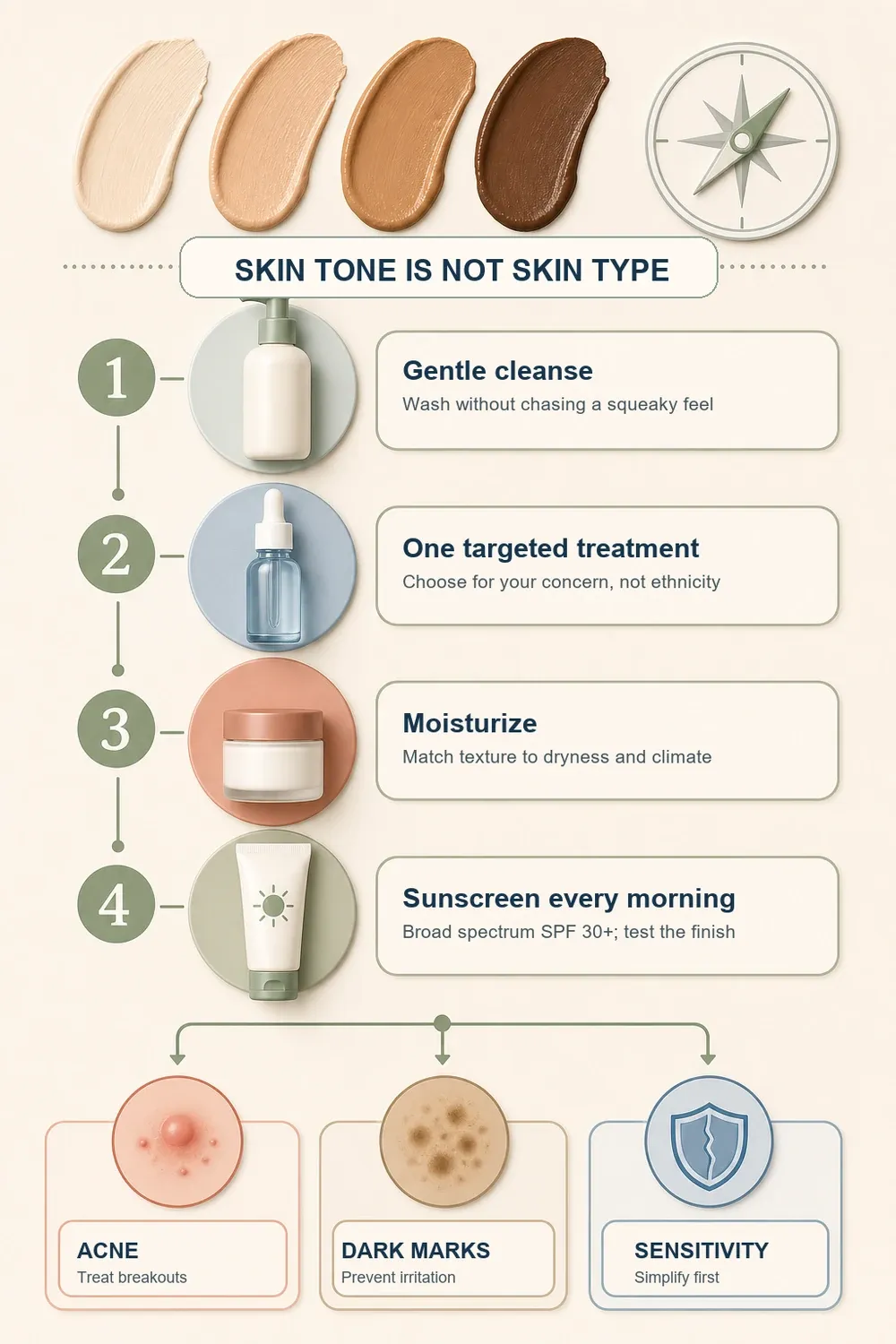
Searching for skincare for Asian skin often produces two unhelpful extremes. One side promises a universal glass-skin routine built from ten products. The other lists biological traits as though someone from Seoul, Mumbai, Manila, Almaty, and Beirut must have the same skin. Both flatten a huge population into a marketing category.
A more useful guide can acknowledge population-level research without turning averages into personal diagnoses. Some pigment concerns are reported more often or are more visible in certain skin tones. Treatment reactions can also leave longer-lasting marks in more melanated skin. But your climate, age, hormones, medications, eczema history, acne pattern, product use, and individual skin tone remain more actionable than ethnicity alone.
If you are building from zero, our AM and PM routine guide gives the universal foundation. The sections below explain where skin tone and pigment response may change the details—and where they should not.
Why “Asian Skin” Is Not One Skin Type
Skin type describes how your skin behaves: oily, dry, combination, balanced, acne-prone, or sensitive. Skin tone describes color and pigment. Ethnicity describes culture, ancestry, and identity. These categories can overlap in research, but they are not interchangeable.
Two siblings can have different sebum levels and sensitivity. Someone with light East Asian skin can develop prominent post-acne marks; someone with deep South Asian skin may be dry and eczema-prone; someone from West Asia may have rosacea-like flushing, melasma, or neither. Even Fitzpatrick phototype—a scale based mainly on burning and tanning response—does not capture every feature of skin tone or ethnicity.
Use the term “Asian skin” as the start of a question, not the answer. A useful consultation or self-assessment asks:
- Does skin feel tight, flaky, greasy, or comfortable after cleansing?
- Are the main lesions clogged pores, inflamed pimples, an itchy rash, or flat dark marks?
- Does a new product cause immediate sting, delayed itch, or no reaction?
- Do marks remain after acne, insect bites, eczema, or procedures?
- Which climate, indoor heating, humidity, and UV exposure affect the routine?
Those answers lead to better choices than a product labeled “for Asian skin.” If products frequently sting, use our sensitive-skin routine. If the face is shiny but comfortable, a lightweight gel moisturizer may fit. If it is flaky and tight, compare moisturizers for dry skin.
Skin Concerns Often Discussed in Asian Populations
Population reviews describe acne, post-inflammatory hyperpigmentation, melasma, lentigines, and other pigment disorders among concerns seen in Asian patients. But prevalence and presentation vary by region, age, sex, skin tone, environment, and study design. The practical lesson is not “all Asian people have pigment problems.” It is that preventing unnecessary inflammation matters when your skin tends to leave persistent marks.
| What you see | Possible category | First useful move |
|---|---|---|
| Flat brown or gray marks after pimples | Post-inflammatory hyperpigmentation | Control acne, use sunscreen, avoid picking, add one pigment-safe active |
| Symmetrical patches on cheeks, forehead, or upper lip | Possible melasma | Daily UV and visible-light protection; seek diagnosis before aggressive treatment |
| Blackheads, whiteheads, inflamed pimples | Acne | Choose an acne treatment plan; do not scrub marks away |
| Burning, scaling, or widespread itch | Irritation, eczema, or another rash | Stop new actives and get medical advice if persistent or severe |
| New, changing, bleeding, or non-healing spot | Needs professional assessment | Do not assume it is harmless pigmentation; arrange a skin examination |
Diagnosis matters because the same “dark spot” description can refer to post-acne marks, melasma, a medication reaction, a birthmark, or a skin lesion that needs medical evaluation. Cosmetic brightening serums cannot safely substitute for that distinction.
A Simple Skincare Routine That Adapts to Your Concern
The routine below is deliberately shorter than the classic ten-step chart. More products do not create more accuracy. Start with the base for two to four weeks, then add one treatment only if you can name the problem it should address.
Morning: protect rather than over-treat
- Cleanse lightly. Use a gentle cleanser, or rinse with water if dry skin does not need a full morning cleanse.
- Add one treatment only if useful. A tolerated vitamin C, niacinamide, or azelaic-acid product may fit a pigment or acne goal; it is not mandatory.
- Moisturize. Use a gel for humid, oilier skin or a lotion/cream for dry skin. Texture can change with the season.
- Apply sunscreen. Use broad-spectrum SPF 30 or higher, enough to cover exposed skin, and reapply according to the label when outdoors.
Sunscreen finish is personal. A mineral formula may leave visible residue on some skin tones; a chemical or hybrid formula may be more transparent but sting some eyes. Our mineral versus chemical sunscreen guide explains the tradeoff. For shade and cast comparisons, see tinted sunscreens and sunscreens tested for dark-skin usability.
Evening: remove, treat, moisturize
- Remove sunscreen and makeup. Use one effective cleanser or a first cleanse followed by a gentle water-based cleanser.
- Apply one targeted treatment. Choose acne, pigment, retinoid, or hydration support—not all at once.
- Moisturize. Apply enough to leave skin comfortable, not coated or tight.
Introduce treatments slowly. Retinoids, exfoliating acids, benzoyl peroxide, and strong vitamin C can all be useful, but combining them too fast may create irritation and the very dark marks you hoped to prevent. Follow our slow skincare method, especially if previous routines caused burning or peeling.
| Main concern | One treatment direction | Avoid at the start |
|---|---|---|
| Clogged pores | Salicylic acid a few times weekly if tolerated | Daily acid toner plus acid serum plus scrub |
| Inflamed acne | Benzoyl peroxide or a retinoid plan; seek care if painful or scarring | Picking and harsh drying cleansers |
| Post-acne dark marks | Sunscreen plus azelaic acid, niacinamide, or another well-tolerated option | Trying to peel the mark off quickly |
| Dryness and sensitivity | Fragrance-free moisturizer and fewer actives | Essential oils, scrubs, and frequent product changes |
Dark Marks, Melasma, and the Irritation–Pigment Cycle
Post-inflammatory hyperpigmentation is excess pigment left after inflammation. A pimple, eczema patch, insect bite, burn, or cosmetic procedure can trigger it. The mark is not active acne, and scrubbing it does not remove pigment safely. Aggressive exfoliation can restart inflammation and make the area darker.
The American Academy of Dermatology's guide to fading dark spots in darker skin tones begins with sunscreen and recommends tinted sunscreen with iron oxide for protection that includes visible light. A tint must still match your complexion well enough that you will apply the proper amount. One beige tint is not “universal.”
Control the source first. Treat acne before buying three spot correctors. Identify and stop a fragranced or exfoliating product causing dermatitis. Use a clinician-confirmed plan for melasma, which can relapse and may need prescription treatment. The goal is even, healthy-looking skin at your natural tone—not bleaching.
Peels, Lasers, and Devices: Experience With Your Skin Tone Matters
Chemical peels, lasers, and energy devices are not automatically off-limits for more melanated skin. But the settings, device, diagnosis, pretreatment, and aftercare matter because injury can provoke hyperpigmentation or hypopigmentation. A bargain treatment performed without appropriate training can create a longer problem than the one it was meant to solve.
DermNet's overview of laser therapy in skin of colour explains why pigment change is an important risk. Choose a board-certified dermatologist or appropriately qualified clinician who regularly treats your skin tone and your specific condition. Ask to see outcomes in comparable skin tones, discuss test spots, and follow pre- and post-procedure sun protection.
At-home LED masks and beauty devices do not replace diagnosis. A device can also add complexity to a routine already overloaded with actives. If the skin barrier stings or peels, use our skin barrier recovery guide before adding more stimulation.
K-Beauty Principles Without the Ten-Step Myth
K-beauty describes a beauty industry and set of product traditions, not a biologically required routine for Asian people. Korean products can suit any ethnicity, and an Asian person can use products made anywhere. Country of origin does not predict tolerance.
The useful K-beauty principles are gentleness, hydration, enjoyable textures, consistent sunscreen, and targeted layering. Cleveland Clinic's dermatologist overview of Korean skincare likewise focuses on being gentle, hydrating, and finishing with sunscreen rather than demanding ten products.
Double cleansing is useful when one cleanser does not remove water-resistant sunscreen or makeup. Essence is useful when you enjoy a light hydration layer. An ampoule is useful when its formula fills a real gap; our ampoule guide explains why it is not automatically stronger than serum. Sheet masks and sleeping packs are optional experiences, not missing nutrients.
Three Neutral Starter Examples—Not “Asian Skin Products”
These examples show the three base jobs: cleanse, moisturize, and protect. They are not selected because of ethnicity and will not suit everyone. We checked current official U.S. pages in July 2026. Always verify your package because formulas and sunscreen shades change.
Vanicream Gentle Facial Cleanser
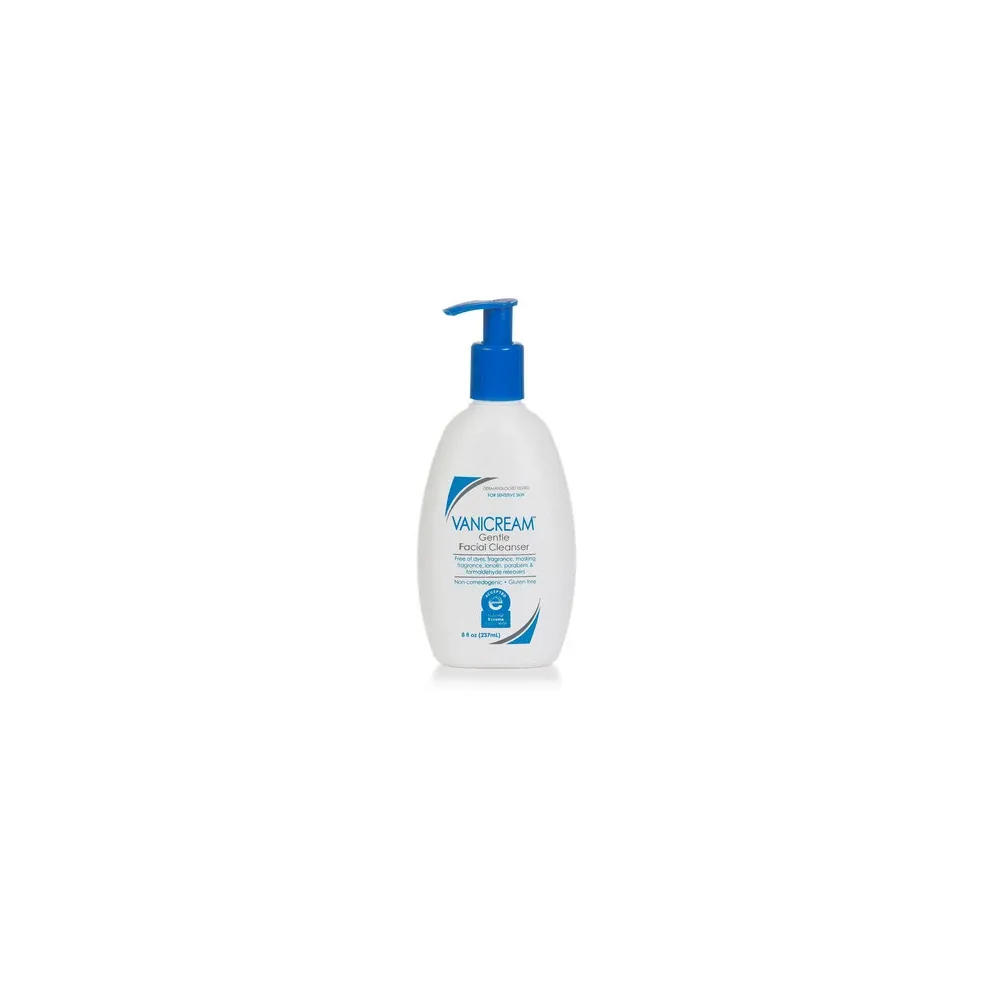
Vanicream's current soap-free cleanser uses a short surfactant system without botanical extracts or essential oils. It is a practical baseline when fragrance, heavy exfoliation, or a complicated cleanser makes skin feel tight. A gentle cleanser cannot treat acne alone, but it leaves room for a separate treatment.
Best fit: normal-to-dry or sensitive routines. Watch-out: heavy makeup or water-resistant sunscreen may need a first cleanse. Review the current Vanicream formula.
Check Vanicream Gentle Cleanser on AmazonCeraVe Daily Moisturizing Lotion
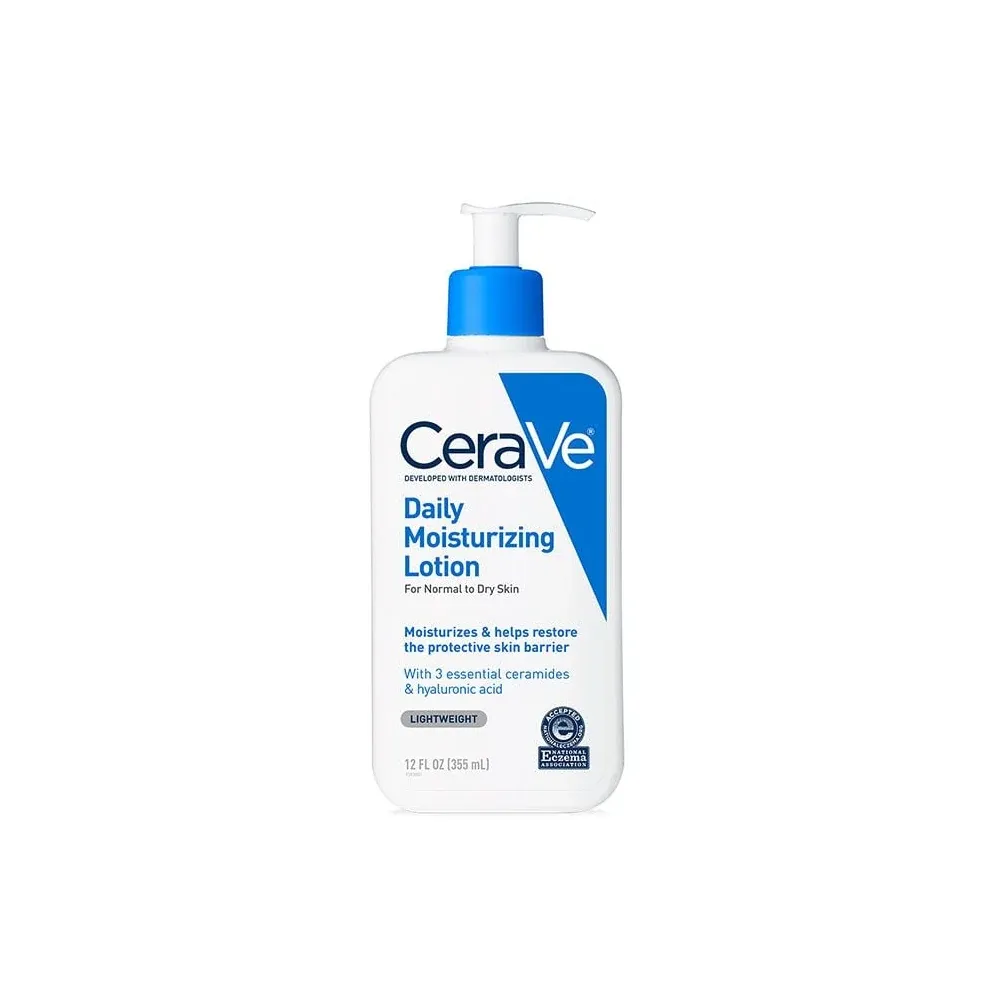
The current fragrance-free face-and-body lotion combines glycerin, emollients, dimethicone, ceramides, cholesterol, and hyaluronic acid in a lightweight base. It illustrates that moisturizer choice depends on dryness and texture preference, not ethnic identity. Very oily skin may prefer a gel; very dry skin may need a richer cream.
Best fit: normal-to-dry skin wanting a straightforward lotion. Watch-out: it may feel too rich or too light depending on climate and skin type. See the current CeraVe ingredients.
Check CeraVe Daily Lotion on AmazonEltaMD UV Clear Broad-Spectrum SPF 46
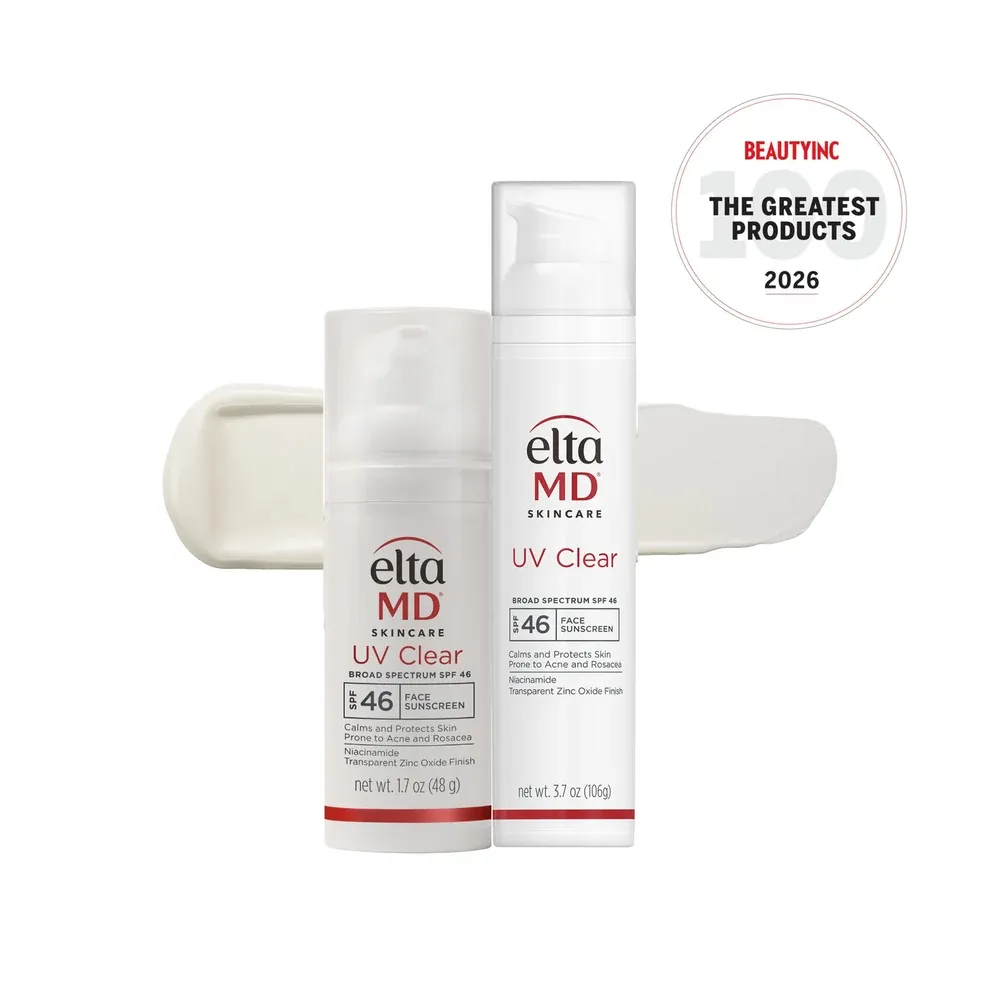
EltaMD UV Clear is a fragrance-free hybrid face sunscreen with zinc oxide, octinoxate, and 5% niacinamide. The current range includes untinted and tinted variants. It is a useful example for acne-prone or discoloration-focused routines, but no sunscreen finish or tint is invisible on every complexion.
Best fit: someone wanting a lightweight daily face sunscreen with tint choices. Watch-out: it is not water resistant, can still leave residue, and the correct variant must match your needs. Check the current EltaMD options and Drug Facts.
Check EltaMD UV Clear SPF 46 on AmazonAs an Amazon Associate, we earn from qualifying purchases. Prices, sellers, packaging, formulas, and sunscreen shades can change; verify the current label and buy from a source you trust.
Skin Cancer Is Possible in Every Skin Tone
More melanin can provide some natural UV protection, but it does not make anyone immune to skin cancer. The AAD's guide to finding skin cancer in darker skin tones notes that suspicious changes may appear on sun-exposed skin or less obvious sites such as palms, soles, and nails.
See a dermatologist for a new or changing spot, a growth that bleeds or itches, a sore that does not heal, or a new nail streak—especially when it changes. Do not diagnose a persistent spot as “just hyperpigmentation” from a photo or an ethnicity-based checklist. Sunscreen, shade, clothing, and self-awareness complement rather than replace professional examination.
Frequently Asked Questions About Skincare for Asian Skin
Is Asian skin more sensitive?
Not universally. Some studies report average barrier or reactivity differences in specific East Asian groups, but research categories and methods are inconsistent and data for many Asian populations are limited. Your own reaction history is more useful. If products often sting, choose fragrance-free formulas and introduce one change at a time.
What is the best skincare routine for Asian skin?
The best starting routine is the same four-step framework used across skin tones: gentle cleanser, one treatment only if needed, moisturizer, and broad-spectrum SPF 30 or higher every morning. Adjust texture and active ingredient to dryness, acne, sensitivity, or pigment concerns rather than ethnicity.
Why do acne marks last so long on some Asian skin tones?
Inflammation can stimulate excess melanin and leave post-inflammatory hyperpigmentation, particularly when skin is more melanated or prone to pigment change. Picking, sun exposure, and irritating products can prolong it. Treat the acne, prevent new inflammation, use sunscreen, and introduce pigment treatments gradually.
Do Asian people need a ten-step Korean skincare routine?
No. K-beauty is an industry and philosophy, not an ethnic requirement. Gentle cleansing, hydration, targeted layers, and sunscreen are useful principles, but cleanser, moisturizer, sunscreen, and one treatment can be enough. Extra toner, essence, ampoule, mask, and sleeping pack steps are optional.
Is mineral or chemical sunscreen better for Asian skin?
Neither category is automatically better. Mineral sunscreens may leave a visible cast on some tones; chemical or hybrid formulas may be more transparent but can sting some users. Choose broad-spectrum SPF 30 or higher that you can apply generously. A well-matched tinted sunscreen can add visible-light protection for pigment concerns.
Bottom Line
There is no universal Asian skincare routine because there is no universal Asian skin. Use population research as context, then build from the person in front of the mirror: their dryness, oiliness, sensitivity, acne pattern, pigment response, climate, and goals.
A short, comfortable routine is not less sophisticated than ten steps. Gentle cleansing, moisturizer, sunscreen, and one well-chosen treatment give you fewer irritation triggers and clearer feedback. That is especially valuable when inflammation tends to leave persistent dark marks.
This content is for educational purposes only and is not a substitute for professional medical advice, diagnosis, or treatment. Always seek the advice of a qualified healthcare provider with questions about a medical condition.