What Is a Skincare Ampoule? How and When to Use It
A formula-first guide to skincare ampoules: what they are, where they go, how often to use them, and when a serum already does the job.
In this guide
A skincare ampoule is a leave-on treatment name most closely associated with Korean beauty. It usually sits in the same routine category as a serum, but “ampoule” is not a standardized promise that a formula is stronger, purer, or more effective. Use the exact ingredient list and label directions—not the category name—to decide. Apply a few drops after cleansing and optional toner, before moisturizer, and finish with sunscreen in the morning. If you also use a serum, layer the thinner formula first or choose only one treatment step.
K-beauty is not an ethnic requirement. Our skincare guide for Asian skin tones keeps the useful gentle-hydration principles while rejecting the idea that every Asian person needs ten steps.
- Ampoule versus serum: often a branding distinction, not a regulated difference in concentration.
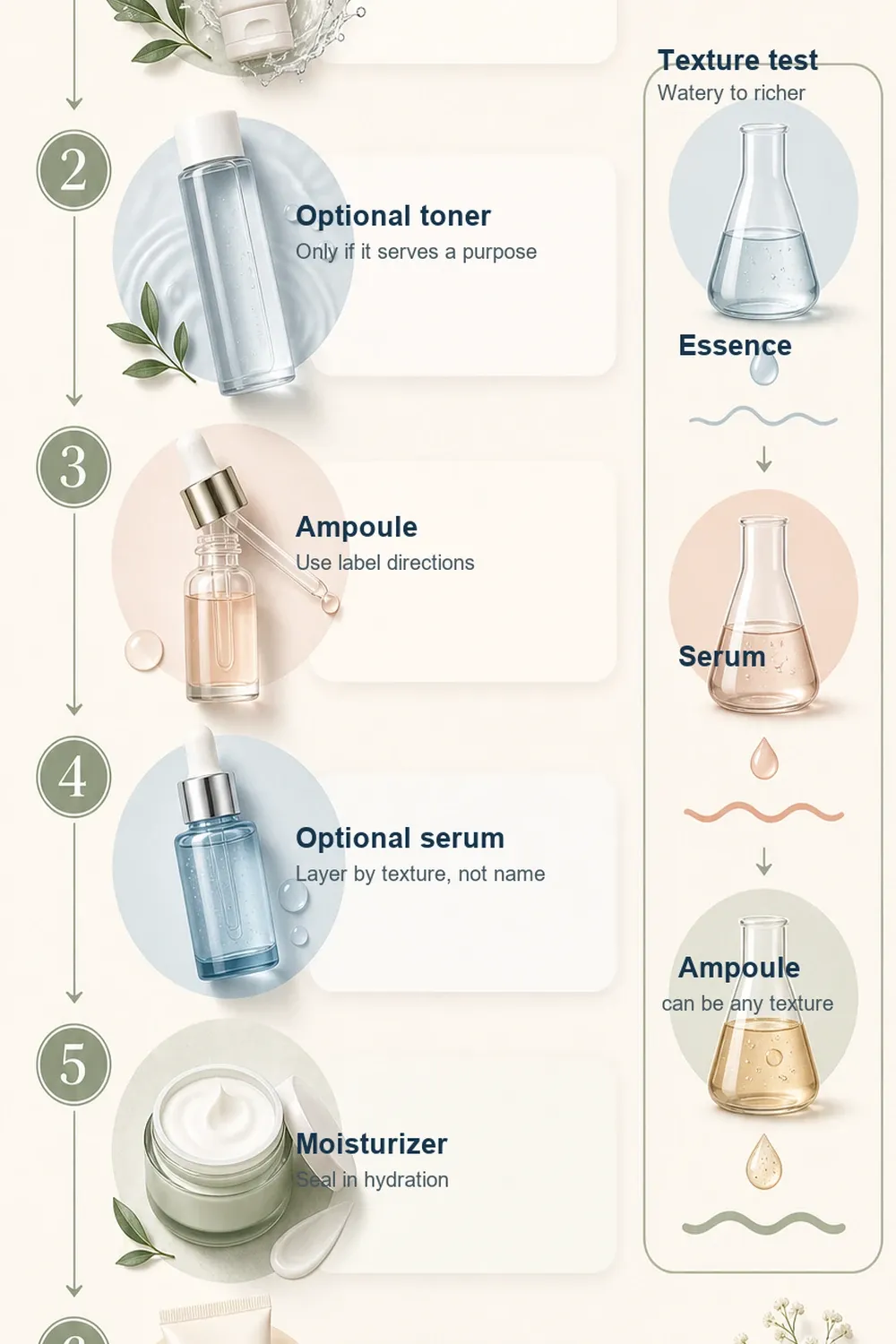
- Routine order: cleanse, optional toner, ampoule or serum, moisturizer, then sunscreen in the morning.
- Frequency: daily, weekly, or short-term only according to the formula and your tolerance.
- Best buying rule: choose by skin goal, complete formula, packaging, and directions—not by the word “ampoule.”
- Safest start: patch test, introduce one product at a time, and stop if persistent burning, swelling, or rash develops.
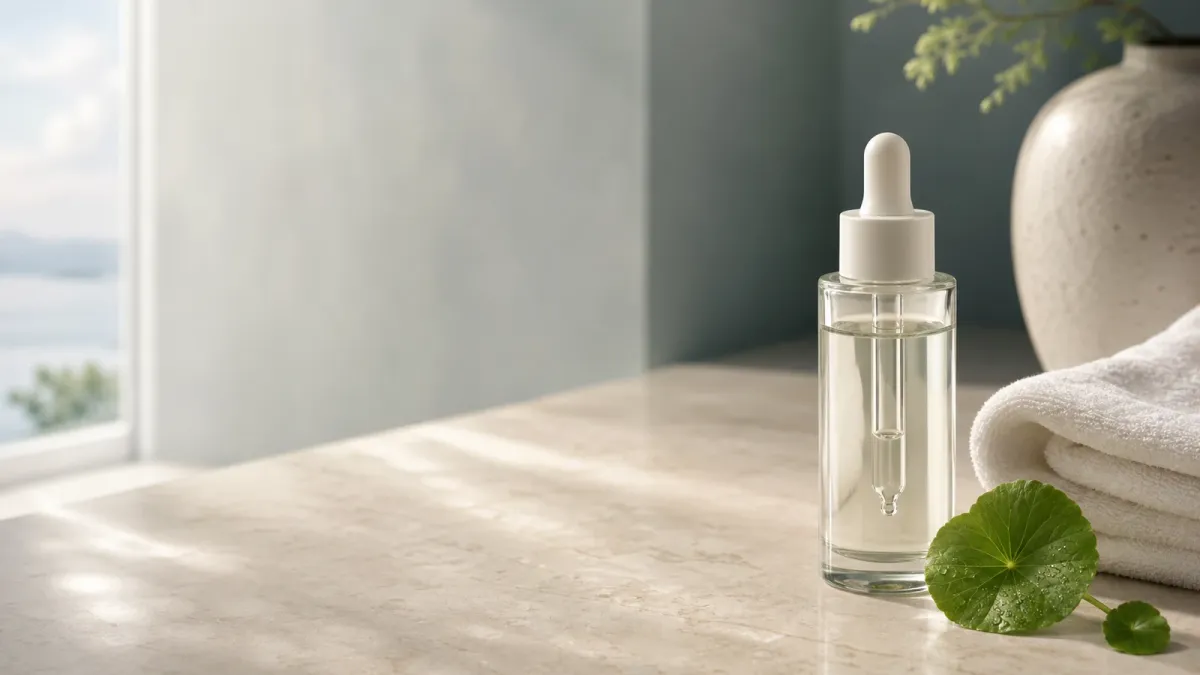
Ampoules can make a simple routine sound more complicated than it is. Some beauty guides call them “supercharged serums,” others reserve them for one-week rescue courses, and brands use the name on everything from watery centella liquids to rich fermented treatments. Those statements cannot all function as universal rules.
The useful question is not whether an ampoule is automatically better than a serum. It is whether the particular formula adds something your routine needs without duplicating actives or increasing irritation. This guide replaces the old category hype with a practical way to read the bottle, place it in your routine, and decide whether you need one at all.
If your routine is already crowded, start with our AM and PM skincare routine and the case for starting skincare slowly. An ampoule is optional. Cleanser, moisturizer, and morning sunscreen remain the foundation.
What Is an Ampoule in Skincare?
In modern skincare, an ampoule is a leave-on liquid or gel treatment marketed to address a specific cosmetic goal such as hydration, visible redness, dullness, uneven tone, or the appearance of fine lines. The category became widely familiar through Korean skincare, although European salon brands also use small single-dose glass ampoules.
The same word now describes two different packaging ideas. One is the breakable or sealed single-dose vial historically associated with an ampoule. The other is a conventional multi-use dropper bottle whose contents are used like a serum. A glass vial can help limit repeated air exposure when it truly contains one dose, but it does not make cosmetic contents sterile, pharmaceutical, or medically effective.
Nor does the name guarantee higher concentration. A watery centella ampoule may be designed mainly for soothing hydration, while a product sold as a serum may contain a precisely disclosed percentage of retinol or vitamin C. Compare the full formula, active level when the brand discloses it, package stability, and directions. The bottle's category is secondary.
| Label | What it often suggests | What it does not guarantee |
|---|---|---|
| Essence | Light hydration or a first treatment layer | Always thinner, gentler, or less active than serum |
| Serum | Targeted leave-on treatment in a fluid base | A standard strength, texture, or clinical result |
| Ampoule | Focused treatment, often in K-beauty positioning | Higher concentration, faster results, or short-course use |
| Booster | Product marketed to add to or precede another step | Compatibility with every cream, serum, or active |
Ampoule vs Serum vs Essence: The Real Difference
There is no dependable industry-wide concentration ladder in which essence is always weakest, serum is medium, and ampoule is strongest. Brands define these names for their own ranges. Within one brand, an ampoule may indeed be positioned as the more concentrated treatment. Across different brands, that comparison falls apart.
Texture also varies. COSRX's propolis ampoule is a viscous humectant-rich formula, while SKIN1004's centella ampoule is very watery. MISSHA describes its Night Repair Ampoule as a nourishing serum. These current examples show why the name cannot determine routine order by itself.
Use this decision rule: if two products target the same concern with similar supporting ingredients, you probably do not need both. A hydrating ampoule plus a hydrating serum may feel elegant, but a suitable moisturizer could give you the same practical result with less layering. If the formulas serve different goals, check whether their actives are compatible and whether your skin tolerates both.
| Question | Better evidence | Weak shortcut |
|---|---|---|
| Will it target my concern? | Relevant ingredients, disclosed percentages, realistic claims | “Ampoule” printed in large type |
| Where does it go? | Brand directions and thin-to-thick texture | A universal ten-step chart |
| How often can I use it? | Label frequency and your tolerance | Assuming all ampoules are short courses |
| Is it worth buying? | A distinct role your routine lacks | More steps must mean better skin |
When to Use an Ampoule in Your Skincare Routine
Most ampoules belong after cleansing and optional toner, before moisturizer. In a morning routine, sunscreen is last. In an evening routine, moisturizer is usually the final standard step. Follow prescription directions first if a clinician has given you a specific order.
- Cleanse. Remove sunscreen, makeup, oil, and debris without leaving the skin squeaky or tight.
- Use toner only if useful. Toner is optional. A hydrating toner can precede an ampoule; a strong exfoliating toner changes the irritation calculation.
- Apply the ampoule. Use the label amount—often a few drops—over the intended area. Patting is optional; gentle spreading is sufficient.
- Add a different serum only if needed. Use the thinner product first unless either label specifies otherwise.
- Moisturize. Choose a gel or cream that matches your skin's dryness and the season.
- Protect in the morning. Finish with broad-spectrum sunscreen and use the label amount.
For dry skin, an ampoule with glycerin or other humectants can go under one of our moisturizers for dry skin. Sensitive skin may prefer a short ingredient list followed by a pick from the fragrance-free sensitive-skin guide. Oily skin does not have to skip hydration; a thin ampoule under a gel moisturizer may feel lighter than stacking several rich treatments.
Do not mix a few drops into another product unless the manufacturer explicitly tells you to. Mixing in your palm changes the dose and distribution of both products. This is especially unhelpful with sunscreen, prescription medication, retinoids, exfoliating acids, and low-pH vitamin C. Apply separate layers or simplify.
How Often Should You Use an Ampoule?
There is no universal schedule. A simple hydrating centella or propolis formula may be labeled for daily use. A strong exfoliating, retinoid, spicule, or peel-style ampoule may require limited evening use. A single-dose vial may be designed as a short course, while a 100-milliliter dropper bottle clearly anticipates repeated use.
Start once daily or less often than the label maximum, depending on the formula. If your skin is reactive, use it every other night for the first week. Keep the rest of the routine stable so you can identify a reaction. The American Academy of Dermatology recommends testing a new skincare product on a small area twice daily for seven to ten days before broad use; see its home product-testing instructions.
“Patch test” here means a cautious home use test, not the formal diagnostic patch testing performed by a dermatologist for contact allergy. A home test lowers surprise risk but cannot guarantee that your entire face will tolerate the product. Introduce only one new leave-on product at a time.
How to Choose an Ampoule by Skin Goal
For dehydration: look for glycerin, propanediol, beta-glucan, panthenol, sodium hyaluronate, or betaine, then seal with moisturizer. Humectants do not replace an emollient cream when skin is genuinely dry.
For visible redness or easily stressed skin: favor short, fragrance-free formulas and ingredients you already tolerate. Centella, panthenol, allantoin, and beta-glucan are common cosmetic choices, but botanicals can still cause reactions. “Soothing” is not a medical treatment for rosacea, eczema, or an unexplained rash.
For dullness or uneven-looking tone: niacinamide, stable vitamin C derivatives, alpha-arbutin, and licorice-derived ingredients appear in many ampoules. Do not stack several brightening products immediately. If vitamin C is your main goal, compare disclosed formulas in our vitamin C serum guide.
For fine lines: hydration can temporarily soften their appearance, but it is not the same as structural reversal. Retinoids have a different evidence base and a different irritation profile. An “anti-aging ampoule” may simply be a hydrating serum with ferments, peptides, or botanical extracts. Read the claim precisely.
For acne-prone skin: choose a non-oily texture if that is your preference, but do not assume “non-comedogenic” guarantees zero breakouts. Avoid adding an ampoule during an active irritation flare. Persistent or scarring acne needs a treatment plan, not a longer cosmetic routine.
Three Current Ampoule Examples, Explained Honestly
These are examples of three distinct formula types, not a universal “best ampoules” ranking. We checked current official U.S. pages and ingredient lists in July 2026. Formulas, packaging, and availability can change, so verify the product page and your box before use.
SKIN1004 Madagascar Centella Ampoule
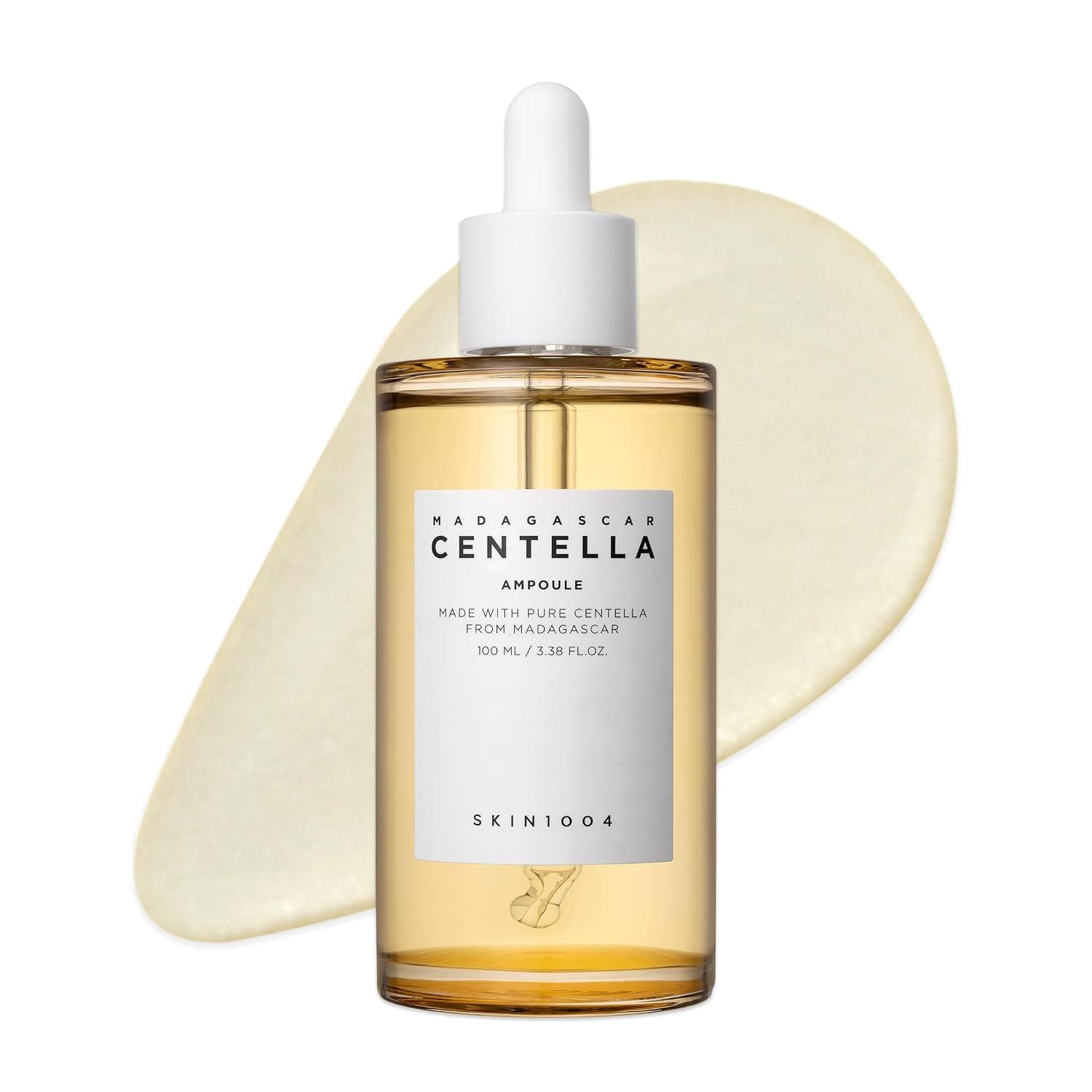
The current formula is short: water, glycerin, butylene glycol, centella asiatica extract, and supporting texture and preservation ingredients. It is a watery hydrating treatment rather than proof that every ampoule contains an aggressive active concentration. That makes it the clearest example for someone who wants a low-complexity layer.
The brand positions it for hydration and soothing visible redness, but it does not disclose a clinical treatment role. Even a short botanical formula can irritate an individual user. Review the current SKIN1004 ingredients.
Best fit: a watery hydrating step under moisturizer. Watch-out: it may be redundant if your serum and moisturizer already hydrate well.
COSRX Full Fit Propolis Light Ampoule
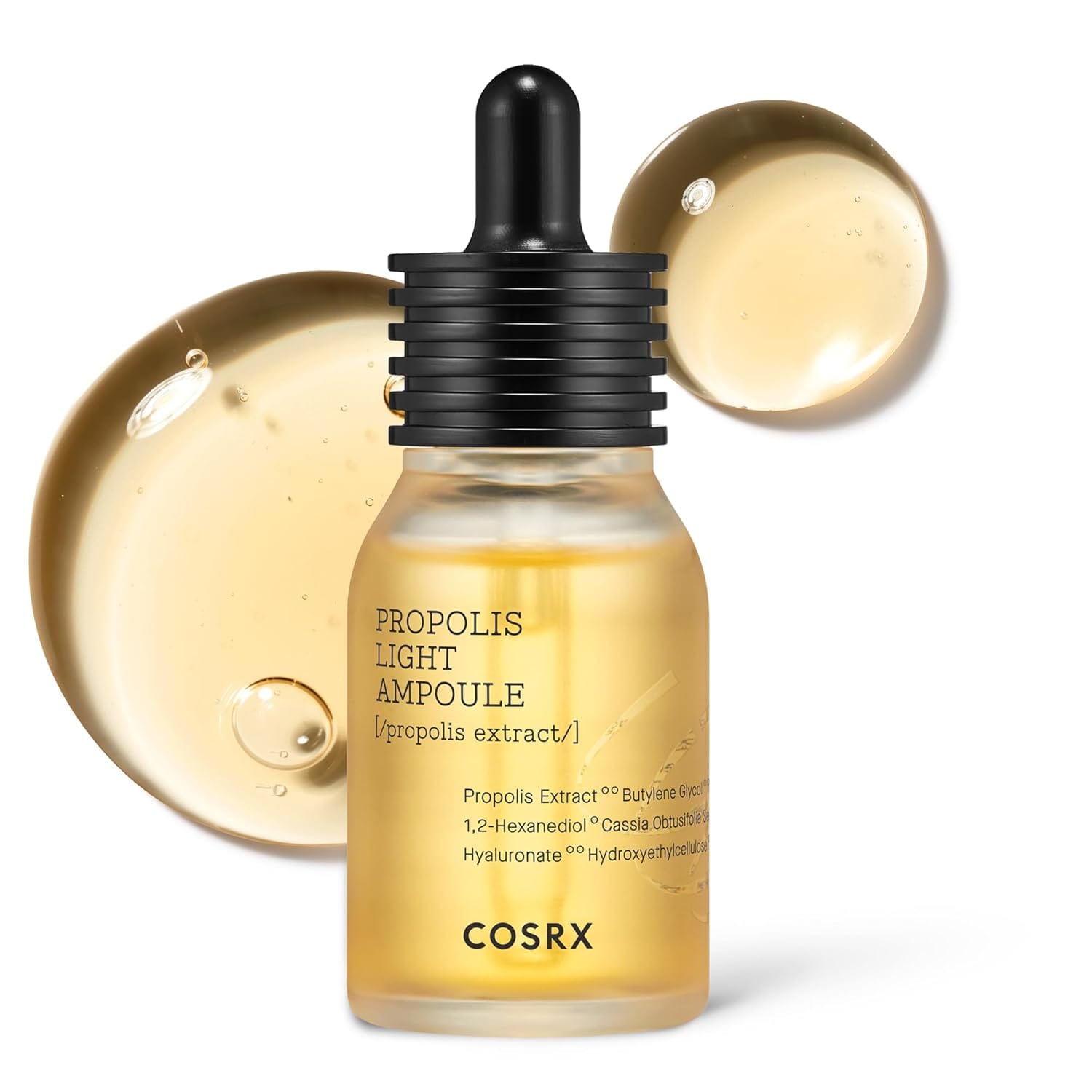
COSRX lists 83.3% propolis extract plus butylene glycol, glycerin, betaine, sodium hyaluronate, panthenol, and a compact support system. The texture is richer than the SKIN1004 example, demonstrating why thin-to-thick order works better than a category chart. The brand directs users to apply it after cleansing and toning and before moisturizer.
Propolis is bee-derived. Avoid it if you know you react to propolis or related bee products, and patch test even if you do not. “Reduces redness” is a cosmetic brand claim, not a diagnosis or treatment for inflammatory skin disease. See the current COSRX formula and directions.
Best fit: dehydrated skin that likes a cushiony, glow-focused layer. Watch-out: bee-product sensitivity and potential redundancy with another humectant serum.
MISSHA Time Revolution Night Repair Ampoule 5X
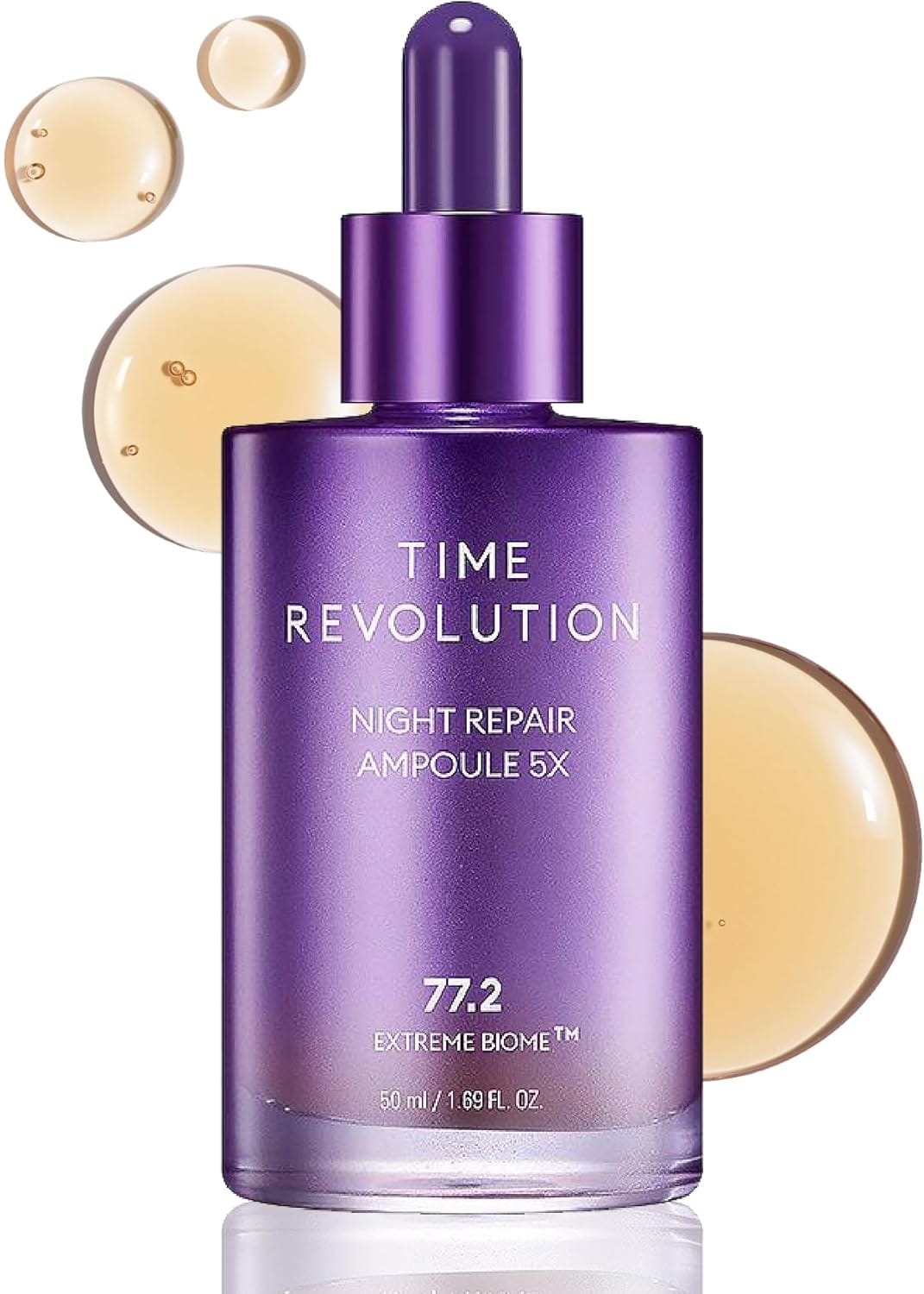
MISSHA's current 5X formula is the opposite of the minimalist example. It combines bifida and multiple ferments with humectants, niacinamide, squalane, panthenol, ceramide, cholesterol, botanical extracts, and several fragrant essential oils. The brand calls it both an ampoule and a nourishing serum, which neatly illustrates the category overlap.
The complex formula offers more potential roles but also more variables if skin reacts. Lavender, bergamot, orange, geranium, chamomile, and sandalwood oils make it a poor first choice for fragrance-sensitive skin. Treat the brand's overnight firming and radiance claims as marketing evidence unless you review the underlying study. Check the current MISSHA ingredients.
Best fit: fragrance-tolerant users who want a richer fermented night treatment. Watch-out: long ingredient list, fragrant oils, and easy duplication with other niacinamide or ferment products.
As an Amazon Associate, we earn from qualifying purchases. Prices, sellers, packaging, and formulas can change; verify the current label and buy from a source you trust.
Common Ampoule Mistakes
- Assuming concentrated means better. A stronger active can be more irritating and is useful only at an appropriate dose.
- Layering every treatment. Ampoule, serum, booster, retinoid, and exfoliating toner in one night create more variables than benefits.
- Following texture rules over label rules. Thin-to-thick is a fallback. A prescription or manufacturer direction takes priority.
- Dropping the pipette onto skin. Avoid touching the dropper to your face; it can transfer oil and microbes back to the bottle.
- Using damaged single-dose vials. Do not use cracked packaging, and protect fingers when opening a glass ampoule according to its instructions.
- Expecting an ampoule to repair every flare. Burning, persistent rash, cystic acne, or suspected dermatitis needs diagnosis, not more cosmetic layers.
If too many actives have already made your routine sting, pause the ampoule and use the framework in our skin barrier damage guide. A simpler routine can tell you more than adding another “soothing” bottle on top of the problem.
Frequently Asked Questions About Skincare Ampoules
Do you use an ampoule before or after serum?
Use brand directions first. If neither label specifies an order, apply the thinner product first and the richer one second, then moisturizer. You may not need both. When the ampoule and serum target the same concern, choosing one treatment reduces duplication and makes reactions easier to identify.
Can I use a skincare ampoule every day?
Some hydrating ampoules are designed for daily use; stronger exfoliating, retinoid, spicule, or peel-style formulas may not be. Follow the exact label and start below the maximum frequency if your skin is sensitive. The word “ampoule” alone does not determine a safe schedule.
Is an ampoule better than a serum?
No category is automatically better. Ampoule and serum are overlapping cosmetic marketing terms. Compare the formula, disclosed active levels, packaging, directions, tolerability, and whether it fills a real gap in your routine. A well-formulated serum can be more targeted than an ampoule, and vice versa.
Can I use an ampoule without toner?
Yes. Toner is optional. Apply the ampoule to clean skin as directed, then use moisturizer. A toner can add hydration or an active ingredient, but it is not required for absorption. Skipping an unnecessary toner often makes a routine cheaper and easier to troubleshoot.
How many drops of ampoule should I use?
Use the label amount because droppers and formulas vary. For many multi-use face ampoules, two to four drops are enough to spread a thin layer, but a single-dose vial may contain a different amount. More product does not guarantee better results and may increase pilling or irritation.
Bottom Line
A skincare ampoule is best understood as an optional targeted treatment, not a guaranteed step above serum. Put it after cleansing and optional toner, before moisturizer, and finish with sunscreen in the morning. Let the actual formula decide order and frequency.
The most useful ampoule is the one that fills one clear gap and remains comfortable with consistent use. If it duplicates a serum, overwhelms your barrier, or relies on a category name instead of transparent information, you can skip it without leaving your routine incomplete.
This content is for educational purposes only and is not a substitute for professional medical advice, diagnosis, or treatment. Always seek the advice of a qualified healthcare provider with questions about a medical condition.