Does Skin Get Used to Products? Why Results Can Plateau
A skincare plateau is usually not immunity. Check goals, timeline, consistency, skin changes, product condition and diagnosis before switching.

In this guide

Quick answer: does skin get used to products?
A skincare plateau alone does not show that your skin has become immune to a product. First separate a stable result from actual worsening, and reduced irritation from a change in the outcome you wanted.
Stable skin also cannot tell you which bottle deserves the credit. Check what changed before replacing a whole routine, and treat a new reaction as a separate problem.
Quick Summary
- Name the change: less dramatic improvement, a returning problem or a new reaction?
- Check the exact product: name, directions, formula version and condition.
- Compare fairly: use the same observation rather than chasing a fresh sensation.
- Keep questions specific: describe what changed when asking a clinician or brand.
When a product first seems helpful, the change is easy to notice. Later, the same routine may feel ordinary, leaving you wondering whether to buy something stronger or switch brands.
Start by finishing this sentence: "I expected this product to help with ___, and the change I can describe is ___." This makes the question more specific than whether your skin looks better overall.
Compare the answer with what you originally wanted. A cleanser chosen for comfortable washing deserves a different question from a prescription chosen to treat acne.
Your goal may have changed. If you now want an additional benefit, discuss that goal; it does not show that a product stopped doing its original job.
What does a skincare plateau actually describe?
A plateau describes a pattern you noticed: improvement appears to have flattened. It does not identify the cause, tell you which ingredient matters or establish what would happen if you stopped.
Describe what you noticed. "My routine feels less exciting" and "I have new painful breakouts" are different problems, even if both feel like the routine has stopped working.
| What you notice | What it does not establish | Useful next question |
|---|---|---|
| Less visible change after initial improvement | That skin became immune | Is the original outcome stable or worse? |
| Less sting or peeling | How much benefit the product provides | What happened to the intended outcome? |
| A problem has returned | Which product or circumstance caused it | What changed, and what needs review? |
| A new reaction | That continuing will produce improvement | What care is needed now? |
Maintenance can matter, but it needs context
In a 16-week maintenance trial, 253 people with severe acne had already improved by at least 50% after earlier treatment. They received adapalene gel 0.1% once daily or vehicle.
Keeping at least 50% improvement in lesion counts from the original baseline occurred in 75% of the adapalene group versus 54% with vehicle. This maintenance outcome among previous responders does not establish indefinite benefit for every cosmetic routine.
A separate trial of 204 people with moderate or severe facial photodamage compared tretinoin emollient cream 0.05% with vehicle for up to two years. Its benefits concern that formulation and population, not every retinol serum or a dose to copy.
For your own question, record whether the original concern is still controlled, unchanged or returning. If several products began together, the record cannot isolate one bottle's contribution.
Less irritation is a separate observation
The Galderma Differin gel 0.3% label says early redness, scaling, dryness and burning often lessen. This is a different concentration from the maintenance trial above.
Reduced irritation does not measure the intended benefit. Do not increase strength or frequency to recreate peeling; follow your own instructions and discuss tolerability problems with your prescriber.
Keep two descriptions: how application feels, and what happened to the original concern. One observation cannot answer both questions.
For an existing retinoid routine, our buffering explanation describes the term. It does not replace the directions for your medication or settle why your results changed.
Antibiotic resistance is a different question
The AAD's 2024 acne guidelines address antibiotic resistance by limiting antibiotic use when possible and combining topical or oral acne antibiotics with benzoyl peroxide. That concerns bacteria and clinical treatment, not skin becoming immune to a moisturizer.
Ask the prescriber about an antibiotic treatment that appears less helpful. This guide is not a reason to take prescription breaks, rotate medicines or add another treatment yourself.
Check for a reaction before running an audit
For a cosmetic that causes a reaction, AAD guidance advises washing it off and stopping use. Do not reapply a suspect product to complete a comparison; a home experiment cannot diagnose allergy.
Seek medical attention for a rash that is painful, spreading rapidly, blistering or accompanied by fever. Trouble breathing or swallowing, or swelling around the eyes or lips, needs immediate medical help.
Persistent acne, especially deep painful spots or scarring, deserves professional review. Our acne-prone cleanser guide addresses washing choices; a cleanser comparison cannot replace assessment of those concerns.
Describe a prescription reaction to the prescriber or pharmacist rather than adapting a cosmetic reset plan.
If pregnant or trying to conceive, discuss retinoids with an appropriate healthcare professional. The AAD's pregnancy guidance advises avoiding retinoids during pregnancy.
Keep our skin barrier guide for background. A symptom description does not establish barrier damage, purging or a specific allergy.
Review a skincare plateau
Six checks before replacing your routine
After addressing urgent problems, gather the information you already have. These checks help you prepare a decision; they do not set a waiting period or confirm that the existing routine suits you.
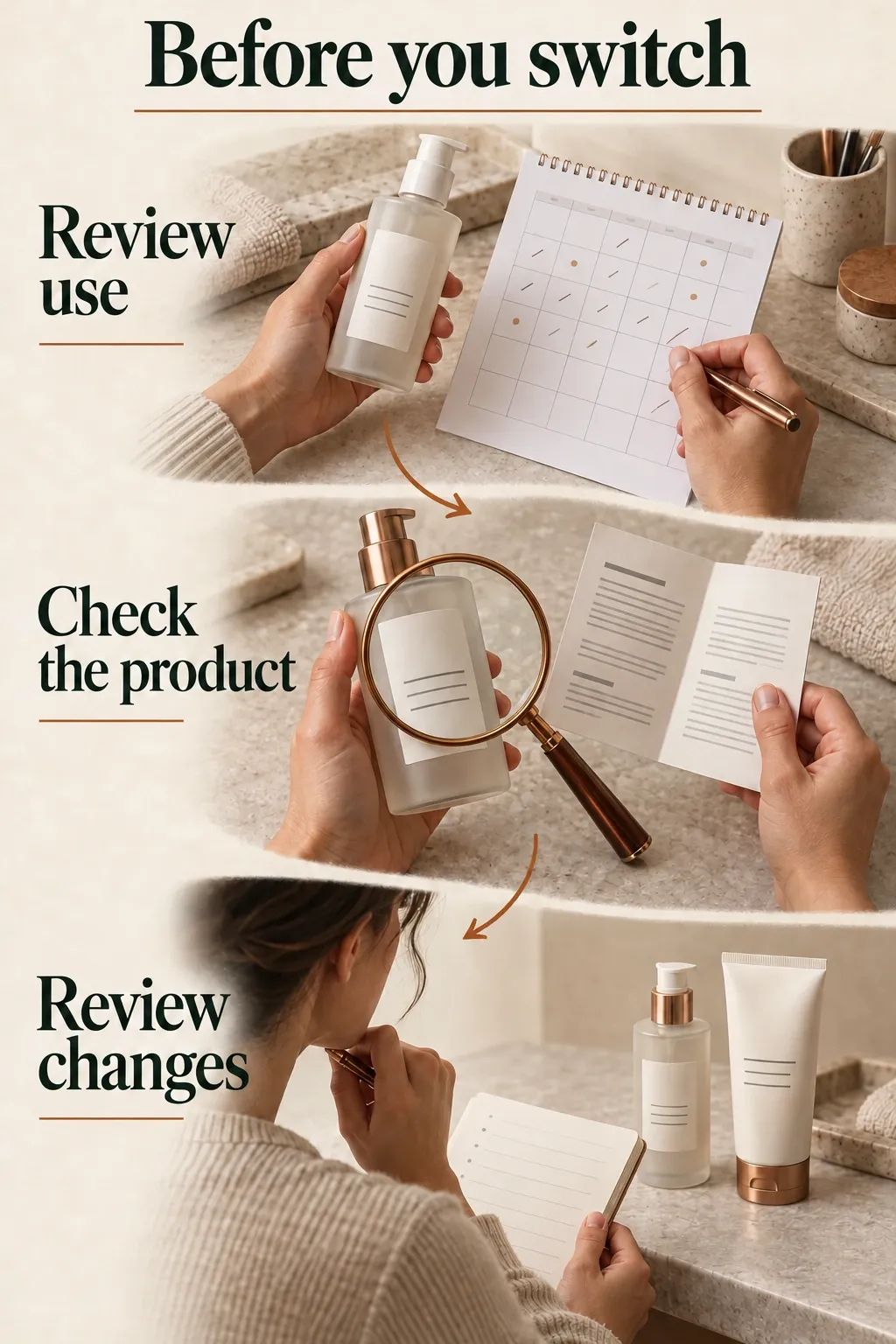
1. Revisit the product's actual role
Give each product one plain description: washing, moisturizing or an intended treatment. Put that description beside the concern you now want to address.
If a bottle has no clear role in your current routine, put that on the list. A vague promise on the packaging is hard to compare with a specific personal goal.
- Original goal: what prompted you to start?
- Current question: what specific observation now concerns you?
- Other products: which were introduced at the same time?
2. Compare your use with the directions
Write down actual use before proposing changes: product, application days and any missed applications. Compare this with the package or the instructions from your clinician.
Do not turn missing entries into a catch-up schedule. If instructions are unclear, ask what the intended routine should look like rather than guessing from another person's routine.
Include the order you actually use. Our moisturizer and serum layering guide addresses that separate question; recording the order does not establish why a result changed.
Our gradual-start guide covers introducing skincare. Starting cautiously and deliberately is a separate issue from needing periodic breaks to reset immunity.
3. Identify the exact bottle you are comparing
Keep a photograph of the front label and directions. Record whether the concern started with the same bottle, a replacement or a differently named version.
Ask the manufacturer whether your old and new versions differ, even if the packaging looks similar. Include the market and lot information if available.
The FDA notes that heat, light, air and moisture can affect cosmetics. Follow the actual storage and expiration directions; appearance alone cannot clear a suspect product for continued use.
Use the skincare storage guide to review the location and the expiration guide to read package marks. Neither a fridge nor a new date label proves an uncertain bottle is suitable again.
4. List what else changed
Write a short sequence of events: replacement bottle, new routine step, travel or a medication change. A sequence helps explain the question without proving that the newest event caused it.
For acne specifically, NIAMS describes hormonal and medication influences, along with factors such as humidity and friction that can worsen acne. These are possibilities to discuss, not explanations for every skincare plateau.
Include prescribed medicines in the list you share with the clinician. Do not stop another medicine because its start date appears close to a skin change.
5. Review the routine as a whole
The AAD's acne-care advice warns that frequent treatment switching and irritating products can complicate acne care. A new purchase every few days makes the question harder to investigate.
Put every current step in one list, including occasional products. Our guide to overdoing skincare can help you review that list without treating extra steps as automatic improvements.
If separate morning and evening bottles confuse the record, describe each one's role. The day and night moisturizer guide addresses that decision without requiring two products.
6. Agree on a useful review point
Ask what outcome should be reviewed, how to describe it and when your particular instructions call for reassessment. Keep that answer with the product record.
A review point is not permission to wait through a reaction. Record the question you need answered rather than choosing a generic calendar deadline for every bottle.
How long should you give a product?
Use a review window connected to the intended goal and exact instructions. The sources below illustrate different contexts; they do not create a universal skincare timetable.
| Context | Source guidance | Limit |
|---|---|---|
| Anti-aging products | AAD: most take at least six weeks, sometimes three months. | Not a guarantee for every formula. |
| Differin gel 0.3% | Label: reevaluate if no results after 12 weeks. | Exact medication label; follow your prescriber. |
| A new reaction | Use the care branch above. | No trial window overrides a reaction. |
The AAD's anti-aging guidance also stresses following directions and avoiding multiple irritating products. Cosmetic stinging is not a reason to assume greater benefit.
For a concern outside these examples, ask for guidance specific to that concern. Do not borrow an acne medication's checkpoint for a pigment serum or turn a study duration into your own treatment plan.
Make a fair comparison you can explain
Pick one description and keep it consistent. If you use photographs, choose similar lighting, position and framing; changing those between pictures adds another difference to interpret.
Record how application feels separately from the concern you wanted to address. Avoid filters, edits and invented symptom scores; the purpose is to describe what you noticed.

| Record item | Example entry | Question it prepares |
|---|---|---|
| Product identity | Exact name and photograph of directions | Am I asking about the correct version? |
| What changed | Replaced the bottle; date recorded | Did the formula or instructions change? |
| Observation | Description in my own words | Am I discussing comfort or the original goal? |
| Uncertainty | Cannot remember when this started | What information would help the review? |
Keep the record short enough to use regularly. Begin with the product identity, use, observations and questions; more spreadsheet columns will not make the conclusions more certain.
Prepare the right question for the right person
Ask the brand about formula identity or package directions. Ask a pharmacist or clinician about medication use, reactions and treatment goals.
You may need to ask about both a formula change and a skin reaction. A brand can clarify product details, but its customer-service answer cannot replace medical assessment.
I use [exact product] for [original goal], following [directions]. I noticed [observation] beginning around [date or uncertainty]. The routine changes I can identify are [brief list].
What should we review next? If this is a medication, when should its intended outcome be reassessed, and what symptoms should prompt earlier advice?
For a manufacturer, attach the label and ask a narrower question: "Are these two versions the same formula and directions?" Include both names rather than asking whether your skin became immune.
When changing the routine makes sense
Before replacing a bottle, name the reason: an unclear role, changed instructions, a new goal or advice following assessment. This gives you a specific question to resolve.
If your main concern is cost or complexity, say so. You can review those priorities without pretending the product failed or claiming that a simpler routine will produce a particular result.
- New goal: discuss the outcome you now want.
- Unclear instructions: ask before adjusting use.
- Changed version: establish the product identity.
- New symptoms: follow the appropriate care branch.
There is no reset schedule established by the evidence summarized here. A break taken to manage a reaction or under a prescriber's instructions serves a different purpose from a break claimed to prevent immunity.
Before the discussion, list what you would like to keep and what you find difficult. Mention practical problems, such as remembering applications, alongside your original goal.
Frequently asked questions about skincare plateaus
We reviewed discussions about routine switching, acid strength, stable versus worsening results and reordered products. These threads identify questions; medical guidance and label evidence support the answers.
Should I rotate skincare products every few months?
No mandatory rotation schedule follows from the evidence reviewed here. Base a change on a specific goal, product question or professional advice, rather than a calendar intended to reset skin immunity.
Should I use something stronger when results plateau?
A plateau alone does not justify increasing strength. Identify the intended outcome, review the exact directions and ask about the concern before escalating, especially with a prescription.
How can I tell maintenance from a product that stopped working?
Describe whether the original concern is stable or returning, using a consistent observation. A personal record cannot prove which product caused the result, particularly when several products started together.
Does less retinoid peeling mean it no longer works?
Less peeling describes a change in tolerability; it does not measure effectiveness. The checked Differin label describes irritation often lessening; assess the intended outcome separately and follow your own product instructions.
When should I seek help instead of waiting for results?
Ask for medical advice about persistent or concerning symptoms. Seek immediate help for breathing or swallowing trouble or eye/lip swelling; an observation record should never delay that care.
Give the next decision a clear reason
Start with what changed: the outcome, the product or how application feels. Review what you know, then decide which question needs an answer.
Bring that question and the product details to the appropriate professional when needed. The purpose of the record is to make the discussion clearer, not to diagnose your skin at home.
This article is for informational purposes only and does not replace professional dermatological advice.