How to Store Skincare Products: A Risk-Based Guide
Most skincare needs stable room-temperature storage, not a fridge. Use this risk-based guide for light, heat, air, expiry and contamination.
In this guide
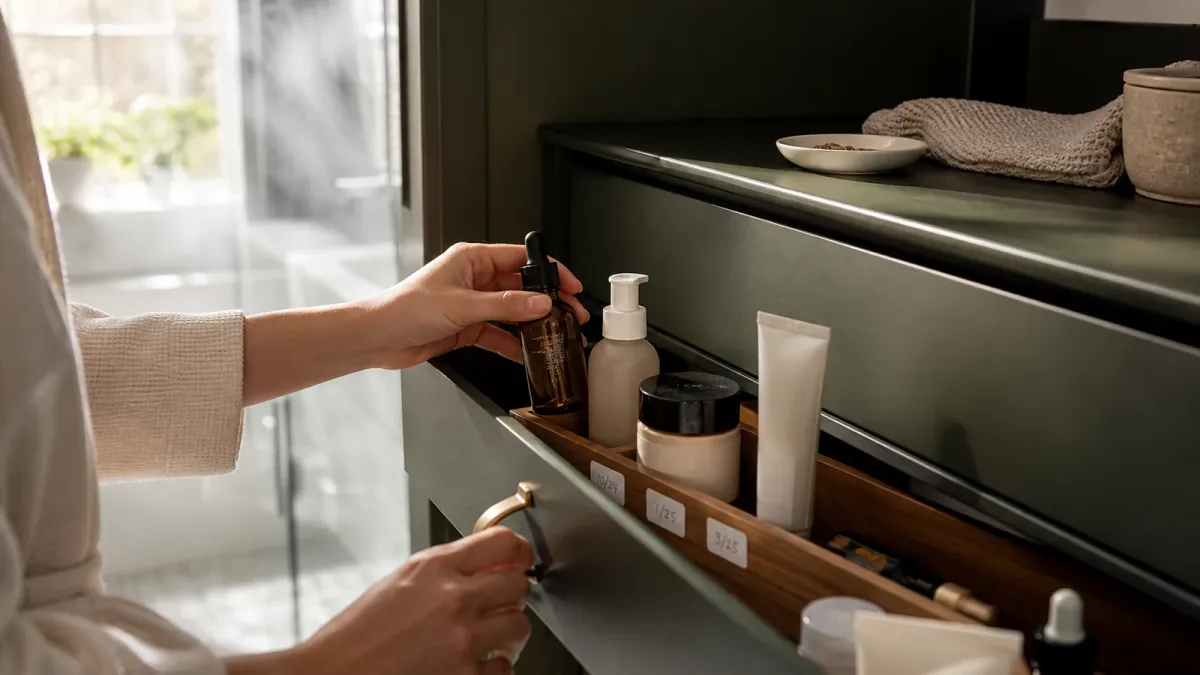
Quick answer: how to store skincare products
Follow the exact product's storage directions. Use a closed cupboard away from heat and direct sun when permitted; refrigerate only as instructed.
Keep the container clean and its instructions available. Record first opening, and ask the manufacturer or pharmacist about uncertain storage or exposure.
Quick Summary
- Start with the bottle and carton. Check the precise formula, market and instructions.
- Inspect the actual spot. A room name does not tell you its storage conditions.
- Separate special instructions. Different products can need different locations.
- Keep a short record. Include opening dates, package marks and unresolved questions.
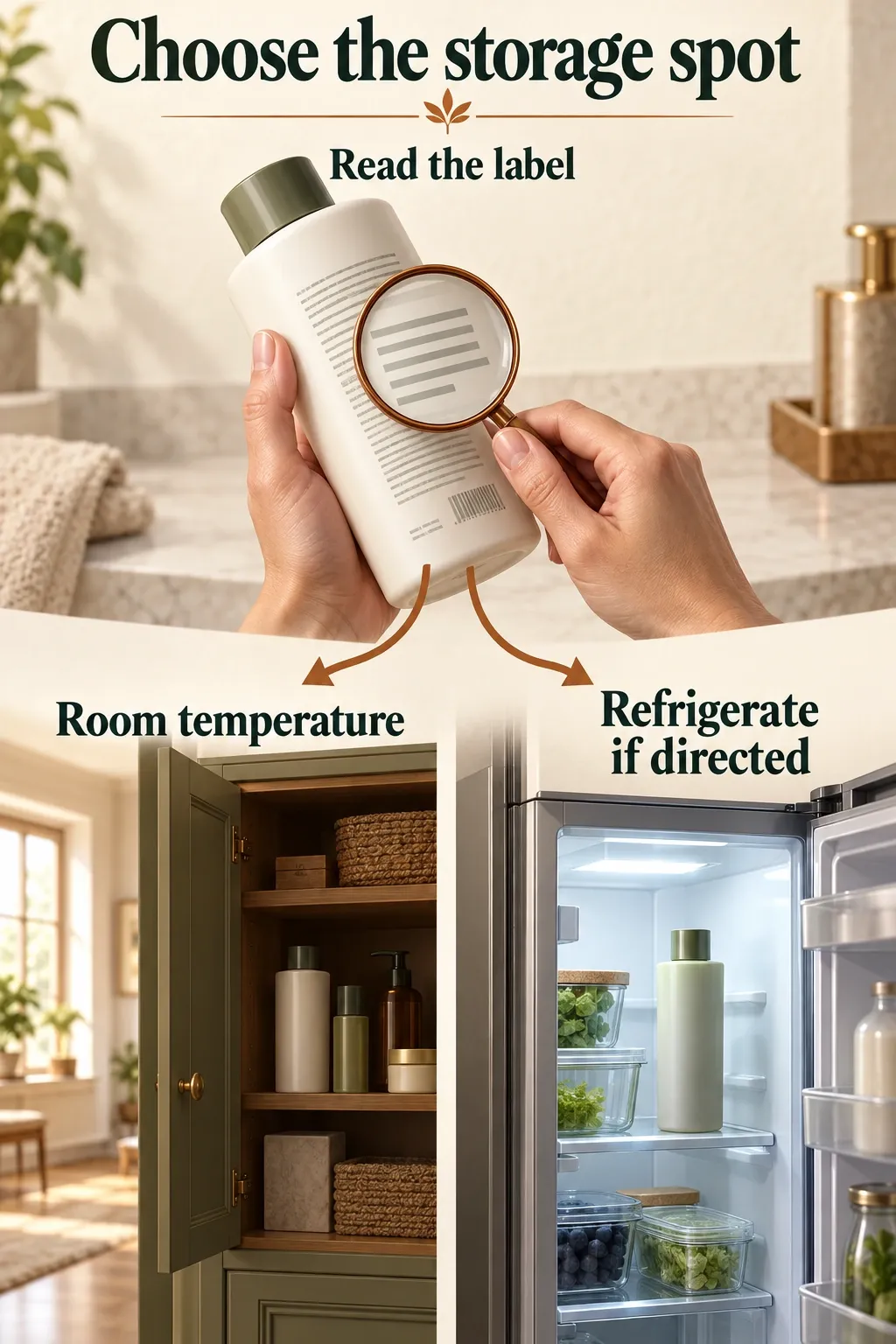
Knowing how to store skincare products starts with the products you already own. Set the bottle beside its carton, look for directions, and decide where those directions fit into your home.
You do not need matching jars or another appliance to begin. A drawer, a small tray and a phone note can organize the task without changing the product itself.
Use an AM shelf if it makes your routine easier to find. Organizing a shelf does not establish or extend a product's shelf life.
Read the product before rearranging the shelf
Start with any storage wording on the container, carton or enclosed instructions. If it is a prescription product, keep the dispensing pharmacy's information with it and ask the pharmacist about unclear directions.
Check whether instructions change after opening. A direction applying to an unopened product does not automatically describe what to do once you start using it.
When searching a manufacturer's website, match the product name, size, market and formula version. An old photograph or a similarly named serum may carry different information.
- Identify: which exact bottle are you checking?
- Locate: where are its storage instructions printed?
- Separate: are there instructions specifically for after opening?
- Clarify: what still needs a manufacturer or pharmacist's answer?
Retinoids belong to one ingredient family, but their finished formulas can have different storage instructions.
Choose a location by its conditions
The FDA's cosmetic shelf-life guidance identifies heat, sunlight, air, moisture and contamination as factors affecting products. It advises keeping cosmetics away from heat, including hot cars.
Look at the spot you intend to use, rather than declaring one room suitable for every bottle. Check it while the room is in use, not only when it is empty and tidy.
| Possible spot | Check first | Practical next step |
|---|---|---|
| Closed bedroom drawer | Nearby window or heater; product directions | Compare the actual spot with the label. |
| Bathroom cabinet | Splash exposure and conditions during showers | Inspect the cabinet, rather than assuming. |
| Refrigerator shelf | Whether this formula calls for refrigeration | Use the specified conditions. |
| Travel bag | Product instructions and journey plans | Plan where the bag will stay. |
A bedroom drawer directly over a radiator can be a poor choice. A bathroom cupboard separated from the shower may fit the product's directions.
How to store skincare products in a bathroom
Compare a bathroom cabinet with the directions for the products you want to keep there. Check whether splashes reach the shelf or containers, and whether the cabinet is beside a source of heat.
If that spot does not fit the instructions, choose another. A small carry tray can let you bring your routine to the sink and return it afterward; it is a convenience option, not temperature-controlled storage.
Keep the routine manageable. If moving everything makes daily use awkward, separate the products with special directions from the ones whose directions fit your chosen cabinet.
For shared bathrooms, give each person an identifiable space. That makes it easier to find your own bottle and its record without rearranging someone else's routine every morning.
Choose skincare storage from the label
Refrigeration depends on the exact formula
These three products have different storage instructions. They are label-reading examples, not recommendations to buy a product or start a treatment.
| Exact example | Checked direction | What to remember |
|---|---|---|
| The Ordinary Retinol 0.2% in Squalane | Refrigerate after opening; use within three months. | Applies to this formulation. |
| Geek & Gorgeous C-Glow | Refrigerator storage; three months after opening. | Not a rule for every vitamin C serum. |
| Alembic adapalene gel 0.3% | Controlled room temperature; protect from freezing. | Read your own drug label. |
The Ordinary's current directions include an after-opening refrigeration instruction. Do not transfer that instruction to every retinol serum, or to every product containing squalane.
The C-Glow manufacturer FAQ supplies its own storage and opened-period guidance. Follow the actual deadline rather than extending it because the bottle has been refrigerated.
The checked Alembic adapalene 0.3% label specifies 20 to 25°C, with permitted excursions of 15 to 30°C. Those figures belong to that label; they are not a temperature rule for your entire collection.
If you are considering a skincare fridge
Write down which exact product requires it before shopping. Find the specified conditions and ask the manufacturer about anything the directions do not explain.
A mini fridge's advertised purpose does not establish its suitability for a medicine or a particular serum. Check the appliance's operating information against the product requirements rather than assuming "skincare" on the box answers both questions.
If you already have a suitable place for a product that requires refrigeration, another appliance may add little to your routine. Make the decision around a real instruction and household need, rather than the number of bottles on display.
Vitamin C, retinol and acne-treatment questions
Use the bottle's directions for storage. Our vitamin C guide explains the ingredient, while the manufacturer answers storage questions about its finished formula.
If you replace one serum with another, make a new record instead of copying the old storage note. Check the new carton even when both front labels advertise vitamin C.
The same applies when comparing retinol with an acne medication. Our retinol guide and benzoyl peroxide guide cover use; a pharmacist can clarify a particular drug's storage instructions.
Keep medications identifiable when packing a shared bag. If several tubes look similar, retain their cartons or a clear photograph of each rather than using cap color as the only clue.
Keep expiry and opening information together
The open-jar PAO mark describes an after-opening period under EU cosmetic labeling rules, Article 19. Record that mark and any printed expiry date alongside first opening; do not substitute purchase day for opening day.
Our guide to checking skincare expiry covers date formats, PAO and batch codes in detail. Use storage planning to keep that information accessible, rather than inventing a new deadline.
Imagine keeping an opened moisturizer beside an unopened backup. Give each its own entry, so the replacement does not inherit the first jar's opening date when you move it to the front of the shelf.
For an older gift, record the information you actually have. "Purchase and opening unknown" is clearer than filling in today's date to make the note look complete.
Clean handling matters when you use the bottle
Follow the FDA's safe-use guidance: stop using a product with an unexpected change in smell or appearance, or foreign material such as visible mold. Do not apply it to check whether it stings.
Discard visibly contaminated products. Set aside leaking or damaged containers and ask the brand or pharmacist about them; damage alone does not identify the cause. Follow printed expiry and after-opening limits even if the bottle looks unchanged.
The FDA's microbial safety guidance recommends clean containers and washed hands before application. Do not add water or saliva: that can introduce microorganisms and dilute preservatives.
A spatula does not make a jar sterile. Do not return used product to the container. Follow the product's instructions, and do not use an accessory's appearance as proof that the contents are protected.
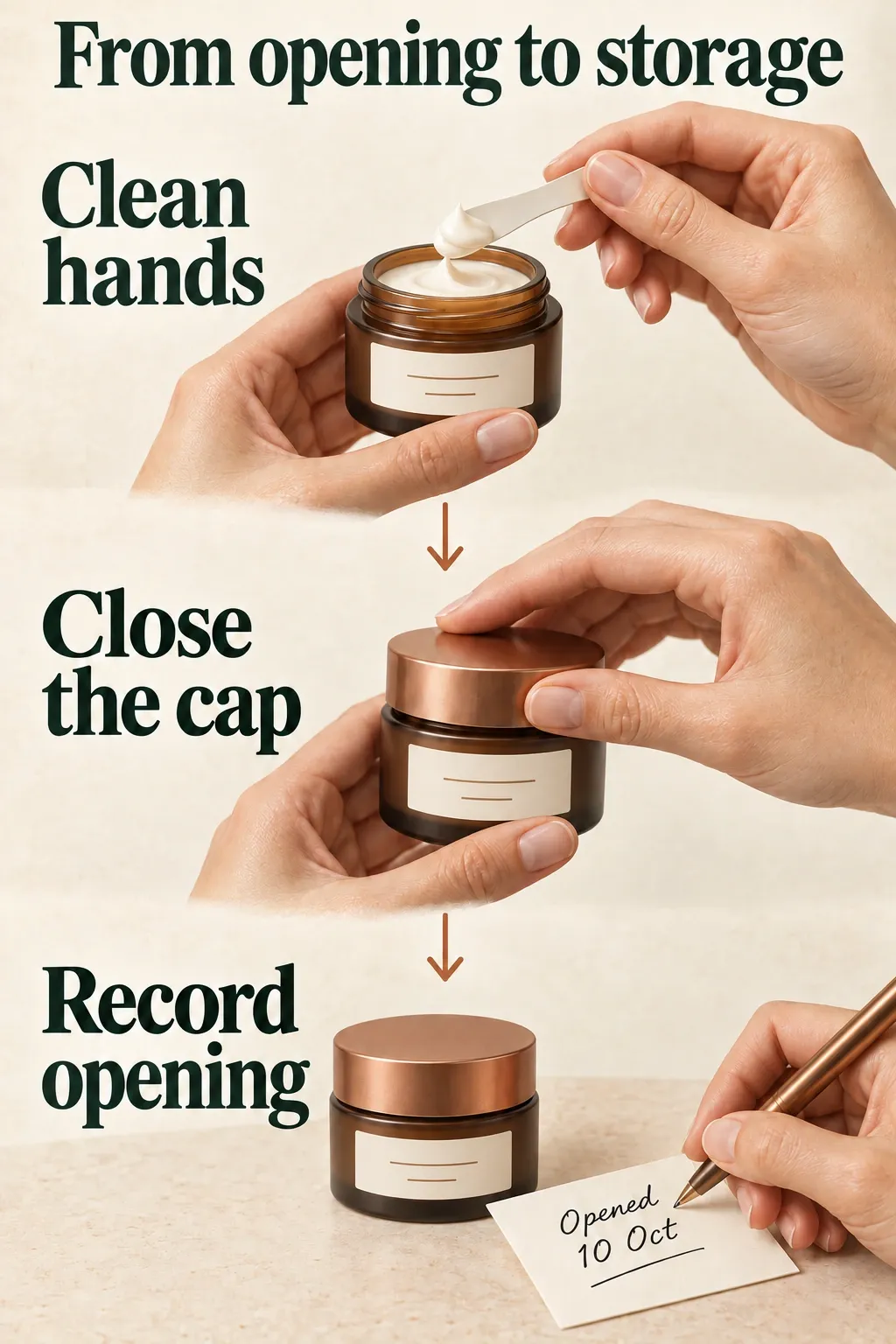
Arrange a clear place to set down the cap during your routine. Keep the product's instructions beside the tools you actually use, especially when an applicator needs its own care.
For a dropper, read how the brand directs you to dispense the product. For a pump, check whether there is a cap or locking position before deciding how to pack it.
Leave useful package information intact when organizing jars and tubes. If you add a personal opening-date sticker, place it somewhere that does not cover the original directions, lot number or printed date.
Sheet masks and single-use pouches
Read the pouch's own instructions before opening it. If it is marked single-use, plan that use rather than assuming a folded corner or refrigerator creates instructions for storing leftovers.
Keep masks in an identifiable group without hiding their marks. If you remove them from a multipack, check whether information is printed on each pouch or only on the outer packaging.
Do not assign one mask's instructions to every pouch in the drawer. Different products may have different directions, even if their packaging looks alike.
Sunscreen needs protection from heat and direct sun
The FDA's sunscreen guidance advises protecting its container from excessive heat and direct sun. Outdoors, shade or wrapping the container in a towel can help keep it out of direct exposure.
Plan where the bottle will be between applications, rather than leaving it on a dashboard. A beach visit alone is not enough information to declare a formula damaged or unaffected.
Keep the bottle's name and directions accessible in your bag. Our sunscreen reapplication guide addresses use; it does not establish the condition of a heat-exposed container.
Travel with the instructions you need
Choose the products you will actually use before packing. Check accommodation, transport and storage plans against their directions, especially for an item needing a separate location.
Start with original labeled containers. If considering a transfer, check the exact brand's instructions instead of assuming a decorative travel pot is an equivalent package.
Keep photographs of important labels available offline. A picture saved only in an email attachment is less convenient when you cannot connect during a journey.
- Before leaving: check product directions and transport restrictions.
- At arrival: identify a place matching those directions.
- During the trip: keep any unusual exposure details with the product record.
- If unsure: ask the brand or pharmacist about the exact item.
An insulated bag is not proof of temperature control. If a product needs a specified range, ask how to meet it during the journey; do not invent a safe journey length from the bag's description.
What to do about a hot or frozen delivery
A warm parcel or an unusually cold bottle leaves unanswered questions about the exposure. Its appearance alone cannot establish whether the product still meets its specifications.
Set aside the item while seeking product-specific advice. Do not apply a suspect formula to see whether it stings, or treat cooling it as proof that it is suitable again.
Keep the packaging and order record. Describe what you observed separately from what you guessed; "parcel felt warm" is different from a measured maximum temperature.
| Record | Include | Avoid guessing |
|---|---|---|
| Product identity | Name, size, market and lot photograph | A similar formula's instructions |
| Exposure | Location, approximate duration and known measurements | A temperature inferred from touch |
| Condition | Photographs of packaging or observed changes | A safety verdict from appearance |
Use the manufacturer's official contact route, or the dispensing pharmacy for a medication. The following administrative template organizes the question; it cannot supply a stability test.
I have [exact product, size and market], lot [code]. It was [unopened/opened on date/opening unknown] when it was exposed to [location and approximate duration].
I observed [facts], and I [do/do not] have temperature measurements. Please advise whether your guidance covers this exposure and what I should do with this exact product.
If you noticed a skin reaction, explain that separately and seek appropriate healthcare advice. A storage question should not be used to diagnose its cause.
Build a storage system you can maintain
Start with a small active-use group and keep unopened backups separate. Put a product with special directions in its required location, then note where to find it.
Try grouping your remaining routine by morning and evening. This is a personal organization choice, not a recommendation to add steps; our AM and PM routine guide can help you review each product's role.
Keep occasional products in a clearly identified group instead of mixing them with unopened backups. You should be able to tell whether a bottle is currently in use without relying on where it happened to land.
- Active routine: products you are using, with their own records.
- Unopened backups: separate entries and package information.
- Special directions: required location noted beside the exact product.
- Unresolved questions: items awaiting a brand or pharmacist's answer.
Before buying another bottle, check those groups. Our unused skincare guide helps review products without a role; the restock guide offers a way to review buying frequency.
If the system becomes hard to follow, simplify the record rather than abandoning it. Exact name, directions, opening date and question are a workable starting point.
Keep application order separate from storage location. Our moisturizer and serum layering guide answers the routine question; a serum used first does not automatically need the first position on your shelf.
Frequently asked questions about skincare storage
Questions came from reviewed discussions about humid homes, whole-routine refrigeration, hot houses and cabinet organization. Those threads identify questions; regulator and product-label sources support the answers.
Can I store skincare products in the bathroom?
Check the actual cabinet or shelf against each product's directions. A bathroom's name alone does not establish its temperature, splash exposure or suitability.
Should my whole skincare routine go in a fridge?
Check each product's directions before moving your routine. Some call for refrigeration, while others specify room-temperature storage.
Has a warm delivery ruined my skincare?
Touch and appearance cannot settle that question. Keep the product identity and available exposure details, then ask the manufacturer or pharmacist rather than guessing a safe duration.
Do vitamin C and retinol always need refrigeration?
Check the finished formula. The Ordinary's checked retinol and G&G C-Glow have specific instructions; those examples do not establish directions for another serum or medication.
What is the simplest way to organize skincare storage?
Keep current products, unopened backups and unresolved questions identifiable. Record each bottle's directions and first opening, using a phone note or another system you can maintain.
Keep the directions with the routine
A useful storage setup makes product information easy to find. Read the label, choose a matching location and keep a short record for each bottle.
If the storage history is uncertain, ask the manufacturer or pharmacist about the exact product and describe the information you have.
This article is for informational purposes only and does not replace professional dermatological advice.