Does Expensive Skincare Work Better? Price vs. Evidence
Expensive skincare is not automatically more effective. Learn what a premium can buy and how to compare evidence, formula, tolerance and cost per use.

In this guide
Expensive skincare does not automatically work better than affordable skincare. A higher price may pay for texture, packaging, stability work, proprietary delivery, brand distribution or prestige, but efficacy still depends on the finished formula, evidence, correct use and tolerance. Spend more only when a specific feature solves a real routine problem or improves consistent use.
Quick Summary
- Price is not a clinical endpoint and prestige is not regulation.
- Finished-product evidence matters more than a fashionable hero ingredient.
- Texture and packaging can justify cost when they improve adherence or stability.
- Compare cost per successful use after core care and prescriptions are covered.
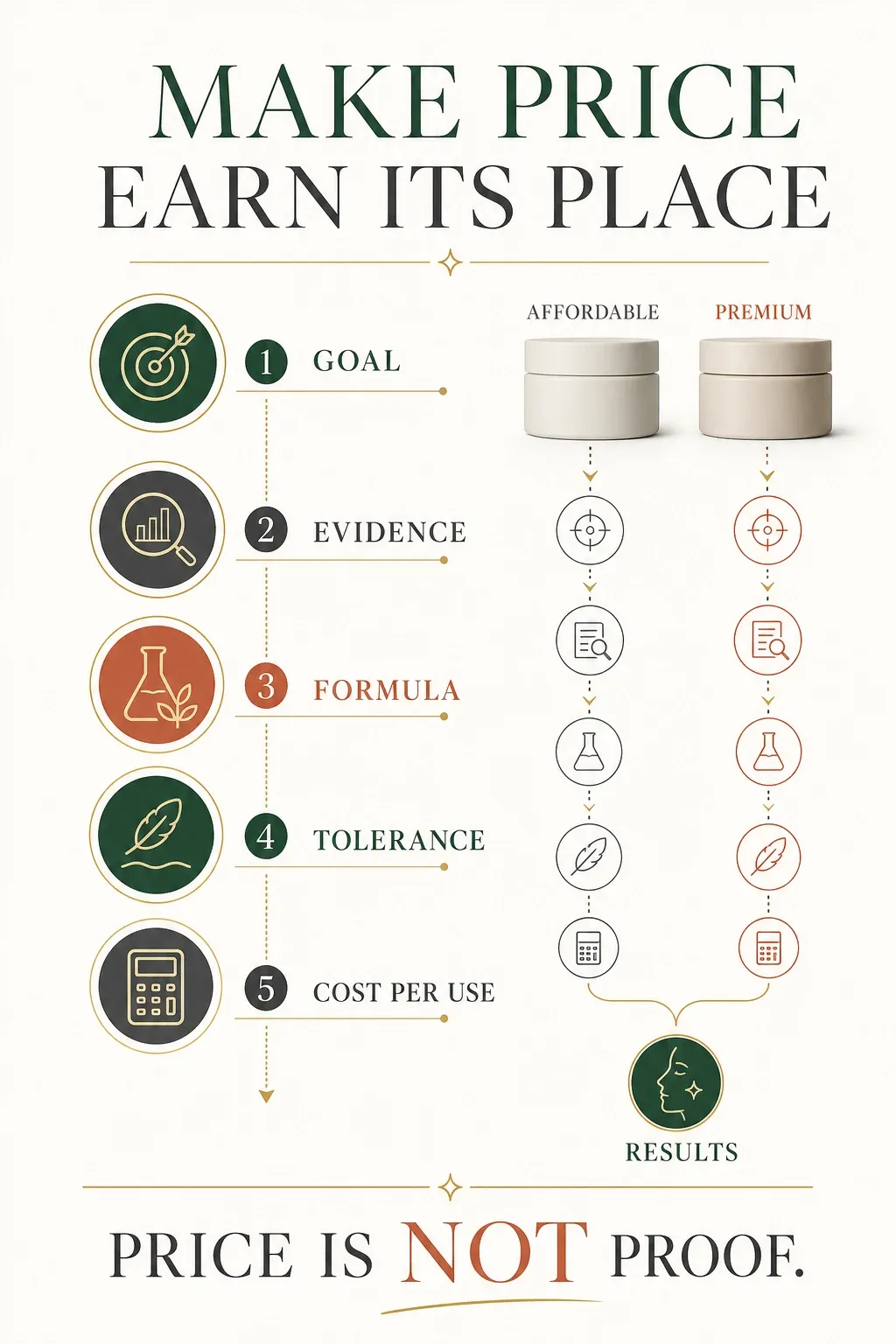
Luxury skincare can be beautifully formulated, while affordable skincare can be clinically sensible and highly effective. The mistake is treating price as a shortcut for evidence. This guide separates legitimate formulation and packaging value from prestige language, explains how cosmetic claims are regulated and provides a repeatable way to compare performance and cost.
Does a Higher Price Mean Better Results?
No. Price can reflect formulation work, packaging, texture, brand distribution, advertising or exclusivity, but it does not prove that a product improves acne, pigment, dryness or wrinkles better than a lower-priced alternative. Evidence must support the finished formula and the specific claim.
A low-cost moisturizer can use well-established humectants and barrier lipids, while a luxury cream can provide a more elegant sensory experience. Either may be the better purchase depending on tolerance, adherence and the outcome being measured. Expensive and effective sometimes overlap, but one does not establish the other.
The American Academy of Dermatology notes that effective anti-aging products exist at all price points. It recommends starting with sunscreen and moisturizer rather than buying multiple products at once.
| What price may pay for | Possible reader benefit | What it does not prove |
|---|---|---|
| Elegant texture | More comfortable daily use | Stronger clinical efficacy |
| Airless or opaque packaging | Better protection for some formulas | That the active reaches an effective dose |
| Stability and delivery research | Potentially more reliable performance | A meaningful result without finished-product data |
| Brand and retail service | Samples, returns or consultation | Better ingredients |
| Fragrance and sensory design | Enjoyable experience for some users | Suitability for sensitive skin |
| Scarcity or prestige | Status and packaging appeal | Any skin benefit |
What Counts as Evidence for a Skincare Product?
Strong evidence names the exact product or a closely matching formulation, the people studied, the outcome, duration and comparison. A study of an ingredient in a laboratory does not automatically validate every cream containing a trace amount. Consumer perception data can support feel or appearance claims but not a medical treatment claim.
Photographs are useful only when lighting, position, expression and timing are controlled. Before-and-after images selected by a brand can show possibility rather than average probability. Look for numerical outcomes, adverse events and the number of participants who completed the study.
Independent replication increases confidence. Brand-funded research is not automatically false, but funding, comparator choice and selective reporting should be visible. A premium price cannot repair a weak study design.
Cosmetic versus drug claims
The FDA distinguishes cosmetic wrinkle claims from claims that affect skin structure or function. Products marketed with drug-like promises may be regulated as drugs. Words such as clinically proven still need context about what was tested.
The FDA also explains that cosmeceutical has no legal meaning under United States law. The term can sound more scientific without creating a separate regulatory category. Do not pay extra for the word itself.
Compare Formula, Fit and Cost per Use
Begin with a precise routine gap. Dryness needs barrier support, clogged pores need an appropriate acne strategy, and photoaging prevention needs sunscreen. A product that solves no defined problem is expensive even at a low price.
Next compare the active ingredient and vehicle. A well-tolerated formula used consistently can outperform a theoretically stronger product that pills, burns or remains in the cabinet. Packaging matters when light, air or contamination can degrade the contents.
Finally calculate cost per application. Divide price by realistic uses, not just container size. A concentrated serum may cost more per ounce but less per use, while a small luxury moisturizer applied to face and neck may empty quickly.
| Decision factor | Question to ask | Red flag |
|---|---|---|
| Goal | Which measurable concern should improve? | General detox or transformation language |
| Formula | Does the vehicle fit my skin and routine? | Choosing from one hero ingredient alone |
| Evidence | Was the finished product tested? | Laboratory mechanism presented as a clinical result |
| Tolerance | Can I use it at the intended frequency? | Persistent burning framed as proof of activity |
| Packaging | Does it protect and dispense the formula? | Prestige jar with no practical advantage |
| Value | What is the cost per successful use? | Large backup purchase before a patch test |
Where Budget Products Often Perform Well
Basic cleansers, petrolatum ointments, fragrance-free moisturizers and many sunscreens use established ingredient systems that do not require luxury positioning. The AAD budget skincare guidance emphasizes simple habits, petroleum jelly for selected dry areas and products that serve more than one useful role.
A cleanser has short contact time and mainly needs to remove soil without excessive irritation. Paying more may improve texture or fragrance, but it does not guarantee better cleansing. The acne cleanser guide shows how product role matters more than prestige.
Moisturizers often rely on glycerin, fatty alcohols, ceramides, petrolatum, dimethicone and related barrier-supporting ingredients. A less expensive formula can be highly effective if it is comfortable and used consistently. See the anti-aging moisturizer guide for realistic expectations.
When a Higher Price Can Be Rational
A more expensive formula may be worth it when a cheaper option causes irritation, the texture prevents adequate sunscreen use, or a delivery system has credible finished-product evidence. It may also be rational to pay for packaging that protects an unstable formula or a retailer with a reliable return policy.
Sensory elegance is a legitimate preference when it improves adherence. Enjoyment is not the same as superior treatment, but a product used every day can be more valuable than a cheaper one you avoid. State that benefit honestly instead of inventing stronger biology.
Some prescription or professionally dispensed products cost more because of drug development, regulation or care delivery. Compare them within the correct category. A cosmetic luxury cream should not borrow the authority of a prescription merely because both discuss wrinkles.
Anti-Aging: Where Marketing Inflates Value
Wrinkle language is especially vulnerable to overstatement. Hydration can temporarily plump the outer skin and make fine lines less visible without rebuilding deeper structure. A photograph taken immediately after moisturizing should not be presented as long-term remodeling.
The AAD wrinkle guidance prioritizes sun protection, moisturizer and realistic timelines. Retinoids have stronger evidence than most trend ingredients, but irritation and pregnancy considerations matter. The retinol versus bakuchiol comparison explains those tradeoffs.
The FTC's L'Oreal anti-aging advertising settlement is a useful reminder that scientific-sounding claims can exceed the supporting evidence. Regulatory action does not mean all premium products fail; it means claims must be evaluated independently of prestige.
Acne: More Expensive Does Not Mean More Therapeutic
Acne responds to mechanisms such as follicular plugging, inflammation and microbial activity. Benzoyl peroxide, topical retinoids, salicylic acid and azelaic acid have defined roles. A luxury botanical blend does not automatically target those mechanisms more effectively.
Expensive acne routines can also stack several acids and create barrier damage. The breakout prevention guide supports a smaller routine with one main active. Painful or scarring acne may need medical care rather than another cosmetic purchase.
Judge a cleanser or serum by lesion change over an appropriate period, not immediate tingling. Photograph active lesions in consistent light and track treatment interruptions. A cheap product that causes no interruption can produce better adherence.
Vitamin C, Peptides and Proprietary Complexes
Vitamin C performance depends on form, concentration, pH, stability, packaging and supporting ingredients. A high percentage does not guarantee delivery, and a low price does not prove instability. Look for clear storage instructions and replace visibly oxidized formulas.
Peptides are a broad family, not one proven ingredient. A proprietary name may represent a defined mixture, but the reader needs evidence for the exact complex and outcome. The anti-aging serum guide helps compare active categories without ranking by price.
Patents also require interpretation. A patent can protect novelty or a method without proving meaningful benefit in consumers. Do not treat patented, medical-grade or dermatologist-developed as substitutes for study details.
Packaging: Useful Engineering or Luxury Theater?
Airless pumps can reduce air exposure and finger contamination, while opaque containers can protect light-sensitive ingredients. Metered pumps also help dose consistency. Those functions may justify some cost when the formula needs them.
Heavy glass, metallic caps and secondary boxes can feel premium without improving stability. Jars can work for stable creams, but repeated finger contact requires clean use. Compare package function before assigning value to weight or ornament.
A refill system can reduce some packaging but only if refills are available, hygienic and actually purchased. Sustainability claims should include material, transport and reuse details. Prestige does not guarantee a smaller footprint.
How to Run a Fair Split-Routine Test
When two products serve the same job and are safe to compare, use one on each side of the face for two to four weeks. Keep cleanser, sunscreen and other actives stable. Avoid this method with prescription drugs unless a clinician approves it.
Choose one outcome such as dryness, pilling, redness or oil breakthrough. Photograph both sides in the same light and record comfort. Do not switch sides daily because inconsistent exposure makes interpretation harder.
At the end, compare result, tolerance, amount used and cost. If performance is equivalent, preference and budget can decide. If the expensive formula is clearly more usable, identify the feature that earned the difference.
Build an Evidence-First Budget
Protect spending for sunscreen, cleanser, moisturizer and prescribed care before optional products. A routine should remain affordable enough to continue. Running out of a proven product because a luxury serum consumed the budget is poor optimization.
Set a monthly or quarterly experiment allowance. Use samples where hygiene and stability permit, and avoid buying backups before tolerance is known. The slow skincare guide provides a controlled introduction schedule.
Review subscriptions and automatic shipments. A replacement schedule should follow actual use, not retailer timing. Pause products that accumulate faster than they are finished.
Three Products at Three Prices: A Better Comparison
Suppose three moisturizers cost 15, 45 and 150 dollars. The least expensive formula is fragrance-free and comfortable, the middle option uses an airless pump and an elegant texture, and the luxury jar adds fragrance and prestige packaging. Price alone cannot rank their barrier performance.
Use each candidate's ingredient system, packaging need and tolerability to narrow the choice. Then compare the outcome after several weeks: less tightness, fewer treatment interruptions and reliable daily use. If all three perform similarly, the premium remains a preference rather than a necessary efficacy purchase.
The same logic applies to a day and night moisturizer decision. Buying two expensive jars is not automatically more advanced than using one suitable formula twice daily. Separate products only when texture, sunscreen, treatment or dryness creates a real functional difference.
For serums, compare the exact active and the finished-product evidence before price. A proprietary complex with no relevant outcome data should not outrank a well-formulated established active. The burden of proof rises with the size of the promise, not with the weight of the bottle.
Record the number of comfortable applications before deciding value. A formula that repeatedly causes burning has a high cost per successful use even when it was discounted. Return policies and samples can therefore be practical value features.
Common Price and Efficacy Mistakes
- Reading price as proof: cost is not a clinical endpoint.
- Judging one hero ingredient: vehicle and finished formula matter.
- Counting tingling as activity: irritation can reduce adherence.
- Believing medical-looking language: cosmeceutical has no legal status.
- Ignoring cost per use: package price alone can mislead.
- Upgrading every step: pay only where a real bottleneck exists.
The Bottom Line
You do not need expensive skincare to see results. Price can buy a better texture, packaging, stability work or a more enjoyable experience, but it cannot substitute for evidence, correct use and consistency.
Spend first on the steps and treatments that address a defined need. Pay more only when a specific feature improves performance or adherence enough to justify the cost.
Frequently Asked Questions About Does Expensive Skincare Work Better? Price vs. Evidence
Is expensive skincare more effective?
Not automatically. Higher price can reflect formulation, packaging, sensory design, distribution or branding, but meaningful efficacy requires evidence for the formula and outcome.
Are drugstore moisturizers as good as luxury creams?
Many affordable moisturizers use established humectants, emollients and occlusives effectively. A luxury formula may feel more elegant, but the better choice is the one that meets the skin need and remains comfortable.
What skincare step is worth spending more on?
Spend more only where a specific bottleneck exists, such as sunscreen texture that prevents adequate use or packaging needed for stability. Core care and prescribed treatment take priority over optional prestige products.
Does medical-grade skincare work better?
Medical-grade is not a universal legal category for cosmetics. Evaluate the exact active, claim, evidence, regulation and formula rather than assuming the phrase guarantees prescription-level results.
For the US label distinctions, read what medical-grade skincare tells you, including cosmetic registration, nonprescription drugs and prescription status.
How should I compare skincare value?
Define the goal, review finished-product evidence, assess tolerance and packaging, and calculate cost per realistic use. A cheaper product that remains unused is not good value, and an expensive product still needs measurable benefit.
This article is for informational purposes only and does not replace professional dermatological advice.