Are Natural Ingredients Safe for Skin? What to Watch For
Learn which natural skincare ingredients are lower risk, which can irritate sensitive skin, and how to patch test before using them.
In this guide
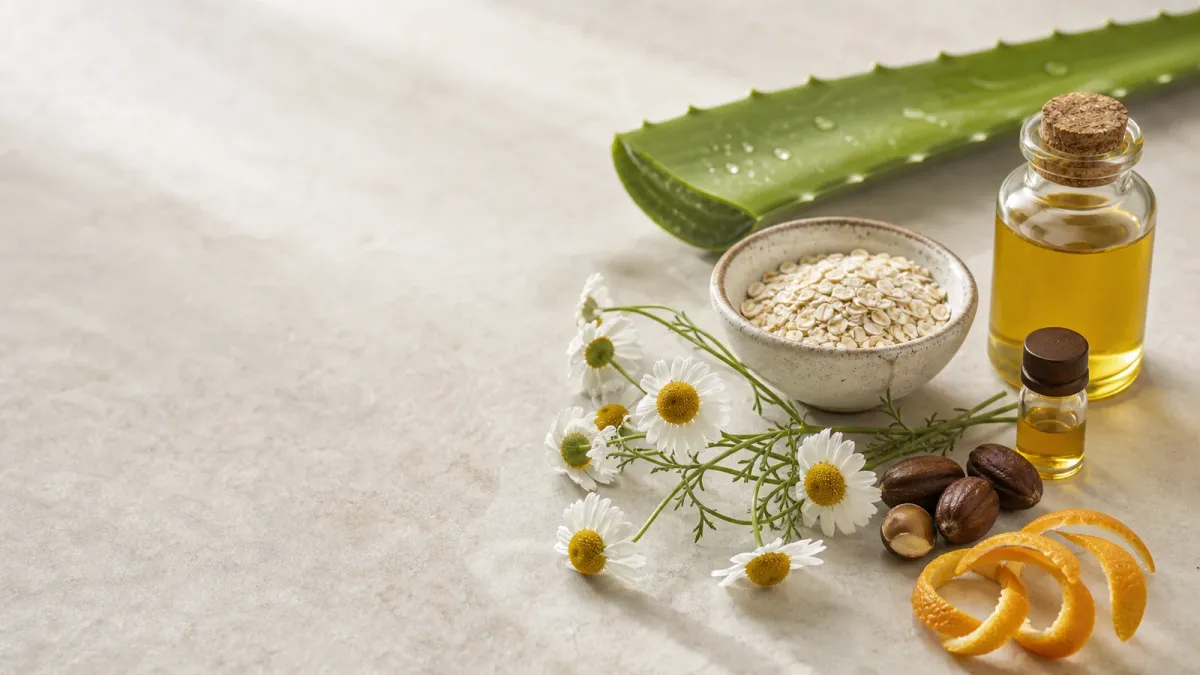
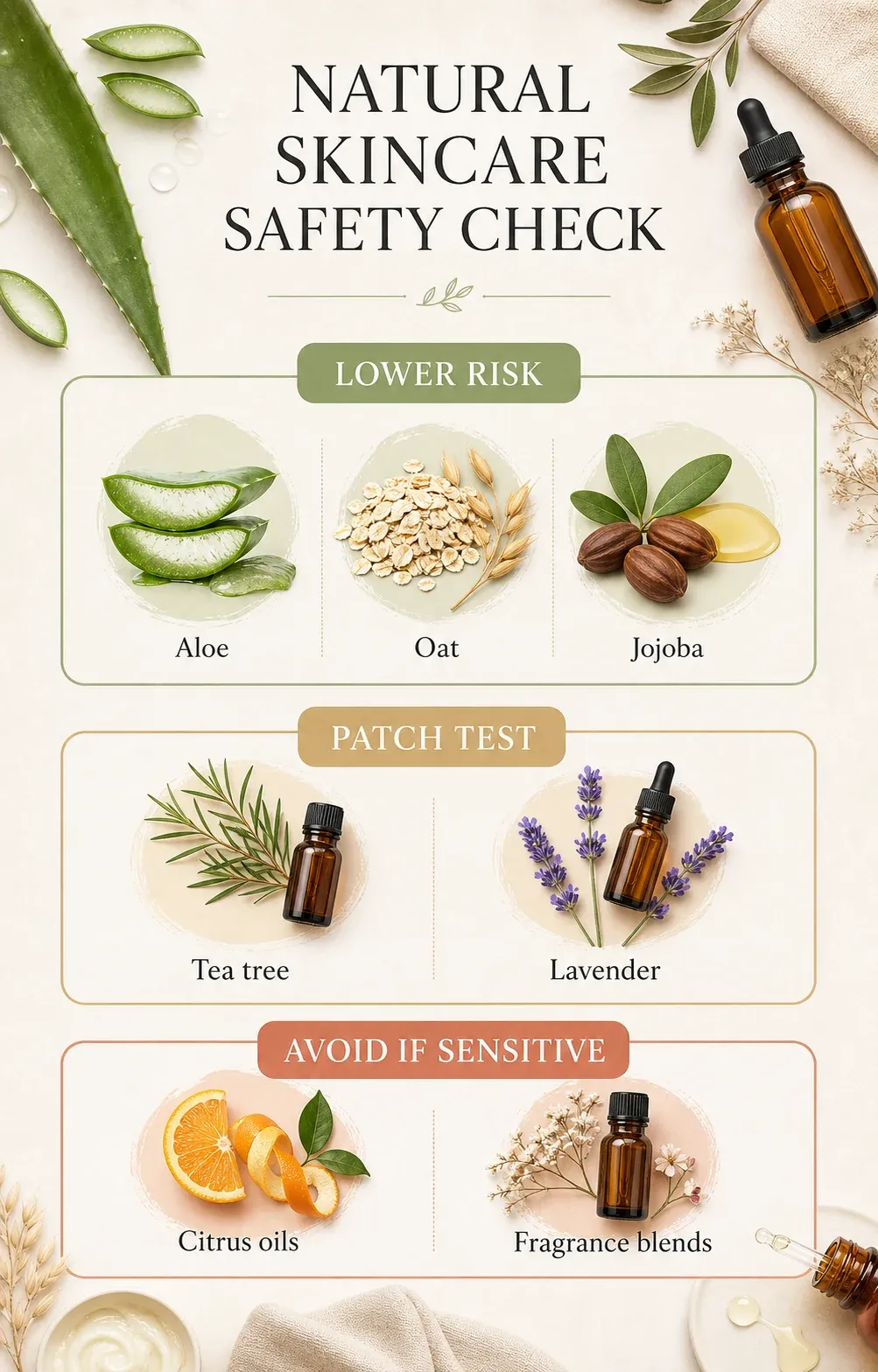
Look past the word natural and check fragrance, essential oils, and active extracts.
Patch test one new product before using it on the full face.
If skin burns or bumps appear, return to fragrance-free basics.
Are natural ingredients safe for skin? Some are. Some are not. The word natural tells you where an ingredient came from, not how your skin will react to it. A plant extract can be soothing in one formula and irritating in another. An essential oil can smell clean and still trigger burning, redness, or allergy-prone irritation.
This is where natural skincare marketing becomes confusing. It often frames natural as pure and synthetic as suspicious. Real skin does not work that way. Skin responds to chemistry, concentration, formulation, barrier health, and personal sensitivity. A lab-made ingredient can be gentle. A botanical ingredient can be harsh.
This guide gives you a practical way to sort natural skincare ingredients: what is usually lower risk, what deserves a patch test, what to avoid if your skin is sensitive, and when a simple fragrance-free routine is the smarter move.
Are Natural Ingredients Safe for Skin? The Real Answer
Natural ingredients are not automatically safer than synthetic ingredients. Safety depends on the ingredient, the dose, the formula, the product type, and your skin condition. A rinse-off cleanser with a small amount of botanical extract is different from leaving pure essential oil on your face overnight.
Stanford Medicine has warned that some natural skin products can irritate skin, especially when they contain complex botanical blends or fragrance-like components. The issue is not that natural skincare is always bad. The issue is that natural skincare is often treated as automatically gentle, which is not true.
A better rule is simple: if your skin is calm, you can test natural products carefully. If your skin is irritated, stinging, acne-prone, eczema-prone, or barrier-damaged, choose fewer ingredients and avoid fragrance-heavy natural formulas first.
Natural Does Not Mean Non-Irritating
The biggest natural skincare myth is that irritation only comes from synthetic chemicals. In reality, many natural substances contain fragrant compounds, acids, enzymes, or active plant chemicals that can irritate skin.
DermNet notes that fragrance allergy can come from perfumes and scented products, and natural fragrance materials can be part of that problem. DermNet also has a specific overview of allergic contact dermatitis to essential oils. That matters because essential oils are common in natural skincare, facial oils, masks, balms, and DIY recipes.
A PubMed Central review also makes the point clearly: essential oils are natural products, but not necessarily safe products. They can cause reactions depending on the oil, concentration, oxidation, and skin exposure.
| Natural ingredient type | Possible issue | Better move |
|---|---|---|
| Essential oils | Fragrance allergy, burning, irritation | Patch test or avoid if sensitive |
| Citrus oils | Irritation and sun-sensitivity concerns depending on formula | Avoid leave-on DIY use |
| Heavy butters | Can feel occlusive or clog-prone for some skin | Use only on dry patches, not acne zones |
| Plant extracts | Helpful or irritating depending on extract and dose | Judge the full formula, not the plant name |
| Colloidal oatmeal | Usually gentle, but allergies are possible | Good lower-risk option for many sensitive routines |
| Aloe | Can soothe some skin; can irritate others | Use simple formulas and patch test |
Lower-Risk Natural Ingredients for Many Routines
Some natural or naturally derived ingredients can be useful. The key is to choose simple, well-formulated products instead of assuming raw ingredients are better.
Colloidal oatmeal
Colloidal oatmeal is one of the more useful natural-leaning ingredients for dry or sensitive skin. It is often used in barrier-supportive products and can feel calmer than fragrant botanical blends. It is not exciting, but boring is often good when the skin is reactive.
Aloe
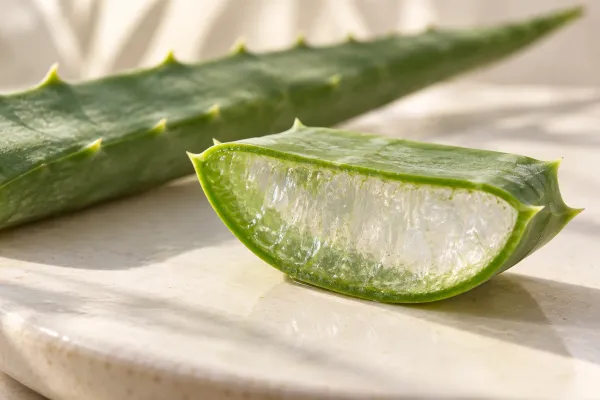
Aloe can feel cooling and comfortable for some people, especially after dryness or mild irritation. The watch-out is formula quality. A simple aloe product is different from a heavily fragranced gel with alcohol, dyes, and perfume.
Jojoba and squalane
Jojoba and squalane can be easier to test than rich oils for many routines. They are still not guaranteed. If you break out easily, read our guide to whether facial oils cause breakouts before using oils all over your face.
Green tea
Green tea extract can be useful in some products, especially when the formula is gentle and fragrance-free. The ingredient is not the whole story. A good green tea serum can be calming; a fragranced green tea mask can still irritate. For a deeper ingredient view, see our guide to green tea in skincare.
Natural Ingredients to Avoid If Your Skin Is Sensitive
If your skin is sensitive, eczema-prone, rosacea-prone, or barrier-damaged, be careful with strong-smelling natural products. Scent is often a clue. The stronger the botanical fragrance, the more cautious you should be.
The National Eczema Association advises people with eczema-prone skin to be careful with common irritating ingredients, including fragrance and essential oils. Even if you do not have eczema, the same logic can help if your skin burns or itches easily.
Natural vs Synthetic Skincare: Which Is Safer?
Neither natural nor synthetic is automatically safer. A synthetic ingredient can be purified, stable, and used at a tested concentration. A natural extract can contain many compounds that vary by plant source, processing, storage, and oxidation.
Preservatives are a good example. Some people fear preservatives because they sound chemical. But unpreserved or poorly preserved skincare can grow microbes, especially if it contains water. A safe product needs a stable formula, not just a natural story.
This is why natural skincare should be judged by product design. Is it fragrance-free? Is it made for sensitive skin? Does it disclose ingredients clearly? Is it packaged to stay stable? Does it ask you to use lemon juice, baking soda, or essential oil directly on the face? These questions matter more than a green label.
| Claim on label | What it really tells you | What to check next |
|---|---|---|
| Natural | Ingredient source or marketing position | Full INCI list, fragrance, essential oils |
| Organic | Farming or certification context | Still patch test if sensitive |
| Clean | Brand-defined term | Not a medical or universal safety guarantee |
| Preservative-free | May sound gentle | Check product type, water content, shelf life |
| Fragrance-free | Often more useful for reactive skin | Still check essential oils and aroma extracts |
How to Patch Test Natural Skincare
Patch testing matters most when a product contains essential oils, citrus extracts, fragrance, strong actives, or many botanical extracts. It also matters if your skin has been reacting to everything lately.
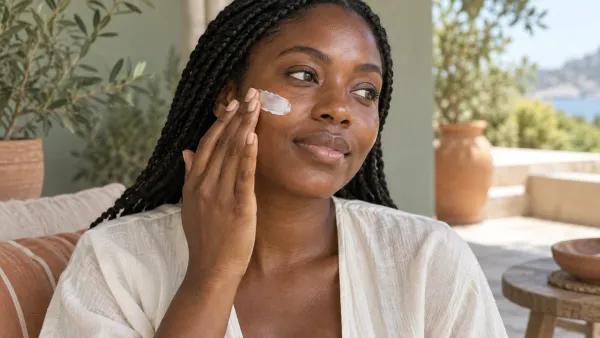
Choose one test area near the jaw, side of the neck, or behind the ear. Apply a small amount once daily for 7 to 10 days. Do not test five new products at once. If the area burns, itches, swells, gets rashy, or develops repeated bumps, stop the product.
If your whole face is already irritated, patch testing may still be too much. In that case, simplify first. Our guide to skin barrier damage explains how to pause actives and rebuild a calmer routine.
Natural Skincare for Acne-Prone Skin
Acne-prone skin needs special caution with natural oils, balms, and DIY treatments. Coconut oil, heavy butters, and thick plant-based balms may feel nourishing but can be too occlusive for clog-prone areas. Essential oils may feel like a natural acne solution, but they can irritate the skin and make acne routines harder to tolerate.
If you have acne-prone skin, a simple routine usually works better than a long natural routine. Use a gentle cleanser, a light moisturizer, sunscreen, and acne-targeted ingredients only when your skin tolerates them. Our skincare routine for acne-prone skin gives a safer structure.
Also avoid common DIY acne mistakes. Lemon juice, baking soda, toothpaste, and undiluted essential oils are not smart facial treatments. If you are trying to fix breakouts, read our guide to skincare mistakes that cause acne before adding more natural experiments.
Natural Skincare for Sensitive or Eczema-Prone Skin
Sensitive skin does not need more plant extracts. It usually needs fewer variables. If your skin is reactive, choose fragrance-free, dye-free, and simple products first. Natural fragrance, floral water, citrus oil, and herbal blends can still be too much.
Rose-derived ingredients are a useful example: our rosewater guide separates an optional refreshing mist from unsupported acne, pore and wrinkle claims, while explaining when fragrance-sensitive skin should skip it.
If you have eczema-prone skin, repeated irritation, or suspected allergy, do not self-diagnose with skincare trends. Ask a qualified professional if reactions keep returning. A dermatologist can help identify allergic contact dermatitis, eczema, rosacea, or another condition that needs more than product switching.
If dryness is the main issue, compare your product with our guide on how to pick the right moisturizer. A boring moisturizer may do more for sensitive skin than a complex botanical oil.
Fragrance-Free Baseline Products: simple options after natural product irritation
If a natural product made your skin sting, itch, or break out, do not replace it with another complex botanical blend right away. Use a plain baseline for a short reset. These product picks are not natural skincare claims. They are simple, fragrance-free options that can help you compare whether your skin does better with fewer variables.

1. Baseline Cleanser: Vanicream Gentle Facial Cleanser
Best for: resetting after a fragrant or botanical cleanser feels irritating.
Watch out: if even gentle cleanser stings, rinse with lukewarm water only for a few mornings and focus on barrier repair.
Check price on Amazon
2. Baseline Moisturizer: CeraVe Moisturizing Cream
Best for: dry or barrier-stressed skin that needs a fragrance-free moisturizer instead of a scented botanical cream.
Watch out: rich creams can feel heavy for very oily or clog-prone skin. Patch test first.
Check price on AmazonAs an Amazon Associate, we earn from qualifying purchases. Product availability, images, and prices can change on Amazon.
How to Read a Natural Skincare Label
Start with the full ingredient list, not the front label. The front label sells the idea. The ingredient list tells you what your skin will meet.
Look for fragrance, parfum, aroma, essential oils, citrus peel oil, limonene, linalool, eugenol, peppermint, cinnamon, clove, lavender, tea tree, and long botanical blends. These are not automatically bad for everyone, but they are worth caution if your skin is sensitive.
| Reader question | What to check | Safer choice |
|---|---|---|
| Is it truly gentle? | Fragrance, essential oils, alcohol-heavy feel | Fragrance-free, short ingredient list |
| Can it clog pores? | Heavy oils, butters, waxes, balm texture | Light lotion or gel-cream if acne-prone |
| Can I use it with actives? | Acids, retinoids, exfoliating enzymes | Test on non-active nights first |
| Is it stable? | Packaging, preservative system, expiration | Airless pump or tube, clear shelf life |
Bottom Line
Natural skincare can be helpful, but natural does not mean safe for every face. The safest approach is to stop treating natural as a shortcut. Read the label. Watch fragrance and essential oils. Patch test. Keep your routine simple when your skin is reactive. Choose ingredients based on skin behavior, not marketing language.
If your skin keeps burning, itching, swelling, or breaking out after natural products, stop testing more botanicals. Return to fragrance-free basics and ask a professional if the reaction continues.
Frequently Asked Questions About Natural Skincare Safety
Are natural ingredients always safe for sensitive skin?
No. Sensitive skin can react to natural fragrance, essential oils, citrus oils, herbal extracts, and some plant-based actives. Fragrance-free and simple formulas are often safer starting points.
Can essential oils irritate skin?
Yes. Essential oils can irritate skin or trigger allergic contact dermatitis in some people, especially when used undiluted, oxidized, or in leave-on products.
Is natural skincare better than synthetic skincare?
Not automatically. Natural and synthetic ingredients can both be helpful or irritating. Safety depends on the formula, dose, stability, and your skin's needs.
Which natural ingredients are lower risk?
Colloidal oatmeal, simple aloe formulas, jojoba, squalane, and some green tea products can be lower-risk for many routines, but allergies and irritation are still possible.
How should I test a natural skincare product?
Patch test one product on a small area for 7 to 10 days. Do not test multiple new products at the same time, and stop if you notice burning, itching, rash, swelling, or repeated bumps.
This article is for informational purposes only and does not replace professional dermatological, medical, or nutrition advice.