LED Light Therapy for Skin: What Works and What Does Not
LED light therapy may modestly help selected acne or fine-line goals, but wavelength, dose and device-specific evidence determine whether it fits.

In this guide
LED light therapy can modestly help selected mild inflammatory acne and may improve fine lines or texture, but the evidence is specific to wavelength, dose, device and treatment schedule. Blue, red, near-infrared, photodynamic therapy, IPL and lasers are not interchangeable. Verify the exact device indication, protect the eyes and do not replace proven acne care or sunscreen with a mask.
Quick Summary
- Blue LED mainly targets selected inflammatory pimples, not every acne lesion.
- Red LED results for aging are usually gradual and device-dependent.
- FDA clearance applies to an exact device and indication, not every light mask.
- Eye guidance, medication review and a sustainable schedule matter.
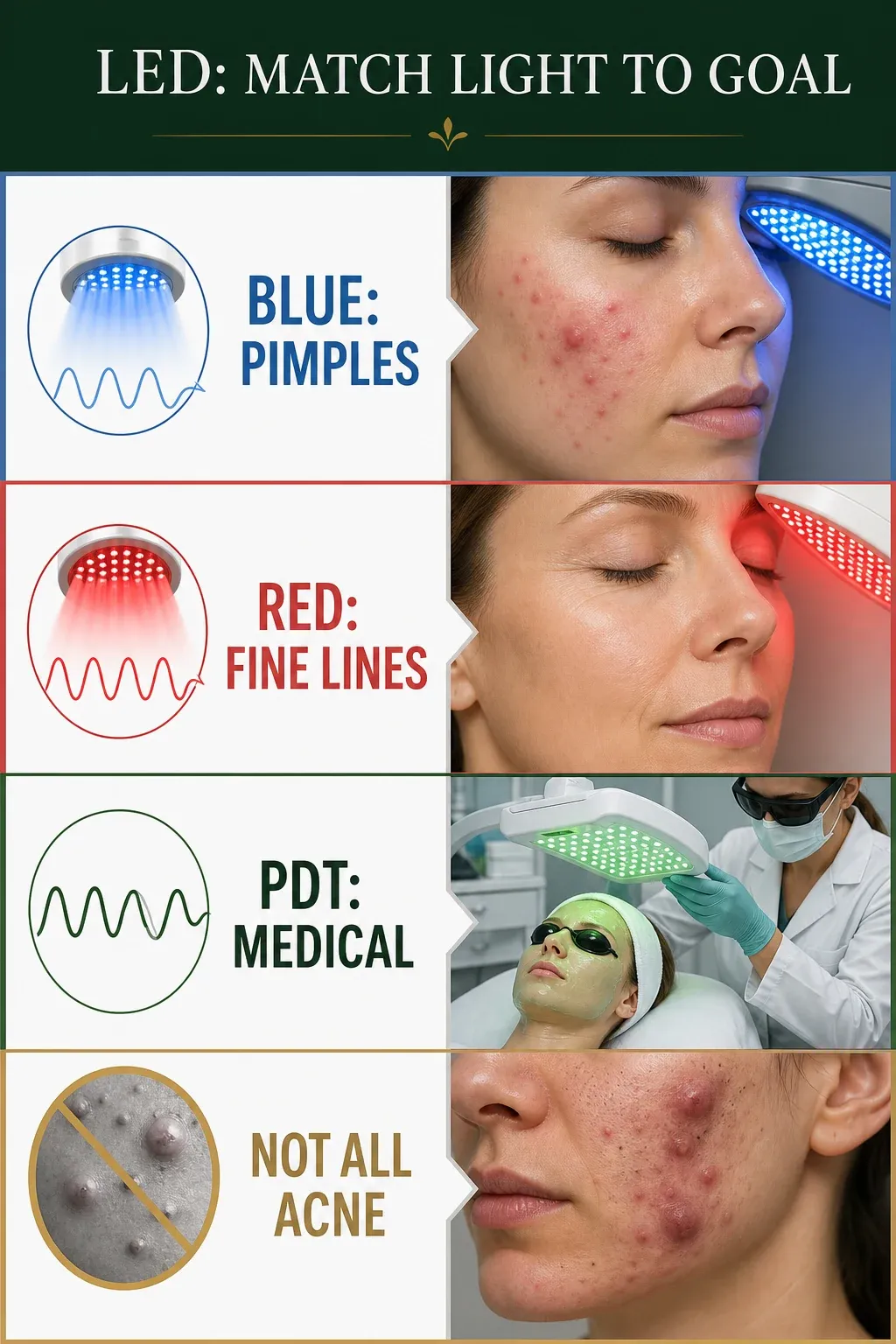
LED masks are now marketed for acne, collagen, redness, healing and hair growth, often with the same glowing photographs. That collapses several distinct treatments into one trend. This guide starts with the target and wavelength, examines current acne and red-light evidence, and gives a device checklist that separates a usable protocol from marketing language.
Does LED Light Therapy Work?
LED light therapy can produce modest benefits for selected concerns, but “LED” is not one treatment. Wavelength, dose, device power, treatment schedule and diagnosis determine whether the light reaches a useful target. Results from one cleared device cannot be transferred to every mask or panel.
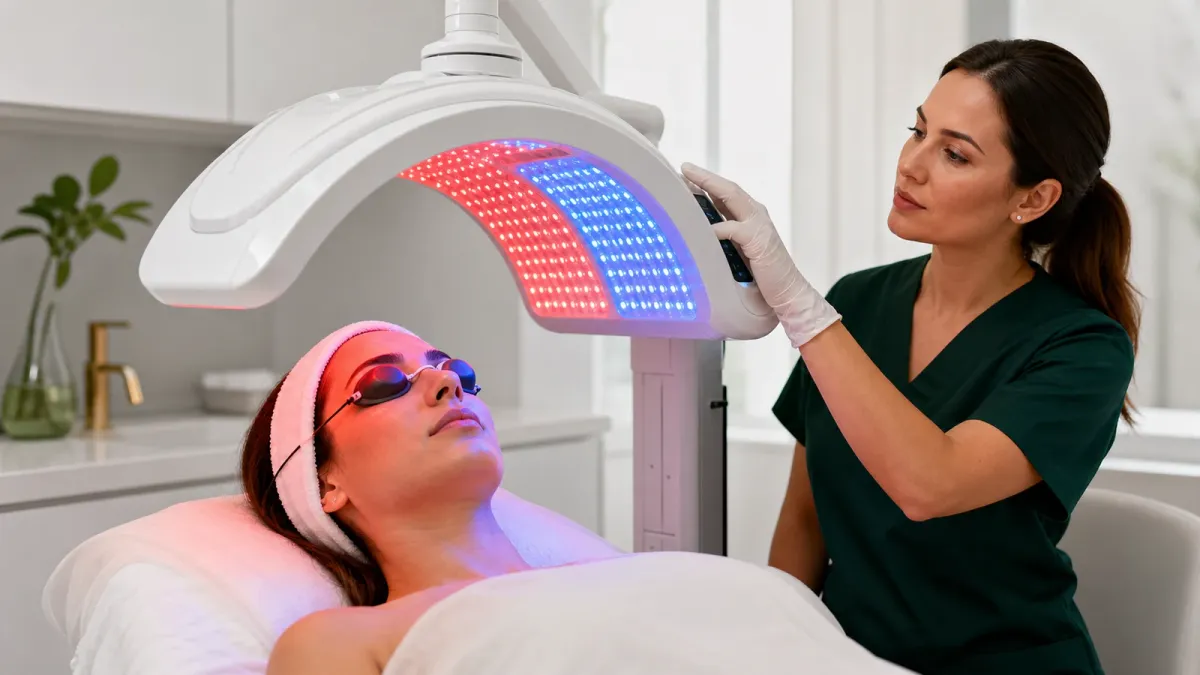
Blue visible light is commonly used for mild to moderate inflammatory acne, while red or near-infrared light is studied for inflammation, healing and signs of aging. Photodynamic therapy adds a photosensitizing medicine and is a different medical procedure. Lasers and IPL are also different energy systems.
Expect gradual change and variable response. LED should support a broader plan rather than replace sunscreen, acne medication or diagnosis. A glowing mask is not evidence that the delivered dose matches a clinical study.
| Light category | Common skin use | Main limit |
|---|---|---|
| Blue LED | Selected inflammatory acne pimples | Does not treat blackheads, cysts or every acne type |
| Red LED | Fine lines, redness and recovery claims | Device protocols and evidence vary |
| Near-infrared | Deeper photobiomodulation research | Invisible output is hard to verify at home |
| PDT | Clinician-directed acne or precancer treatment | Requires photosensitizer and medical precautions |
| Laser or IPL | Specific vessels, pigment, hair or resurfacing | Not interchangeable with low-power LED |
What the Evidence Says About Acne
Visible blue and red light can reduce some inflammatory acne lesions, but results are inconsistent and usually incomplete. The AAD states that light treatment rarely clears acne alone and that no one device treats pimples, blackheads, whiteheads, cysts and nodules. Medication may still be needed.
A 2025 systematic review and meta-analysis of at-home LED devices examined six studies for acne. That newer evidence is encouraging for selected home use, but study devices and schedules differ. A specific product should be judged against its own clinical data.
An earlier Cochrane review included 71 randomized trials of light therapies and found that comparisons were difficult and evidence quality was often low. It combined varied interventions, including photodynamic therapy, so it does not answer whether every consumer mask works. The acne-prevention guide covers the routine factors LED cannot replace.
The abridged Cochrane review found low-certainty evidence for several key comparisons. That is a reason to demand device-specific outcomes, not a reason to assume light has no biological effect.
The AAD's laser and light acne guidance says visible light can treat pimples but not blackheads, whiteheads, cysts or nodules. It also notes that results vary and at-home devices are less powerful than professional systems.
Which acne lesions may respond?
Blue and blue-red visible light is aimed mainly at inflammatory pimples. It is not a reliable treatment for closed comedones, blackheads, deep cysts or established scars. A person with painful nodules should not delay effective care while testing a cosmetic device.
Acne outcomes should be tracked by lesion type and count over several weeks. Daily mirror impressions are distorted by lighting and inflammation cycles. The benzoyl peroxide guide explains an evidence-based topical route for inflammatory acne and its irritation tradeoffs.
What About Red Light for Fine Lines?
Red-light photobiomodulation is studied for fine lines, texture, redness and healing. The AAD reports that some studies show subtle to noticeable improvement, while emphasizing that at-home devices vary and optimal dose and long-term safety questions remain. Results should not be marketed as equivalent to a facelift or resurfacing laser.
If you are comparing consumer facial masks, our Men-versus-Series-2 buying guide explains why the exact model, contraindications and return policy matter alongside the light specifications.
FDA clearance is device- and indication-specific. One 510(k) summary describes a red-and-blue facial device intended for wrinkles and mild to moderate inflammatory acne. That does not prove an unreviewed panel, bulb or imported mask has the same output or effect.
The FDA clearance record for one wrinkle-and-acne LED device names those specific intended uses. Clearance means the agency found the submitted device substantially equivalent for its stated use; it is not a general endorsement of photobiomodulation claims.
The AAD's red-light therapy guidance highlights both encouraging studies and unresolved questions about optimal dose and duration. It also recommends medical review when medication or a health condition could change risk.
For photoaging, daily photoprotection has broader preventive value. The retinol evidence guide compares a well-studied topical strategy with realistic timelines and tolerance needs.
How to Evaluate an LED Device
| Question | Why it matters | Better evidence |
|---|---|---|
| What is the exact indication? | Clearance and studies are concern-specific | Mild inflammatory acne or facial wrinkles, not generic wellness |
| Which wavelengths are emitted? | Different wavelengths reach different targets | Measured nanometer ranges |
| What dose reaches skin? | Time alone does not define exposure | Irradiance, fluence, distance and schedule |
| Was the exact model studied? | Similar-looking masks can differ greatly | Peer-reviewed or regulatory device data |
| What eye protection is required? | Brightness and wavelength affect comfort and safety | Manufacturer-specific instructions |
| Who should not use it? | Medication and conditions can change risk | Written contraindications and support |
Terms such as “medical grade,” “clinical strength” and “NASA inspired” do not define a device standard by themselves. The AAD explicitly notes that impressive marketing terms can lack meaning when applied to medical devices. Look for the exact model, cleared use and instructions.
A manufacturer should disclose treatment distance and session schedule. If the mask must touch skin, clean it according to instructions without damaging LEDs or lenses. A panel used too far away may deliver a different dose than the advertised protocol.
At-Home vs. In-Office LED
In-office systems may deliver higher or more controlled output and can be combined with diagnosis and other treatment. Home devices trade power for convenience and require consistent repeated use. Neither setting guarantees a response.
Photodynamic therapy is not simply a stronger LED facial. A clinician applies a photosensitizing medicine, waits for uptake and activates it with a specific light. It can cause substantial redness, crusting and sun sensitivity and requires medical aftercare.
Ask whether the clinic is offering LED alone, laser, IPL or PDT. The IPL decision guide explains why broad-spectrum intense light has different targets and risks from low-level LEDs.
How Long Until Results Appear?
Most studied protocols require several sessions per week or a short in-office series. Acne lesion counts may change over four to twelve weeks depending on the device and accompanying care. Fine-line changes are gradual and can be subtle.
Follow the exact device schedule rather than doubling time to accelerate results. Photobiomodulation may have a dose window; more exposure is not automatically better. Overuse can create irritation, heat or a routine that is impossible to sustain.
Take baseline and monthly photos with the same camera, distance and lighting. Track inflammatory lesion count, redness and adverse effects separately. Stop if the condition is worsening while proper treatment is delayed.
LED Safety, Eyes and Medications
Most at-home red-light devices are described as non-invasive and generally well tolerated, but temporary irritation, redness, discomfort or headache can occur. Eye sensitivity differs, and protection requirements vary by wavelength and device. Closed eyes are not a substitute when the instructions require goggles.
Review photosensitizing medications and conditions with a clinician. Examples can include selected antibiotics, retinoids, diuretics, anti-inflammatory drugs and herbal products, but risk depends on the drug and wavelength. Do not stop a prescription merely to use a cosmetic device.
People with light-triggered disorders, seizure sensitivity, active eye disease or a suspicious lesion need individualized advice. Pregnancy safety data may be limited for a particular device. The manufacturer’s contraindication list and clinician guidance come before social-media routines.
Can LED worsen melasma?
Visible light and heat can matter in pigment-prone conditions. Red LED is not the same as blue visible light or infrared heat, but a device that warms the face or triggers irritation may be unsuitable for some melasma patients. Monitor pigment rather than assuming “non-UV” means pigment-neutral.
Use broad-spectrum sunscreen and consider an iron-oxide tint when visible-light-sensitive pigment is a concern. The tinted sunscreen guide explains shade, finish and iron-oxide relevance.
How to Fit LED Into an Acne Routine
Keep cleanser, moisturizer, sunscreen and prescribed treatment stable when beginning LED. Introduce the device as one change and record the schedule. This makes benefit or irritation easier to attribute.
Do not apply an unapproved photosensitizing acid or essential oil before treatment. Some devices specify clean dry skin, while others allow particular products. Follow the exact instructions rather than copying another brand’s protocol.
If benzoyl peroxide, adapalene or salicylic acid is already controlling acne, LED may add cost and complexity without a clear gap. The acne cleanser guide helps keep the support step gentle so leave-on treatment remains tolerable.
How to Fit Red LED Into an Anti-Aging Routine
Use sunscreen every morning and a tolerable moisturizer. A retinoid can remain the main evidence-based topical when appropriate. LED should not become a reason to skip daily prevention or spend beyond the likely subtle benefit.
Separate a new device from a new retinoid or peel by several weeks. Otherwise, irritation and results cannot be assigned. The slow-start skincare method gives a one-variable testing schedule.
Choose the device only after defining the goal: fewer inflammatory pimples, a small fine-line change or post-procedure recovery under professional guidance. “Glow” is too subjective to justify an expensive protocol.
Red Flags in LED Marketing
- One color claims to treat everything: indications and wavelengths should match.
- No exact model or output data: a photograph is not a specification.
- “FDA approved” without a record: many devices are cleared, not broadly approved.
- Before-and-after images use different lighting: redness and texture become unreliable.
- No contraindication or eye guidance: safety information is incomplete.
- Guaranteed collagen or acne clearance: response varies and evidence is device-specific.
- Unlimited use is encouraged: dose and schedule still matter.
When to Skip LED and Seek Care
Skip self-treatment for painful cystic acne, scarring, rapidly worsening rash, eye involvement, severe photosensitivity or a changing lesion. These concerns need diagnosis. LED can delay more appropriate care when it is treated as harmless experimentation.
Stop for persistent burning, blistering, swelling, hives, visual symptoms or a significant pigment change. Contact the manufacturer for device malfunction and the appropriate clinician for a skin reaction. Preserve the device model and use log.
The acne-scar guide explains why active acne control and scar classification come before device shopping. A home LED mask does not remodel deep established scars.
A Four-Week LED Trial Framework
Confirm that four weeks is compatible with the device’s evidence and instructions; some goals need longer. Photograph the same area, keep other treatment stable and log every session. Define one outcome before starting.
At two weeks, review tolerance and adherence rather than demanding a final result. At four weeks, compare inflammatory lesion count or another defined measure. Continue only when the schedule is safe, practical and aligned with the recommended review window.
Do not use the trial to override prescription follow-up. If acne is painful, scarring or worsening, contact a qualified professional regardless of the device timeline.
The Bottom Line
LED light therapy can support selected mild inflammatory acne and may create modest improvement in fine lines or texture, but outcomes depend on the exact wavelength, dose, device and schedule. Red, blue, near-infrared, PDT, IPL and lasers are not interchangeable.
Verify the specific device’s indication and instructions, protect the eyes, review photosensitizing risks and track a defined outcome. Use LED as an optional addition to evidence-based care, not as a glowing substitute for diagnosis, sunscreen or effective acne treatment.
Frequently Asked Questions About LED Light Therapy for Skin
Does red light therapy really reduce wrinkles?
Some studied devices produce subtle to noticeable improvement in fine lines or texture, but results vary. At-home masks are not equivalent to resurfacing lasers or surgery.
Does blue LED light clear acne?
Blue or blue-red LED can reduce selected inflammatory pimples, but it does not reliably treat blackheads, whiteheads, cysts or scars and rarely replaces a complete acne plan.
How often should I use an LED face mask?
Use only the exact model's instructions and studied schedule. Session time alone does not define dose, and more frequent or longer use is not automatically more effective.
Do I need eye protection for LED therapy?
Follow the specific device instructions. Some devices require goggles, and closed eyes are not a substitute when protection is specified.
Can LED light therapy worsen melasma?
Heat, visible light or irritation may worsen pigment in some people. Discuss melasma with a dermatologist, monitor color change and use appropriate photoprotection.
This article is for informational purposes only and does not replace professional dermatological advice.