Acne Scar Treatment Options by Scar Type and Skin Tone
Acne scars need treatment matched to texture, depth and skin tone. First separate true scars from flat red or dark post-acne marks.

In this guide

First separate flat red or dark post-acne marks from true texture changes. Control active acne, then match treatment to scar type: focal methods may fit ice-pick scars, subcision may fit tethered rolling scars, resurfacing may help selected boxcar scars, and raised scars need a different anti-collagen pathway. Skin tone, pigment history, downtime and budget should shape the plan, and complete scar removal is not a realistic promise.
Quick Summary
- Flat color is usually PIH or redness, not a structural acne scar.
- Control active acne before starting a cosmetic procedure series.
- Match the procedure to ice-pick, boxcar, rolling or raised morphology.
- Discuss skin tone, PIH risk, downtime, sessions and realistic improvement.
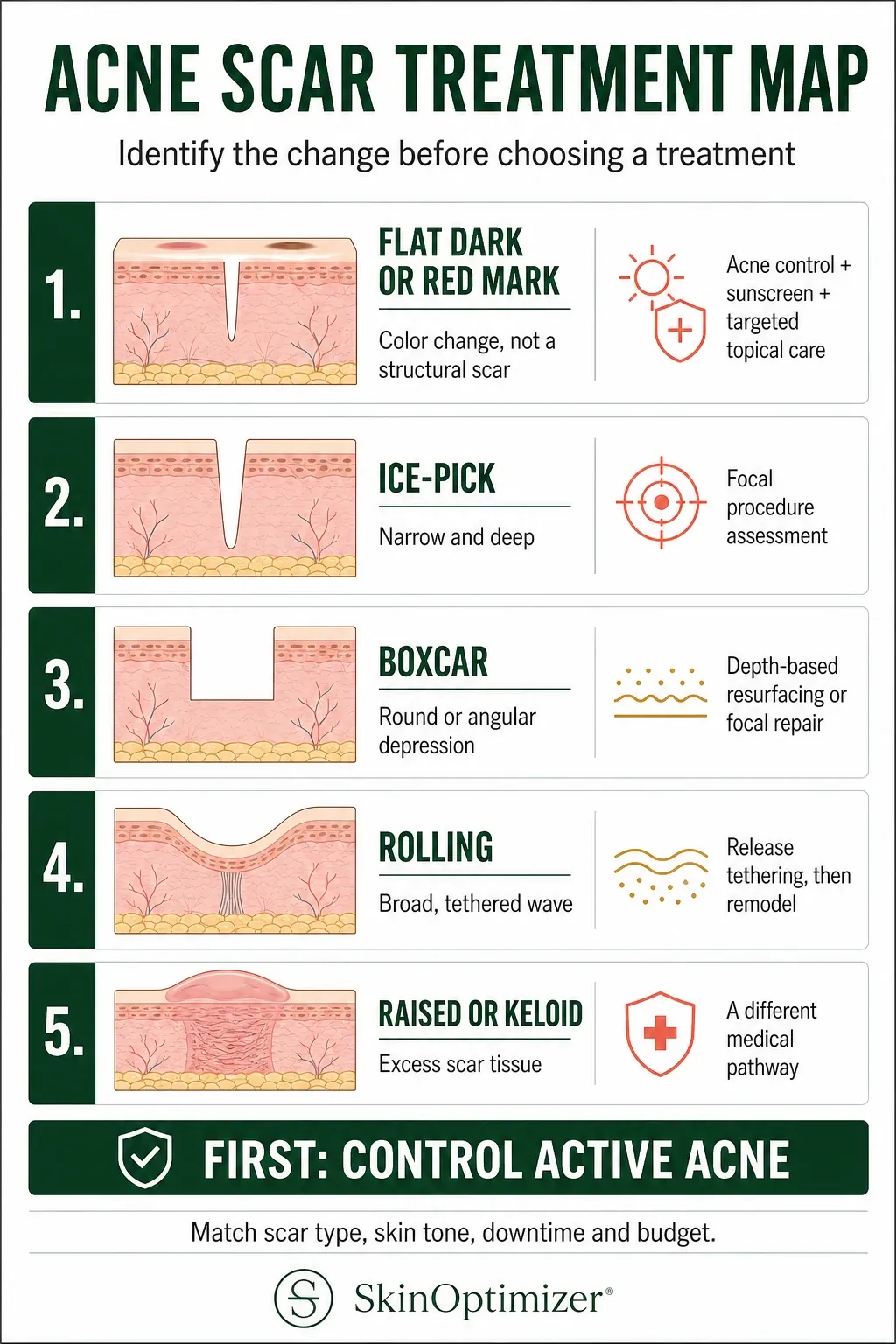
Acne-scar marketing often groups dark marks, dents and raised tissue into one problem. This guide starts with diagnosis, maps procedure mechanisms to scar morphology and gives a consultation checklist that makes risk, cost and expected improvement visible.
First Decide: Scar, Dark Mark or Red Mark?
A true acne scar changes skin texture. A flat brown, gray or blue area is usually post-inflammatory hyperpigmentation, while a flat pink, red or purple area may be post-inflammatory erythema. These marks can persist, but they are not treated like ice-pick, boxcar, rolling or raised scars.
The American Academy of Dermatology acne-scar overview makes this distinction explicit. Pigment often fades over time, while a depression or raised area reflects altered collagen and rarely disappears completely without targeted treatment. A mixed pattern is common.
Look at the area in side light, not only in a bright bathroom mirror. If the surface remains level while color changes, start with acne control, sunscreen and pigment-safe care. If shadows reveal dents or the area stays elevated, a scar consultation is more useful than buying another brightening serum.
| What you see | Most likely category | First useful step |
|---|---|---|
| Flat brown, gray or blue spot | Post-inflammatory hyperpigmentation | Control acne, daily sunscreen, targeted topical care |
| Flat pink, red or purple spot | Post-inflammatory erythema | Gentle routine, sun protection, time or vascular assessment |
| Narrow deep opening | Ice-pick scar | Procedure matched to focal depth |
| Round or angular depression | Boxcar scar | Assess depth and edges before resurfacing |
| Broad wave or tethered dip | Rolling scar | Evaluate tethering and possible subcision |
| Firm raised tissue | Hypertrophic scar or keloid | Early dermatologist assessment; do not resurface like a dent |
The Main Acne-Scar Types
Ice-pick scars are narrow and deep, often extending farther than surface treatments can reach. Boxcar scars have wider bases and more defined edges; shallow examples may respond to resurfacing, while deeper scars can need focal surgery or lifting. Rolling scars create broad undulations because fibrous bands tether the skin downward.
Raised hypertrophic scars remain within the original inflammatory area, while keloids grow beyond it and can itch or hurt. They represent excess collagen rather than collagen loss. A treatment that intentionally stimulates collagen for a depressed scar is therefore not the logical first choice for a keloid.
Most people have more than one morphology. The AAD treatment guide explains why dermatologists often combine methods after examining scar type, location, skin tone, active acne, downtime and budget. A single trending device cannot fit every pattern.
Control Active Acne Before Scar Procedures
New inflammatory lesions can create new scars while old ones are being treated. A scar plan usually starts by controlling acne and reducing picking. Deep painful nodules or cysts deserve early medical care because delay increases the chance of permanent texture change.
Use the cystic acne treatment guide when lesions are deep, recurrent or painful. Do not puncture them with a needle or use an extraction tool at home. Trauma increases inflammation, infection risk and pigment change.
Acne control may include benzoyl peroxide, a topical retinoid, azelaic acid, salicylic acid, hormonal therapy, antibiotics or isotretinoin depending on severity and patient factors. Tell the scar clinician every current and recent medication. Timing around procedures and isotretinoin requires individualized medical judgment rather than an old universal waiting rule.
Match the Procedure to the Scar
Scar treatment works by releasing tethering, removing a focal scar, adding volume, remodeling collagen or changing surrounding surface height. The correct mechanism matters more than the device brand. Rolling scars may need release, ice-pick scars may need focal treatment and broad shallow boxcar scars may respond to resurfacing.
A 2020 evidence review for acne scars in skin of color found useful evidence for microneedling, fractional radiofrequency and selected fractional lasers, while emphasizing morphology-based treatment and the limits of available studies. Combination plans often outperform one repeated method.
Ask the clinician to name your scar types and explain which part of the plan addresses each one. A credible consultation also discusses expected degree of improvement, number of sessions, downtime, pigment risk and what will remain. "Erase" and "permanent flawless skin" are warning signs.
Microneedling and Radiofrequency Microneedling
Medical microneedling creates controlled injury to stimulate remodeling and can help selected atrophic scars. It is not the same as using a consumer roller at home, where depth, sterility, pressure and treatment of active acne are poorly controlled. Professional assessment is especially important when there is a history of keloids or pigment change.
A 2024 network meta-analysis of 24 randomized studies reported that combinations involving microneedling may improve outcomes compared with microneedling alone. The studies used varied protocols, so the finding does not identify one universally best package. Redness, pain and PIH still require discussion.
Radiofrequency microneedling adds thermal energy at controlled depths. It may be useful for selected rolling and boxcar scars, but operator skill and parameters matter. Ask how the clinic adjusts settings for your skin tone and whether treatment is postponed when active inflammatory acne is present.
Subcision, Punch Techniques and Fillers
Subcision releases fibrous strands beneath tethered rolling scars. It can be combined with filler, microneedling, laser or platelet-rich plasma, but bruising, swelling, bleeding and contour change are possible. It should be performed by a clinician trained in facial anatomy.
Punch excision removes a narrow deep scar and closes the opening, while punch elevation raises a depressed scar base. These focal methods can be more logical for selected deep ice-pick or boxcar scars than repeatedly resurfacing the entire face. They trade one controlled repair site for an irregular acne scar.
Fillers add temporary or longer-lasting volume beneath selected depressions. They do not treat every scar and carry injection risks, including rare vascular complications. Ask which material is used, how long results generally last and whether the provider has a plan for complications.
Fractional Lasers and Energy Devices
Ablative fractional lasers remove microscopic columns of tissue, while non-ablative devices heat tissue with less surface removal. Both can remodel atrophic scars, but downtime, redness and pigment risk differ. The fractional laser guide explains the basic categories.
Laser selection cannot be reduced to "stronger is better." Skin tone, recent tanning, scar depth, history of PIH and willingness to follow aftercare influence risk. A test spot may be reasonable for some patients, but it does not guarantee the full-face response.
A 2024 systematic review of PIH treatment in skin of color found incomplete responses across modalities and reported cases of laser-related PIH worsening. That does not make lasers universally unsafe; it means parameters, diagnosis and clinician experience deserve explicit attention.
Chemical Peels and TCA CROSS
Superficial chemical peels can help color and mild surface irregularity, while stronger peels reach deeper and carry more downtime and pigment risk. TCA CROSS places a high-concentration acid precisely inside selected ice-pick scars rather than over the whole face. It is a medical focal procedure, not a home peel recipe.
The chemical peel guide for acne scars compares peel depth, preparation and aftercare. Home acid stacking, neutralizing with improvised ingredients and picking crusts can cause burns or new scars. Do not use online percentages as a treatment prescription.
Pre-treatment may include acne control, pigment management, antiviral prophylaxis or temporary medication changes. Follow the clinician's directions exactly. Sun avoidance and sunscreen are part of the procedure, not optional cosmetic extras.
Dermabrasion Versus Microdermabrasion
Dermabrasion is a surgical resurfacing procedure that reaches much deeper than microdermabrasion. Microdermabrasion can temporarily smooth the surface and support tone, but it does not meaningfully lift deep atrophic acne scars. Similar names create unrealistic expectations.
The microdermabrasion versus dermabrasion guide compares depth and recovery. Ask which exact procedure is offered, who performs it and how complications are managed. A spa facial and surgical dermabrasion are not interchangeable.
Aggressive exfoliation immediately before or after a procedure increases irritation. Provide a complete product list, including retinoids, benzoyl peroxide, acids and supplements. Pause only what the treating clinician specifically instructs you to pause.
PRP and Combination Treatment
Platelet-rich plasma uses a patient's processed blood component and is often added to microneedling or laser sessions. Some studies report improved healing or scar appearance, but protocols vary and PRP is not a replacement for matching the main procedure to scar structure. Marketing often runs ahead of standardization.
The PRP facial evidence guide separates adjunctive use from broad regeneration claims. Ask whether PRP changes the expected outcome enough to justify cost. Also ask how blood is handled and who is licensed to perform each step.
Combination treatment can make sense because one method releases tethering while another remodels the surface. It can also increase cost, downtime and cumulative irritation. A staged plan with reassessment is easier to evaluate than a prepaid bundle of many devices.
What Topicals Can and Cannot Do at Home
Topical retinoids and salicylic acid may make mild surface irregularity less noticeable while controlling acne, but they do not mechanically release a tethered rolling scar or fill a deep ice-pick scar. Their preventive role is often more valuable. Use the retinoid acne guide for gradual introduction.
Azelaic acid, retinoids and sunscreen can help post-inflammatory color. They should not be marketed as structural scar erasers. The hyperpigmentation routine is the better pathway when the surface is flat.
Rosehip oil, vitamin E and silicone are frequently promoted for acne scars, but evidence depends on scar type and product. Vitamin E can cause contact dermatitis, and oils do not rebuild a missing dermal structure. Patch test skincare and keep expectations proportional.
Skin Tone, PIH and Procedure Safety
All skin tones can develop PIH, but it can be more persistent and visually prominent in melanin-rich skin. That risk should shape preparation, device parameters, aftercare and follow-up. It should not be used to deny effective treatment automatically.
Ask the clinician to show experience with your skin tone and scar pattern rather than generic before-and-after photos. Discuss previous dark marks, keloids, eczema, cold sores and reactions to peels. Pigment prevention is part of scar planning.
Daily broad-spectrum SPF 30+ supports pigment control and post-procedure healing. The acne-prone sunscreen guide helps select a tolerable formula. A sunscreen that is actually used is more valuable than a theoretically perfect one that pills or stings.
How to Compare an Acne-Scar Clinic
| Question to ask | Strong answer includes | Caution sign |
|---|---|---|
| What scar types do I have? | Named morphologies and mapped areas | Every depression called the same scar |
| Why this procedure? | Mechanism matched to each scar | Device chosen because it is newest |
| What improvement is realistic? | Range, sessions and what remains | Guaranteed removal |
| What is the pigment risk? | Skin-tone experience and prevention plan | Risk dismissed completely |
| What happens after a complication? | Contact pathway and treatment plan | No medical follow-up |
| How is cost structured? | Itemized sessions and reassessment | Pressure to buy a large bundle today |
A Realistic Timeline
First control active acne, which may take several months. Then allow inflammation and color to settle enough for accurate assessment. Procedure series are commonly spaced over months because collagen remodeling and healing are slow.
Early swelling can temporarily make depressions look better, so next-day photos exaggerate results. Compare standardized photos with the same light, angle and expression after the full healing interval. Texture, color and quality of life are separate outcomes.
Maintenance depends on the treatment and ongoing acne. New scars can form if acne returns. A long-term prevention plan is part of protecting the investment.
When to See a Dermatologist Soon
Seek care early for deep painful acne, rapidly forming scars, raised scars, keloids or acne that affects mood and daily life. Early acne control prevents more damage. Scars that itch, enlarge or extend beyond the original lesion also deserve assessment.
Do not perform home microneedling on active acne, use strong online peels or inject filler. Infection, burns, vascular injury and new pigmentation can be harder to treat than the original scar. Professional does not mean risk-free, but it adds diagnosis, sterile technique and complication management.
The scar-support skincare routine can maintain a gentle base before consultation. It cannot replace treatment for deep structural change. Use skincare to support the plan, not to promise a procedure-level result.
The Bottom Line
Acne-scar treatment starts with diagnosis. Flat marks, depressed scars and raised scars require different pathways, and most mixed scar patterns need a staged combination plan. Control active acne first, then match the procedure to morphology and skin tone.
Topicals can support acne prevention and discoloration but cannot release or fill every structural scar. Choose a qualified clinician who explains mechanism, limitations, pigment risk and recovery. The best plan is not the most aggressive one; it is the one that targets the actual scar safely.
Frequently Asked Questions About Acne Scar Treatment Options by Scar Type and Skin Tone
Can acne scars go away completely?
Flat color may fade substantially, but structural scars rarely disappear completely on their own. Procedures can make them less noticeable, often through a staged combination plan.
What is the best treatment for ice-pick acne scars?
Focal techniques such as TCA CROSS or punch methods may fit selected ice-pick scars. A dermatologist must assess depth, number, skin tone and pigment risk before choosing.
Is microneedling safe for darker skin?
Medical microneedling can be used across skin tones, but settings, sterile technique, active acne and PIH history matter. Home rollers are not equivalent to a clinician-controlled procedure.
Can retinol remove acne scars?
A retinoid can control acne, support texture and help post-acne color, but it cannot release a tethered rolling scar or fill every deep depression.
Should acne be clear before scar treatment?
Usually active acne should be controlled first so new scars are not forming during treatment. A clinician may coordinate acne care and scar planning rather than waiting for perfect skin.
This article is for informational purposes only and does not replace professional dermatological advice.