How to Organize Skincare in a Bathroom Without Ruining It
A practical bathroom storage system that separates current routines from backups, protects formulas from steam and light, and makes expiry and safety checks easy.

In this guide
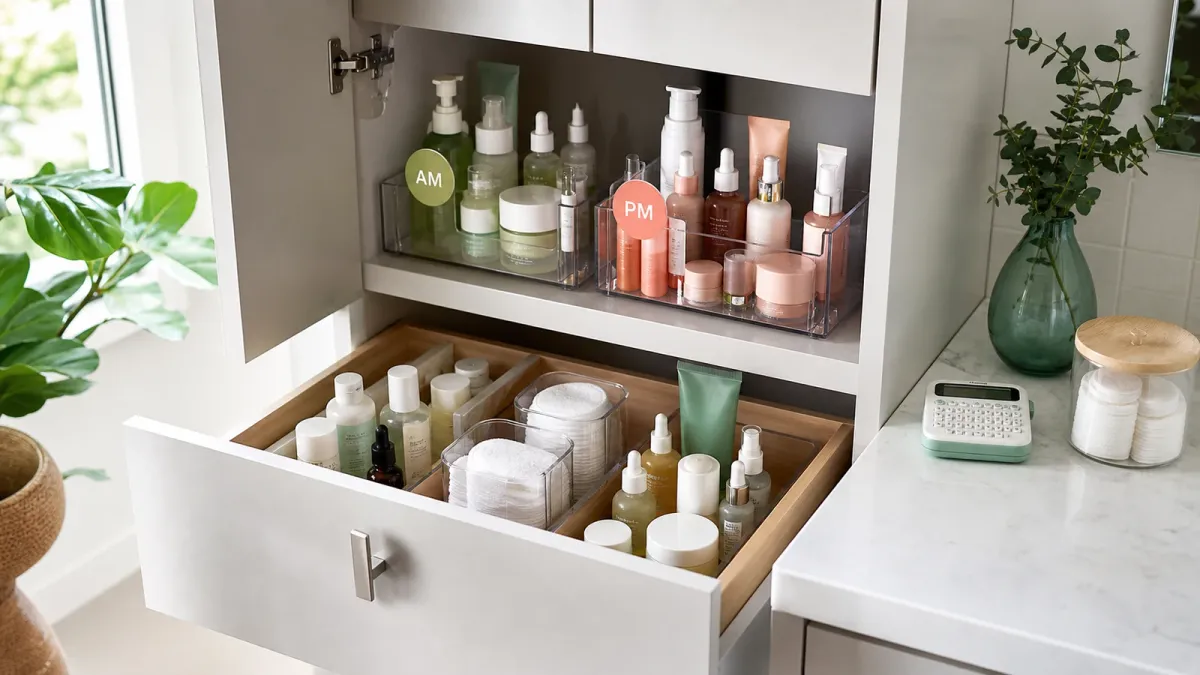
Keep only current daily essentials in a closed bathroom cabinet away from direct steam, sun and splash. Move backups, medicines and heat- or light-sensitive products to a cool, dry place according to their labels; skincare refrigeration is not required by default. Organize the current routine into AM, PM and occasional zones, preserve original packaging and check expiration, smell, color, texture and cap condition monthly.
Quick Summary
- Use a closed cabinet and move products away from shower steam and sunny windows.
- Create AM, PM and occasional-use zones in the order products are applied.
- Keep medicines and OTC drugs in original packaging and follow their labels.
- Inspect dates, condition and packaging monthly instead of collecting invisible backups.
First Decide What Belongs in the Bathroom
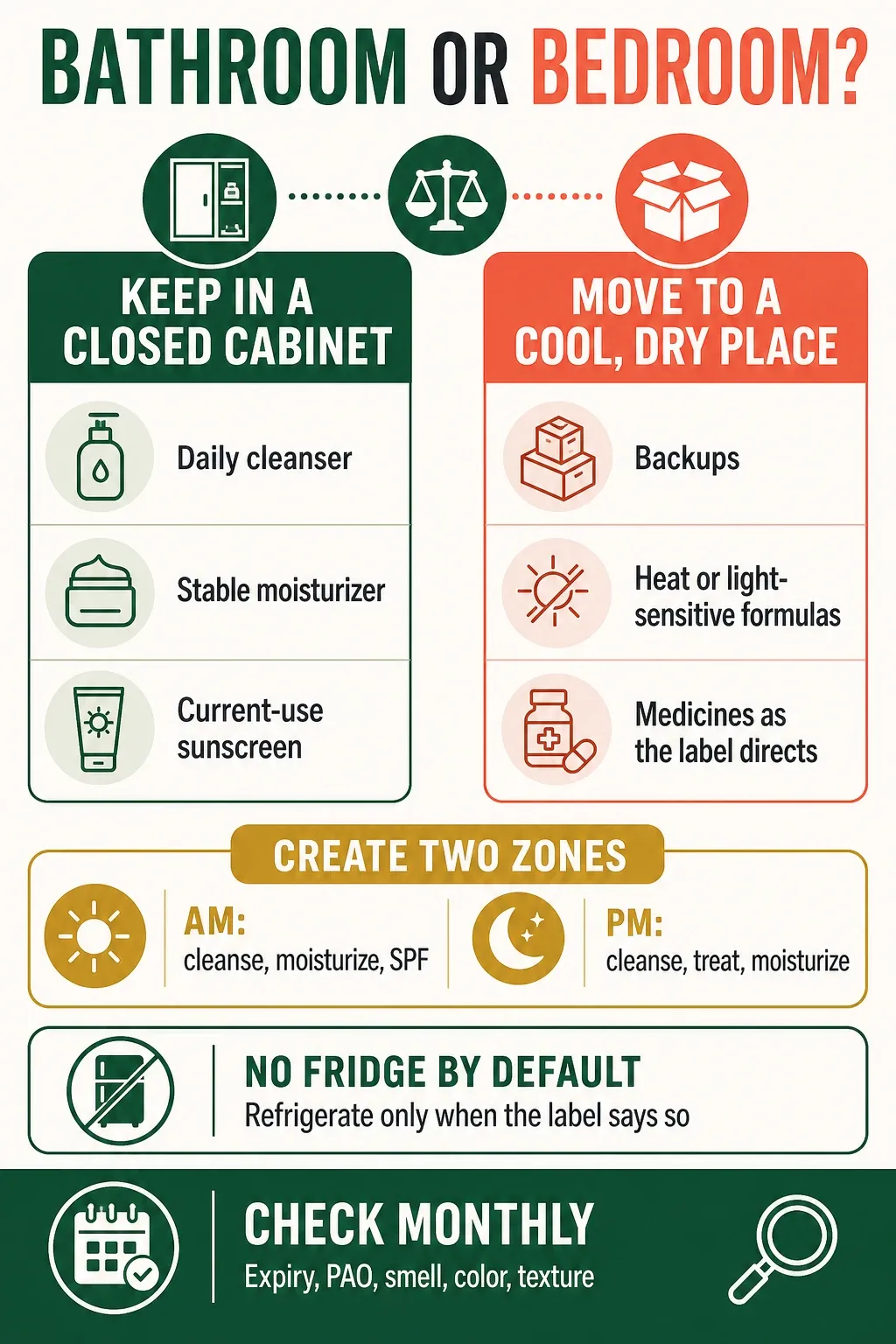
A bathroom can be convenient, but heat, humidity, sunlight and repeated handling can shorten the useful life of some products. Keep stable daily essentials in a closed cabinet away from shower spray, then move backups, medicines and heat- or light-sensitive formulas to a cooler, drier location according to their labels.
The goal is not a perfect shelf photograph. It is a storage system that protects formulas, reduces contamination, shows what you already own and puts the correct products in the order you use them. A small repeatable setup usually works better than transferring every formula into decorative containers.
| Product or category | Bathroom decision | Reason |
|---|---|---|
| Current cleanser | Usually keep in a closed cabinet or by the sink | Frequent use; cap must stay clean and dry |
| Current moisturizer | Closed cabinet if the room does not become very hot | Daily convenience without direct shower exposure |
| Sunscreen | Closed, shaded cabinet; check expiration | OTC drug stability and daily access matter |
| Retinoid or prescription treatment | Follow label or pharmacist directions | Light, heat and child-safety requirements vary |
| Backups and unopened stock | Move to a cool, dry room | They do not need daily bathroom exposure |
| Powders, cotton pads and tools | Use sealed or lidded storage | Reduces splash, dust and humidity exposure |
| Skincare refrigerator | Not needed by default | Use only when the label specifically requires refrigeration |
The FDA notes that bathroom moisture can make it easier for bacteria and fungi to grow. Heat, sunlight, air and temperature changes can also alter color, texture and smell. That does not make every bathroom unsafe, but it supports using a closed, dry cabinet rather than an open ledge beside the shower.
Read each label before creating a universal rule. Sunscreens and acne treatments are regulated as over-the-counter drugs in the United States and carry expiration dates, while many ordinary cosmetics do not. Prescription products may have specific storage instructions that take priority over organizer aesthetics.
Create AM and PM Zones
Organize by when products are used, not by bottle color or brand. An AM zone can hold cleanser, moisturizer and sunscreen. A PM zone can hold cleanser, one current treatment and moisturizer, with occasional products stored separately so they do not look like daily requirements.
Place products from left to right in use order, or front to back if the shelf is narrow. This simple sequence reduces missed sunscreen and accidental active stacking. The AM and PM routine guide helps decide what actually earns a place in each zone.
If several people share the bathroom, give each person one labeled bin rather than mixing products by category. Shared mascara, jars and applicators create hygiene problems, while duplicate-looking prescriptions can create medication errors. Keep medicines in original containers with the label readable.
Control Heat, Humidity, Light and Air
Move products away from the shower
A shelf inside or directly beside the shower experiences repeated warmth, spray and condensation. Keep shampoo and body wash there if their packaging is designed for it, but move facial serums, jars, sunscreen and treatment products into a closed cabinet. Wipe wet packaging before returning it.
Ventilate the bathroom after bathing with an exhaust fan or open window when safe and appropriate. Do not store skincare where condensation visibly collects. If the room remains damp for long periods, relocate the entire skincare routine to a bedroom dresser or hall cabinet.
Protect light-sensitive formulas
Opaque or amber packaging helps reduce light exposure, but it does not justify a sunny windowsill. Store vitamin C, retinoids and other sensitive formulas in their original packaging and follow the manufacturer's directions. Do not decant them into clear decorative bottles.
A pump or tube can reduce repeated air and finger contact compared with a wide jar, although formulation and preservation still matter. Close caps immediately and clean residue from necks and pumps. A cracked cap or failed pump is a packaging problem, not an invitation to leave the product open.
Avoid temperature cycling
Moving a product from a cold refrigerator into a steamy bathroom twice daily can create condensation and repeated temperature swings. Refrigeration is useful only when the current label or manufacturer specifically calls for it. Cooling eye gel may feel pleasant, but pleasant does not equal necessary stability.
Do not freeze skincare or place it near a radiator, heated towel rail or hot styling tool. Travel products should not remain in a parked car. Heat can degrade preservatives and change formulas even when the package looks intact.
Choose Storage by Packaging, Not Instagram Style
| Packaging | Best storage position | Practical reason |
|---|---|---|
| Pump bottle | Upright in a stable bin | Prevents tipping and keeps the pump clean |
| Dropper bottle | Upright, shaded and easy to grip | Reduces leaks and light exposure |
| Tube | Upright cap-down only when the cap seals well | Improves access without creating leaks |
| Jar | Level shelf with clean hands or spatula nearby | Reduces tipping and contamination |
| Sheet masks and flat sachets | Vertical file-style divider | Makes dates and labels visible |
| Cotton pads and reusable tools | Lidded washable container | Protects from splash and dust |
Measure the cabinet width, depth and shelf height before buying an organizer. Leave enough clearance to remove tall pumps without knocking over neighboring glass bottles. A shallow turntable can help in a deep cabinet, while a narrow riser works better when shelf height is underused.
Clear organizers make inventory visible, but they do not protect light-sensitive formulas by themselves. Put the organizer inside a closed cabinet or choose an opaque bin for sensitive products. Avoid stacking heavy jars above glass droppers where one slip can break both.
Use washable bins with straight interior corners instead of fabric baskets that absorb spills. Place a thin removable liner under oils and leaky pumps. Clean the bin when residue appears rather than waiting for a monthly reset.
Two Tools That Solve Real Organization Problems
The organizer creates stable, visible zones, while the label maker helps identify AM, PM, owner and opened-on dates. Neither product preserves skincare by itself. Measure the space, verify the current listing and use the tools only when they solve a repeated problem.
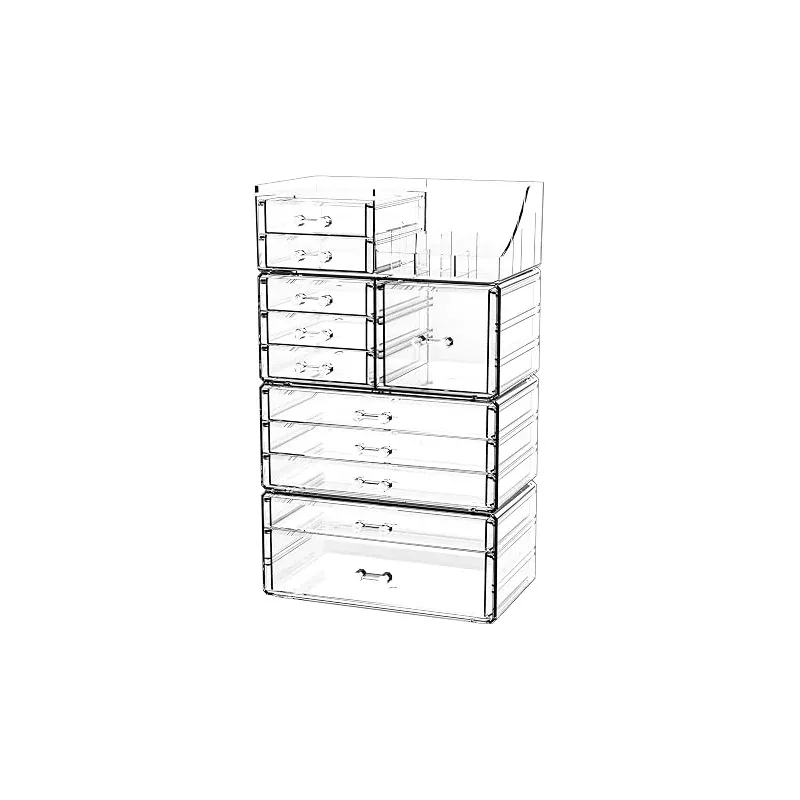
Clear Acrylic Skincare Organizer
A closed cabinet or deep shelf where small bottles disappear behind larger ones.
Separate compartments can keep current AM and PM products upright and visible without decanting them.
Watch-out: Measure width, depth and bottle height first. Clear acrylic does not protect light-sensitive formulas, so keep it out of direct sun.
View on AmazonAs an Amazon Associate, SkinOptimizer may earn from qualifying purchases. Prices, sellers and availability can change.
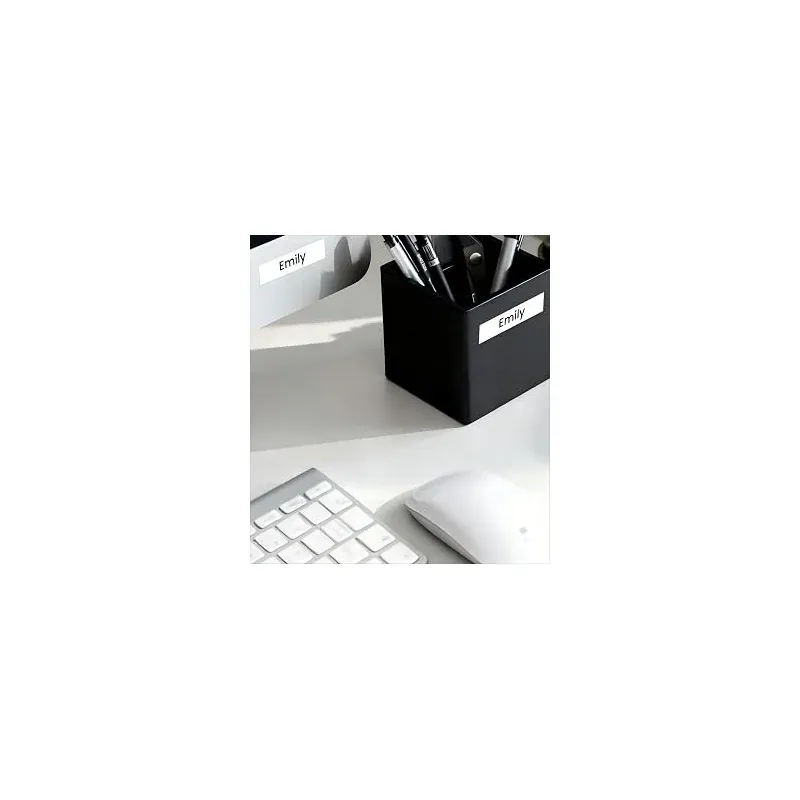
VolenGo Waterproof Label Maker
Shared bathrooms, opened-on dates and routine zones that are easy to confuse.
Short washable labels can mark AM, PM, owner, backup and opened-on dates without writing on product packaging.
Watch-out: Do not cover directions, ingredient lists, lot numbers or expiration dates. Verify app requirements and replacement-label availability.
View on AmazonAs an Amazon Associate, SkinOptimizer may earn from qualifying purchases. Prices, sellers and availability can change.
Amazon listings can change seller, dimensions and included accessories. Confirm the current product size before ordering and preserve all original skincare labels. A handwritten waterproof sticker is a valid lower-cost alternative when a dedicated label maker would add clutter.
Build a Monthly Expiry and Condition Check
Once a month, inspect every current product for its printed expiration date, period-after-opening symbol, changed smell, color, texture or separation. Check pumps and caps for cracks and remove products you no longer recognize. A five-minute review prevents the shelf from becoming invisible inventory.
Do not add water or saliva to dried mascara or another product. The FDA specifically warns that this introduces microorganisms. Eye-area products need particular care because infections can be serious.
Keep the newest backup behind the older unopened item and use first-in, first-out rotation. Do not open several identical products at once. Buying a multipack saves money only when the products remain stable and are used before their dates.
Photograph lot numbers and receipts for products with an unusual reaction, then stop using the item. Do not retain a leaking or contaminated bottle merely because it was expensive. Contact the manufacturer or seller when packaging fails.
Keep Medicines and High-Risk Products Separate
Prescription creams, strong acne treatments and other medicines should remain in original labeled packaging. Follow the storage temperature on the label and ask a pharmacist when the instruction is unclear. Do not transfer a prescription into an unmarked cosmetic jar.
Store medicines and potentially harmful products out of sight and reach of children, using a locked location when appropriate. Child-resistant packaging is not child-proof, and a high shelf alone may not be enough as children climb. Keep emergency information accessible without leaving the product accessible.
Poison Control's medicine-safety guidance reinforces secure storage and original packaging. For sunscreen, follow the printed expiration and storage directions; the FDA sunscreen guidance also explains that an expired product should be discarded.
Households with pets should also secure products. Retinoids, minoxidil and essential oils can pose risks if licked or ingested. Wipe spills immediately and keep cotton pads carrying active product in a closed trash container.
How to Organize a Small Bathroom
Limit the visible routine to one cleanser, one moisturizer, one sunscreen and one current treatment. Use the back of a cabinet door only for lightweight, securely mounted items. Avoid adhesive racks above a toilet or sink where failure would contaminate or break products.
A narrow vertical riser uses cabinet height without increasing footprint. Put tall bottles at the back only when labels remain visible and shorter items can be removed safely. A shallow tray is better than a deep basket when you need to see every active.
Keep backups outside the bathroom in one labeled box. Add a simple inventory note with product and quantity, then check it before shopping. The minimalist skincare routine helps reduce duplicates that do not have distinct jobs.
Organizing for Acne, Retinoids and Sensitive Skin
Separate potentially irritating actives from the core routine. Put the current acne or retinoid product in a small PM treatment zone and store exfoliating acids elsewhere on nights they are not used. This visual separation reduces accidental stacking.
For sensitive skin, keep a “reset” group with gentle cleanser, familiar moisturizer and sunscreen. When burning or a rash appears, the basic routine is immediately available. The sensitive-skin moisturizer guide can help choose one dependable product.
Use different colored labels for prescription and cosmetic products, but never cover the pharmacy label. If medication schedules are complex, use a written plan from the prescriber rather than relying on bottle placement. The slow-start routine explains why one active at a time is easier to tolerate and trace.
Keep the routine order visible when several leave-on steps remain necessary. The serum and moisturizer layering guide prevents storage order from becoming application confusion, while the retinol versus bakuchiol guide helps separate treatment nights from ordinary hydration.
Travel and Backup Storage
Use travel-size original packaging when available or a clean, compatible container for ordinary cosmetics when the manufacturer permits decanting. Label the container with product and date. Do not decant sunscreen, prescription medication or air- and light-sensitive formulas when packaging is part of stability.
Place liquids in a sealed pouch and keep glass droppers padded. Do not leave the bag in a hot car or checked luggage for longer than necessary. On arrival, store products away from a sunny hotel bathroom window.
Bring only the routine you will use. Travel is a poor time to test a new peel, fragranced mask or high-strength active. The reapplication guide can help decide what sunscreen format belongs in the day bag.
Common Bathroom Organization Mistakes
- Keeping everything on an open shelf: steam, splash and light reach every package.
- Decanting for aesthetics: directions, lot numbers and protective packaging are lost.
- Buying a skincare fridge by default: few ordinary formulas require refrigeration.
- Hiding products in deep bins: duplicates expire because nobody sees them.
- Mixing every active together: placement can encourage unsafe routine stacking.
- Ignoring dimensions: a beautiful organizer is useless when pumps do not fit.
Another mistake is cleaning organizers with a fragranced spray and returning products before the surface dries. Use an appropriate mild cleaner, rinse or wipe as required and dry completely. Keep cleaning chemicals away from open jars and applicators.
When a Product Should Be Discarded
Discard a product when it is past a required expiration date, has an unexplained change in smell, color or texture, shows visible contamination, or has compromised packaging. Stop using anything linked to swelling, blistering or a spreading rash. When uncertain, contact the manufacturer with the lot number.
Separation is not always failure because some formulas instruct users to shake them. Compare the change with the label and original appearance. Do not keep a questionable eye product while waiting to see whether irritation returns.
A 20-Minute Bathroom Reset
Remove every product, wipe and dry the cabinet, then discard obvious waste. Sort remaining items into current AM, current PM, occasional, backup and medicine groups. Return only the current routine to the bathroom.
Place products in use order and add opened-on labels where useful. Move backups to a cool, dry area and record what you own. Schedule the next check for one month rather than waiting for clutter to return.
After one week, notice where the routine breaks. If sunscreen is forgotten, move it forward; if a bottle leaks, change its position or bin. Organization is a workflow that can be adjusted, not a decorative final state.
The Bottom Line
Keep a small current routine in a closed bathroom cabinet away from steam, direct sun and splash. Store backups and sensitive products in a cool, dry place, follow every medicine and OTC-drug label, and skip refrigeration unless the manufacturer requires it. Organize by AM, PM and occasional use so the system improves both product care and routine decisions.
Frequently Asked Questions
Is it bad to store skincare in the bathroom?
Not automatically. Stable current-use products can stay in a closed, dry cabinet away from shower steam, direct sun and splash. Move backups and sensitive formulas elsewhere.
Should skincare be kept in a refrigerator?
Usually not. Refrigerate only when the current label or manufacturer specifically requires it. Repeated cold-to-steamy temperature changes can be unhelpful.
How should I organize an AM and PM skincare routine?
Place morning cleanser, moisturizer and sunscreen in one use-order zone. Put nighttime cleanser, current treatment and moisturizer in a second zone, with occasional exfoliants stored separately.
How do I know when skincare has expired?
Check required expiration dates and period-after-opening guidance, then watch for changed smell, color, texture, separation or damaged packaging. When uncertain, contact the manufacturer with the lot number.
Can I decant skincare into matching bottles?
Avoid decanting sunscreen, medicines and light- or air-sensitive formulas. Original packaging protects the formula and preserves directions, lot numbers and expiration information.