How to Add Kojic Acid into Skincare: Tips for Radiant Skin
A practical guide to choosing one kojic acid product, testing a small area and deciding when to pause.
In this guide
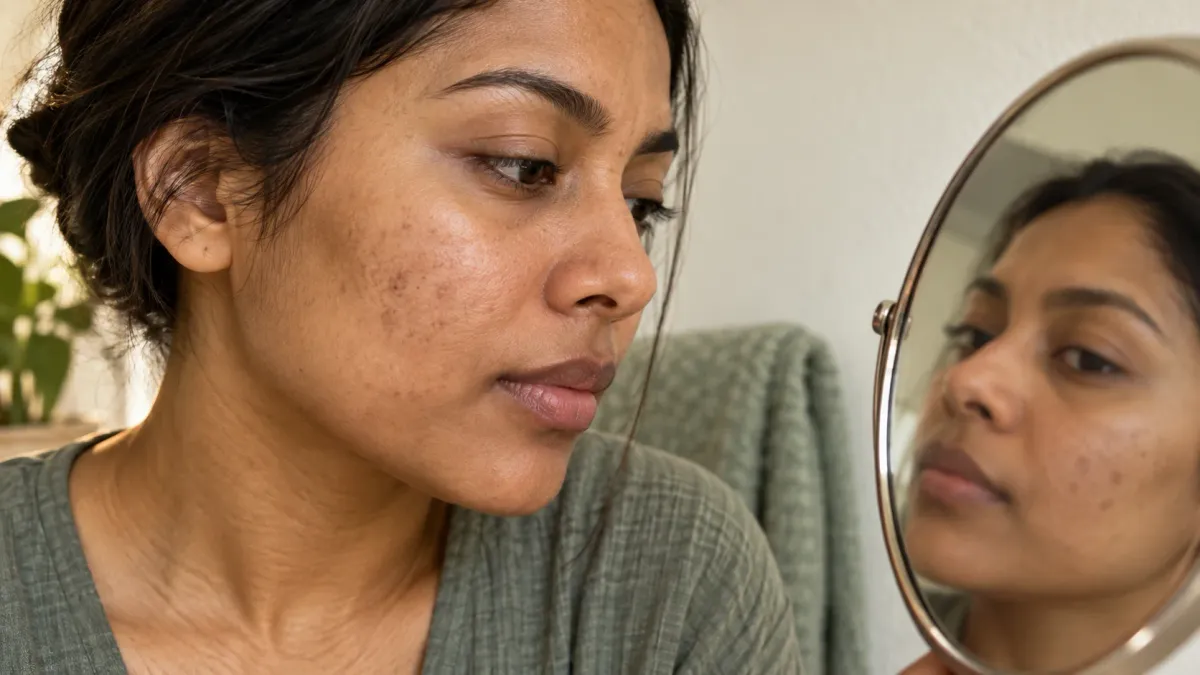
Quick Answer
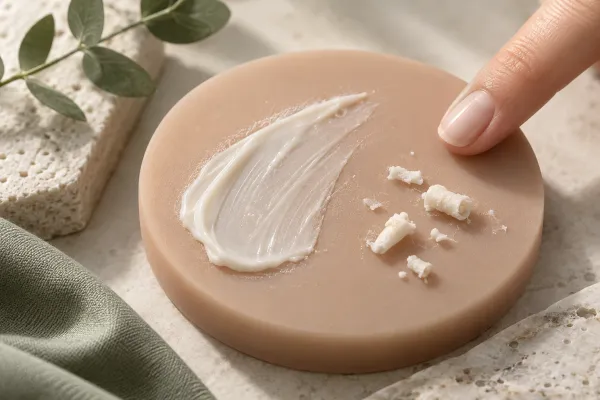
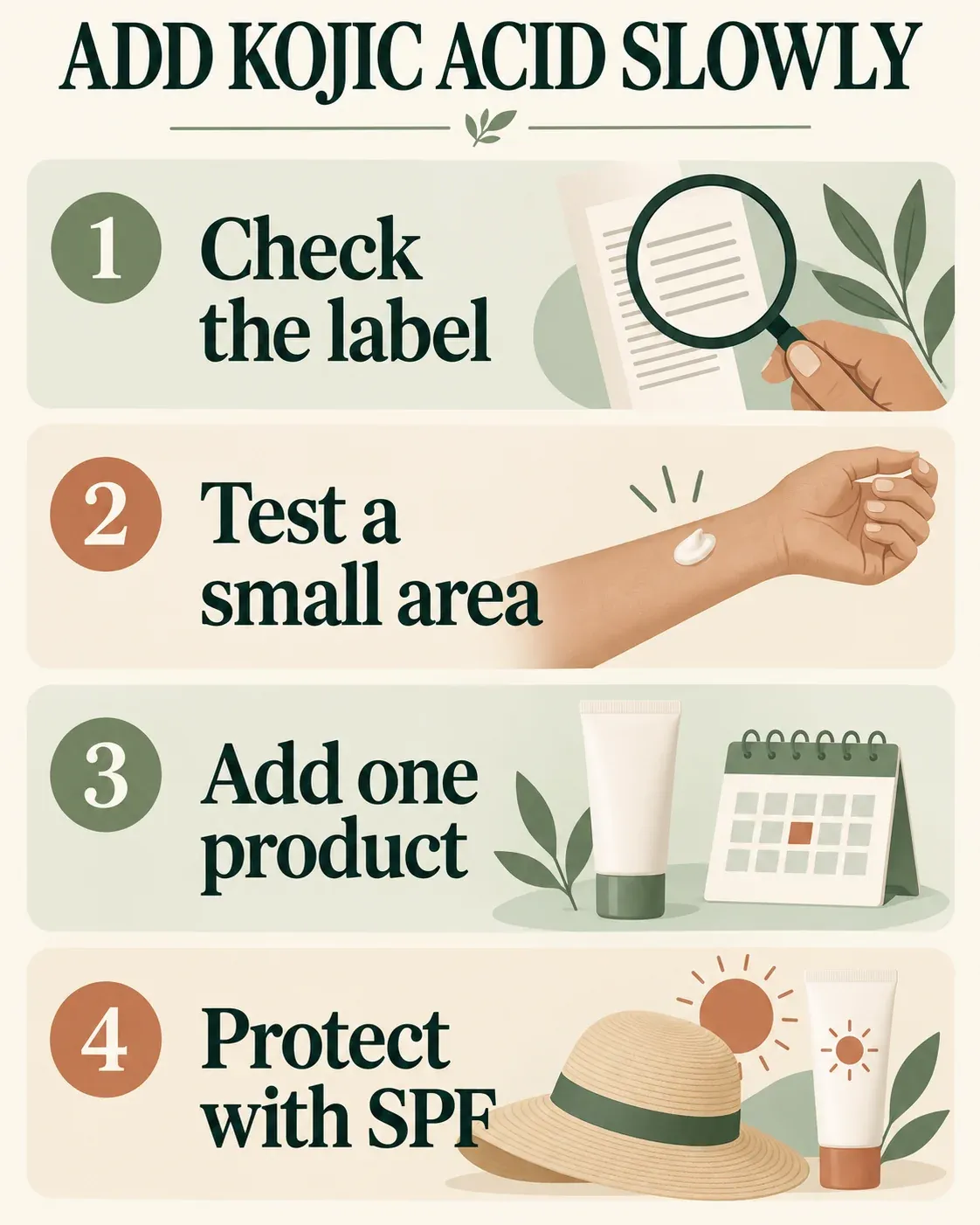
To add kojic acid into skincare, choose one clearly labeled product, test it on a small area, and introduce it without adding other new actives. Follow that product's directions: a cleansing bar washes off, while a serum or cream may stay on.
Use a moisturizer and daily sun protection. Avoid starting on irritated, broken, or recently treated skin, and stop if a rash, persistent burning, or swelling develops.
Kojic acid may help some brown discoloration, but it does not fill indented scars. If the mark is changing or you are unsure what it is, get it assessed before trying to fade it.
Quick Summary
- Choose a target: a flat brown mark is different from redness, an active breakout, or an indented scar.
- Read the whole formula: added exfoliants or retinoids change the routine decision.
- Keep the test simple: one new product, familiar basics, and a short record of use.
- Protect progress: sun protection matters more than collecting additional brightening products.
Your introduction plan in 12 seconds
Editorial note: SkinOptimizer is an editorial skincare resource, not a medical practice. We reviewed dermatology guidance and published research for this substantial revision; we have not clinically tested these products or verified individual treatment outcomes.
Updated: . Originally published November 17, 2024. Product guidance, study limitations and introduction steps reviewed.
Knowing how to add kojic acid into skincare starts with deciding what you want to change. A dark mark after a healed spot creates a different question from repeated acne, widespread patches, or skin that already feels sore.
Choose a formula for a specific concern and check whether your skin tolerates it. Adding more brightening products makes it harder to identify which one helps or causes a reaction.
This guide helps organize cosmetic choices rather than prescribe treatment. If you already follow a clinician's plan, use that plan as the starting point instead of inserting another active independently.
The Skin Insider
A routine can look simple while containing several actives. A kojic soap, exfoliating moisturizer, and retinol serum are three separate decisions, even when each product has a different marketing label.
Write down the complete product names before changing anything. That small inventory makes overlap easier to spot and gives a clinician something concrete to review if irritation develops.
What kojic acid can do for dark spots
Kojic acid is used in pigmentation products because it inhibits tyrosinase, an enzyme involved in making melanin. That mechanism explains the interest in brown discoloration; it does not establish how well every finished cosmetic will work.
In an 80-person randomized melasma study, researchers compared a 1% kojic acid cream with several combinations over 12 weeks. Results depended on the formulation, and the combination with hydroquinone performed best in that study.
That is not a recommendation to mix hydroquinone or steroid creams yourself. It is a reason to separate supervised treatment research from claims about a bar of soap bought online.
A 30-participant split-face pilot published in the 2025 journal issue tested a kojic acid and alpha-arbutin combination for 12 weeks, with four weeks of follow-up. It did not isolate kojic acid's contribution or establish that an over-the-counter product is equivalent to prescription treatment.
Do not interpret a small trial as proof that a cosmetic replaces prescription treatment. For a broader starting framework, see our hyperpigmentation routine guide.
- Brown, flat marks: pigment-focused care may be relevant once the cause is understood.
- Indented or raised scars: color improvement and structural scar treatment are different goals.
- Ongoing acne: address new breakouts instead of only chasing the marks they leave.
- Changing or unexplained spots: assessment comes before brightening experiments.
Our scar routine overview distinguishes flat discoloration from changes in skin texture. A pigment-focused cosmetic should not be expected to fill an indented scar.
Choose the format before choosing the routine
A kojic acid soap and a leave-on serum are not interchangeable. Contact time, cleansing ingredients, and the rest of the formula differ, so you should not copy instructions from one format to another.
| Format | Practical fit | Decision limit |
|---|---|---|
| Wash-off cleanser | Replaces an appropriate cleansing step when its directions suit your skin. | Rinse as directed; do not turn it into a leave-on mask. |
| Leave-on serum | A separate step whose placement follows the label. | Check for additional actives before pairing it with existing treatments. |
| Leave-on cream | May combine pigment-focused ingredients with a cream texture. | Texture alone does not establish concentration, gentleness, or effectiveness. |
If you already have a cleanser you tolerate, buying a brightening cleanser is not automatically the easiest change. You may prefer to preserve that familiar step while reviewing a single leave-on option.
Conversely, a wash-off product does not need an extra serum simply to make the routine feel complete. Choose according to the label and your actual gap, not the idea that every category needs representation.
Read the ingredient name and concentration carefully
The European Commission's SCCS opinion assessed kojic acid as a cosmetic skin-lightening ingredient at concentrations up to 1%. It also flagged increased absorption through a weakened barrier and did not evaluate certain kojic acid derivatives.
This assessment is not a personal safety guarantee or a universal instruction for all countries. It does not justify picking the highest percentage you can find or applying a product over a much larger area than intended.
For a cautious consumer decision, look for a manufacturer that clearly identifies the ingredient, intended area, directions, and relevant warnings. If the concentration is unclear, ask the manufacturer rather than estimate it from the ingredient's position.
Kojic acid dipalmitate is not simply another way of writing kojic acid. Do not transfer percentages or study results between them without evidence about that specific ingredient and finished formula.
- Keep a photo of the box and complete ingredient list.
- Check whether the product is intended for the face, hands, or another area.
- Look for added exfoliating acids, retinoids, and fragrance.
- Skip DIY powder mixtures and products with unclear directions.
How to add kojic acid into skincare step by step
First, establish a comfortable baseline
Before introducing a new active, identify the cleanser, moisturizer, and sunscreen you already tolerate. If even your familiar routine feels uncomfortable, this is not the right moment to test an additional pigment product.
Our skin barrier reset guide offers a simpler framework. Recent peels, procedures, persistent irritation, or prescription treatment deserve individual advice about when another product is appropriate.
Take one neutral reference photo if you want to track a particular mark. Keep the lighting and distance repeatable, and avoid filters; a dramatic change in bathroom lighting can make an ordinary comparison misleading.
Test a small area before wider use
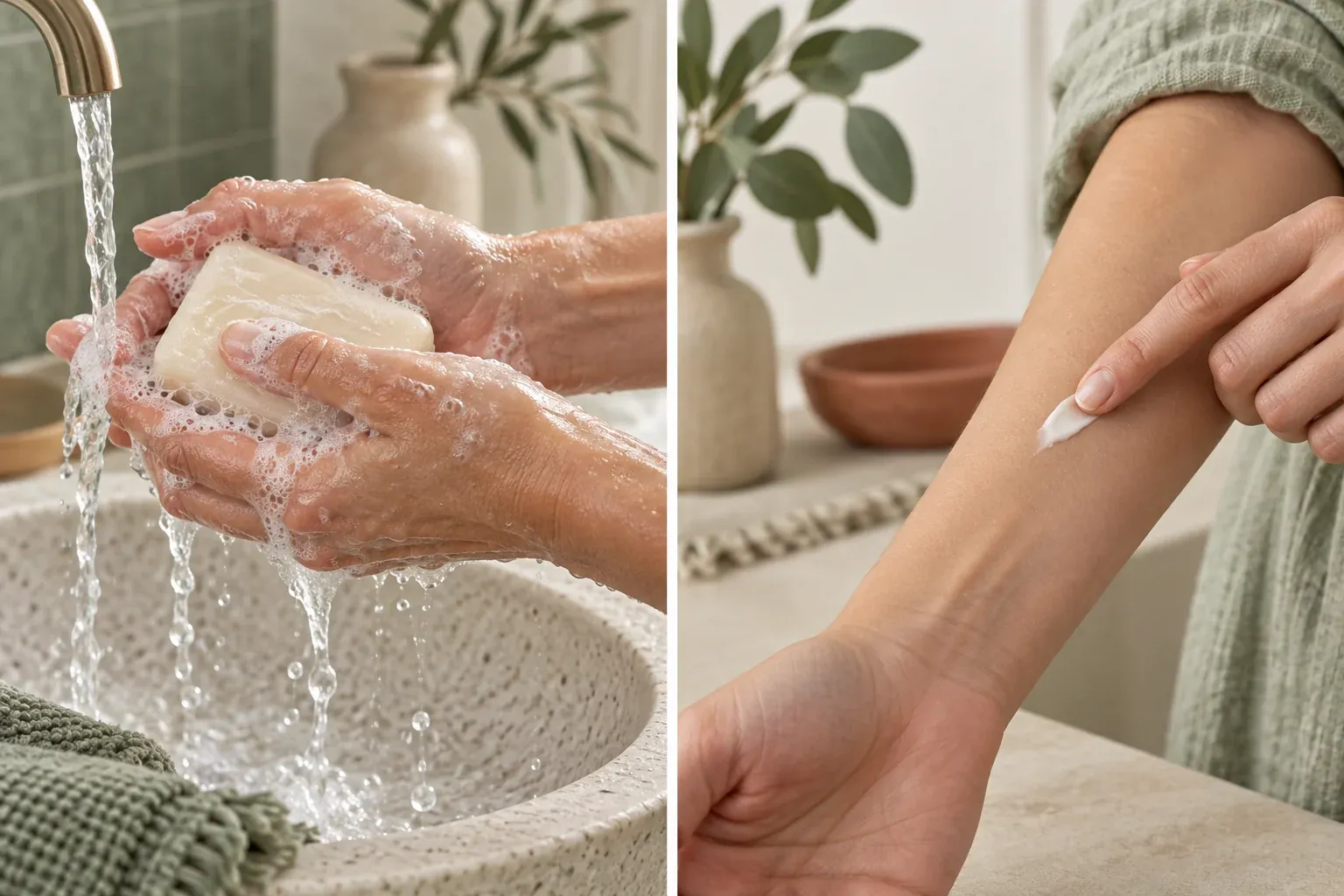
The AAD's product-testing guidance recommends a small-area test over seven to ten days, generally twice daily. Respect the product's own contact-time and frequency restrictions rather than exceeding them to complete a test.
Use an intact area such as the inner arm. Rinse a wash-off formula as instructed; a cleanser test is not permission to leave lather on overnight.
If redness, itching, or swelling develops, wash it off gently and stop using it. A home test can miss later reactions and is not the same as diagnostic patch testing performed by a clinician.
Introduce one change, not an entire brightening set
After a tolerated test, keep the rest of the routine familiar. A conservative editorial approach is to try the new product on a few separated occasions first, within its directions, rather than automatically starting twice-daily full-face use.
This is a way to observe tolerance, not a clinically proven kojic acid dosing schedule. The correct frequency depends on the specific formula, your skin, and any treatment advice you have received.
- Cleanse gently: remove what needs removing without adding an unnecessary third cleansing step.
- Use the chosen formula: wash off or leave on exactly as its directions require.
- Moisturize if needed: keep the familiar product that already suits your skin.
- Protect during the day: use suitable sunscreen and other sun-protection habits.
If you prefer an evening introduction, keep mornings simple. Evening use is an organizational choice, not a reason to skip daytime protection or a guarantee that irritation cannot happen.
For basic order questions, use our serum and moisturizer layering guide. If a manufacturer's directions differ from a generic diagram, do not silently replace them with the diagram.
A simple first-use plan
Suppose you already tolerate a gentle cleanser, plain moisturizer and morning sunscreen. A leave-on kojic acid product would be the only new step; do not also replace the cleanser with a brightening soap.
Complete the small-area test first. For wider use, follow the label's amount, application area and frequency, then keep a note of when you used it and how your skin felt.
If you choose a wash-off formula instead, use it as the directed cleansing step and rinse it off. Keep the familiar moisturizer afterward rather than adding a second kojic product for extra strength.
A moisturizer option if your routine needs one
If your current moisturizer is comfortable, keep it. Vanicream Daily Facial Moisturizer is one option to compare when you need a lightweight facial lotion without adding another brightening active.
As an Amazon Associate, we earn from qualifying purchases.

Vanicream's current label lists squalane, glycerin, hyaluronic acid and five ceramides. This is the Daily Facial Moisturizer, not the richer Moisturizing Cream or the SPF 30 version.
Buy it if: You want a lighter facial lotion and its complete ingredient list fits your known sensitivities.
Skip it if: You already have a comfortable moisturizer, need sunscreen in this step, or react to an ingredient in this formula.
A lightweight lotion may not provide enough comfort for very dry skin. We have not independently wear-tested it with kojic acid, and a sensitive-skin label cannot guarantee tolerance.
View Vanicream Daily Facial Moisturizer on AmazonCheck the exact version, seller and current label before buying. Price and availability can change.
Can you combine kojic acid with other actives?
The useful question is not whether two ingredient names are always forbidden together. It is whether your full routine, product formulas, and skin condition make another change sensible.
A study of a finished combination cream tests that formulation. It does not establish the effectiveness or tolerance of layering separate products with the same ingredient names.
| Existing step | Cautious default | Why it helps |
|---|---|---|
| Familiar moisturizer | Keep it if comfortable. | Preserves a known baseline while one variable changes. |
| Retinol or prescription retinoid | Review the whole plan before adding kojic acid. | Avoids changing an established treatment independently. |
| Exfoliating acids | Do not introduce both together. | Makes reactions easier to interpret. |
| Another brightening serum | Ask whether it fills a distinct gap. | Reduces redundant experimentation and cost. |
If you already use vitamin C comfortably, there is no obligation to add kojic acid for a more impressive ingredient list. Our vitamin C serum comparison can help you evaluate that existing step instead.
Do not stop prescribed acne or pigmentation medication just to make room for a cosmetic. Bring the new product's label to the prescriber and ask whether it fits, replaces anything, or should wait.
The Optimizer's Edge
Change only one part of the routine at a time: the product, its frequency or a pairing. Keeping the other steps familiar makes it easier to trace a reaction.
A short note is enough: “Used the new cream Tuesday evening; no other changes.” Record any dryness, stinging or rash alongside it.
Sun protection belongs in the plan from day one
The AAD's dark-spot guidance places sunscreen at the center of care and recommends tinted, iron-oxide sunscreen with broad-spectrum SPF 30 or higher and water resistance. Visible light can contribute to pigmentation concerns.
Choose a tint and texture you can actually wear, alongside shade and protective clothing. Follow the sunscreen label for application and reapplication, particularly during outdoor activity, sweating, or swimming.
Use sun protection while managing discoloration to limit further exposure-related darkening. This advice does not depend on claiming that every kojic acid formula causes photosensitivity.
Our sunscreen reapplication guide addresses practical obstacles. If protection is inconsistent, improve that habit before spending on another brightening step.
When to pause and when to get help
Burning or a rash does not show that dark spots are fading. Stop the new product if it causes a reaction, even if other people report tolerating it.
| What you notice | Next step | Avoid |
|---|---|---|
| Persistent stinging or new rash | Stop the new product and seek advice if symptoms persist. | Increasing frequency to “push through.” |
| Marked swelling, blistering, or severe pain | Seek prompt medical assessment. | Experimenting with more actives. |
| Breathing difficulty or rapidly spreading swelling | Seek emergency help. | Waiting for a skincare routine adjustment. |
| No visible fading, but comfortable skin | Review the goal, label, and progress before changing anything. | Automatically escalating concentration. |
If a spot changes shape, bleeds, or otherwise concerns you, arrange an assessment instead of trying to conceal the change with a brightener. Cosmetic trial-and-error is not a diagnostic method.
Pregnancy, breastfeeding, childhood use, known allergies, and active skin disease need individualized product advice. Do not infer suitability for those situations from a general adult cosmetic study or an online ingredient summary.
Track comfort first, then decide whether to continue
Research commonly follows participants for weeks rather than days. Both studies used 12-week treatment periods; neither establishes a deadline for your chosen product to clear a mark.
Choose a review date rather than checking the mirror repeatedly. Compare the same area in similar lighting, then consider whether the routine has remained comfortable and realistic to maintain.
- Product: record the full name and when you started it.
- Use: note which days you applied it and any other changes.
- Comfort: record stinging, dryness, itching, or a new rash.
- Decision: continue within directions, stop, or ask for professional review.
If nothing seems to change, revisit whether pigment is the right target. Our guide to dark spots on darker skin offers broader context; an assessment may be more useful than another brightening product.
Supplementary video. Follow your product's directions and the safety guidance in this article; the linked research supports the written advice.
Your Clear Skin Checklist
- Identify whether the concern is pigment, redness, active acne, or texture.
- Check the complete formula, directions, and intended application area.
- Test first, then introduce only one new product.
- Keep moisturizer and sun protection consistent.
- Stop for concerning reactions instead of escalating the routine.
Frequently Asked Questions About Kojic Acid in Skincare
Discussions about overlapping actives, kojic acid soap and redness after a new product informed these questions. Community experiences are not evidence of effectiveness or safety.
Can I use kojic acid with retinol or Differin?
Do not assume that a combination is suitable because both products are available without a prescription. Review their directions and your existing routine; if a clinician manages your retinoid treatment, ask before adding kojic acid.
Introducing them together makes reactions harder to interpret. Separate scheduling is not a guarantee of tolerance.
Does kojic acid soap count as another active product?
Yes, include it when reviewing the routine rather than treating it as irrelevant because it rinses off. Check its full ingredient list and contact-time directions, especially if other steps already contain exfoliants or retinoids.
Should kojic acid burn when it is working?
No: burning is not a measure of pigment improvement. Stop for persistent burning, itching, swelling, or a rash, and seek medical advice for significant or continuing symptoms instead of increasing use.
How often should a beginner use kojic acid?
There is no single schedule for every soap, serum, and cream. Follow the specific label, test a small area first, and introduce it cautiously without exceeding the directions; do not automatically copy another person's twice-daily routine.
How long does kojic acid take to fade dark spots?
Expect assessment over weeks, not an overnight transformation, but no universal deadline is established for every product. The studies discussed used 12-week periods with particular formulations; their results do not guarantee that your marks will fade on that schedule.
Before your first application
Check the product label, test a small area and keep the rest of your routine familiar. If your skin is already sore or your marks are unexplained, postpone the new active and get advice.
This article is for informational purposes only and does not replace professional dermatological advice.