Effective Skincare Routine for Scars: Heal and Restore Your Skin's Natural Glow
Discover an effective skincare routine to heal scars and restore your skin's natural glow!

In this guide

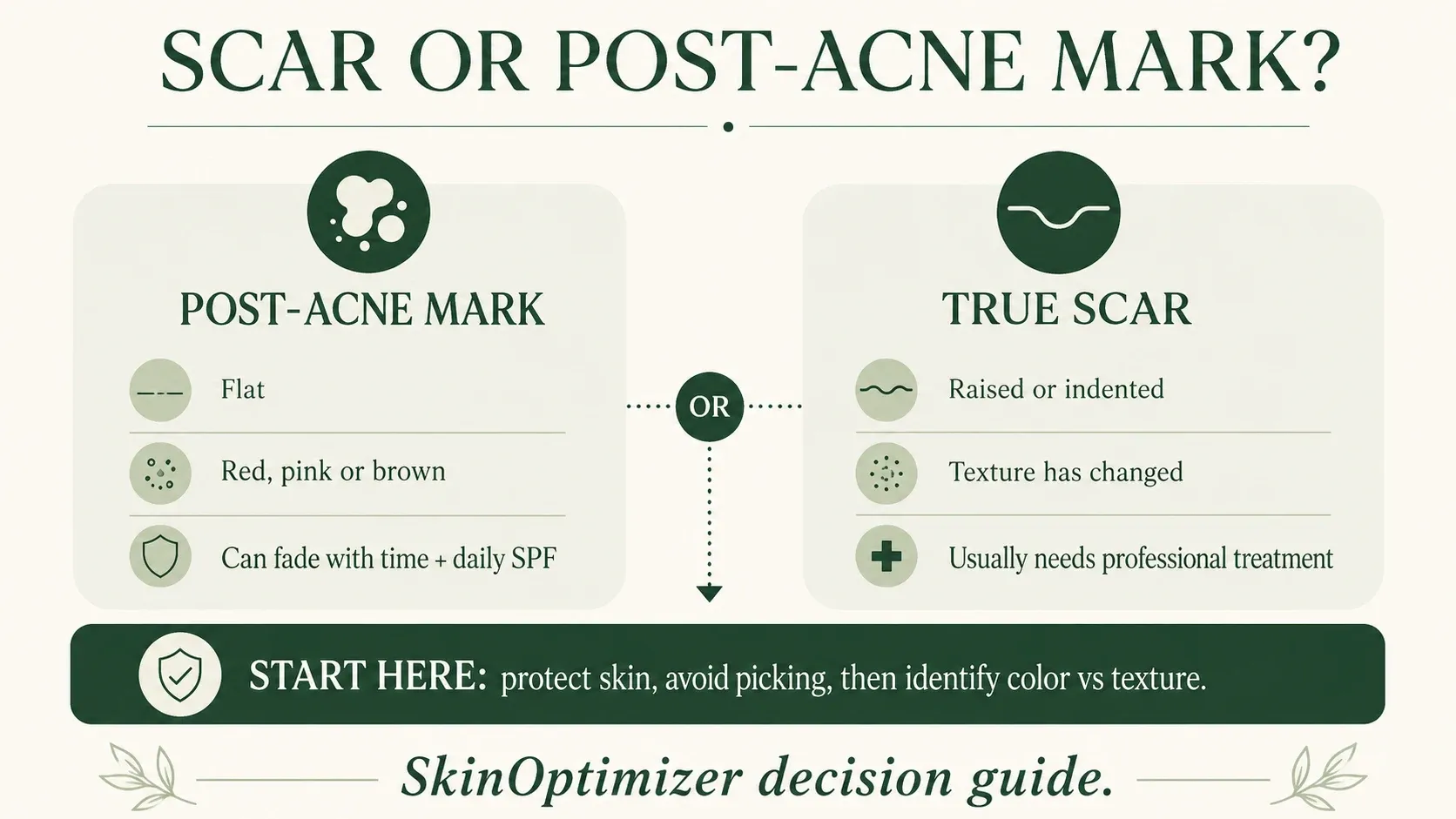
A useful skincare routine for scars starts by identifying what you actually have. Flat red or brown post-acne marks may fade with sun protection, acne control, and a carefully chosen active, while indented or raised scars usually need a dermatologist-led treatment plan.
Keep the daily routine simple: gentle cleansing, moisturizer when needed, broad-spectrum SPF 30 or higher, and no picking. Do not apply strong actives or silicone products to an open, infected, or unhealed wound.
- Flat color change: skincare can often help, but improvement is gradual.
- Indented texture: creams cannot lift a deep pit or release a tethered scar.
- Raised tissue: silicone may be useful after closure, but growing or painful scars need medical guidance.
- Active acne: prevent the next scar before adding several brightening products.
- Any routine: irritation is not proof that a product is working.
SkinOptimizer is an educational skincare publication, not a medical clinic. We reviewed guidance from the American Academy of Dermatology, Mayo Clinic, and NHS, then translated it into a routine that makes clear what topical skincare can and cannot do.
Audio archive: the player above is preserved from the original 2024 article. The written guide below was medically rechecked and substantially updated in September 2026, so use the written version as the current reference.
A skincare routine for scars should not begin with a shopping list. It should begin with a classification, because a flat dark mark, a red mark, a pitted acne scar, a raised keloid, and a healing surgical incision are different problems.
The word “scar” is used loosely online, which creates unrealistic expectations. The American Academy of Dermatology explains that color left after acne is often post-inflammatory hyperpigmentation rather than a true structural scar.
This guide focuses on closed, healed skin. If a wound is open, draining, increasingly painful, warm, or swollen, pause cosmetic skincare and ask a qualified clinician for advice.
First, Identify the Scar, Mark, or Wound
| What you notice | Likely category | What skincare can do |
|---|---|---|
| Flat brown, gray, or tan area after inflammation | Post-inflammatory hyperpigmentation | Help prevent darkening and support gradual fading |
| Flat pink, red, or purple area | Post-inflammatory erythema or vascular color | Reduce irritation and protect the area; color may fade slowly |
| Ice-pick, boxcar, or rolling depression | Atrophic acne scar | Support skin health, but not rebuild deep lost structure |
| Firm tissue above the surface | Hypertrophic or keloid scar | Support protection; clinician-directed options are often needed |
| Crust, drainage, warmth, or broken skin | Healing or possibly complicated wound | Avoid cosmetic actives and seek wound-specific guidance |
Run a fingertip lightly over clean skin without pressing. If the area is flat and only the color changes, a pigment- or redness-focused routine may be reasonable.
For flat brown marks, the kojic acid introduction guide explains how to evaluate one pigment-focused product while keeping structural scars and redness separate.
If light creates a shadow because the skin is indented, the concern is structural. Our guide to acne scar treatment options by scar type and skin tone explains why procedures are matched to ice-pick, boxcar, rolling, and raised scars instead of treating them as one category.
Raised scars also require careful identification. A hypertrophic scar stays within the original injury boundary, while a keloid can extend beyond it; neither should be managed with aggressive exfoliation.
A Simple Morning and Evening Skincare Routine for Scars

A longer routine is not automatically a better routine. The best base is the one you can repeat without burning, peeling, or triggering more breakouts.
Step 1: Cleanse only as needed. Use a gentle cleanser after sweating or when oil and residue are present. Very dry or reactive skin may need only a water rinse in the morning.
Step 2: Use one optional treatment. Choose a well-tolerated antioxidant, azelaic acid, or niacinamide product only when it matches a flat-mark or acne goal.
Step 3: Moisturize for comfort. A plain moisturizer can reduce dryness and improve adherence to acne treatments.
Step 4: Apply broad-spectrum SPF 30 or higher. Use enough for exposed skin and reapply during extended outdoor exposure.
Step 1: Remove sunscreen and makeup gently. Avoid repeated scrubbing or a harsh brush over the area.
Step 2: Apply one main active. A retinoid, azelaic acid, or exfoliating acid may fit some routines, but starting all three together makes irritation harder to diagnose.
Step 3: Moisturize. Apply before or after a retinoid when that approach helps you tolerate it.
Step 4: Leave the skin alone. Picking, squeezing, and repeatedly checking texture under harsh light can prolong inflammation and increase scar risk.
If acne is still appearing, prevention has the highest value. The AAD advises early acne treatment and avoiding picking because deeper inflammation is more likely to leave a scar.
Use our evidence-based acne prevention plan to choose a breakout strategy before building a separate fading routine. For persistent flat redness, the guide to post-acne redness separates barrier care from treatments that require professional input.
The most useful progress photo is not a close-up taken whenever you feel discouraged. Use the same room, distance, camera, and indirect light every four weeks so shadows do not turn normal texture into apparent worsening.
Choose Ingredients by the Problem, Not by the Hype
No single ingredient treats every form of scarring. A topical may reduce active acne or uneven color while doing very little for a deep depression or raised collagen.
| Ingredient or tool | Best-fit goal | Boundary or watch-out |
|---|---|---|
| Topical retinoid | Active acne, clogged pores, and some post-acne dark marks | Can irritate; introduce slowly and ask about pregnancy or medication-specific restrictions |
| Azelaic acid | Acne plus uneven tone or redness-prone skin | Can sting at first; does not lift pitted scars |
| Vitamin C or niacinamide | Support for uneven tone in a stable routine | Formulation and tolerance matter; not a structural scar treatment |
| AHA or BHA exfoliant | Surface roughness, clogged pores, or selected pigment concerns | Overuse can worsen irritation and discoloration |
| Silicone gel or sheet | Some closed, raised scars | Not for open wounds and not a treatment for acne pits |
Retinoids: a topical retinoid is mainly an acne-control and cell-turnover tool, not a filler for holes in the skin. The AAD’s acne treatment guidance notes that retinoids can clear pores and help lighten dark spots after acne.
Start on a stable moisturizer-and-sunscreen base. If irritation develops, reducing frequency or using moisturizer first may improve tolerance, but prescription directions should be changed with the prescriber.
Azelaic acid: this can be a practical choice when acne and post-inflammatory color overlap. Our azelaic acid format and strength guide explains how to compare products without assuming the highest percentage is always best.
Vitamin C and niacinamide: these may support a tone-focused routine, but they are optional. If sunscreen, acne control, and moisturizer are not consistent, another serum is usually not the missing foundation.
AHAs and BHAs: exfoliating acids can improve surface feel or help a clogged-pore routine. They cannot release a tethered rolling scar, and excessive use can create burning, peeling, and more visible color change.
Silicone: silicone gel or sheets are relevant to some closed, raised scars, including certain surgical or injury scars. The NHS scar overview lists silicone dressings or gels among options a clinician may recommend, alongside treatments for more severe scars.
Do not use kitchen remedies as scar actives. Lemon juice, baking soda, rough sugar scrubs, undiluted essential oils, and repeated rubbing can irritate skin without remodeling a true scar.
Aloe, rosehip oil, or a bland facial oil may make dry skin feel softer, but comfort is not the same as scar removal. Patch test any optional product and stop if itching, swelling, or persistent burning appears.
How to Introduce an Active Without Damaging the Barrier
Community threads repeatedly show the same problem: people are trying to combine retinoids, exfoliating acids, benzoyl peroxide, vitamin C, and brightening serums before they know which product is helping. A controlled routine gives clearer answers.
Stabilize for two weeks. Use only the cleanser, moisturizer, and sunscreen that already feel comfortable.
Add one product. Introduce the chosen active at the lowest practical frequency directed by its label or prescriber.
Watch for sustained irritation. Brief mild tingling can occur with some formulas, but burning, swelling, cracked skin, or a persistent rash means stop and reassess.
Increase only after tolerance is clear. More frequent use is not useful when it keeps the barrier inflamed.
Change one variable at a time. This makes it easier to identify the cause of improvement or irritation.
If your skin already stings during cleansing or reacts to plain moisturizer, pause the active plan. Review the signs of a damaged skin barrier and rebuild comfort before trying to accelerate fading.
Adjust the Plan for Skin Tone and Sensitivity
Post-inflammatory hyperpigmentation is often more noticeable and longer-lasting in medium-to-deep skin tones. That makes inflammation control especially important, because an overly aggressive routine can create the very discoloration it is meant to treat.
Choose a cautious starting frequency and avoid layering several low-pH or irritating products in one session. A routine that looks slow on paper may produce steadier progress if it prevents repeated flares.
Procedures also require skin-tone-aware settings and aftercare. Ask the clinician how often they treat your skin tone, what pigment-change risks apply, and how they will adjust the device, peel, or technique.
For a deeper look at treatment selection, see our guide to dark spots on darker skin. It focuses on reducing avoidable irritation rather than chasing rapid peeling.
When Skincare Stops: Professional Options by Scar Type

Indented and raised scars are three-dimensional changes. Once the skin surface has changed, a clinician may use procedures that remodel collagen, release tethering, remove a narrow scar, reduce vascular redness, or control raised tissue.
| Scar pattern | Options a clinician may discuss | Key planning question |
|---|---|---|
| Rolling or tethered depression | Subcision, microneedling, selected lasers, or combination care | Is tethering present, and what sequence is safest? |
| Boxcar scar | Fractional resurfacing, microneedling, focal techniques, or combination care | How deep and sharply edged is the scar? |
| Ice-pick scar | Focal chemical reconstruction, punch techniques, or combination care | Would a focal treatment fit better than full-face resurfacing? |
| Raised scar or keloid | Silicone, injections, cryotherapy, laser, or other specialist care | Is it still growing, itchy, painful, or limiting movement? |
| Persistent red or dark mark | Topicals, vascular or pigment-targeted procedures, or time | Is it color only, or is texture also changed? |
The Mayo Clinic’s acne-scar overview emphasizes that no single treatment is best for everyone. Scar type, skin type, severity, downtime, budget, and risk tolerance all influence the plan.
Microneedling is one option, not a universal answer. The AAD notes that results develop gradually, several sessions may be needed, and a pre- and post-treatment routine can include temporary changes to retinoids and strict sun protection.
Do not use an at-home needle device over active acne, open skin, or a tendency to form keloids without medical advice. Device hygiene, needle depth, diagnosis, and aftercare are safety issues, not minor details.
Ask a procedure provider to name the scar type they are targeting and the change the procedure is expected to create. “Improves texture” is too vague when rolling, boxcar, ice-pick, and raised scars may need different techniques.
A Realistic Timeline for Scar and Mark Improvement
Flat post-acne marks often improve slowly over months, especially when breakouts continue. The NHS notes that many scars fade over time, sometimes over two years or longer, but a true scar may not disappear completely.
Give a tolerable topical routine roughly eight to twelve weeks before judging early change in flat marks. Stop sooner if the skin becomes persistently painful, swollen, cracked, or rashy.
Structural scar procedures work on a different timetable. Collagen remodeling can continue for months, and a series of sessions may be recommended before the full result is visible.
Use monthly photographs, not daily mirror checks. Note active breakouts, irritation days, treatment frequency, and menstrual or medication changes that may affect interpretation.

Three Practical Routine Examples
Morning: gentle cleanser, light moisturizer if needed, and non-comedogenic sunscreen.
Evening: cleanser, one acne treatment such as a clinician-recommended retinoid, and moisturizer.
Priority: stop new inflamed breakouts and picking before chasing old marks with several serums.
Morning: water rinse or gentle cleanser, moisturizer, and broad-spectrum sunscreen.
Evening: gentle cleanser, moisturizer, then one low-frequency active if tolerated.
Priority: avoid repeated exfoliation that keeps the skin red and delays consistent use.
Daily: simple barrier-supportive routine and sunscreen.
Next step: obtain a scar-type assessment and discuss procedure combinations, expected sessions, and pigment risk.
Priority: do not spend months expecting a serum to lift deep structural depressions.
Daily: protect from friction and sun, and follow wound or surgical aftercare instructions.
Next step: ask whether silicone is suitable and seek review if the scar grows, hurts, or limits movement.
Priority: avoid acids, retinoids, or massage unless the treating clinician says the scar is ready.
Common Mistakes That Keep a Scar Routine Stuck
- Treating every mark as a scar. Flat color and changed texture need different expectations.
- Starting four actives at once. This hides the cause of irritation and makes adherence fragile.
- Using a scrub on indented scars. Surface abrasion cannot replace missing collagen.
- Skipping acne control. New deep breakouts can create new scars while old marks are fading.
- Changing products every week. Most visible change takes longer than a short trend cycle.
Another common mistake is treating sunscreen as an optional brightening accessory. Daily protection supports every color-focused plan and is especially important around procedures or irritation-prone actives.
If sunscreen tends to pill, use the troubleshooting steps in our guide to stopping skincare pilling. A comfortable sunscreen you will use is more valuable than a perfect formula left in the drawer.
- I know whether the concern is flat color, indented texture, raised tissue, or an unhealed wound.
- I am treating active acne and avoiding picking.
- My cleanser, moisturizer, and sunscreen do not keep the skin irritated.
- I introduced only one main active and recorded the start date.
- I use monthly photos in consistent lighting.
- I know the warning signs that require medical review.
Frequently Asked Questions About a Skincare Routine for Scars
Question-source note: We reviewed recurring routine questions in a retinoid routine thread, a sunscreen and acne-marks thread, and an overwhelmed-by-actives thread. These discussions were used only to identify questions; the answers below rely on medical guidance and bounded editorial reasoning.
Can a skincare routine remove indented acne scars?
No topical routine can reliably rebuild a deep ice-pick, boxcar, or tethered rolling scar. A routine can prevent new acne, reduce irritation, protect against discoloration, and prepare the skin for clinician-directed procedures.
How do I tell a dark post-acne mark from a true scar?
A flat brown, gray, red, or pink area is usually a post-inflammatory color change rather than a structural scar. A true scar changes the surface by creating an indentation, a raised area, or firm tissue.
Should retinoid, acids, and vitamin C be used together for acne scars?
Most people should not start several strong actives at once. Build a gentle cleanser, moisturizer, and sunscreen base first, then introduce one active and increase only when the skin remains comfortable.
How long should I wait before judging a scar skincare routine?
Use the same tolerable routine for about eight to twelve weeks before judging flat post-acne marks, unless irritation or worsening acne requires an earlier change. Structural scars often need professional treatment and may improve gradually over several procedure sessions.
When should a scar be checked by a dermatologist or other clinician?
Seek medical advice for deep or painful acne, spreading raised scars, significant itching or movement restriction, or a scar that becomes warm, swollen, increasingly painful, or drains pus. A clinician can also identify scar type before a procedure.
Bottom Line
A strong skincare routine for scars is simple, specific, and honest about its limits. Protect the skin, control new inflammation, use one suitable active for flat marks, and do not expect cosmetics to erase a structural scar.
If the surface is indented or raised, the best next step is classification rather than another serum. A dermatologist can match the scar pattern, skin tone, downtime, and risk tolerance to a realistic treatment plan.
This article is for informational purposes only and does not replace professional dermatological advice.