Hard Water and Skin: What It Can Affect and What Actually Helps
An evidence-led guide to hard water and skin, including a gentle routine, filter-versus-softener limits, and a practical 14-day test.

In this guide
- Hardness describes dissolved minerals, not whether water is dirty or unsafe.
- Dryness, tightness, residue, and irritation can have several overlapping causes.
- A shower filter and a water softener do different jobs; most filters do not remove hardness minerals.
- The best first experiment is a simpler routine plus a controlled 14-day comparison.
Need the practical answer first?
Jump to the step that matches the decision you need to make.
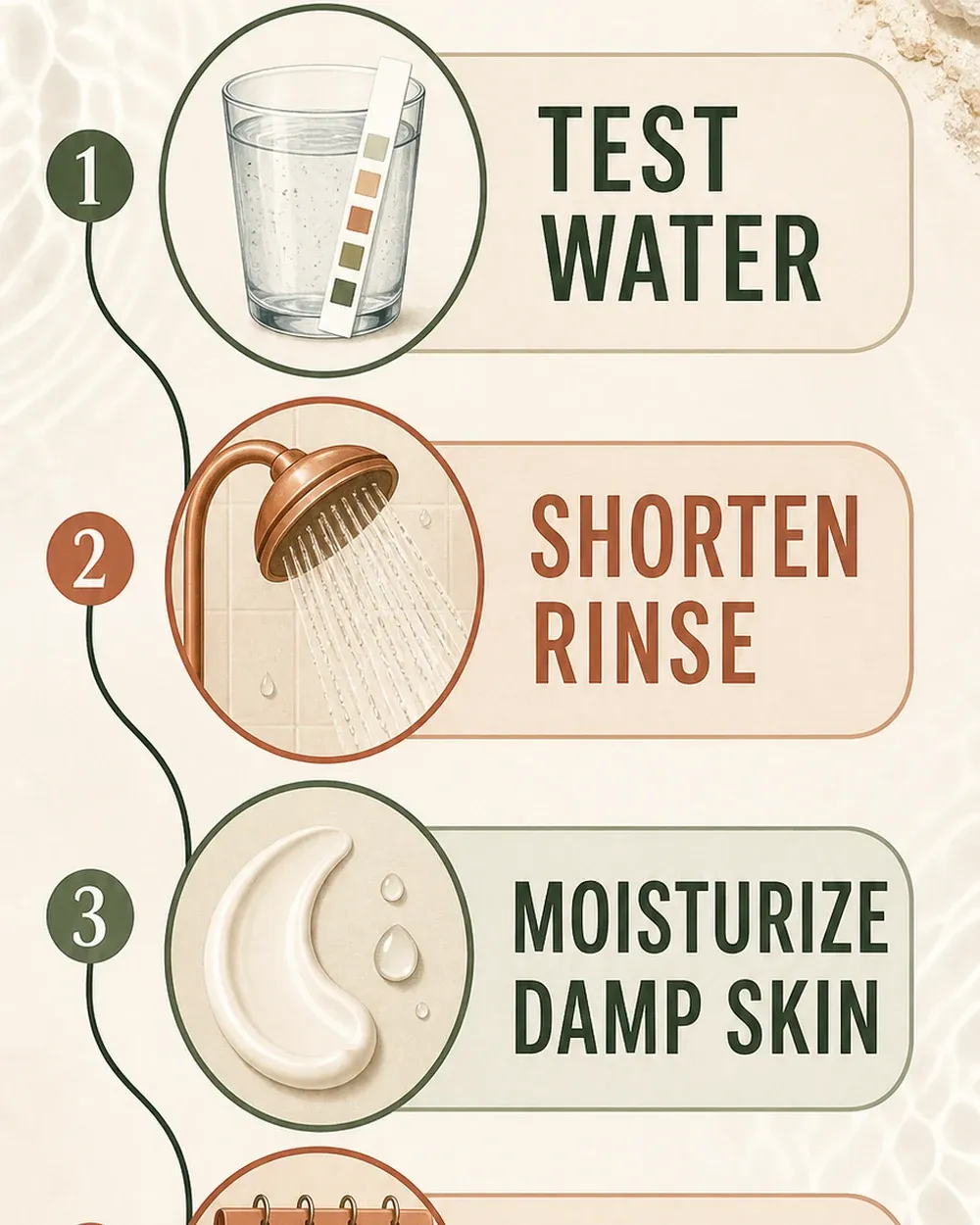
Hard water and skin is a frustrating topic because the bathroom evidence looks convincing. Chalky marks appear on glass. Cleanser seems harder to rinse. Skin may feel tight after moving or traveling.
It is tempting to blame every dry patch or breakout on the tap. We take a more useful approach: separate what water hardness means from what it does not mean, then test the least expensive variables first.
Our central rule is simple: change one important variable at a time. A move often changes water, climate, humidity, shower habits, and products together. Replacing the whole routine and installing equipment in the same week removes any chance of learning what mattered.
A two-week comparison cannot diagnose eczema or an allergy. It can show whether shorter rinsing and better moisturizer timing improve ordinary post-wash tightness.
Use a utility report or hardness test. Do not estimate a number from faucet scale.
Shorten warm-water exposure and keep cleanser and moisturizer stable.
A persistent rash, swelling, cracks, or oozing needs more than a home experiment.
What Hard Water Means—and What It Does Not
Water hardness mainly reflects dissolved calcium and magnesium. The U.S. Geological Survey’s water-hardness guidance classifies water by calcium carbonate concentration and explains why hard water creates scale and affects soap performance. Hardness is not the same as chlorine, microbial contamination, pH, or total water safety. A home can have hard water with low chlorine, or soft water with noticeable chlorine.
| Hardness level | USGS range | Practical meaning |
|---|---|---|
| Soft | 0–60 mg/L as CaCO3 | Less mineral scale; soap may lather more readily. |
| Moderately hard | 61–120 mg/L | Some scale and soap interaction may become noticeable. |
| Hard | 121–180 mg/L | Scale and residue management often matter more. |
| Very hard | More than 180 mg/L | Equipment and cleaning effects can be pronounced. |
Use your utility’s annual water-quality report when available. A basic hardness test strip can provide a rough home reading, while a laboratory or water professional can answer a higher-stakes question. Do not use white spots on a faucet as a numerical test. Also remember that a building’s plumbing or a private well may make your tap result different from a regional average.
Two Optional Routine Basics
These are familiar examples, not universal winners and not treatments for hard-water-related disease. Check current ingredients and choose by your skin’s needs.

CeraVe Hydrating Facial Cleanser
Who it fits: Normal-to-dry skin wanting a non-foaming cleanser for the evening rinse.
Why it fits: A lotion-like wash can reduce the urge to chase abundant foam.
Watch-out: The conditioned finish may feel too rich for oily skin and may not remove resistant makeup by itself.
Check Current Amazon Option
CeraVe Moisturizing Cream
Who it fits: Dry-leaning face or body skin that needs a richer moisturizer after rinsing.
Why it fits: A cream texture can help reduce the uncomfortable dry-down after water exposure.
Watch-out: It may feel heavy on oily facial areas; use a smaller amount or choose a lighter lotion.
Check Current Amazon OptionAs an Amazon Associate, we earn from qualifying purchases. Product availability, labels, and formulas can change.
Hard Water Effects on Skin: What the Evidence Can Support
The most responsible summary is that hard water may contribute to an irritating cleansing environment for some people, but it is rarely the only variable. Mineral ions can interact with cleansing agents and alter how easily residues rinse away. That does not mean minerals simply “coat and suffocate” skin, a common online explanation that is too dramatic and biologically vague.
Eczema research is also easy to overstate. A systematic review of domestic water hardness and atopic eczema found observational associations in children, but the certainty was very low. Importantly, randomized trials of ion-exchange water softeners did not show an objective improvement in the severity of established eczema. Association is not the same as proof that hard water caused a particular person’s condition, and buying a softener should not replace appropriate eczema care.
Hard water changes scale formation and the way soap behaves.
It may add to an uncomfortable cleansing environment for some skin.
A softener is not a proven treatment for established eczema.
For an otherwise healthy adult, the more immediate questions are practical: Does skin feel tight only after cleansing? Does reducing water temperature help? Does the problem affect the hands and body too? Did it begin after a move, a new active, or a change in weather? Our guide to a barrier-first routine for dehydrated skin can help when temporary water loss, rather than a permanently dry skin type, is the better fit.
Hard Water Skincare Starts With a Differential Check
| Pattern | More likely contributors | Best first test |
|---|---|---|
| Tight only after washing | Hot water, long rinse, strong cleanser, repeated cleansing | Short lukewarm rinse and less cleanser for one week |
| Dry all day and on the body | Dry skin type, low humidity, seasonal change, frequent bathing | Richer damp-skin moisturizer and shorter showers |
| Burning after products | Barrier stress, fragrance, acids, retinoids, allergy | Pause new actives and simplify; seek care if persistent |
| New acne-like bumps | Product change, occlusion, hormones, acne or rosacea | Do not assume minerals; review the full routine and diagnosis |
A Simple Skincare Routine for Hard Water
You do not need a special ten-step “hard water detox.” The routine should reduce exposure, minimize unnecessary cleansing, and slow water loss after rinsing. The American Academy of Dermatology’s dry-skin guidance supports short warm showers, gentle fragrance-free cleansing, and moisturizer applied while skin is still damp.
Morning: Reduce Unnecessary Water and Friction
If your face is not oily or sweaty on waking, a brief lukewarm rinse may be enough. Pat rather than rub. Apply a simple moisturizer before the skin becomes completely dry, then sunscreen. If you need a cleanser in the morning, use a small amount and keep contact short. More foam is not evidence of a better cleanse.
Readers with persistent dryness can compare this approach with our daily routine for dry skin. If oil and tightness happen together, use the dehydrated-skin guide instead of automatically choosing the richest cream.
Evening: Remove What Needs Removing—No More
At night, the job is to remove sunscreen, makeup, sweat, and ordinary soil without turning cleansing into a stripping ritual. Use a gentle cleanser for one short pass. Resistant makeup or sunscreen may need a separate first-removal product, but two aggressive foaming cleanses are not the goal. Our cleanser-versus-face-wash guide explains why product labels matter less than surfactant strength, texture, and post-rinse feel.
Product examples are secondary to technique. If every cleanser stings, review our skin barrier repair protocol before rotating through more products. If a thick cream feels wrong, compare options in the dry-skin moisturizer guide rather than assuming that more occlusion is always better.
How to Run a 14-Day Hard Water Skin Test
A home routine test cannot prove causation, but it can reduce guesswork. Choose a stable two-week period. Do not start a retinoid, acid, scrub, peel, or several new products during the comparison. If you recently overdid actives, first use our guide to avoiding further skin-barrier damage.
Rate tightness or itching on the same simple 0–10 scale at the same time each day. Photos can help you compare visible flaking, but lighting changes can be misleading. If the routine improves comfort, keep the useful changes. If it does not, that is also valuable evidence: water hardness may not be the main driver.
Shower Filter vs. Water Softener
This distinction prevents expensive disappointment. A typical shower filter is designed to reduce selected substances such as chlorine or sediment, depending on the cartridge. It usually does not remove the dissolved calcium and magnesium that define hardness. An ion-exchange water softener addresses hardness minerals across the home, but it is a larger equipment and maintenance decision.
| Option | What it may change | Main limitation |
|---|---|---|
| Shower filter | Selected chlorine compounds, odor, or sediment depending on certified design | Usually does not soften hard water; cartridges need replacement |
| Ion-exchange softener | Calcium and magnesium hardness across treated plumbing | Cost, space, salt or potassium, maintenance, and no eczema cure guarantee |
| Routine-only test | Temperature, exposure time, cleanser use, moisturizer timing | Does not change the water; cannot diagnose a skin condition |
Before buying either device, define the problem. If the concern is limescale, laundry, or appliance protection, a softener conversation may be reasonable. If the concern is chlorine odor, a properly specified and maintained filter may be relevant. If the concern is facial tightness, perform the routine test first. Ask for independent certification that matches the substance you want to reduce, not vague “purification” language.
Common Hard Water and Skin Myths
Myth 1: Hard Water Directly Causes Acne
Acne has multiple drivers, including follicular plugging, sebum, inflammation, hormones, medications, and product occlusion. Hard water may change cleansing feel, but a new breakout does not prove a mineral cause. Avoid escalating to harsh scrubs or repeated washing. Use our acne-prone cleanser decision guide if breakouts and sensitivity overlap.
Myth 2: Hard Water Permanently Darkens or Ages Skin
Temporary dullness can reflect dryness, scale on hair, product residue, irritation, or lighting. That is not the same as proving permanent pigmentation or accelerated aging from hardness minerals. Persistent discoloration deserves a proper assessment rather than a “detox” routine.
Myth 3: Acidic Toner Must Neutralize Mineral Residue
Skin is not a bathroom tile. Adding a strong acid toner after every rinse can worsen stinging and barrier stress. The role of cleanser pH and skin recovery is more nuanced; see our guide to pH and skin-barrier health. Do not use vinegar or lemon juice as a facial descaler.
Myth 4: More Cleansing Removes the Problem
Repeated washing can compound the very tightness you are trying to solve. If products roll or flake, diagnose application amount and layering before assuming mineral buildup; our skincare pilling guide walks through those variables.
When Hard Water Is Not a Safe DIY Explanation
Do not let a water theory delay care. Seek medical advice for a persistent or spreading rash, severe itching that disrupts sleep, painful cracks, bleeding, oozing, crusting, swelling, hives, eye or lip involvement, signs of infection, or breathing difficulty. Urgent symptoms need urgent care. Children, people with established eczema, and anyone using prescription skin treatment may need individualized guidance.
Also consider contact allergy or irritant exposure when a reaction is sharply limited to one product or develops after changing fragrance, laundry products, cleaning sprays, hair care, or topical medication. A dermatologist or other qualified clinician can evaluate conditions that cannot be separated through a blog checklist.
Conclusion: Test the Routine Before Buying the Fix
Hard water can affect scale, soap behavior, and the way cleansing feels. It may be one contributor to dryness or irritation for some people, especially when other barrier stressors are present. But the most dramatic online claims run ahead of the evidence. Hard water does not explain every breakout or rash, and a filter is not automatically a softener or a medical treatment.
Begin with information and reversible changes: get the hardness number, shorten warm-water exposure, simplify cleansing, moisturize damp skin, and record the result. If this improves comfort, keep the routine. If symptoms persist, worsen, or include warning signs, step away from the water theory and seek qualified care.
Frequently Asked Questions About Hard Water and Skin
Is hard water bad for your skin?
Not automatically. Many people tolerate hard water without a skin problem. It may make cleansing and residue management less comfortable for some people, particularly when hot water, strong cleansers, low humidity, or barrier irritation are also present.
Can hard water cause dry or itchy skin?
Hard water may contribute to a drying or irritating washing environment, but dry or itchy skin has many possible causes. Test water hardness and simplify the routine; persistent itching, rash, cracking, or inflammation deserves professional assessment.
Can hard water cause acne or breakouts?
A breakout after moving does not prove hard water caused acne. Review cleansers, moisturizers, sunscreen, climate, hormones, friction, and medication changes. Avoid trying to scrub or “descale” the face.
Does a shower filter soften hard water?
Most shower filters do not remove the dissolved calcium and magnesium that define hardness. They may target other substances depending on design. Verify the product’s certified reduction claims rather than relying on the word “filter.”
How long should I test a hard water skincare routine?
Two stable weeks is a practical window for comparing ordinary post-wash comfort. Keep other variables steady. Stop sooner and seek help if significant burning, swelling, hives, open skin, oozing, or rapidly worsening symptoms occur.
This article is for informational purposes only and does not replace professional dermatological advice.