Fractional Laser Therapy: Benefits, Downtime and Risks
A diagnosis-first guide to ablative and non-ablative fractional laser, including acne-scar fit, skin-tone planning, downtime, aftercare and urgent warning signs.

In this guide
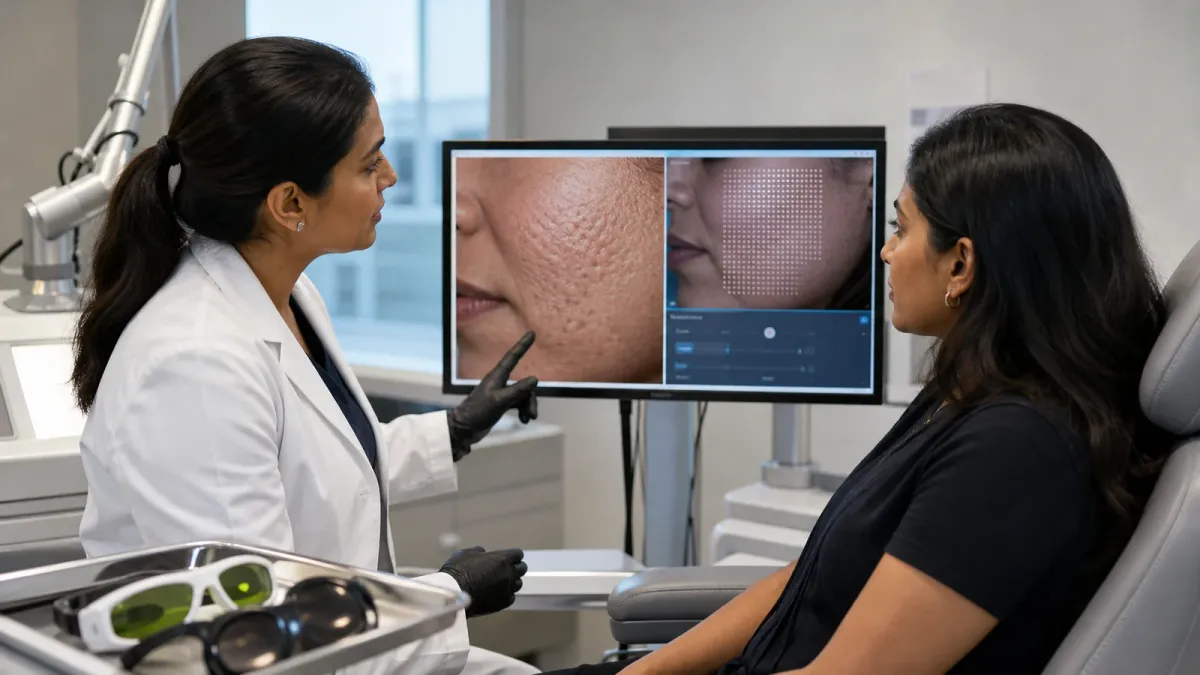
Fractional laser treats microscopic columns of skin and may improve selected acne scars, fine lines, photoaging and texture. Non-ablative systems usually mean shorter recovery and subtler results, while ablative systems remove columns of tissue and carry more downtime and complication risk. Choose by diagnosis, wavelength, depth, density, skin tone and healing capacity, with a qualified laser clinician, wavelength-specific eye protection and written aftercare.
Quick Summary
- Fractional describes a treatment pattern, not one laser strength or recovery.
- Ablative resurfacing is generally stronger and riskier than non-ablative treatment.
- Scar type, wavelength, depth, density and skin tone must shape the plan.
- Eye protection, cold-sore history, pigment planning and aftercare are essential.
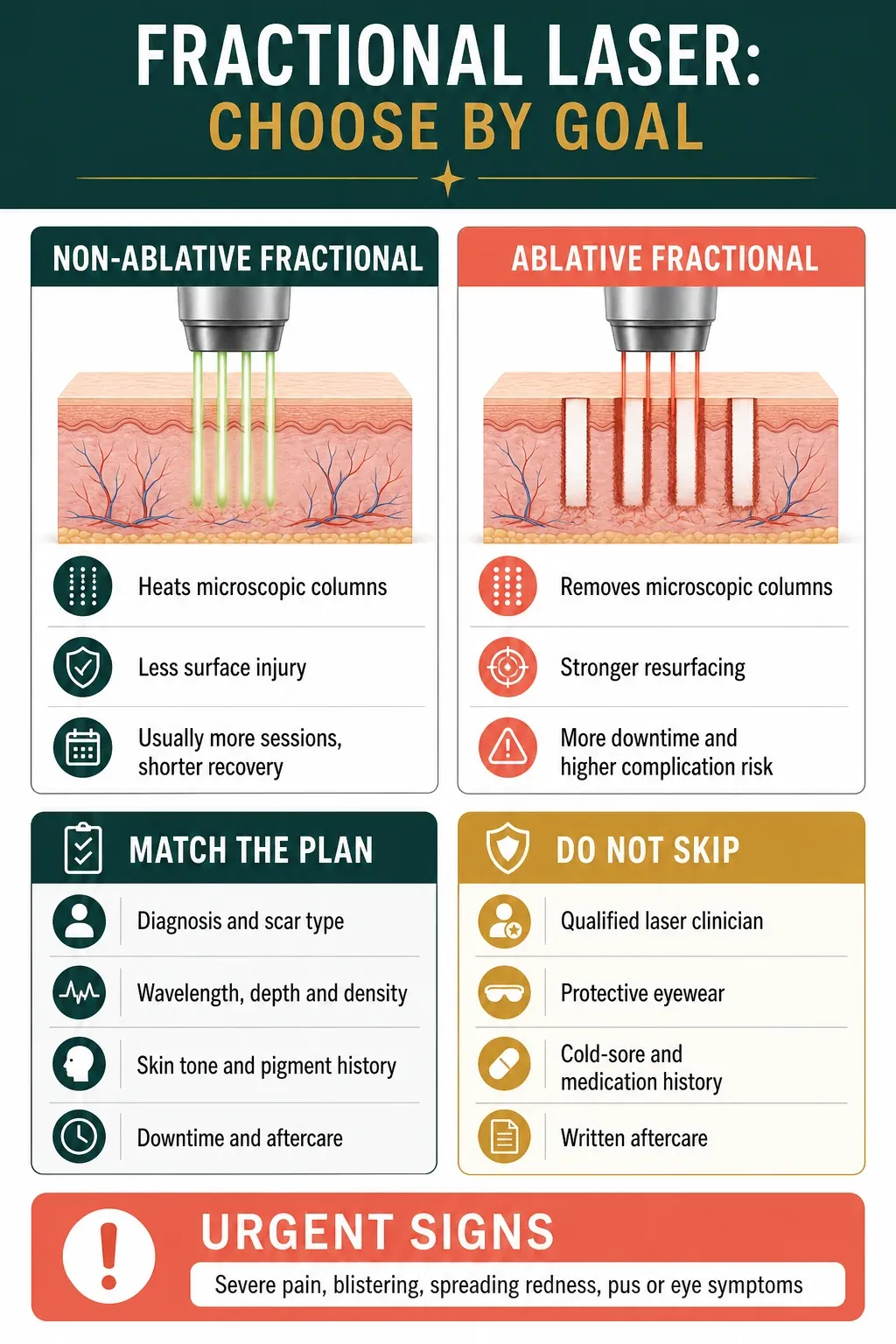
Fractional Laser Treats Columns, Not the Entire Surface
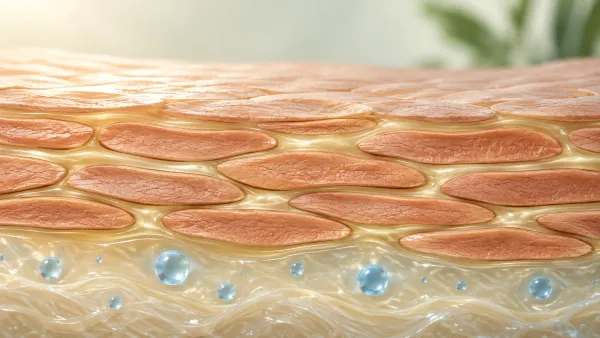
Fractional laser creates a grid of microscopic treatment zones surrounded by untreated skin. The untreated areas support healing, but “fractional” does not describe one strength, wavelength or recovery. Ablative and non-ablative systems have different effects and trade-offs.
Non-ablative fractional lasers heat microscopic columns while leaving more of the surface intact. Ablative fractional lasers remove microscopic columns of tissue and usually produce stronger resurfacing with more wound care, downtime and complication risk. Hybrid systems combine wavelengths or treatment depths.
| Approach | Tissue effect | General trade-off |
|---|---|---|
| Non-ablative fractional | Heats columns beneath a more intact surface | Shorter recovery, often more sessions and subtler change |
| Ablative fractional CO2 or erbium | Vaporizes microscopic columns | Stronger resurfacing, more downtime and higher complication risk |
| Hybrid fractional | Combines two wavelength strategies | Device-specific benefit and recovery |
| Fully ablative resurfacing | Treats the full surface rather than a fraction | Different procedure with substantially greater recovery |
Wavelength determines what absorbs the laser energy, while fluence, pulse duration, spot size, depth and density shape the injury. Two clinics can both advertise “fractional laser” while offering procedures that are not clinically comparable.
The laser resurfacing overview explains the broader category. The non-surgical treatment guide compares resurfacing with injectables and energy-based tightening.
Which Concerns Can Fractional Laser Address?
Fractional resurfacing may improve selected acne scars, fine lines, photoaging and uneven texture. Some systems are used for surgical scars or pigment concerns. Benefit depends on diagnosis, scar architecture, skin tone and whether the selected wavelength reaches the relevant target.
Rolling, boxcar and ice-pick acne scars respond differently. A laser may soften edges and texture but cannot lift every tethered scar or close every deep narrow tract. Subcision, punch techniques, chemical reconstruction, fillers or combination treatment may be discussed.
A 2025 systematic review of fractional CO2 laser for atrophic acne scars found improvement across studies but also substantial protocol variation. The evidence supports a role for selected scars, not one universal number of sessions or complete removal.
For brown spots, melasma or a changing lesion, diagnosis comes first. Heat and inflammation can aggravate pigment, and a laser should never be used to erase a lesion that has not been appropriately assessed. The age spot guide explains when evaluation matters.
Ablative Versus Non-Ablative: How to Choose
| Decision factor | Leans toward a gentler non-ablative plan | May support ablative discussion |
|---|---|---|
| Desired change | Incremental texture or pigment improvement | Stronger resurfacing for selected scars or photoaging |
| Downtime | Several days of redness or swelling may be acceptable | Longer visible healing and wound care are acceptable |
| Pigment history | Conservative settings and staged response may be preferred | Only after expert risk assessment and preparation |
| Number of sessions | Often accepts a series | May seek greater change per session but not guaranteed |
| Work and caregiving | Shorter interruption is important | Recovery support and time off are available |
| Complication tolerance | Lower-intensity approach preferred | Understands higher infection, scar and pigment risk |
Neither column is automatically better. A gentler treatment can disappoint when the target needs deeper remodeling, while an aggressive treatment can create avoidable pigment or scar risk for a modest cosmetic concern. The right plan balances likely benefit with acceptable recovery.
Ask whether the treatment is ablative, non-ablative or hybrid, then get the wavelength and intended depth. “Baby laser,” “lunchtime laser” and “deep resurfacing” are marketing terms rather than complete treatment specifications.
Skin Tone and Post-Inflammatory Pigment Risk
Darker skin can be treated with fractional lasers, but post-inflammatory hyperpigmentation and hypopigmentation require specific planning. Risk varies with wavelength, density, energy, cooling, diagnosis, recent tanning, inflammation and individual history. Skin tone should neither exclude treatment nor be ignored.
A 2024 review of lasers in darker phototypes emphasizes careful device selection and parameter adjustment. A 2023 review of post-inflammatory hyperpigmentation in skin of color describes prevention and treatment challenges after procedures.
Ask how the clinician has treated your skin tone and condition, how they reduce pigment risk and what happens if darkening develops. Test spots can provide information for selected situations but cannot guarantee the full-face outcome.
Recent sun exposure and tanning can change risk. Use sun protection consistently and disclose any pigment reaction, melasma, keloid or prolonged dark mark after acne or procedures. The anti-aging guide for melanin-rich skin provides the daily context.
Risks Need More Than a Consent-Form Mention
Expected effects can include pain, redness, swelling, warmth, crusting, peeling and temporary darkening. Complications can include infection, prolonged redness, acne or milia flares, post-inflammatory hyperpigmentation, hypopigmentation, scarring and eye injury.
The American Society of Plastic Surgeons lists laser resurfacing risks including burns, scarring, infection and pigment change. A 2026 review of laser resurfacing complications reinforces that prevention depends on patient selection, technique and aftercare.
Cold-sore reactivation can occur after facial resurfacing, so disclose any history even when the last outbreak was years ago. The clinician may prescribe antiviral prevention for selected patients. Do not use another person's tablets or alter the schedule yourself.
Protective eyewear must match the wavelength and be worn by everyone in the treatment room. Treating near the eyes requires specific expertise and protection. Ordinary sunglasses or closing the eyes are not substitutes.
Who May Need to Delay or Choose Another Plan?
Active infection, cold sore, open wound, sunburn, uncontrolled dermatitis or significant skin-barrier injury can justify delay. Medicines, immune conditions, pregnancy, healing disorders, recent procedures and a history of abnormal scarring may change candidacy. The clinician needs the full context.
People who cannot avoid sun exposure, follow wound care or attend follow-up may not be ready for aggressive resurfacing. A major event immediately after treatment is another reason to postpone. Recovery cannot be guaranteed to match the shortest advertised timeline.
Unrealistic expectations are a clinical issue. Laser can improve a scar or wrinkle without erasing normal skin texture. If the goal is poreless, filter-like skin or guaranteed permanent removal, the consultation should reset the target before consent.
How to Choose a Laser Clinician
Verify medical credentials, laser training and experience with the exact device and your skin tone. Ask who will perform each part of the treatment and who is available after hours. Regulations differ, so do not assume the person wearing scrubs is licensed for the procedure.
Request the exact device, wavelength, handpiece, treatment area, depth and density. Ask whether the planned use is authorized, off-label or part of a combination protocol. The clinician should explain why the proposed setting is appropriate rather than hiding behind proprietary mode names.
Review unedited, standardized results in patients with similar scar type and skin tone. Social-media photographs can differ in lighting, makeup, angle and timing. Ask when each “after” image was taken and whether other treatments were used.
A qualified clinician should discuss alternatives, including doing nothing. For acne scars, the acne scar treatment guide explains why scar-directed combinations often outperform a one-device package.
How to Prepare for Fractional Laser
Provide a complete list of medicines, supplements, topicals, allergies, prior procedures, cold sores, infections and healing problems. Do not stop retinoids, anticoagulants, antibiotics or other prescriptions based on a generic countdown. Follow the treating clinician's written plan.
Avoid tanning and protect the treatment area from sun. Do not wax, pick, dermaplane or start new acids close to the appointment unless the clinician permits it. Arrive with the skin prepared exactly as instructed.
Ask whether pretreatment is recommended for pigment risk or viral prevention. Understand the purpose, dose, start date and what to do after a missed dose. A product should not be added simply because another laser patient used it.
The chemical peel preparation guide shares useful provider-first principles, but laser-specific instructions take priority. The treatment team should give a written recovery plan before the procedure.
What Recovery Can Look Like
Non-ablative treatment may cause redness, swelling, warmth and a rough or bronzed appearance for several days. Ablative fractional resurfacing creates a more significant wound with oozing, crusting, peeling and longer redness. Exact timing varies by device, density, area and individual healing.
Use the cleanser, ointment, moisturizer, dressings and sunscreen approved by the clinician at the stated stages. Do not pick crusts, scrub flakes or accelerate peeling with acids. Keep hands, towels and pillowcases clean according to the aftercare plan.
Avoid heat, heavy exercise, swimming, saunas and makeup for the specified period. Sun protection continues after the surface closes because pigment risk can persist. The sunscreen reapplication guide becomes relevant when the clinician permits sunscreen.
Redness can last longer than expected after deeper treatment, and improvement continues as remodeling develops. Schedule outcome photographs after the planned healing interval rather than judging through early swelling. Contact the practice for asymmetry or a course that deviates from instructions.
How Many Sessions and When Will Results Appear?
Session count depends on the goal, laser type, density, recovery tolerance and response. Non-ablative plans often involve a series, while a more aggressive ablative session may aim for greater change with longer recovery. Neither approach guarantees completion in one visit.
Texture can look different as redness and swelling resolve, while collagen remodeling develops over months. Acne scars may need combination treatment or additional sessions. A maintenance plan should follow measured response, not an automatic package renewal.
Ask for the total expected cost including anesthesia, prescriptions, dressings, follow-up and time away from work. Compare the likely degree of improvement with less invasive options and with no treatment. The most expensive setting is not necessarily the most appropriate.
Fractional Laser Versus RF Microneedling and Chemical Peels
RF microneedling creates needle injury plus radiofrequency heat and is not a laser. The energy pathway, tissue target and safety warnings differ. Read the radiofrequency guide before comparing the two by downtime alone.
Chemical peels use acids to create controlled chemical injury at a selected depth. They may help texture or pigment but have their own depth, medication and skin-tone considerations. A percentage on a peel bottle cannot be compared directly with a laser energy setting.
Use the chemical peel decision guide by acne-scar type to check whether a surface peel fits the pigment or shallow texture being treated before comparing it with fractional laser.
For deep tethered acne scars, subcision or surgical techniques may address structures that surface resurfacing cannot release. For dynamic expression lines, botulinum toxin targets muscle rather than skin resurfacing. Different tools should not be stacked until each has a defined job.
Common Fractional Laser Myths
- “Fractional means gentle.” Ablative fractional resurfacing can involve substantial wound care and risk.
- “One laser treats every scar.” Scar type, depth and tethering change the plan.
- “Darker skin cannot have laser.” Appropriate treatment is possible, but pigment-aware selection and settings are essential.
- “A test spot guarantees safety.” It can inform a plan but cannot reproduce the full treatment area or healing course.
- “More density means better results.” Greater injury can also mean more pigment, infection and scar risk.
- “Downtime ends when peeling stops.” Redness, sensitivity and pigment risk can continue after the surface looks healed.
The Bottom Line
Fractional laser can improve selected acne scars, photoaging, fine lines and texture by treating microscopic columns of skin. The term includes non-ablative and ablative procedures with very different recovery and risk.
Choose by diagnosis, scar type, wavelength, depth, density, skin tone and acceptable downtime. Use a qualified laser clinician, insist on appropriate eye protection and written aftercare, and seek prompt help for severe pain, blistering, spreading redness, infection signs or eye symptoms.
Frequently Asked Questions
What is the difference between ablative and non-ablative fractional laser?
Non-ablative fractional lasers heat microscopic columns while leaving more surface intact. Ablative fractional lasers remove columns of tissue and usually require more wound care, downtime and risk management.
Can fractional laser remove acne scars completely?
No treatment guarantees complete removal. Fractional laser can improve selected scar types, but tethered, deep or narrow scars may need subcision, punch techniques, chemical treatment or a combination plan.
Is fractional laser safe for darker skin tones?
Appropriate treatment can be possible, but post-inflammatory hyperpigmentation and hypopigmentation require careful wavelength, density and energy selection by a clinician experienced with darker skin.
How long is fractional laser downtime?
Downtime depends on whether treatment is non-ablative or ablative, plus depth, density and area. It can range from several days of redness and roughness to longer wound care and persistent redness.
Which symptoms after fractional laser need urgent help?
Seek prompt assessment for severe or increasing pain, extensive blistering, spreading redness, pus, fever, black or gray tissue, vision changes or eye pain. Use the treating clinic's emergency plan.
Resurfacing lasers and hair-removal lasers are not interchangeable: one creates controlled skin remodeling, while the other targets pigment in follicles. Read how laser hair removal works for wavelength, skin-tone and session differences.