Radiofrequency Skin Tightening: Results, Risks and Types
A device-specific radiofrequency guide comparing surface RF, RF microneedling and minimally invasive treatments, with realistic results and current safety warnings.

In this guide
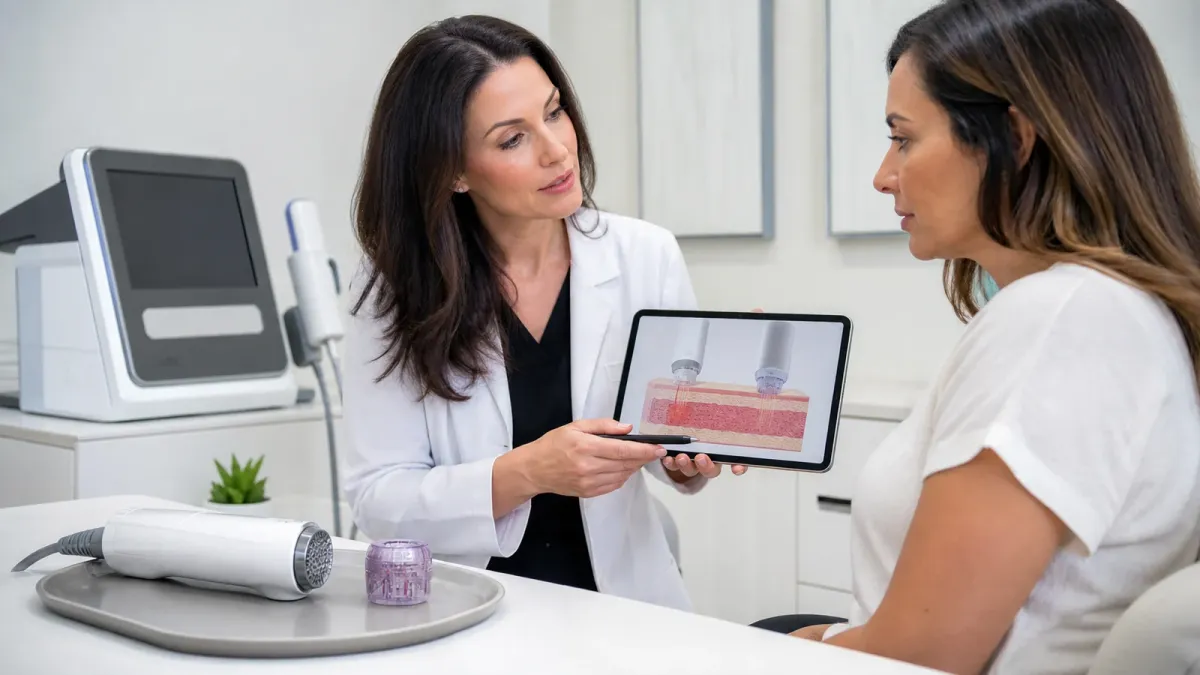
Radiofrequency can produce modest, gradual tightening or texture improvement, but surface RF, RF microneedling and minimally invasive RF are different procedures with different risks. In 2025 the FDA warned about serious reported RF microneedling complications including burns, scars, fat loss, disfigurement and nerve damage. Get the exact device, applicator, depth, settings, authorization and clinician qualifications before consenting, and never perform professional RF microneedling at home.
Quick Summary
- Identify the exact RF modality and device before comparing outcomes.
- Expect modest gradual change, not a surgical facelift result.
- Discuss burns, scars, pigment, fat loss and nerve risk explicitly.
- RF microneedling is a medical procedure and not an at-home treatment.
“Radiofrequency” Is a Category, Not One Treatment
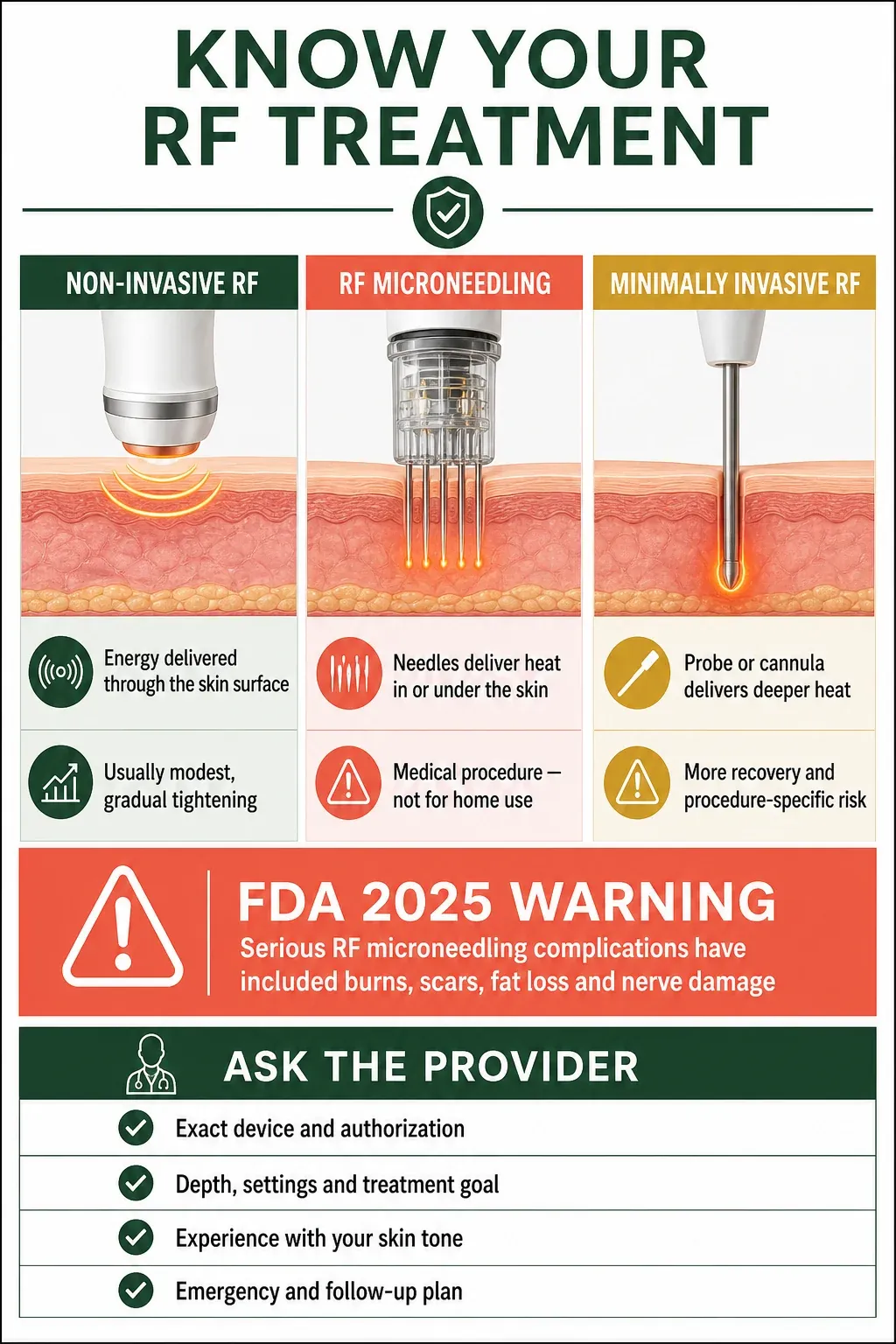
Radiofrequency procedures use electrical energy to create controlled tissue heating, but the delivery method and depth can differ dramatically. A surface device, RF microneedling system and minimally invasive probe do not share the same risk profile, downtime or expected result.
Non-invasive RF delivers energy through an applicator placed on intact skin. RF microneedling uses insulated or non-insulated needles to deliver energy within or below the skin. Minimally invasive or endodermal RF places a probe or cannula under the skin and may reach deeper tissue.
| Modality | How energy is delivered | Typical trade-off |
|---|---|---|
| Non-invasive surface RF | Electrodes contact intact skin | Less downtime, usually modest gradual change |
| RF microneedling | Needles deliver RF at selected depths | More controlled injury, more recovery and procedure-specific risk |
| Minimally invasive RF | Probe or cannula works beneath the skin | Potentially stronger effect with more invasive risk |
| Home RF device | Lower-energy consumer system | Different authorization and evidence; not equivalent to office treatment |
Marketing often compresses these modalities into “RF tightening.” That obscures the most important safety questions: which device, which applicator, which depth, what settings and what anatomy are being treated. A consultation should name all five.
The non-surgical anti-aging treatment guide helps place RF among injectables, resurfacing and surgery. The microneedling guide explains why adding RF creates a different procedure rather than a simple upgrade.
What Results Are Realistic?
Controlled heating can trigger tissue contraction and a wound-healing response that remodels collagen over time. This can produce a modest improvement in selected laxity, fine lines or texture. It does not recreate the tissue repositioning of a surgical facelift.
A 2022 systematic review of monopolar and bipolar RF for facial rejuvenation reported generally positive outcomes with variable study quality, devices and protocols. Heterogeneity makes a universal percentage improvement or session count unreliable.
A separate systematic review of RF microneedling found evidence across acne scars, rejuvenation and other dermatologic uses, while also noting variability in methods. Device-specific counseling is more defensible than claiming that RF as a category is proven for every concern.
Results usually develop gradually over weeks to months as swelling resolves and remodeling occurs. Immediate tightness can partly reflect transient contraction or edema. Standardized photographs, identical lighting and a defined assessment point reduce false before-and-after impressions.
Match the Treatment to the Problem
Mild lower-face or neck laxity may be a reasonable discussion for non-invasive RF when the patient accepts subtle results. Acne scars or texture may lead to a conversation about RF microneedling, but scar type, depth, skin tone and prior treatments influence the plan.
Marked jowling, substantial neck laxity or displaced tissue is unlikely to be corrected by a low-downtime surface treatment. A surgical consultation can clarify the gap between what RF may improve and what only tissue repositioning can achieve. Choosing no procedure is also valid.
If the main issue is brown spots, melasma or redness, heating may not be the direct answer and can sometimes worsen pigment or inflammation. The age spot guide explains why a diagnosis comes before treatment, and the dark spots guide covers pigment-sensitive planning.
Disclose implanted electronic devices, metal in or near the treatment area, dental work, prior facial surgery and every recent injectable or energy procedure. Pregnancy, breastfeeding, immune conditions, altered sensation and medicines that affect healing or bleeding also require an individualized decision. Do not conceal a condition because a package is non-refundable.
Device labeling may exclude or caution against specific conditions. The clinician should compare your history with the current instructions for that exact system, not a generic RF checklist. When another specialist manages an implant or medicine, coordination may be safer than guessing.
| Primary concern | Possible discussion | Reason to reconsider |
|---|---|---|
| Mild laxity | Non-invasive RF | Expectations require a dramatic lift |
| Acne-scar texture | RF microneedling or other scar-directed treatment | Active infection, poor healing or unclear scar type |
| Deep wrinkles from movement | Other treatments may fit better | RF does not selectively relax muscle |
| Volume loss | Volume-focused or surgical assessment | Unwanted fat loss would worsen the concern |
| Melasma or pigment instability | Skin-tone-aware dermatology assessment | Heat or inflammation may aggravate pigment |
| Severe laxity | Surgical consultation | A subtle result would not meet the goal |
The FDA Warning on RF Microneedling
In October 2025, the FDA issued a safety communication about serious complications reported with certain uses of RF microneedling. Reported complications included burns, scarring, fat loss, disfigurement and nerve damage.
The FDA described RF microneedling as a medical procedure and stated that it should not be performed at home. The agency advised choosing a licensed healthcare provider trained and experienced with the procedure and discussing benefits, risks and alternatives.
The American Academy of Dermatology supported the FDA warning and emphasized physician-led care. This is not a reason to claim that every RF procedure inevitably causes harm; it is a reason to stop treating all RF modalities as interchangeable spa services.
Ask whether the proposed use is within the device's current authorization and whether the clinician has experience with that applicator, depth and facial area. A device being cleared for one indication does not authorize every off-label combination promoted online.
Why Fat Loss Is a Serious Planning Issue
Facial fat supports contour. Unintended fat injury can create hollowness, asymmetry or a prematurely aged appearance that is difficult to correct. The risk discussion should be especially explicit when treating thin faces, temples, under-eyes or areas with limited soft-tissue reserve.
Do not accept “RF melts fat and tightens skin” as an automatic benefit. Fat reduction may be desirable in one body area and harmful in another. Ask whether the device and settings are intended to heat dermis, subcutaneous tissue or both.
Before photographs should include frontal, oblique and profile views without dramatic lighting. If contour changes later, a complete baseline helps distinguish expected remodeling from swelling, weight change or unintended volume loss.
Skin Tone, Pigment and Scar Risk
RF is sometimes marketed as “color blind” because it does not target melanin in the same way as many lasers. That does not make it risk-free for darker skin. Needle injury, heat, inflammation and aftercare can still trigger post-inflammatory hyperpigmentation, hypopigmentation or scars.
Ask the clinician how they adjust depth, density, energy and passes for your skin tone and pigment history. Request examples in similar skin tones without relying on edited social images. A prior keloid, hypertrophic scar or prolonged pigment response needs discussion.
The anti-aging guide for melanin-rich skin covers daily pigment-conscious care. If the skin is actively irritated or stinging, stabilize the damaged skin barrier before elective controlled injury.
How to Vet the Provider and Device
Verify the clinician's license and training for the exact procedure. Ask who selects settings, who physically operates the device and who manages complications. A medical director who is never present does not answer those questions.
Request the device name and current patient labeling. Search the relevant regulator's database or ask the practice to show the authorization for the proposed indication. Avoid counterfeit, modified or unlabeled cartridges and needles.
Ask how temperature or tissue response is monitored and how the clinician avoids nerves, vessels, eyes and areas with little fat. For RF microneedling, discuss needle depth, insulation, number of passes and whether energy is delivered during insertion, withdrawal or both.
The clinician should explain why this modality is preferable to non-invasive RF, conventional microneedling, fractional laser, ultrasound, injectables or surgery. A provider who offers only one device may still be skilled, but the limitation should not be disguised as universal suitability.
What Treatment and Recovery Can Look Like
Preparation depends on modality, area and anesthesia. Give the practice your complete health, implant, medication, skin-treatment and healing history. Do not stop prescribed medication or apply numbing cream without written instructions.
Non-invasive RF may feel warm and can cause temporary redness or swelling. RF microneedling creates needle channels and commonly causes more redness, swelling, pinpoint bleeding or crusting. Minimally invasive RF may require local anesthesia, compression, more downtime and closer follow-up.
Use only approved aftercare. Gentle cleansing, moisturizer and sun protection may be recommended at specific stages, but timing varies. Do not apply retinoids, acids, fragranced oils or makeup to injured skin until the clinician permits it.
A planned check should distinguish normal recovery from burns, infection, pigment change, nerve symptoms or contour loss. Keep the emergency contact and written recovery timeline available. Do not wait for the next paid session to report a complication.
How Many Sessions and How Long Do Results Last?
There is no category-wide answer. Some non-invasive protocols use a series, while selected devices are marketed as single-session treatments. RF microneedling schedules depend on diagnosis, device, depth and recovery.
Collagen remodeling takes time, and aging continues. Maintenance may be offered, but it should follow an assessment rather than a permanent subscription. Repeat treatment is not automatically appropriate when the first result was unclear or a complication occurred.
Ask for the total planned cost, not the per-session price. Include anesthesia, consumables, follow-up, skincare and time away from work. Compare that total with the expected degree of improvement and alternative treatments.
RF Versus Fractional Laser, Microneedling and Surgery
Conventional microneedling creates mechanical channels without RF heat. RF microneedling adds thermal energy, which changes both the intended effect and the risk. The treatments should not be compared by needle count alone.
Fractional lasers create columns of laser injury and can be ablative or non-ablative. Wavelength, water or pigment absorption, density and skin tone affect selection. Read the fractional laser guide before comparing package prices.
Surgery physically repositions tissue and may provide a larger result for substantial laxity, with greater procedural and recovery demands. Non-invasive RF cannot honestly be promised as a “facelift without surgery” when the expected magnitude differs.
At-Home RF Devices Are Not Office Procedures
A consumer RF device should be evaluated by its exact authorization, labeling and evidence. Lower power does not mean no contraindications, and an online device cannot diagnose whether a lump, pigment change or facial weakness is appropriate to heat.
Do not use professional RF microneedling equipment at home. The FDA specifically describes RF microneedling as a medical procedure. Needles, heat, depth and facial anatomy create risks that a tutorial cannot control.
If you own a cleared consumer device, follow its instructions, exclusions and treatment schedule exactly. Stop for persistent pain, blistering, numbness, contour change or skin injury and seek assessment. Do not combine it with acids, retinoids or recent procedures unless the labeling and clinician support the combination.
Common RF Marketing Claims to Reject
- “All RF is the same.” Surface, microneedling and minimally invasive systems differ substantially.
- “Zero risk for every skin tone.” Pigment, scar, burn and contour risks still require planning.
- “A non-surgical facelift.” Modest tightening is not surgical tissue repositioning.
- “Fat melting is always good.” Unintended facial fat loss can worsen contour.
- “More heat means more collagen.” Excess heat can cause burns, scars, fat loss and nerve injury.
- “No downtime means no injury.” Complications can appear after the appointment.
The Bottom Line
Radiofrequency can produce modest, gradual improvement for selected laxity or texture concerns, but the category contains very different procedures. The exact device, delivery method, depth, settings, anatomy and operator determine far more than the word “RF.”
RF microneedling is a medical procedure, and the FDA has warned about serious reported complications including burns, scars, fat loss and nerve damage. Choose a qualified provider, demand device-specific consent and reject facelift promises or at-home professional treatments.
Frequently Asked Questions
Does radiofrequency skin tightening really work?
It can produce modest gradual improvement for selected laxity or texture concerns, but results vary by device, modality, settings and patient. It does not reproduce a surgical facelift.
Is RF microneedling the same as non-invasive RF?
No. RF microneedling delivers heat through needles in or below the skin, while non-invasive RF delivers energy through intact skin. Downtime and risk profiles differ.
Can radiofrequency cause facial fat loss?
Unintended fat injury has been reported and can create hollowness or contour change. Discuss tissue depth, facial anatomy and how the clinician avoids unwanted fat heating.
Is RF microneedling safe for darker skin?
It may be appropriate with a trained clinician and careful settings, but darker skin can still develop burns, pigment change or scars. Ask about experience with your skin tone and condition.
Can I use an RF microneedling device at home?
No. The FDA describes RF microneedling as a medical procedure and advises against home use. Professional needles, heat and depth create risks that consumer tutorials cannot control.