Laser Hair Removal: How It Works, Results and Risks
Laser hair removal creates long-term reduction in suitable pigmented hair. Learn how sessions, skin tone, devices and maintenance affect results.

In this guide
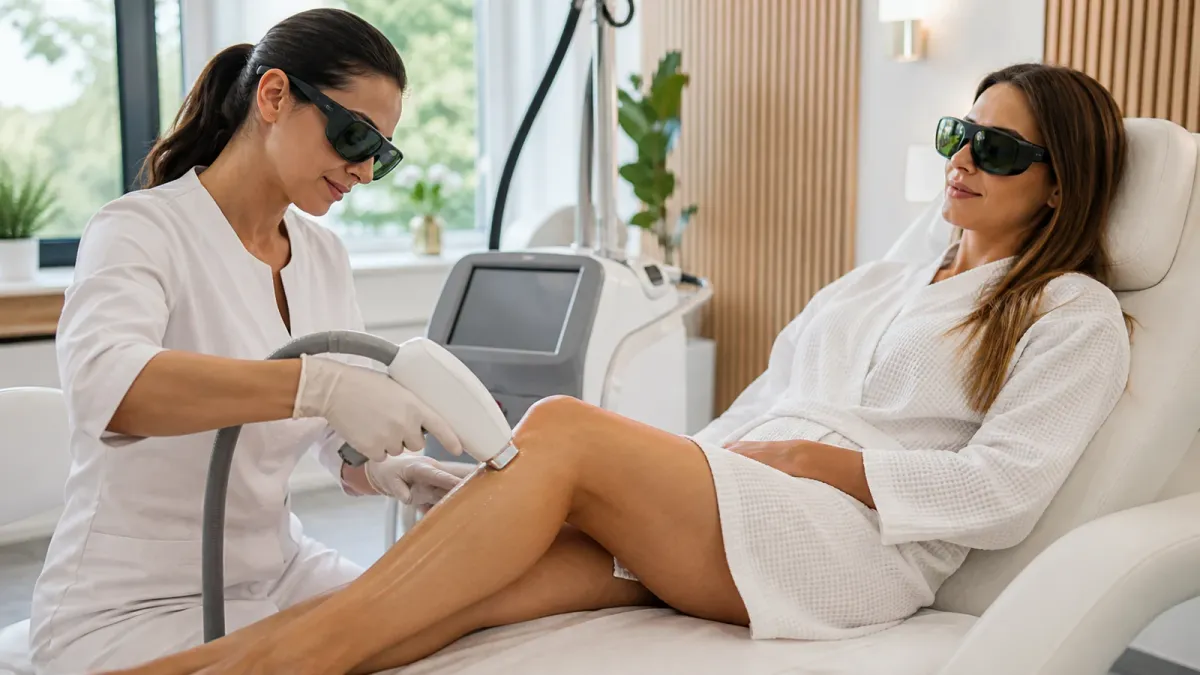
Laser hair removal uses light absorbed by pigment in active hair follicles, where heat damages future growth. It creates long-term hair reduction rather than guaranteed removal of every hair, and repeated sessions are needed because follicles grow in cycles. Results and safety depend on hair pigment, skin tone, body area, wavelength, settings, cooling and operator experience.
Quick Summary
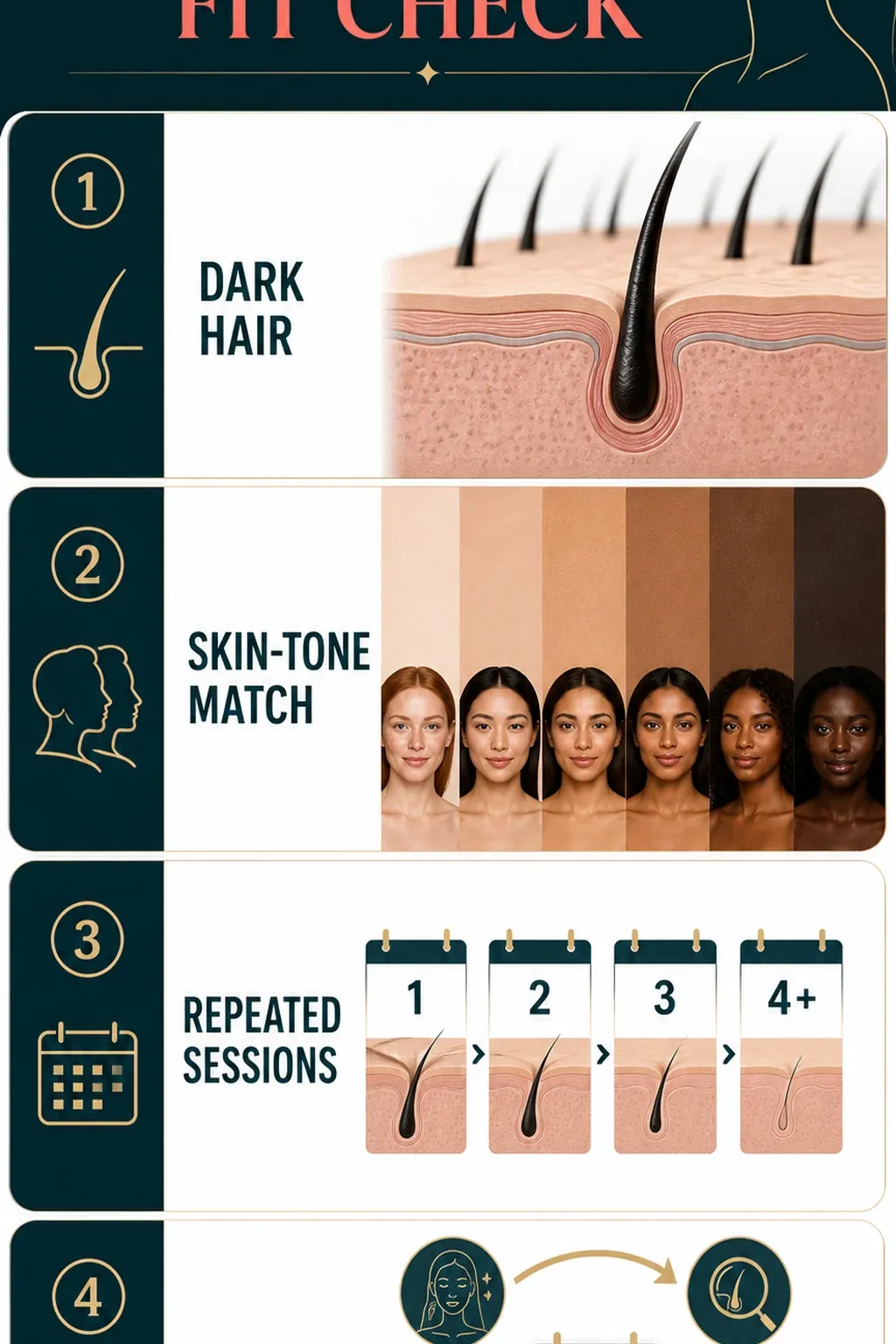
- Dark coarse hair usually responds better than blonde, gray, white or red hair.
- Repeated sessions target follicles as they enter active growth.
- Darker skin can be treated when wavelength, cooling and experience are appropriate.
- Hormonal areas and home devices often require ongoing maintenance.
Laser hair removal is usually described as a simple path to permanent smoothness, yet hair color, skin tone, body area and growth cycles make the outcome more nuanced. This guide explains the mechanism, compares device categories, shows how to evaluate a clinic and separates professional treatment from lower-power home laser or IPL devices.
How Laser Hair Removal Works
Laser hair removal uses light that is preferentially absorbed by melanin in the hair shaft and follicle. The absorbed energy becomes heat and damages structures involved in future hair growth. Surrounding skin is protected through wavelength choice, pulse duration and cooling.
The treatment works best when the hair contains enough pigment and is in an active growth phase. Not every follicle is active at the same time, which is why sessions are repeated. Blonde, white, gray and many red hairs absorb too little energy for reliable laser targeting.
The goal is long-term hair reduction, not a promise that every hair will disappear forever. Regrowth often becomes finer or sparser, and maintenance may be needed. Hormones, body area, device and treatment settings all influence durability.
| Factor | Why it changes results | What to ask |
|---|---|---|
| Hair color and thickness | Dark coarse hair contains more target pigment | Is my hair likely to respond? |
| Skin tone | Epidermal melanin can also absorb energy | Which wavelength and cooling fit my tone? |
| Body area | Growth cycles and hormonal influence differ | How many sessions are typical here? |
| Device type | Wavelength and pulse design change depth and safety | Is this a laser or an IPL device? |
| Operator experience | Settings must match both hair and skin | How often do you treat my skin tone? |
| Hormonal driver | New hairs may continue to develop | Should the underlying cause be assessed? |
Who Gets the Best Results?
Dark, coarse hair with clear contrast from surrounding skin is generally easiest to target. Modern devices can treat people with darker skin, but safe treatment depends on longer wavelengths, conservative parameters, effective cooling and operator experience.
The AAD states that people of all skin tones can have laser hair removal, while emphasizing that the clinician must have experience with the patient's tone. A review of hair reduction in Fitzpatrick IV-VI likewise identified wavelength and setting selection as central to minimizing blisters, crusting and pigment changes.
Recently tanned skin is harder to treat safely because epidermal pigment increases. Self-tanner can also interfere with visual assessment. Follow the clinic's waiting period rather than hiding exposure.
The AAD laser hair removal FAQ warns that inexperienced treatment can cause burns, permanent skin-color changes and scars. It also recommends choosing a medical doctor skilled in lasers and skin, which is especially relevant when baseline pigment narrows the safety margin.
Hair colors that respond poorly
White and gray hair lacks melanin. Blonde and red hair often contains too little of the target pigment for predictable results. A clinic should not sell a large package without explaining this limitation.
Electrolysis uses an electrical current in individual follicles and does not depend on hair pigment in the same way. It is slower for large areas but may be considered for light-colored hair. The AAD's hair-removal overview compares these methods.
Hormonal facial or body hair
Laser can reduce existing pigmented hair, but it does not treat a hormonal cause that stimulates new follicles. Sudden facial hair growth, irregular periods, scalp hair changes or other symptoms deserve medical assessment. Treatment may still help, but expectations and maintenance differ.
Facial hair can be more persistent than underarm or lower-leg hair. The AAD notes that removal is not necessarily permanent on a woman's face. Ask for area-specific data instead of a whole-body promise.
Laser Hair Removal for Darker Skin Tones
Melanin in the epidermis competes with melanin in the hair. If too much energy is absorbed at the surface, burns and pigment changes can occur. Longer-wavelength Nd:YAG systems are commonly considered for deeper skin tones, but the device name alone does not make a treatment safe.
Pulse duration, fluence, spot size, cooling, hair thickness and recent sun exposure all matter. A conservative test spot can reveal an unexpected response, though it cannot eliminate every risk. Ask how long the provider waits before evaluating the test.
People who develop dark marks after acne, burns or waxing should disclose that history. The post-inflammatory dark-spot guide explains why preventing inflammation is often easier than treating the pigment afterward.
Alexandrite, Diode, Nd:YAG and IPL
| Technology | Typical consideration | Main caution |
|---|---|---|
| Alexandrite laser | Efficient for many lighter skin tones and dark hair | Surface melanin absorption rises with darker or tanned skin |
| Diode laser | Versatile wavelength and device designs | Safety still depends on parameters and cooling |
| Long-pulsed Nd:YAG | Longer wavelength often chosen for darker skin | May require more sessions and skilled settings |
| Ruby laser | High melanin absorption | Usually limited to lighter untanned skin |
| IPL | Broad-spectrum hair reduction with filters | Not a laser; device quality and skin-tone limits vary |
| Home device | Lower-energy repeated use for selected users | Not equivalent to professional treatment |
This table is not a prescription. Device generations differ, and a provider may choose one technology for reasons that are not visible in the wavelength name. Ask for the exact model and why it fits your combination of skin and hair.
FDA classification and labeling show whether a device is cleared for a particular intended use. The FDA also explains that professional lasers can fall into higher hazard classes and require appropriate controls. Clearance does not replace training or guarantee an individual result.
The FDA's laser classification overview distinguishes consumer products from higher-class professional lasers and requires hazard labeling. Ask to see the actual device label rather than relying on a generic word in the clinic name.
What to Expect During Treatment
The area is cleaned and eye protection is applied. Hair should usually be shaved rather than waxed or plucked beforehand so pigment remains inside the follicle. The provider may mark the area and use contact, spray or air cooling.
Each pulse can feel like heat, a snap or a sting. Coarse dense areas may feel stronger. Numbing products should be used only under professional direction because large-area misuse can be dangerous.
The skin may develop temporary redness and swelling around follicles. These effects often settle within hours, but timing varies. Blistering, severe pain or gray-white skin is not a normal endpoint.
Use a simple moisturizer when the treated area feels dry and a comfortable broad-spectrum sunscreen on exposed sites. The sunscreen guide for darker skin is useful when white cast or pigment prevention affects adherence.
How Many Sessions Are Needed?
The AAD describes about six treatments as a common professional course, but some areas and people need more. Sessions are spaced to catch new hairs entering active growth. Facial intervals may differ from leg or back intervals.
Judge the course by slower regrowth, patchier density and finer hair, not by one perfectly smooth week. Photograph the area before each session under consistent lighting. Shaving between visits can make the change harder to remember but does not reverse follicle damage.
Maintenance may be needed once or twice a year or at another interval, especially for hormonally influenced areas. Ask whether maintenance is included in the quoted result. Avoid a contract that defines no endpoint.
Schedule outdoor travel around recovery and sun restrictions. The sunscreen reapplication guide gives practical dose and timing options once the treated skin can tolerate normal products.
Preparation: What to Stop and What to Keep
- Avoid tanning: follow the clinic's exact interval for sun, beds and self-tanner.
- Do not wax or pluck: the follicle needs pigment to target.
- Shave as directed: surface hair can waste energy and burn.
- Review medication: disclose photosensitizers, acne drugs and recent changes.
- Report skin conditions: active rash, infection, cold sores or open skin can change timing.
- Skip fragrance and irritants on treatment day: follow the clinic's preparation sheet.
Do not independently stop a prescription because an aesthetic provider suggests it casually. The prescribing clinician and treating laser professional should coordinate when timing is uncertain. Bring the medication list rather than relying on memory.
Aftercare and Ingrown Hair
Use cool compresses only as instructed and apply a bland moisturizer when needed. Protect the area from sun and avoid friction, heat and intense exercise for the recommended interval. Do not pick perifollicular swelling or emerging hairs.
Laser can reduce shaving-related ingrown hairs by decreasing the number and thickness of hairs. It does not treat every bump cause. Active infection, keloidal scarring or severe pseudofolliculitis may need a dermatologist-led plan.
The coffee-scrub safety guide explains why mechanical friction needs restraint, but do not restart acids or scrubs until the treated skin has recovered. More exfoliation immediately after laser can create the irritation you are trying to avoid.
If treated bumps resemble acne, do not automatically add a stronger scrub. The over-exfoliation guide helps separate barrier irritation from a breakout, while the acne-prone sunscreen guide offers lighter post-recovery options for exposed areas.
Side Effects and Complications
Common short-term effects include redness, warmth and follicular swelling. Burns, blisters, infection, scars, hyperpigmentation and hypopigmentation can occur. Rare paradoxical hair growth has also been reported, particularly in selected facial or neck contexts.
The AAD warns that inexperienced treatment can cause burns, permanent skin-color change and scars. Risk reduction begins with candidate selection and operator skill. A cheap session is not cheap if pigment change lasts for months.
Call the clinic for escalating pain, blistering, crusting, pus, spreading redness, fever or eye symptoms. Seek urgent care for severe burns or systemic symptoms. Take photographs and preserve the treatment record.
Home Laser and IPL Devices
Most consumer devices use lower energy and require repeated use plus maintenance. Some are IPL rather than true lasers. They are designed for a limited range of skin tones and hair colors, and built-in sensors do not make every use appropriate.
Check the exact FDA-cleared indication and manufacturer compatibility chart. Do not use a device on tattoos, dark moles, genital tissue, near the eyes or over a skin condition unless the instructions explicitly permit it. Never override a lockout sensor.
Home devices are not substitutes for diagnosis, professional treatment of high-risk skin or management of complications. The FDA's home-device guidance recommends checking reliability, support and safe operation before buying online.
A recent FDA home hair-removal clearance record illustrates why the exact model matters: the intended use and comparison with predicate devices are documented for that product. A marketplace listing that says only “FDA registered” does not provide the same information.
If shaving leaves the area inflamed before every session, reduce friction rather than adding multiple acids. The slow-start skincare method helps isolate one irritant while the laser schedule stays interpretable.
How to Compare Clinics
Start with credentials, supervision and experience treating your skin tone. Ask who will perform each session and whether the same person controls the plan. Confirm who evaluates complications outside normal hours.
Request before-and-after images for the same body area, hair type and skin tone. Ask how many sessions the images represent and whether maintenance occurred. Consistent lighting is essential.
Compare the total course, not the introductory session. Include test spots, consumables, missed-session policy, maintenance and treatment of adverse effects. A package should not expire before the growth-cycle schedule can be completed.
Laser Hair Removal vs. Other Methods
Shaving removes surface hair and is quick but temporary. Waxing and epilation pull hair from the follicle and can last longer, yet they must stop before laser. Depilatories dissolve hair and can irritate sensitive skin.
Electrolysis treats follicles individually and can work regardless of hair pigment. It is practical for smaller areas or light hairs but time intensive. Laser is efficient for larger areas with appropriate pigmented hair.
The best method can vary by site. Someone may use laser for underarms, electrolysis for remaining pale facial hairs and shaving during maintenance. Avoid forcing one technique onto every body area.
Common Laser Hair Removal Mistakes
- Waxing before treatment: it removes the target from the follicle.
- Hiding a tan: added pigment can narrow the safety margin.
- Expecting blonde or gray hair to respond: light absorption is inadequate.
- Choosing only by device name: settings, cooling and operator skill matter.
- Buying too few sessions: hair grows in cycles.
- Ignoring hormonal drivers: new hair can continue to develop.
- Using home IPL over tattoos: concentrated pigment can absorb energy.
The Bottom Line
Laser hair removal heats pigment in active hair follicles to create long-term reduction. It works best on dark pigmented hair and requires repeated sessions because follicles cycle independently. Light-colored hair responds poorly, and hormonal areas often need maintenance.
People with darker skin can be treated, but wavelength, parameters, cooling and real operator experience are essential. Compare clinics by diagnosis, test-spot logic and complication care rather than package price or a famous device name.
Frequently Asked Questions About Laser Hair Removal
Is laser hair removal permanent?
It can create stable long-term hair reduction, but not every follicle disappears forever. Regrowth, new hormonally stimulated hair and maintenance needs vary by area and person.
How many laser hair removal sessions do I need?
About six sessions is a common starting estimate, but facial, hormonal and lower-response areas may need more. Spacing follows the growth cycle for the treated area.
Does laser hair removal work on blonde or gray hair?
Usually not well because light-colored hair contains too little melanin for reliable targeting. Electrolysis may be considered because it does not depend on hair pigment in the same way.
Is laser hair removal safe for dark skin?
Yes, when an experienced provider chooses an appropriate wavelength, pulse, energy and cooling plan. Recent tanning and poor settings increase burn and pigment-change risk.
Can I shave between laser sessions?
Shaving is generally allowed and often required, while waxing or plucking removes the follicular pigment target. Follow the clinic's exact timing instructions.
This article is for informational purposes only and does not replace professional dermatological advice.