Preventative Botox: Does Starting Early Prevent Wrinkles?
An evidence-led guide to preventative Botox covering dynamic wrinkles, the limits of early-treatment claims, injector selection, product safety and urgent warning signs.

In this guide
Botulinum toxin can temporarily soften selected expression lines, including before a crease remains visible at rest, but evidence does not establish one ideal age to start or guarantee prevention of future wrinkles. Decide from a specific line, anatomy, desired movement and qualified medical assessment; confirm the exact authorized product and dose. Seek immediate care for swallowing, speaking or breathing difficulty, generalized weakness or vision symptoms.
Quick Summary
- Treat a defined dynamic line rather than starting on a birthday schedule.
- Preventive long-term claims remain less certain than short-term wrinkle reduction.
- Botulinum toxin units are product-specific and cannot be converted automatically.
- Verify the injector, product source, dose, emergency plan and desired remaining movement.
What Preventative Botox Actually Means
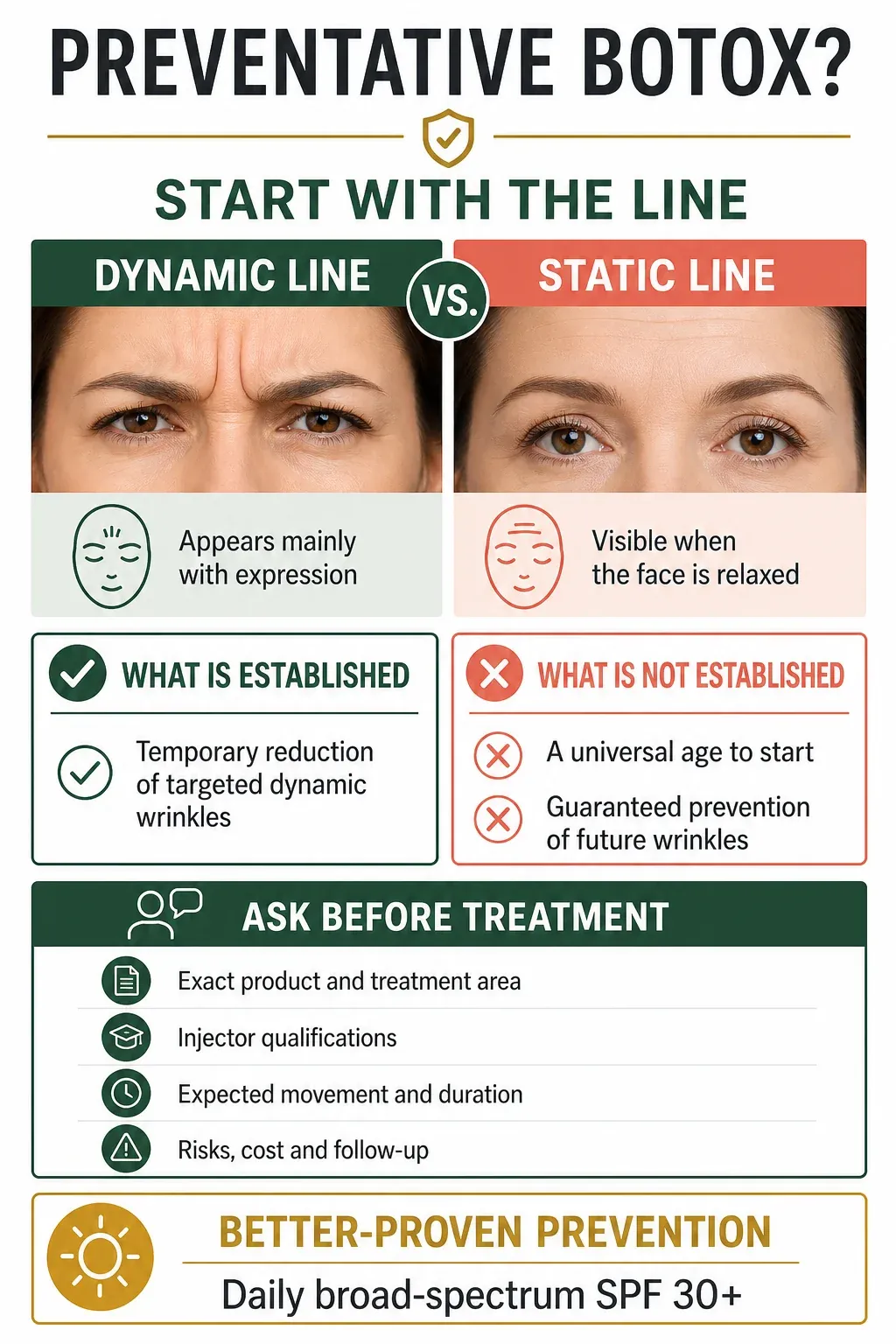
Preventative Botox usually means treating selected expression lines before they remain visible when the face is relaxed. It does not mean freezing a young face on a birthday schedule, and it has not been proven to guarantee that future wrinkles will never form.
Botox Cosmetic is one brand of botulinum toxin type A. The medicine temporarily reduces signaling between a nerve and a targeted muscle, so the treated muscle contracts less strongly. That can soften dynamic lines caused by repeated movement, such as frown lines, forehead lines and crow's feet.
Dynamic lines appear or deepen during expression. Static lines remain visible at rest because aging also involves collagen change, sun damage, skin thinning, volume change and anatomy. Botulinum toxin addresses the muscular component; it does not reverse every cause of facial aging.
| Question | Evidence-based answer | What it does not establish |
|---|---|---|
| Can it soften targeted expression lines? | Yes, temporarily, when the product and injection plan fit the indication | Permanent wrinkle removal |
| Can treatment begin before a line is deeply etched? | Yes, after an individual assessment | A universal age to start |
| Can less movement reduce repeated folding? | This is biologically plausible and supported by limited long-term observations | Guaranteed prevention over decades |
| Does more toxin prevent more aging? | No | A dose-escalation strategy for the whole face |
| Is every botulinum toxin product interchangeable? | No | Automatic unit-for-unit substitution |
The word “preventative” is therefore a treatment goal, not a separate FDA-approved category. A qualified injector should identify the exact muscle pattern and explain whether a line is mainly dynamic, already static or unrelated to muscle activity. If the concern is pigment, laxity or acne scarring, another plan may fit better.
Our non-surgical anti-aging treatment guide compares the jobs of injectables, resurfacing and energy-based procedures. The aging-skin routine guide covers the daily measures that support every procedure.
What the Evidence Shows and What Remains Uncertain
A Cochrane review of botulinum toxin type A for facial wrinkles found that treatment can improve upper-face wrinkles compared with placebo. Most included trials assessed relatively short follow-up, and adverse events were reported inconsistently across studies.
A 2025 review of proactive botulinum toxin use concluded that preventive claims are supported by a plausible mechanism and some observational evidence, but protocols and long-term data are heterogeneous. That is not the same as proving that everyone who starts in their twenties will age better.
A long-term twin observation and retrospective studies are often cited in marketing. They are interesting but cannot answer every question about ideal starting age, lifetime dose, untreated comparison groups or individual preferences. Strong claims require stronger evidence than before-and-after photographs.
Repeated treatment can also change muscle size and movement patterns. A 2021 review of long-term repeated aesthetic botulinum toxin treatment reported sustained efficacy and generally favorable satisfaction data while noting limitations in the available evidence. Long-term management still needs periodic reassessment rather than an automatic appointment calendar.
There Is No Evidence-Based Birthday to Start
Age alone is a poor treatment trigger. Some adults develop strong dynamic lines early because of anatomy and expression, while others have few lines at rest much later. A line that appears only during a normal smile is not a disease that must be prevented.
Consider treatment only when a specific expression line bothers you, the likely benefit is clear and you understand the trade-off in movement. Starting early solely from fear, social pressure or a subscription discount is not an evidence-based indication.
People under 18 should not receive cosmetic Botox based on social-media wrinkle prevention. Cosmetic indications, approved ages and treatment areas vary by product and country. The current United States label should be checked for the exact product, indication and patient.
Daily broad-spectrum sunscreen has a stronger prevention rationale for photoaging because ultraviolet exposure contributes directly to premature skin aging. The anti-aging sunscreen guide explains how to choose and use protection, while the retinol serum guide covers a topical option for appropriate users.
Who May or May Not Be a Reasonable Candidate?
| Situation | Consultation direction | Why |
|---|---|---|
| A defined dynamic line is bothersome | Discuss a conservative targeted plan | The muscular cause and outcome can be described |
| The line is already visible at rest | Discuss toxin plus or instead of other approaches | Muscle relaxation may not erase an established crease |
| The concern is loose skin or volume loss | Ask about alternatives | Botulinum toxin does not restore volume or lift tissue globally |
| Pregnant, breastfeeding or trying to conceive | Discuss timing with qualified medical professionals | Elective cosmetic treatment can usually wait when safety data are limited |
| Neuromuscular disease, swallowing or breathing problems | Require careful medical assessment | Risk and suitability can differ substantially |
| Active infection at an injection site | Delay and assess | Injecting through affected skin is inappropriate |
The injector needs a full history of medicines, supplements, prior toxin use, allergies, facial surgery and neuromuscular symptoms. Mention antibiotics, muscle relaxants, anticoagulants and any product with botulinum toxin, even when it was used for migraine, sweating or another medical condition.
Do not stop prescribed medication on your own to qualify for a cosmetic appointment. The injector should explain whether another clinician needs to be involved. A legitimate consultation can end with a decision not to treat.
Product, Dose and Injector Are Not Interchangeable
The FDA prescribing information for Botox Cosmetic states that units cannot be compared with or converted into units of another botulinum toxin product. A safe record should name the exact product, lot when available, dose, dilution, injection sites and treating professional.
The label carries a boxed warning about distant spread of toxin effect. Symptoms can include generalized weakness, double or blurred vision, drooping eyelids, difficulty speaking or swallowing, loss of bladder control and breathing difficulty. These effects can occur hours to weeks after injection and require prompt medical attention.
Common aesthetic effects can include pain, swelling, bruising, headache and temporary weakness of nearby muscles. Eyelid or brow droop, asymmetry and an unwanted change in expression may occur when toxin affects a neighboring structure or the plan does not match the anatomy.
The American Academy of Dermatology's botulinum toxin overview emphasizes treatment by a qualified physician with expertise in anatomy. A home, party, hotel room or non-medical retail setting cannot substitute for appropriate storage, examination, sterile technique and complication management.
How to Vet a Botox Provider
Confirm the clinician's license, specialty training and experience with facial anatomy. In the United States, the AAD Botox FAQs recommend seeing a board-certified dermatologist or another appropriately qualified physician. Rules differ by jurisdiction, so verify who evaluates, prescribes and injects.
Ask where the product was obtained, how it is stored and who handles complications after hours. Counterfeit or mishandled injectable products can create risks beyond an imperfect cosmetic result. A deeply discounted “Botox equivalent” should not be accepted without the exact brand and authorization.
A good injector watches your face at rest and in motion, discusses areas where treatment may alter function and explains how much movement is likely to remain. They should not diagnose from a filtered selfie or pressure you into treating every visible line.
What to Expect Before, During and After Treatment
Before the visit, follow the clinician's instructions and provide a complete medication and procedure history. The AAD preparation guide advises patients to tell the dermatologist about all medicines and supplements and to avoid self-directed changes.
The clinician cleans the area, identifies injection points and places small amounts with a fine needle. The visit may be brief, but the assessment should not be. Photographs and a documented baseline help evaluate whether the result matches the plan.
Effects are not instant. Movement commonly begins to change over several days and the result is assessed after the product has taken effect. Duration varies by product, area, dose, metabolism and prior treatment; many cosmetic effects last several months rather than permanently.
Follow written aftercare. Advice about exercise, pressure, lying down and skin treatments can differ, so use the treating clinician's protocol instead of viral rules. Do not massage or manipulate an injected area unless specifically instructed.
How Much Movement Should Remain?
The answer depends on your goal. Some people want a subtle reduction that preserves strong expression, while others prefer a smoother appearance. Preventative framing should not automatically mean maximal immobility.
Ask the injector to describe the intended endpoint in ordinary language. “Less bunching between the brows while still looking like me” is more useful than requesting a number of units copied from another person. Dose follows anatomy and product, not influencer templates.
Overtreatment can make expression feel unfamiliar and may shift movement to nearby muscles. Undertreatment may leave more line activity than expected. A planned review is safer than adding toxin impulsively from a different provider.
Costs and the Commitment to Repeat Treatment
Pricing may be per unit, per area or as a package. Compare the total dose, exact product, injector qualifications, follow-up and complication access rather than the headline price. A low quote can become expensive if it leads to correction visits or treatment of areas you did not intend.
The effect wears off, so maintaining a result requires repeat treatment. That creates a long-term financial and scheduling commitment. You can stop, allow movement to return and reassess; stopping does not mean the face suddenly ages faster than it otherwise would.
Track satisfaction before rebooking. If the result was too still, asymmetric or shorter than expected, discuss it before repeating the same plan. A subscription should never remove the clinical decision at each visit.
Alternatives That Address Different Causes of Aging
Sunscreen, shade and protective clothing reduce ongoing ultraviolet exposure. Retinoids can support photoaging for appropriate users, while moisturizer improves dryness and temporarily softens the appearance of fine lines. None creates the same muscle-relaxing effect as botulinum toxin.
Fractional laser and chemical peels address surface texture and selected pigment concerns through controlled injury and recovery. Radiofrequency treatments target heating at different depths and may produce modest tightening. Fillers address selected volume deficits but carry their own serious risks.
Choose the option by diagnosis and desired outcome. The fractional laser guide, radiofrequency guide and chemical peel preparation guide explain those pathways.
Common Preventative Botox Myths
- “Everyone should start at 25.” There is no universal evidence-based starting age.
- “Botox prevents all wrinkles.” It targets selected muscle-driven lines, not sun damage, pigment, laxity or volume loss.
- “More units mean better prevention.” Dose must fit the product, muscles, anatomy and desired movement.
- “All toxin brands are the same.” Units are product-specific and not directly interchangeable.
- “A med spa price proves medical quality.” Verify the evaluating and injecting professional, product source and emergency plan.
- “Once you start, you can never stop.” Effects are temporary; movement gradually returns when treatment is not repeated.
The Bottom Line
Botulinum toxin can temporarily soften selected dynamic wrinkles, including before a crease is deeply visible at rest. Evidence does not establish one correct age to start or guarantee prevention of future facial aging.
Decide from a specific line, anatomy, desired movement, medical history and qualified consultation. Use daily sun protection for photoaging prevention, insist on the exact authorized product and documented dose, and treat swallowing, breathing, vision or generalized weakness symptoms as urgent.
Frequently Asked Questions
What age should you start preventative Botox?
There is no universal evidence-based age. Consider treatment only when a specific dynamic line bothers you and a qualified clinician confirms that targeted muscle relaxation fits your goal.
Does preventative Botox stop wrinkles permanently?
No. The effect is temporary and targets selected muscle-driven lines. It does not prevent sun damage, skin thinning, pigment change, volume loss or every future wrinkle.
What happens if I stop preventative Botox?
The effect gradually wears off and muscle movement returns. You can reassess or stop; the face does not suddenly age faster simply because treatment is not repeated.
Are Botox, Dysport, Xeomin and other toxins interchangeable?
No. Formulations and potency units are product-specific, and units cannot be converted automatically. The record should name the exact product and dose.
Which Botox side effects need urgent medical help?
Seek immediate care for difficulty swallowing, speaking or breathing, generalized weakness, double or blurred vision or loss of bladder control. Contact the injector promptly for significant eye symptoms, infection or an unexpected reaction.