Can You Bring Skincare on a Plane? 2026 Packing Rules
Current carry-on and checked-bag skincare rules for TSA, EU and UK travel, plus leak-proof packing and a minimal in-flight routine.
In this guide
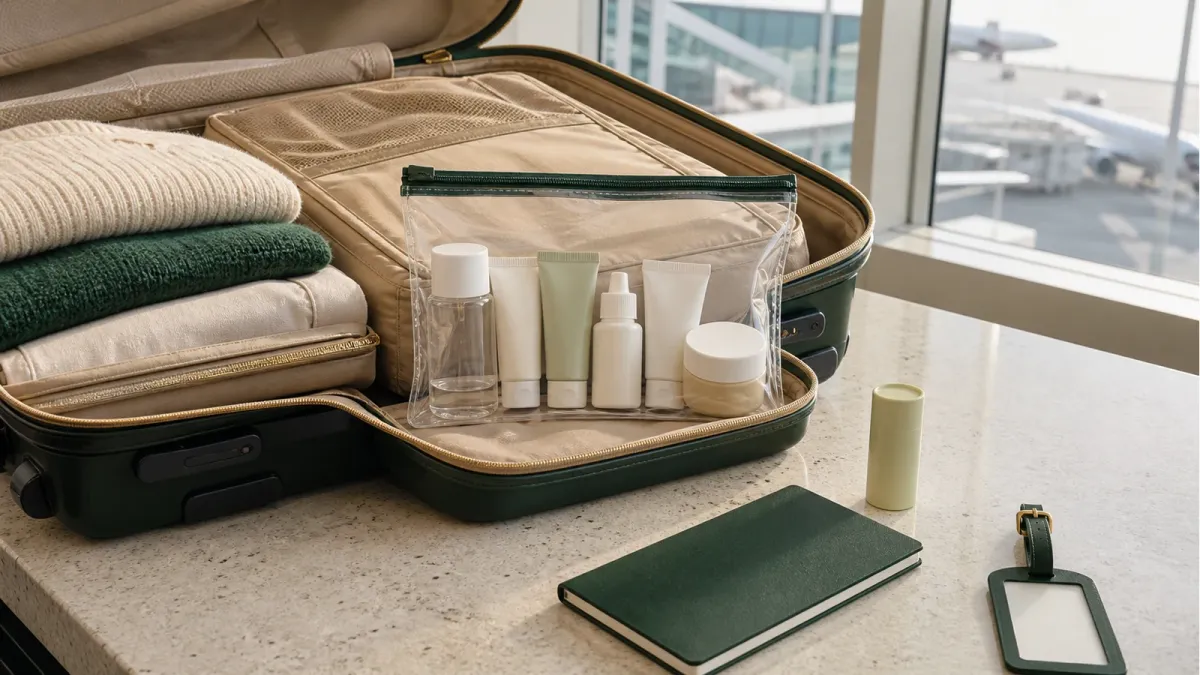
Yes, with limits. For ordinary U.S. carry-on travel, skincare liquids, creams, gels, oils, pastes, sprays and aerosols must generally be in containers of 3.4 ounces or 100 ml or less and fit in one quart-size bag. EU rules are similar; UK limits now vary by airport, so check every departure, connection and return point and protect pumps and aerosol caps.
Quick Summary
- Container capacity matters even when the bottle is almost empty.
- Creams, gels, oils, pastes, sprays and aerosols usually count as liquids.
- Airport and airline rules can differ across one itinerary.
- Pack one familiar cleanser, moisturizer, sunscreen and treatment.
The Carry-On Liquid Rules for Skincare
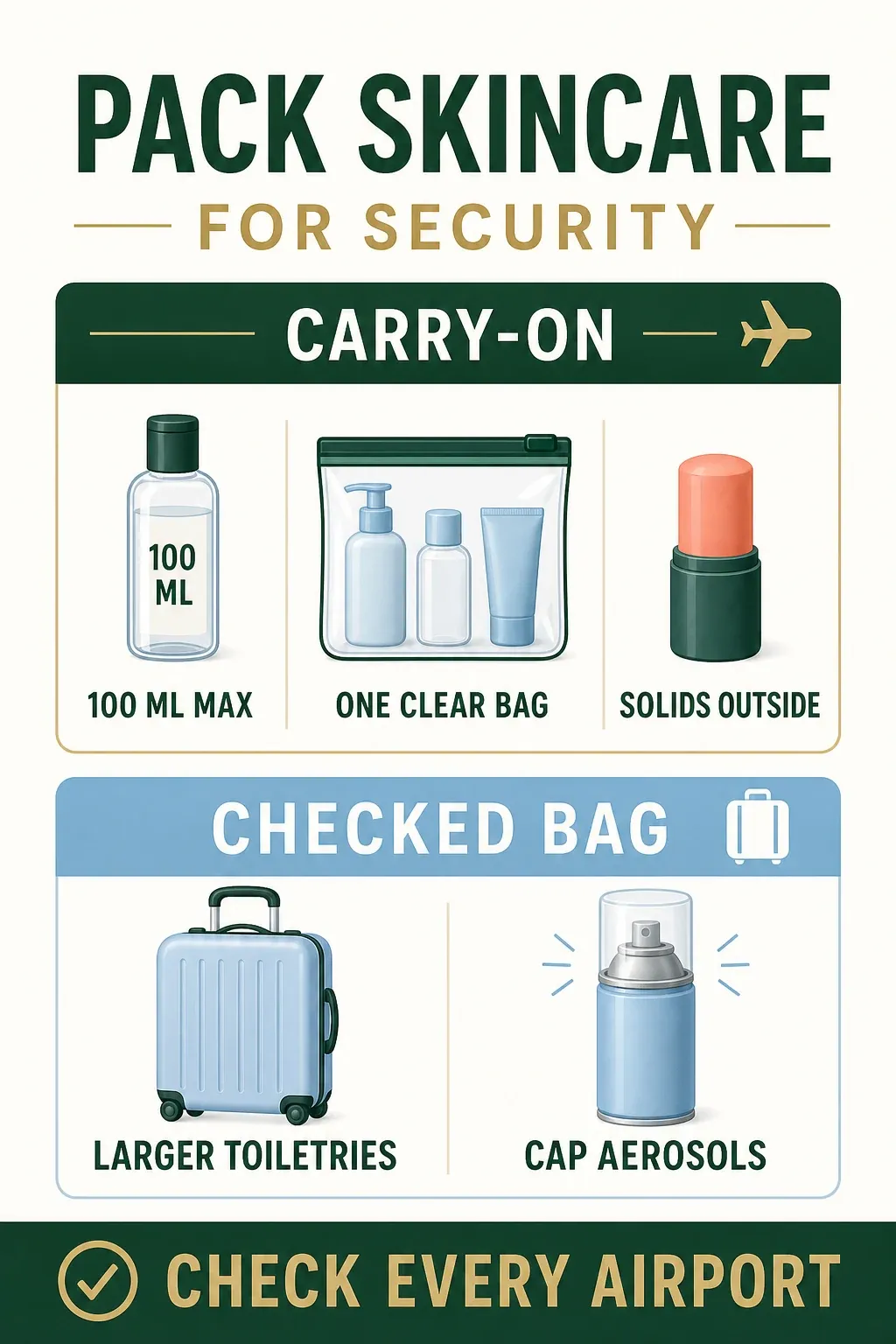
Creams, lotions, oils, gels, pastes, mascara, lip gloss, sprays and aerosols generally count as liquids for airport security. In the United States, the TSA 3-1-1 rule means each carry-on container must usually hold 3.4 ounces or 100 ml or less and all containers must fit in one quart-size bag. The container's capacity matters even when it is nearly empty.
The TSA states that liquids, aerosols, gels, creams and pastes must follow its carry-on rule. Medically necessary liquids may be allowed in larger quantities with separate screening, but ordinary skincare does not become medical merely because it is important to your routine. The officer at the checkpoint makes the final security decision.
| Skincare item | Carry-on | Best packing choice |
|---|---|---|
| Cleanser, serum, lotion or oil | 100 ml/3.4 oz container or less | Clear liquids bag |
| Cream or balm with soft texture | Usually treated as a liquid | Use small original or labeled jar |
| Solid cleansing bar or stick | Usually outside liquids bag | Keep accessible for screening |
| Aerosol sunscreen | 100 ml or less plus safety rules | Protect nozzle and check airline |
| Larger toiletries | Not through ordinary carry-on screening | Checked bag if otherwise permitted |
EU airports use a closely related rule: individual liquid containers no larger than 100 ml in one transparent resealable bag with capacity no greater than one liter. The European Commission includes gels, aerosols, pastes, lotions and liquid-solid mixtures. Duty-free and medical exemptions have separate conditions.
UK rules are now airport-specific. The current UK guidance says most airports still limit containers to 100 ml, while some may allow larger containers. Check the departure, connection and return airports rather than assuming a new scanner at one terminal changes the whole trip.
How to Pack Skincare Without Leaks
Use original travel sizes when product stability matters
Original small packaging reduces labeling confusion and may protect air-sensitive or light-sensitive formulas better than a clear decanting jar. Sunscreen, prescription products, retinoids and vitamin C are poor candidates for random containers when material compatibility or light protection is uncertain. Buy a legitimate travel size or keep the original compliant bottle when practical.
Do not transfer sunscreen into an untested decorative jar merely to save space. The formula was tested in its intended packaging, and contamination or material interaction can affect stability. A smaller official tube also preserves the Drug Facts directions.
Decant simple cleansers and moisturizers carefully
Use a clean, dry, compatible bottle and label it with the product name. Leave a little expansion space, wipe the threads and cover the opening with a small piece of clean plastic film before tightening the cap. Place the container inside the required clear bag, then place that bag in an easy-to-reach pocket.
Do not mix leftovers from different formulas. Wash and fully dry reusable containers between trips. Discard a decanted product if its smell, color, texture or separation changes.
Protect pumps and aerosols
Twist-lock pumps, replace caps and use a small clip or protective sleeve when the pump can move. The FAA requires aerosol release devices to be protected from accidental release. Toiletry quantities also have aggregate and per-container limits even in checked luggage.
Nail polish, remover, rubbing alcohol, perfume and aerosols can fall under hazardous-material exceptions with specific limits. The FAA distinguishes permitted personal toiletries from prohibited non-toiletry flammable aerosols. Check the FAA PackSafe tool, TSA and the airline when an item is flammable or pressurized.
A Minimal Travel Skincare Routine
Travel is a poor time to test a new acid, retinoid, peel or fragranced mask. Cabin air, schedule changes and unfamiliar water already make skin feel different. Keep the routine familiar and reduce the number of steps.
| Trip moment | Useful routine | Skip |
|---|---|---|
| Before departure | Moisturizer and sunscreen for exposure | A strong peel or new active |
| During a short flight | Leave skin alone; use lip balm as needed | Repeated cleansing and misting |
| During a long flight | Clean hands, light moisturizer on dry areas | Sheet masks and fragranced sprays |
| After arrival | Gentle cleanse, familiar moisturizer | Immediate treatment escalation |
| Sunny destination | Broad-spectrum SPF 30+, hat and shade | Relying on makeup SPF |
Before boarding
Cleanse only if the normal schedule calls for it, then apply a familiar moisturizer. Use sunscreen when traveling to the airport in daylight, sitting near a bright window or arriving outdoors. Our sunscreen reapplication guide explains how to refresh before renewed exposure.
Do not apply a thick occlusive mask under makeup simply because the cabin will be dry. A normal cream used at the right amount is often enough. The overnight hydration mask guide helps decide whether a richer texture solves a real comfort gap after arrival.
During the flight
For a short flight, the best routine may be no routine. Repeatedly touching the face with unwashed hands adds friction and contamination. Drink according to thirst and normal health needs without promising that extra water directly hydrates the outer skin.
On a long flight, use clean hands and apply a small amount of familiar moisturizer to tight areas. A bland lip balm can reduce chapping. Avoid spraying fragranced mist around other passengers or using products that require sink rinsing in a small shared lavatory.
After landing
Remove sunscreen and makeup with a familiar gentle cleanser, then moisturize. Wait until the skin is comfortable before restarting a strong active that was paused for travel. Jet lag and a different climate can change tolerance for several days.
The hydration versus moisturization guide explains why a water mist alone may evaporate without solving tightness. Use a complete moisturizer when the surface feels dry.
Carry-On Versus Checked Bag
Keep irreplaceable, medically necessary and arrival-essential products in carry-on when permitted. Checked bags can be delayed or exposed to temperature extremes. Larger ordinary toiletries may go in checked luggage when airline and hazardous-material rules allow them.
Do not place every valuable bottle in checked luggage just because it exceeds 100 ml. Buy a compliant size, decant a stable basic product or plan to purchase it after arrival. Prescription products should remain labeled and accessible according to destination and airline requirements.
| Put in carry-on | Put in checked bag | Reason |
|---|---|---|
| Essential compliant cleanser | Large backup cleanser | Arrival access versus volume |
| Daily moisturizer | Large body lotion | Immediate comfort versus space |
| Compliant sunscreen | Large nonessential backup | Protection after landing |
| Prescription medication | Do not separate without advice | Loss and documentation risk |
| Solid balm or stick | Optional duplicates | Saves liquid-bag space |
Temperature-sensitive formulas may not tolerate a hot baggage hold, parked transfer cart or freezing destination. Brand stability data is rarely available for the exact trip. Keep essential products in the cabin when allowed and avoid taking fragile formulas you cannot protect.
For sunscreen, enough volume matters. A tiny face tube may cover several days but not a family beach trip. Pack a compliant arrival supply and buy a larger trusted product after security or at the destination.
Special Cases: Sunscreen, Aerosols, Nail Products and Devices
Sunscreen
Cream, gel and spray sunscreen count as liquids or aerosols for carry-on screening. A solid sunscreen stick can reduce pressure on the liquids bag, but it still needs to be applied generously. Compare formats in our sunscreen stick guide.
Aerosol sunscreen may be allowed as a toiletry within FAA and TSA limits, but the nozzle must be protected. Do not use aerosols near an ignition source or spray them in the cabin. Check the airline when in doubt.
Nail polish and remover
These products can be flammable and are subject to hazardous-material rules. Small personal-use quantities may be permitted, but that does not make every solvent or professional nail product acceptable. Use FAA PackSafe and airline guidance for the exact item.
LED masks and powered devices
Battery rules can be more important than the skincare device itself. Spare lithium batteries and power banks generally belong in carry-on, not checked luggage, under separate aviation rules. Verify watt-hour limits and airline instructions before packing.
Travel rarely justifies bringing a bulky device. The LED mask guide helps decide whether the treatment's consistency benefit is large enough to earn suitcase space.
International Connections and Airport Scanner Changes
A rule at the first airport does not automatically apply at a connection or on the return. Security screening may occur again, and a larger container allowed at one airport can be refused at the next. Save the official airport pages before departure.
Do not rely on old social posts claiming that the 100 ml rule has ended everywhere. The current UK guidance explicitly says rules depend on the airport, while the EU's general rule remains 100 ml. When sources conflict, follow the official departure airport, national security authority and airline.
Duty-free liquids can have tamper-evident bag and receipt requirements. Keep them sealed until the final destination when instructed. Opening the security bag may remove the exemption during a later screening.
Common Packing Mistakes
- Using a half-empty large bottle: container capacity still exceeds 100 ml.
- Calling a cream a solid: soft creams and balms are often screened as liquids.
- Assuming one airport's scanner sets global rules: connections can screen again.
- Decanting sunscreen into a random jar: packaging can matter for stability and directions.
- Leaving pumps unlocked: pressure and movement can empty the bottle.
- Ignoring aerosol caps: release devices must be protected.
- Packing a ten-step routine: duplicates consume space and add irritation variables.
If a product leaks, clean the bag and container before applying it. Cross-contamination from cleanser, remover or fragrance can make a familiar moisturizer irritating. Discard products that clearly mixed or changed texture.
For sensitive travelers, the simple sensitive-skin routine provides a useful packing template regardless of age. Familiar basics are easier to troubleshoot than a destination-specific haul.
Pack Different Amounts for a Weekend, a Week and a Long Trip
For a weekend, use original minis or estimate only the number of applications you need. Cleanser and moisturizer often require less volume than expected, while sunscreen requires more because it must cover every exposed area. Test the amount at home instead of filling every travel bottle to the top.
For a one-week trip, prioritize enough sunscreen and any prescription treatment that cannot be replaced easily. A small cleanser can be stretched by using it once nightly, but sunscreen should never be rationed below the labeled amount. Plan a destination purchase when carry-on limits make the required volume unrealistic.
For longer travel, choose widely available basics and keep a photograph of the ingredient list. That makes it easier to replace a lost product without guessing from marketing names. Do not carry a month's worth of unstable serum when a simple local moisturizer fills the same practical job.
Dry destinations may justify a cream instead of a light lotion, while hot humid destinations may make a gel-cream more comfortable. Change texture only when the climate creates a real need and introduce the substitute before departure. The dry-skin cleanser guide helps reduce stripping when cold air or cabin travel increases tightness.
Share volume across the group only when everyone tolerates the same product. One large checked sunscreen can serve a family after arrival, while each traveler carries a small compliant backup. Keep prescription products and allergy-sensitive formulas separate and clearly identified.
Count applications rather than steps. A product that will be used once during a five-day trip probably does not deserve liquid-bag space unless it is medically necessary. A minimal kit is easier to secure, inspect and use consistently.
The Bottom Line
You can bring skincare on a plane when each item follows the applicable security and hazardous-material rules. For ordinary carry-on travel, plan around 100 ml containers, one clear liquids bag and airport-specific checks. Pack a minimal familiar routine, protect against leaks and never assume a scanner upgrade at one airport changes every leg of the journey.
Frequently Asked Questions
Does moisturizer count as a liquid on a plane?
Yes. Creams and lotions generally count as liquids for carry-on screening and must follow the applicable container and bag limits.
Can I bring a 200 ml bottle if it is almost empty?
Usually no at a standard 100 ml checkpoint. The container capacity, not the amount left inside, controls the rule.
Do solid skincare sticks go in the liquids bag?
Solid sticks generally do not need the liquids bag, but security authorities make the final decision. Keep them accessible and check the departure airport.
Can aerosol sunscreen go in checked luggage?
Personal toiletry aerosols may be allowed within FAA and airline quantity limits when the nozzle is protected. Verify the exact product and airline before travel.
Should I use a sheet mask during a flight?
It is optional and often unnecessary. A familiar moisturizer applied with clean hands is simpler, less messy and less likely to irritate or disturb nearby passengers.