Can Men Use Women's Skincare? Choose by Skin, Not Label
Men can use skincare marketed to women. Product fit depends on skin type, concern, shaving exposure and formula, not the aisle or package color.

In this guide
Men can use cleansers, moisturizers, serums and sunscreens marketed to women because a gender label is not an ingredient category. Average differences in oil production, facial hair and shaving exposure can influence product choice, but individual skin type, condition, tolerance and formula matter more. Choose by function and follow treatment directions rather than buying an entire gendered line.
Quick Summary
- Gendered skincare is primarily a marketing and sensory category.
- Average sex differences exist, but individual skin behavior overlaps widely.
- Shaving exposure often changes the routine more than gender does.
- Compare formula, fragrance, texture, evidence and cost per use.
Skincare aisles often imply that men's and women's faces need separate chemistry. Research supports some average physiological differences, but those averages do not justify a complete parallel product universe. This guide separates biology from packaging, explains the practical effect of shaving and provides a routine that works by skin need rather than gender identity.
Women's Skincare Is a Marketing Label, Not a Skin Type
A cleanser, moisturizer or sunscreen does not detect the gender printed on its package. It interacts with oil, water, the skin barrier, hair follicles and any condition being treated. If the formula fits those needs, a man can use it.
Brands often divide products by color, scent, texture and advertising audience. A men's moisturizer may be lighter, more fragranced or packaged in dark colors, while a women's version may emphasize softness or anti-aging. Those choices can affect preference, but they do not create separate cosmetic biology.
The useful comparison is the full ingredient list, vehicle, directions and outcome. A fragrance-free lotion in a pink bottle may suit irritated post-shave skin better than a strongly scented gel labeled for men.
| Label claim | What may really differ | What to decide instead |
|---|---|---|
| For men | Scent, lighter texture, shaving language | Does it match oiliness, dryness and shaving exposure? |
| For women | Richer texture, floral scent, anti-aging positioning | Are the formula and active ingredients suitable? |
| Unisex | Neutral design or fragrance | Neutral branding does not guarantee gentle care |
| Sensitive | Sometimes fewer irritants, but not a regulated promise | Check fragrance and the full ingredient list |
| Clinical | Medical-looking packaging | Look for evidence, not visual authority |
| Natural | Plant-focused marketing | Botanicals can still irritate or cause allergy |
What Research Says About Male and Female Skin
A review of male and female skin describes average differences in sebum, hair growth, thickness, pigmentation and aging patterns. Hormones contribute to several of those differences, especially oil production and facial hair. The review does not conclude that every man needs a men's product line.
A study measuring skin parameters in 300 healthy participants found sex- and age-related patterns, but measurements also varied by body site. That matters because a beard area exposed to shaving is not equivalent to an unshaved cheek, even on the same person.
A later systematic review of epidermal thickness found that anatomical location and measurement method explain important variation. Sex differences were small or inconsistent across some analyses. Marketing categories are therefore much cruder than the biology they claim to organize.
Average oiliness is not universal oiliness
Androgen activity can support higher sebum production in many men, especially earlier in adulthood. Yet men can have dry, eczema-prone or treatment-irritated skin, and women can have very oily skin. Choose cleanser strength and moisturizer texture from current comfort, shine and barrier signs.
If skin feels tight after washing, becomes shiny but flaky, or stings when moisturizer is applied, a stronger foaming wash is not automatically the answer. Use the skin barrier repair guide before adding more oil-control steps.
Shaving Changes the Routine More Than the Gender Label
Razor blades remove hair while also creating friction across the stratum corneum. Repeated passes, a dull blade, shaving against the grain and fragranced aftershave can increase burning, cuts and ingrown hairs. This exposure is often the most practical difference in a beard-area routine.
The American Academy of Dermatology's shaving guidance recommends wetting skin and hair, applying shaving cream, shaving in the direction of hair growth and changing blades regularly. Those steps can matter more than buying a gendered cleanser.
After shaving, use a bland moisturizer that does not sting. Alcohol-heavy splashes and strong fragrance can create a clean sensation while worsening irritation. If bumps persist, distinguish ingrown hairs from acne before treating both with multiple harsh actives.
How to place actives around shaving
Retinoids, exfoliating acids and benzoyl peroxide can make freshly shaved skin less tolerant. Use them at a different time or on non-shaving nights until the skin is stable. Product directions or a clinician's instructions override a generic schedule.
The slow skincare guide explains how to introduce one active at a time. A stable baseline makes it easier to tell whether burning comes from the razor, the treatment or their combination.
How to Choose Any Product Without Gender Marketing
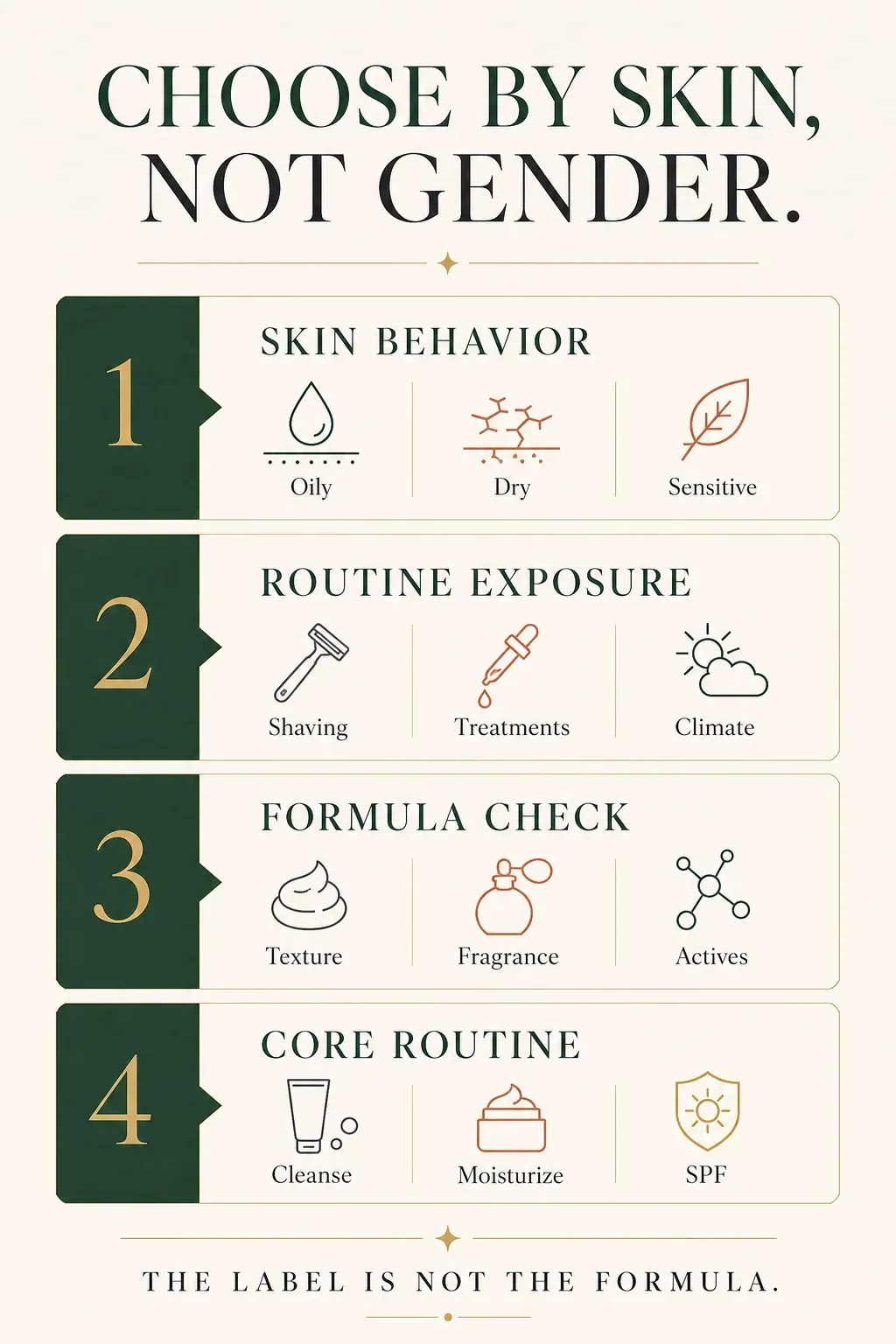
Start with the job. A cleanser should remove sunscreen, excess oil and soil without leaving persistent tightness. A moisturizer should reduce dryness and support comfort, while sunscreen should provide reliable broad-spectrum protection in a texture you will apply generously.
Then choose by skin behavior and condition. Acne, eczema, rosacea, folliculitis, pigment changes and medication use can change the safest formula. A product label cannot diagnose which one is present.
| Skin situation | Useful formula direction | Common mistake |
|---|---|---|
| Oily and comfortable | Light lotion or gel-cream; gentle foaming cleanser | Skipping moisturizer and over-cleansing |
| Dry or tight | Cream cleanser and fragrance-free cream | Choosing an oil-free gel only because it says men |
| Acne-prone | Non-comedogenic support plus one proven active | Stacking scrub, acid and alcohol aftershave |
| Sensitive or reactive | Short ingredient list and fragrance-free options | Assuming natural fragrance is safer |
| Beard and ingrown hairs | Low-friction shave plus targeted treatment | Treating every bump as ordinary acne |
| Dark marks after bumps | Inflammation control and daily sunscreen | Scrubbing pigment away |
A Minimal Routine That Works Across Gender Labels
In the morning, rinse or use a gentle cleanser if needed, apply moisturizer according to dryness, and finish with broad-spectrum SPF 30 or higher. Sunscreen is the step most likely to reduce preventable photoaging and help protect marks from becoming more persistent.
At night, cleanse sunscreen and soil, apply a condition-specific treatment if one is needed, and moisturize. The AM and PM routine guide gives a practical sequence without requiring a separate male product category.
Three reliable products used consistently usually outperform a crowded shelf that causes irritation or inconsistent use. Add a serum only when it has a defined job that the baseline routine does not already cover.
For oily or acne-prone skin
Choose a cleanser by tolerance, not by how aggressively it removes oil. The acne-prone cleanser guide compares gentle, salicylic-acid and benzoyl-peroxide roles. A treatment cleanser still counts as an active and may be too much twice daily.
Use a light moisturizer when acne treatment causes dryness. Avoid the cycle of stripping, stinging and stopping treatment. Painful, scarring or persistent acne deserves professional assessment rather than a stronger men's scrub.
For dryness, sensitivity or redness
Fragrance-free cream or lotion is often more useful than a cooling gel. Look for humectants, emollients and occlusive ingredients that reduce water loss. The redness and rosacea routine shows why heat and fragrance can be more relevant than gender.
Do not use a product through persistent burning because the package promises toughness or performance. Skin irritation is not a character test. Stop the suspected product and rebuild the routine around comfort.
Ingredients Men Can Use
Niacinamide, glycerin, ceramides, hyaluronic acid, vitamin C, salicylic acid and retinoids are not restricted by gender. Their usefulness depends on the concern, formula, concentration, frequency and tolerance. More actives do not automatically create a better routine.
Retinoids can help acne and photoaging, but they commonly cause early dryness. Start slowly and use sunscreen. Vitamin C can support an antioxidant morning routine, yet a stable formula and comfortable use matter more than a high percentage printed on the box.
Salicylic acid can help clogged pores and ingrown-prone areas, while benzoyl peroxide can support inflammatory acne. Both can irritate shaved skin or bleach fabrics. Introduce one first and track the response.
Ingredients and Features to Question
Heavy fragrance, essential oils and high alcohol are not automatically harmful, but they add little for a person whose main problem is irritation. Cooling menthol can feel active without repairing the barrier. Scrub particles can worsen raised bumps and freshly shaved skin.
Claims such as detox, oxygenating, hormonal balance and instant pore closure need defined evidence. The FDA does not pre-approve ordinary cosmetics for effectiveness, and a clinical-looking package is not proof of drug-level testing. Ask what measurable outcome the formula is designed to change.
The AAD men's skincare advice also centers skin type, cleansing, moisturizing and sun protection. Its practical recommendations do not require a separate ingredient universe.
Can Women Use Men's Skincare Too?
Yes. The same principle works in both directions. A woman may prefer the texture, price or packaging of a men's fragrance-free product, provided it fits her skin and any pregnancy, allergy or treatment considerations.
The most common limitation is sensory rather than biological. Men's products are often strongly fragranced or designed for an immediate cooling feel. Anyone with sensitive skin can find those features uncomfortable.
How to Switch Products Without Creating a Reaction
Keep cleanser, moisturizer and sunscreen stable, then replace one item. Patch test when allergy or sensitivity is a concern and use the new product at the lowest practical frequency. Do not change shaving technique and three products in the same week.
Track tightness, burning, bumps, active acne and daily comfort for two to four weeks. Immediate softness can reflect silicones or emollients, while acne and pigment need longer observation. Stop for swelling, blistering, hives or severe pain.
Use the guide to whether skin gets used to products to separate true tolerance from ongoing irritation. A product does not become necessary merely because it was marketed to your demographic.
When a Dermatologist or Clinician Helps
Seek assessment for painful nodules, scars, spreading rash, persistent beard-area bumps, sudden hair loss or redness that does not settle with a simple routine. Folliculitis, pseudofolliculitis barbae, acne and dermatitis can overlap visually but need different plans.
Bring product labels, medication lists and photographs from before the reaction. Mention occupational exposures, helmets, masks and shaving frequency. Those details are more diagnostically useful than whether the bottle came from the men's or women's aisle.
How to Compare Two Gendered Products Side by Side
Put the front labels aside and compare the product type, active ingredients, fragrance, container size and directions. Then calculate price per ounce and estimate how often each formula would be used. A product is not a bargain when its scent or finish prevents consistent application.
Patch test the preferred option and use it on one stable area before replacing the full routine. If both formulas perform the same job, choose by comfort, availability and cost. Do not assume the product with more claims has more useful ingredients.
Our guide to the difference between men's and women's skincare expands the label comparison. Keep the newer routine focused on one cleanser, one moisturizer and one sunscreen before deciding whether a treatment serum is necessary.
Reassess after climate, shaving frequency or medication changes. The best choice can change when the skin becomes drier, more reactive or less oily. That is adaptation to current skin, not evidence that a gender label became biologically correct.
Common Gendered Skincare Mistakes
- Assuming men need stronger cleansing: tightness and stinging indicate excess, not success.
- Using aftershave as treatment: scent and cooling do not prevent ingrown hairs.
- Skipping sunscreen: gender does not change ultraviolet damage.
- Buying a complete line: matching branding does not prove compatible actives.
- Treating all bumps as acne: shaving-related conditions need correct diagnosis.
- Paying for packaging: compare formula, amount and cost per use.
The Bottom Line
Men can use women's skincare, and women can use men's skincare. Average biological differences may influence oiliness, hair growth or aging patterns, but individual skin behavior and treatment needs are much more useful for selecting a formula.
Ignore the aisle, define the job and compare the complete product. A gentle, effective formula that you can use consistently is a better choice than a gendered product that irritates, duplicates actives or solves no real problem.
Frequently Asked Questions About Can Men Use Women's Skincare? Choose by Skin, Not Label
Can men use women's moisturizer?
Yes. A man can use any moisturizer whose texture, fragrance and ingredients fit his dryness, oiliness and sensitivity. The product does not work differently because of the intended marketing audience.
Is men's skin thicker than women's skin?
Some studies report average differences in thickness and other parameters, but results vary with age, body site and measurement method. That average does not prescribe a separate product line for every individual.
Do men need stronger face wash?
No. Many men produce more oil on average, but a cleanser should still avoid persistent tightness and stinging. Dry, sensitive or treatment-irritated skin often needs a gentler formula.
Can women use men's skincare?
Yes. The same formula-first rule applies. Strong fragrance, menthol or a very light texture may be a preference or tolerance issue, but there is no biological prohibition.
What should men apply after shaving?
Use a bland, fragrance-free moisturizer if skin feels dry or irritated. Avoid heavy rubbing and strongly fragranced alcohol splashes, and separate irritating actives from shaving until tolerance is clear.
This article is for informational purposes only and does not replace professional dermatological advice.