Teenage Acne Treatment Options: What Works and When to Get Help
A practical, evidence-based guide to teenage acne treatment options, from a gentle daily routine and OTC actives to the signs that professional care is needed.
In this guide

Quick Answer
For most teens, the best acne plan starts with a gentle cleanser, a non-comedogenic moisturizer and daily SPF, then adds one acne active matched to the breakout type. Salicylic acid can help clogged pores, benzoyl peroxide fits inflamed pimples, and adapalene can help prevent comedonal and recurring acne; deep, painful, scarring or persistent acne deserves professional care rather than a stronger shopping list.
Quick Summary
- Blackheads and whiteheads: consider salicylic acid or adapalene, introduced one at a time.
- Red, inflamed pimples: benzoyl peroxide can be useful, but lower intensity is often easier to tolerate.
- Deep or painful bumps: do not rely on cleansers or spot treatments alone; early medical care can help reduce scarring risk.
- Timeline: expect gradual change, not overnight clearing. A consistent routine usually needs several weeks before it can be judged fairly.
- Barrier rule: persistent burning, rawness, swelling or painful peeling means pause the newest active and reassess.
Teen acne is common, but the correct response is not to strip away every trace of oil. Puberty-related changes can increase sebum, while clogged follicles, inflammation and acne-associated bacteria contribute in different proportions. That is why one teenager may mainly see blackheads around the nose, another may develop red pimples across the cheeks, and another may have deep, tender bumps that need a clinician.
A treatment plan works best when it separates the daily support routine from the active treatment. Cleanser, moisturizer and sunscreen make the routine tolerable; salicylic acid, benzoyl peroxide, adapalene or a prescription medication addresses a defined acne pathway. When several products change during the same week, irritation and normal early adjustment become difficult to tell apart.
This guide organizes teenage acne treatment options by breakout type, tolerance and timeline. It explains what over-the-counter ingredients can reasonably do, what belongs in a clinician-led plan, and when waiting longer is the wrong move. For a gentler starting point, see our guide to teenage skincare for sensitive skin.
Match Treatment to the Breakout Type
Acne often includes more than one lesion type, but naming the dominant pattern helps choose the first active. Blackheads and whiteheads point toward pore-clogging processes, while red or pus-filled pimples bring inflammation into the picture. Deep nodules, cyst-like bumps and early scarring raise the urgency.
Skin tone also changes what improvement looks like. In deeper skin tones, flat brown or gray marks can remain after the raised acne has healed, but those marks are not the same as active pimples or indented scars. Preventing new inflammation and avoiding picking are central to reducing additional discoloration.
| Dominant pattern | What it can look or feel like | Reasonable first direction |
|---|---|---|
| Comedonal acne | Blackheads, whiteheads, rough clogged texture; usually not deeply painful | Gentle base plus one pore-focused active such as salicylic acid or adapalene |
| Inflammatory acne | Red bumps, pustules and tenderness near the surface | Consider benzoyl peroxide; seek advice if widespread or persistent |
| Mixed acne | Both clogged pores and inflamed pimples | Start one treatment, build tolerance, then reassess rather than stacking immediately |
| Deep, nodular or scarring acne | Large painful bumps, lasting lumps, indentations or rapidly increasing marks | Arrange medical assessment early; OTC spot treatment alone is not enough |
If the main problem is blackheads, our blackhead treatment guide goes deeper into pore-focused options. Painful or scar-forming acne belongs on a different pathway, covered in our cystic acne treatment guide.
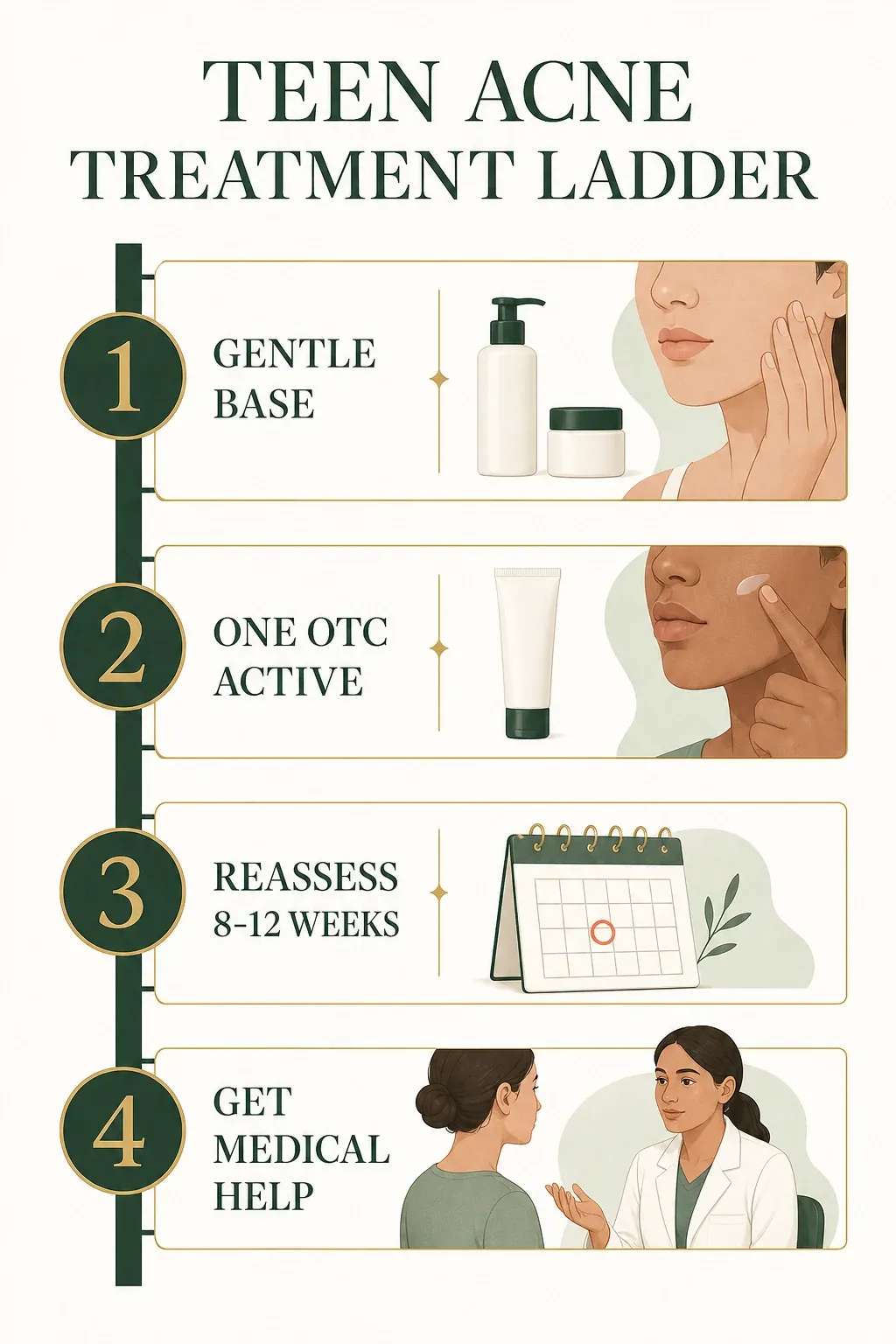
The Teenage Acne Treatment Ladder
The ladder is a decision sequence, not a promise that every teen should complete every step. Some mild acne may improve with a simple base and one active, while deep or scarring acne should move to professional care without waiting through a long series of retail experiments.
STEP 1
Gentle Base
Use a suitable cleanser, moisturizer and broad-spectrum SPF 30+ consistently.
STEP 2
One OTC Active
Match salicylic acid, benzoyl peroxide or adapalene to the main breakout pattern.
STEP 3
Reassess
Check adherence, irritation and trend after a realistic six-to-twelve-week window.
STEP 4
Get Medical Help
Escalate earlier for pain, scars, deep lesions, major distress or rapid worsening.
The American Academy of Dermatology notes that it can take at least six to eight weeks to begin seeing fewer breakouts with an effective plan. That does not mean every product must be tolerated indefinitely: persistent burning, swelling or raw peeling is a reason to stop the newest active and seek guidance.
Over-the-Counter Teenage Acne Treatment Options
Over-the-counter does not mean risk-free or universally appropriate. The useful approach is to select one active for a defined role, start at a manageable frequency, and let moisturizer and sunscreen support adherence. Applying extra product or combining several strong actives rarely clears acne faster.
1. A Gentle Cleanser as the Daily Base
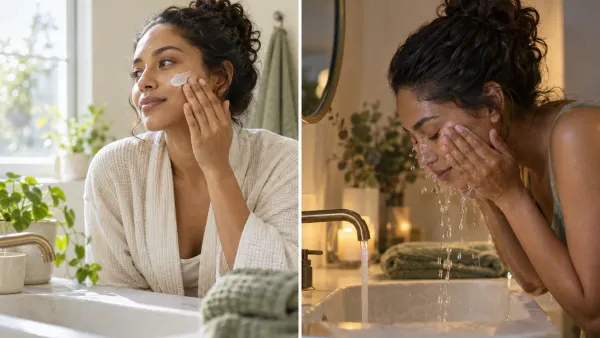
A cleanser removes sweat, excess oil, sunscreen and debris; it does not need to make the face feel squeaky. Fragrance-free, low-irritation formulas are especially useful when a teen is starting adapalene, benzoyl peroxide or another leave-on treatment. Wash with fingertips and lukewarm water rather than a scrub or cleansing brush.
Most teens can cleanse once or twice daily, but dry or reactive skin may only need a proper cleanse at night. Our comparison of the best cleansers for teenage skin matches cleanser texture and actives to different skin signals.
2. Salicylic Acid for Clogged Pores
Salicylic acid is oil-soluble and used in cleansers and leave-on products for blackheads, whiteheads and clogged texture. A rinse-off cleanser may be a more conservative starting format, while a leave-on product has longer contact and can be more irritating. Do not assume that cleanser plus toner plus spot treatment is a faster version of the same plan.
Start slowly, especially if the routine already contains a retinoid or benzoyl peroxide. For product-format differences and sensitivity notes, compare our salicylic acid cleanser guide.
3. Benzoyl Peroxide for Inflamed Pimples
Benzoyl peroxide reduces acne-associated bacteria and is commonly used for inflammatory acne. It appears in washes and leave-on treatments at different strengths; higher percentages can increase dryness without automatically making a beginner routine better. A lower-strength wash with short contact time can be easier to integrate than a maximum-strength face wash.
Rinse carefully and use white towels because benzoyl peroxide can bleach fabrics. If the skin becomes painfully dry, cracked or swollen, stop and reassess instead of using more moisturizer to push through severe irritation.
4. Adapalene for Comedonal and Recurring Acne
Adapalene is an over-the-counter topical retinoid that helps normalize clogged pores and prevent new lesions. It is applied to the acne-prone area rather than only to visible spots, following the product label or clinician guidance. Early dryness can occur, so a pea-sized amount for the whole face and a gradual schedule are common tolerance strategies.
Retinoids increase the importance of moisturizer and daily sun protection. Pregnancy and individual medical circumstances require professional guidance; this article does not replace the label or a clinician's advice.
5. Azelaic Acid as a Versatile Alternative
Azelaic acid can address clogged pores and inflammation, and it may also help post-acne discoloration over time. Some people find it easier to tolerate than a retinoid, while others experience temporary tingling or itching. It still counts as an active and should be introduced separately.
Post-acne marks need patience and sunscreen, not aggressive scrubbing. If marks are changing, raised, painful or diagnostically uncertain, get them assessed rather than treating every dark spot as leftover acne.
| Option | Best fit | Conservative start | Pause or get advice if |
|---|---|---|---|
| Salicylic acid | Blackheads, whiteheads, clogged texture | One rinse-off or leave-on format a few times weekly | Stinging persists, skin looks shiny-raw, or peeling increases |
| Benzoyl peroxide | Red inflamed pimples; face or body depending on product | Lower strength, short contact or low frequency | Painful dryness, cracking, swelling or severe irritation develops |
| Adapalene 0.1% | Comedonal and recurring acne prevention | Follow label; introduce gradually with moisturizer and SPF | Irritation is severe, or pregnancy/medical questions apply |
| Azelaic acid | Mixed acne and post-acne discoloration support | Low frequency before increasing as tolerated | Persistent itching, rash or worsening sensitivity occurs |
When Prescription Treatment Enters the Plan
Prescription care is not a sign that a routine failed. It is the appropriate next level when acne severity, scarring risk, distribution or lack of response requires diagnosis and treatment that retail products cannot provide. A clinician can also distinguish acne from folliculitis, perioral dermatitis and other conditions that can look similar.
Prescription Topicals
Dermatologists may use prescription retinoids, combination products, topical antibiotics or clascoterone depending on acne type and patient factors. Topical antibiotics are generally paired with benzoyl peroxide to reduce antibiotic-resistance risk, not used as a casual long-term solo product. Combination formulas can simplify the schedule while treating more than one acne pathway.
Oral Antibiotics
Oral antibiotics may be used for selected moderate-to-severe inflammatory acne for a limited period. They require clinician supervision and are typically combined with topical treatment rather than replacing the whole routine. They are not the primary solution for nodular acne and should never be borrowed or saved for later self-treatment.
Clinician-Led Hormonal Options
For appropriate patients, a clinician may consider a combined oral contraceptive or spironolactone after reviewing health history, pregnancy potential, other medicines and risks. These are medical decisions, not products to add based on a social-media routine. The plan and monitoring should come from the prescribing professional.
Isotretinoin
Isotretinoin is a powerful prescription option used for severe nodular acne or acne that has not responded to other treatment. It requires close medical supervision, pregnancy-prevention requirements where relevant, and monitoring for side effects. It should not be delayed solely because an influencer says everyone must exhaust every cleanser first.
The American Academy of Dermatology's acne treatment overview explains how treatment is selected by acne type and why professional diagnosis matters.
A Simple Morning and Evening Routine
The routine should be short enough to repeat on school days, weekends and travel days. Acne treatment is more likely to work when the supporting steps remain stable and the active has a clear place.
Morning
- Cleanse gently or rinse with water if dry and comfortable.
- Apply the morning acne active only if the plan calls for it.
- Use a non-comedogenic moisturizer where needed.
- Finish with broad-spectrum SPF 30 or higher.
Evening
- Remove makeup or water-resistant sunscreen without scrubbing.
- Cleanse and pat dry.
- Apply the chosen leave-on acne treatment as directed.
- Moisturize; do not pick or squeeze lesions.
A moisturizer does not “feed” acne when the formula suits the skin. It can reduce the dryness that causes teens to abandon useful treatment, so compare our teen moisturizer recommendations. Daily sunscreen matters because inflammation and some treatments can make post-acne marks and irritation more noticeable; see our teen sunscreen guide.
Spot treatments can help selected individual lesions, but they do not replace prevention across acne-prone areas. Our teen spot-treatment comparison explains when patches, benzoyl peroxide and other formats fit.
What Progress Can Look Like
Acne does not clear in a straight line. Hormonal fluctuations, sports, stress, menstrual cycles and missed applications can create noisy weeks even when the overall direction is improving. Look for fewer new inflamed lesions, faster healing and less tenderness before expecting completely clear skin.
| Time point | What to check | Reasonable next step |
|---|---|---|
| Days 1-14 | Burning, swelling, raw peeling, painful dryness, ability to follow routine | Reduce or stop the newest active if irritation is significant; keep the base simple |
| Weeks 3-6 | Tolerance, adherence and whether new inflamed lesions are beginning to slow | Do not add another strong active just because clearing is incomplete |
| Weeks 6-12 | Overall trend in new lesions, pain, marks and healing time | Continue if clearly improving and tolerable; seek advice if unchanged or worsening |
| Any time | Deep painful bumps, scars, major distress, widespread rash or diagnostic uncertainty | Arrange professional assessment rather than waiting for the retail routine to work |
Changing cleanser, serum and moisturizer together resets the experiment. If one product is tolerated, keep it stable while the treatment plan is evaluated. If the skin is worsening rapidly or the emotional impact is substantial, the calendar should not delay care.
Diet, Stress, Sports and Everyday Habits
Acne is not caused by being dirty, and scrubbing harder does not fix hormones or deep inflammation. Wash after heavy sweating when practical, keep helmets and chin straps clean, and use non-comedogenic products where repeated occlusion seems to trigger breakouts. Avoid picking because it increases inflammation and the risk of lasting marks.
Diet research is nuanced. Some people may notice a relationship with high-glycemic eating patterns or certain dairy intake, but restrictive dieting is not a universal acne prescription and teen nutrition needs matter. Use a short, specific observation log and discuss major dietary changes with a qualified professional.
Stress can coincide with flares and make picking or inconsistent care more likely. The useful response is not to blame the teen; it is to make the routine simpler, protect sleep where possible and ask for help when acne affects confidence, school or social life.
When to See a Doctor or Dermatologist
Professional care is appropriate for deep nodules, cyst-like bumps, visible scarring, rapidly worsening acne or widespread inflammation on the face, chest or back. It is also appropriate when a consistent OTC plan has not produced meaningful improvement, when irritation prevents treatment, or when the diagnosis is uncertain.
Emotional impact counts. Acne that contributes to anxiety, low mood, avoidance or bullying deserves attention even if someone else labels it “mild.” A pediatrician, family doctor or dermatologist can help decide whether prescription treatment, a different diagnosis or mental-health support is needed.
Seek urgent care for facial swelling, breathing difficulty or other signs of a serious allergic reaction. For ordinary treatment questions, bring a list or photos of current products so the clinician can see where ingredients overlap.
Your Clear Skin Checklist
- Name the dominant breakout pattern: clogged, inflamed, mixed or deep.
- Keep cleanser, moisturizer and sunscreen simple and consistent.
- Choose one OTC active with one clear job.
- Introduce slowly and track irritation separately from acne activity.
- Use weekly photos and new-lesion counts instead of daily magnifying-mirror checks.
- Do not pick, scrub or stack acids to chase faster results.
- Get professional help early for pain, scars, distress or deep lesions.
The Bottom Line
The best teenage acne treatment is not automatically the strongest ingredient or the longest routine. It is a plan matched to the acne type, simple enough to follow, and tolerable enough to continue while results develop.
Start with the gentle base, choose one appropriate active, and judge the trend over a realistic interval. Move to professional care sooner when acne is deep, painful, scarring, rapidly worsening or emotionally burdensome.
Frequently Asked Questions About Teenage Acne Treatment
What is the best first treatment for teenage acne?
Begin with a gentle cleanser, non-comedogenic moisturizer and daily sunscreen, then match one active to the main acne type. Salicylic acid or adapalene may fit clogged pores, while benzoyl peroxide is more directly aimed at inflamed pimples.
How long should a teenager try an acne treatment?
Many effective plans need at least six to eight weeks before fewer breakouts become noticeable, and fuller assessment may take up to twelve weeks. Stop sooner and get advice if there is severe burning, swelling, cracking or a significant rash.
Can a teen use benzoyl peroxide and adapalene together?
These ingredients can appear in clinician-guided acne plans, but introducing both at once may make irritation harder to control. A teen should follow product labels or professional advice and build tolerance instead of creating an aggressive combination independently.
Is acne purging normal when starting treatment?
Some pore-normalizing treatments can coincide with a temporary increase in visible breakouts, but “purging” should not be used to excuse severe irritation or months of worsening acne. Persistent pain, swelling, raw peeling or acne in new areas needs reassessment.
When should teenage acne be treated by a dermatologist?
Seek professional care for deep painful acne, scarring, rapid worsening, significant emotional distress, diagnostic uncertainty or lack of improvement after a consistent OTC trial. Early treatment can reduce the chance of additional scars and prolonged distress.