How Often Do Millennials Buy Skincare? A Restock Guide
No single survey can define how often millennials need skincare. A better restock schedule comes from product size, dose, use, shelf life and actual empties.
In this guide
There is no reliable universal frequency for how often millennials purchase skincare. Commercial surveys measure different countries, samples and beauty categories, while official expenditure data often combine skincare with other personal care. Your useful restock cadence comes from container size, dose, frequency, shelf life and actual empty dates, not from matching a generational shopping average.
Quick Summary
- Industry surveys describe selected audiences, not a universal buying rule.
- Separate replenishment, experimentation, promotions and impulse purchases.
- Estimate restocks from volume, dose and applications per day.
- Track open and empty dates to protect budget, safety and reduce waste.
The old question about how often millennials buy skincare looks statistical but lacks one defensible universal number. Market surveys mix discovery, replenishment and impulse shopping, while personal-care expenditure data cover more than skincare. This guide shows how to read those reports honestly and replace the generation headline with a practical restock system based on use, shelf life and routine value.
There Is No Universal Millennial Purchase Schedule
Millennials do not buy skincare on one fixed timetable. A person replacing a daily cleanser behaves differently from someone testing a seasonal serum, stocking up during a sale or buying a gift. Any single monthly or weekly statistic hides those separate behaviors.
Commercial beauty surveys can describe a particular panel at a particular time, but sample design, country, product categories and question wording vary. Self-reported purchase frequency is also not the same as verified use. Treat a trend figure as context, not a personal restock rule.
The more useful question is how long a product should last in your routine. Container size, dose, application area and frequency can estimate that answer without pretending an age cohort uses skincare identically.
| Purchase type | What triggers it | How to judge it |
|---|---|---|
| Replenishment | A regularly used product is nearly empty | Predict from volume and daily dose |
| Experiment | A new concern, claim or recommendation | Limit to one change at a time |
| Seasonal switch | Climate, travel or treatment changes | Use current skin needs, not the calendar alone |
| Promotion stock-up | Discount, bundle or free shipping | Check shelf life and realistic use rate |
| Replacement for reaction | Burning, allergy or worsening condition | Stop first; diagnose before buying more |
| Impulse purchase | Social content, novelty or fear of missing out | Wait 48 hours and name the routine gap |
What Current Beauty Reports Can and Cannot Tell Us
The Wunderkind 2025 beauty consumer report discusses discovery, loyalty, promotions and purchase behavior in its surveyed audience. It is useful for understanding ecommerce decision drivers. It does not establish a biological or universal millennial restock interval.
The McKinsey State of Fashion: Beauty 2025 describes a value-conscious, competitive market and changing consumer priorities. It combines broader beauty categories and market analysis. Readers should not convert its industry outlook into a rule that an individual needs more products.
The U.S. Bureau of Labor Statistics 2024 expenditure release reports personal-care products and services as an aggregate household category. It is stronger for broad spending context than a skincare-only cadence because services, hair care, toiletries and cosmetics can sit in the same family.
Why generation labels can mislead
Millennials span many ages, incomes, households and skin concerns. Someone managing prescription acne, a parent buying family sunscreen and a minimalist replacing moisturizer have little in common beyond a birth-year range. Country and retailer access add more variation.
Generation stories also risk confusing current age with a permanent trait. A cohort's behavior changes with income, parenting, health, inflation and product availability. Use the label for market context, not to prescribe personal consumption.
Calculate Your Own Restock Cadence
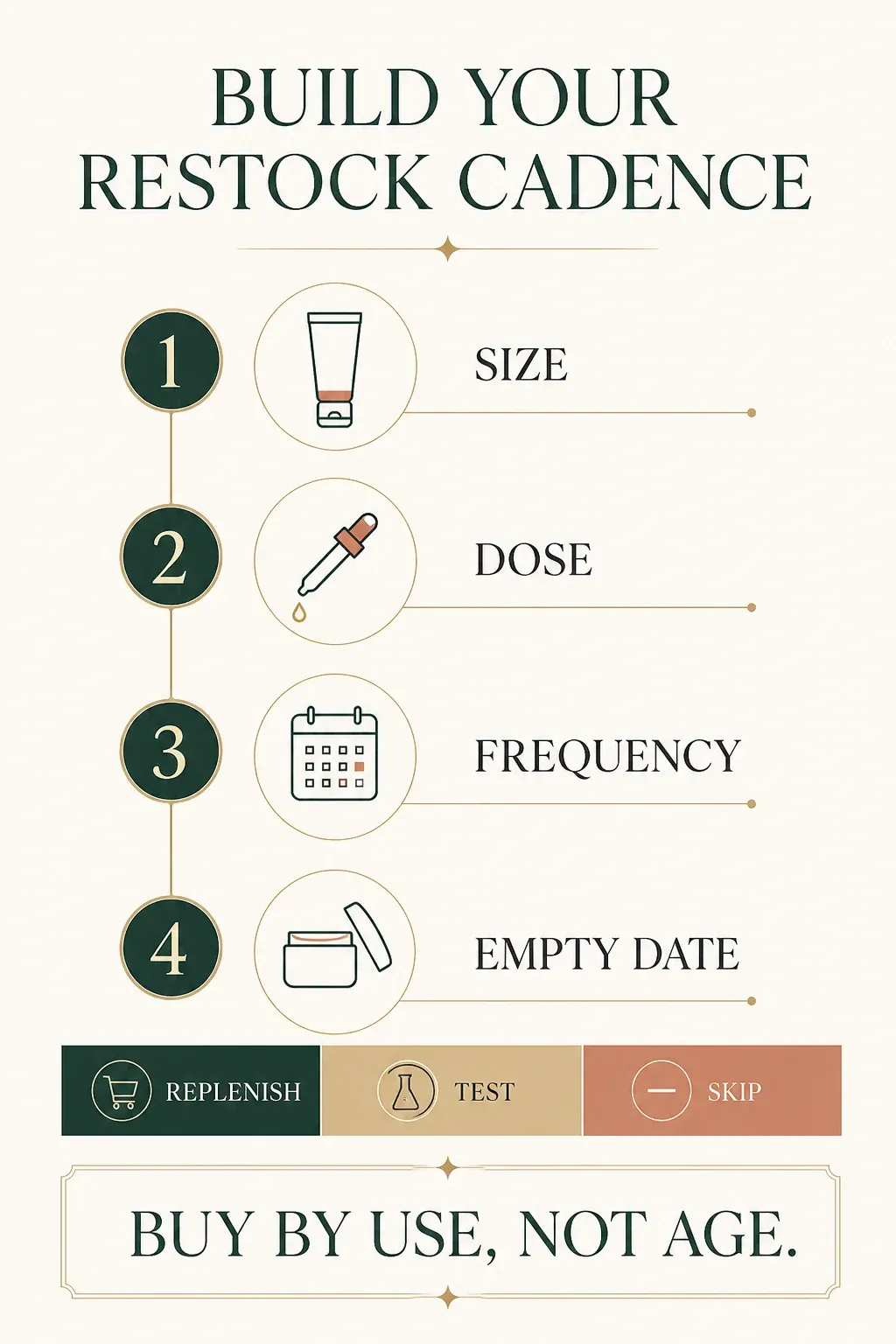
Start with the net contents printed on the package. Estimate the amount used per application and multiply by applications per day. Divide the container amount by daily use to get a rough duration.
For example, a 50-milliliter moisturizer used at 0.5 milliliters once daily lasts about 100 days. Used morning and night at the same dose, it lasts about 50 days. The exact amount varies, but the calculation is more transparent than a generational average.
Sunscreen is different because adequate face, neck and exposed-body application uses much more product than a serum. A small facial sunscreen can empty quickly when applied generously and reapplied. Slow use may signal under-application rather than exceptional value.
| Product | Typical use pattern | What changes replacement speed |
|---|---|---|
| Cleanser | Once or twice daily | Face-only versus face and body; pump size |
| Moisturizer | Once or twice daily | Texture, climate, face/neck coverage |
| Sunscreen | Morning plus reapplication | Exposed area, dose, outdoor time |
| Treatment serum | Several drops once daily or less | Dropper control and frequency |
| Retinoid | Small amount at night | Prescription directions and tolerance |
| Mask | Weekly or occasional | Single-use packets versus jar; contact area |
A simple tracking method
Write the open date on the package or in a phone note. Record the empty date and whether use was consistent. After two containers, your real cadence becomes clearer than any online estimate.
Track only core products first: cleanser, moisturizer, sunscreen and prescribed treatment. Optional masks and serums can remain irregular without creating a problem. The goal is reliable care, not a perfect purchasing dashboard.
Shelf Life, Expiration and Opened Products
The FDA explains that cosmetic shelf life depends on product type, use and storage, and United States law generally does not require ordinary cosmetics to carry expiration dates. Manufacturers remain responsible for product safety. Sunscreens and acne drugs follow drug labeling requirements instead.
Water, heat, sunlight and repeated finger contact can affect a product before the jar looks empty. A bathroom window or hot car is poor storage. Keep lids closed, use clean hands and follow any printed expiration or period-after-opening symbol.
The FDA's guidance on using cosmetics safely advises stopping a product if it causes an unexpected reaction and keeping containers clean. A changed smell, color or texture can justify disposal even before the estimated finish date.
Replenishment Versus Routine Churn
Replacing a sunscreen you reliably finish is different from buying a fourth exfoliating serum. Replenishment maintains a working routine; churn introduces new variables before prior products have been evaluated. Separate these categories in your budget.
Use the minimalist skincare routine to identify the products that deserve automatic replacement. Core care usually includes cleansing as needed, moisturizer according to dryness and sunscreen. Treatment depends on the actual condition.
The slow-start guide is useful when social media makes every launch feel urgent. One new product at a time creates clearer evidence and usually lowers waste.
How Social Media Changes Buying Without Changing Skin Needs
Short-form video compresses a product into texture, packaging and a rapid claim. It rarely shows eight weeks of consistent use, failed products or the rest of the creator's routine. High visibility can make a niche item appear essential.
Before purchasing, write the exact problem the product should solve. If an existing product already performs that job, the new item is a substitute rather than an addition. Compare it against the current product on evidence, tolerance, cost per use and packaging.
Wait 48 hours for nonessential purchases. During that pause, check whether the recommendation is sponsored, whether the creator's skin concern matches yours and whether the active conflicts with your routine. Urgency is a sales condition, not a skin condition.
Build a Replacement Calendar by Product Role
Core products can be checked when roughly one quarter remains. That gives time to reorder without keeping several backups. Treatments should be replaced according to directions, response and expiration rather than promotional cycles.
Seasonal needs are often overstated. A richer moisturizer may help during dry weather, but sunscreen remains relevant year-round. The seasonal routine guide shows how to adjust texture and frequency without replacing everything.
Travel sizes are useful when a formula is uncertain or used infrequently, even when the unit price is higher. A large discounted bottle is poor value if it expires, irritates or sits unfinished. Value depends on usable applications.
Buying for Acne, Sensitivity and Anti-Aging
Acne routines often create churn because early irritation is confused with a need for stronger products. Keep one evidence-based active and support it with moisturizer. The breakout prevention guide helps separate treatment from endless cleansing.
Sensitive skin benefits from fewer simultaneous experiments. Patch testing cannot predict every reaction, but it can identify obvious intolerance before full-face use. Use the sensitive skincare guide even outside the teen years for a barrier-first framework.
Anti-aging marketing can turn prevention into a crowded shelf. Daily sunscreen and a tolerable retinoid usually deserve more attention than rotating trend ingredients. The anti-aging moisturizer guide explains how hydration support fits around proven treatment.
How to Audit a Skincare Shelf
Sort products into daily core care, active treatment, optional use, unopened backup and stop/discard. Remove duplicates that perform the same job. Photograph batch codes and dates when a reaction or recall may need tracing.
For each open product, record its purpose, start date, current frequency and measurable result. If the purpose is unclear, the item should not automatically be replaced. A routine can become better by subtracting confusion.
Use the skincare storage guide for light, heat and contamination decisions. Good storage protects value more reliably than buying backups during every promotion.
Reduce Waste Without Underusing Important Products
The goal is not to make every container last as long as possible. Sunscreen, prescribed treatment and moisturizer should be used at an effective amount. Waste reduction starts with buying fewer unsuitable products, not under-applying the ones that work.
The EPA's sustainable materials framework prioritizes reducing material use and managing products across their life cycle. In skincare, that supports deliberate purchasing, finishing suitable products and checking local packaging rules.
Do not pour large amounts of product into drains merely to recycle a bottle. Follow local disposal instructions, especially for drug products or aerosols. Packaging symbols do not guarantee that a local facility accepts the material.
A Practical 30-Day Buying Reset
For one month, replace only empty core items and prescribed products. Add every desired launch to a waiting list with its promised job and price. Review the list at the end of the month.
During the reset, track products you actually finish and those you avoid. Avoidance can reveal unpleasant texture, irritation or a routine that is too complex. Fix that problem before purchasing another item in the same category.
At day 30, choose no more than one new test. Define its comparison, frequency and stop rule. A product that cannot earn a clear place in the routine does not become necessary because peers bought it.
A Realistic Restock Example
Imagine a routine with a cleanser finished every ten weeks, a moisturizer every eight weeks and a facial sunscreen every four weeks. Those products will create an uneven purchase pattern even when use is perfectly consistent. One month may include two replacements, while the next includes none.
Add a quarterly treatment replacement and one failed experiment, and a shopping app may report frequent beauty purchases without showing routine quality. The useful metrics are how many core products were finished, how many experiments earned a permanent role and how much product was discarded.
Set reorder points by remaining applications rather than dates. When a daily product has roughly one to two weeks left, check delivery time and availability. Keep only one backup unless shortages or household needs justify more.
For a shared household, track who uses each item and which areas it covers. A family sunscreen or body moisturizer can empty much faster than an individual facial serum. Household use should not be misread as generational overconsumption.
Common Purchase-Frequency Mistakes
- Treating a survey as a prescription: a market sample does not define your use rate.
- Counting shopping as consistency: unopened products do not improve skin.
- Buying backups before testing: intolerance turns a discount into waste.
- Ignoring dose: underused sunscreen should not last indefinitely.
- Replacing every season: adjust only what climate actually changes.
- Stacking promotions: a lower unit price is not value when products expire.
The Bottom Line
There is no reliable universal answer for how often millennials purchase skincare. Industry reports describe markets and survey panels, while real replenishment depends on product size, dose, frequency, household use and whether a formula is actually finished.
Build your own cadence from empties, open dates and cost per use. Protect a small routine that works, limit experiments and treat promotions as optional rather than as deadlines.
Frequently Asked Questions About How Often Do Millennials Buy Skincare? A Restock Guide
How often do millennials buy skincare?
No authoritative source establishes one universal interval. Frequency varies by product, household, country, budget, routine size, promotions and whether the purchase replaces an empty or tests something new.
How often should I replace moisturizer?
Estimate from the container size, amount per use and applications per day, then record the actual open and empty dates. A 50-milliliter product can last very different lengths in once- versus twice-daily use.
Is it safe to stock up on skincare during sales?
Only when you already tolerate and reliably finish the product before its expiration or reasonable shelf life. Avoid multiple backups of unstable formulas or products you have not tested.
How can I tell whether skincare has expired?
Follow printed dates and period-after-opening guidance, store products as directed and stop if smell, color or texture changes. Sunscreens and acne drugs should follow their labeled expiration dates.
How do I spend less on skincare without underusing it?
Protect the budget for core products, buy fewer experiments and calculate cost per successful use. Do not make sunscreen last longer by applying too little.
This article is for informational purposes only and does not replace professional dermatological advice.