CoolSculpting for Body Contouring: Results, Risks and Fit
CoolSculpting can reduce a small localized fat bulge, not body weight. Compare realistic results, contraindications, costs and delayed PAH risk.

In this guide

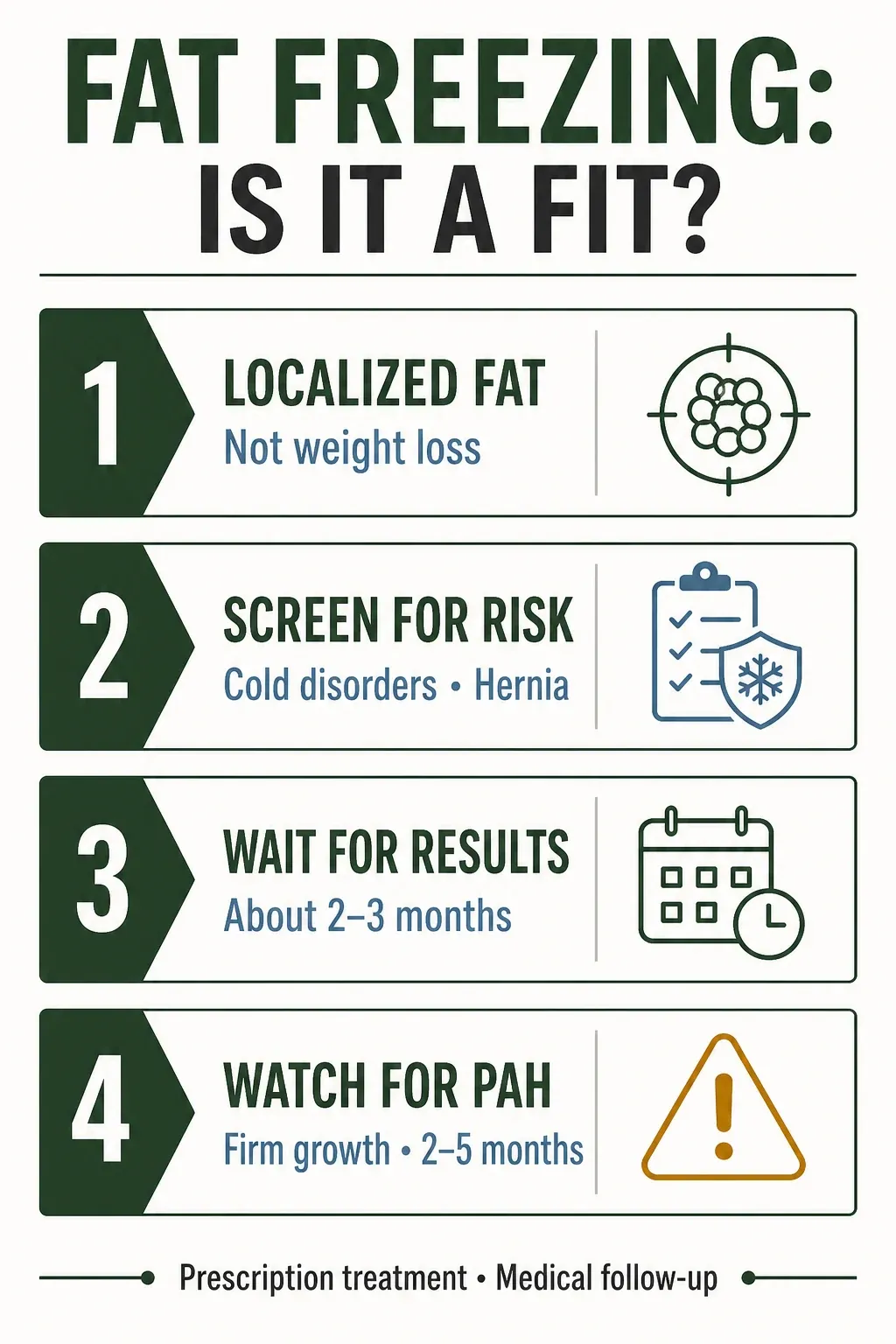
CoolSculpting is a brand of prescription cryolipolysis that can modestly reduce a selected pinchable fat bulge over about two to three months. It is not a weight-loss treatment and does not reliably tighten loose skin. Most side effects are temporary, but burns, nerve effects, hernia and delayed paradoxical adipose hyperplasia can require medical or surgical care.
Quick Summary
- Use fat freezing for a localized contour concern, not overall weight loss.
- Cold-sensitivity disorders, poor circulation and hernia can rule out treatment.
- Results develop over months and may require more than one cycle.
- PAH can enlarge the treated area two to five months later and may need surgery.
Fat freezing sounds simple because it is performed without an incision, but the decision is more specific than choosing a body area from a menu. The tissue must fit an approved applicator, the goal must be modest local contouring, and cold-related conditions or abdominal wall weakness can change safety. This guide explains the evidence, realistic timeline and delayed complications before a package is purchased.
How CoolSculpting and Cryolipolysis Work
Cryolipolysis uses controlled cooling to damage fat cells in a selected superficial bulge while attempting to spare skin and surrounding structures. The body's immune system gradually clears injured fat cells over roughly two to three months. CoolSculpting is a brand of prescription-use cryolipolysis device, not the name of every fat-freezing machine.
An applicator draws pinchable tissue into a cup with vacuum and cools it for a programmed cycle. Different applicators are cleared for specific body areas and contours. A device clearance does not mean every body site, home machine or candidate is appropriate.
This is localized body contouring, not obesity treatment or a substitute for weight management. The scale may barely change even when a small bulge becomes less visible. Visceral fat around internal organs is not targeted by an external applicator.
| Goal | Cryolipolysis fit | Important limit |
|---|---|---|
| Small pinchable abdominal bulge | Potentially reasonable after assessment | Does not treat visceral fat |
| Broad weight loss | Poor fit | Not a weight-loss procedure |
| Marked loose skin | Usually poor fit alone | Fat reduction may reveal laxity |
| Cellulite | Not a dependable primary treatment | Dimpling has structural causes |
| Small submental bulge | Possible with a cleared applicator | Neck anatomy needs assessment |
| Hernia or weak abdominal wall | Potentially unsafe near the area | Vacuum and placement matter |
What Results Are Realistic?
Change develops gradually and is usually modest. Early systematic reviews reported local fat-thickness reductions in selected treatment sites, but many studies were small, uncontrolled or connected to device development. Photographs can make subtle changes look larger when posture, lighting or camera distance differs.
A 2025 systematic review and meta-analysis of cryolipolysis included 30 studies and 3,158 participants. It found reductions in several adiposity measurements at about 12 weeks and high satisfaction, while minor adverse effects such as numbness, redness, swelling and pain were common. Results were compared mainly with baseline rather than a lifestyle or surgical alternative.
Visible change often appears from several weeks through three months. Some people need more than one cycle or session, and some see little difference. Weight gain can enlarge remaining fat cells and change the contour again.
The AAD overview of non-invasive fat removal notes that multiple sessions may be needed and results emerge gradually. Ask the clinic to define the number of treatment cycles, not just visits, because several applicators can be used in one appointment.
What a percentage reduction means
A percentage reduction in measured fat thickness is not the same as losing that percentage of total body fat. It refers to a localized measurement at a treated site. A moderate technical reduction may look subtle on a larger area or more noticeable on a sharply defined bulge.
Request standardized photographs from the front, side and oblique angle with the same posture. Ask how the clinic measures outcomes and when it decides that a second session is justified. Do not buy unlimited cycles without a reassessment point.
Candidate Screening and Contraindications
A reasonable candidate has a stable weight, a localized pinchable fat bulge, intact skin and realistic expectations. The clinician should assess skin laxity, sensation, circulation, abdominal wall strength, scars, previous surgery and the exact applicator fit.
The FDA says fat freezing should not be performed in people with cold-related disorders such as cryoglobulinemia, cold urticaria, paroxysmal cold hemoglobinuria, cold agglutinin disease, Raynaud's disease or poor circulation in the area. These are not minor preference issues. Cold exposure can trigger medically significant reactions.
Pre-existing hernia, separation or weak tissue near a surgical scar needs careful assessment. The FDA reports hernias after treatment and advises against treating in or near a pre-existing hernia or structurally weak area. Pregnancy, active infection, open wounds, impaired sensation and uncontrolled medical conditions also require deferral or medical clearance.
| Screening issue | Why it matters | What to do |
|---|---|---|
| Cold sensitivity disorder | Cooling can trigger blood or skin reactions | Do not proceed without specialist clearance |
| Hernia or abdominal wall weakness | Vacuum may stress a vulnerable area | Medical examination before treatment |
| Poor sensation or circulation | Injury may be harder to detect or heal | Discuss with a qualified clinician |
| Loose skin | Reducing volume may not improve the silhouette | Compare tightening or surgery |
| Active rash, wound or infection | Barrier and healing are compromised | Treat the active problem first |
| Expectation of major weight loss | Procedure cannot meet the goal | Use a weight-management pathway |
Side Effects, PAH and Other Complications
Expected short-term effects include redness, bruising, swelling, tenderness, aching, tingling and numbness. Some numbness can persist for weeks. Nodules, skin discoloration, contour irregularity and severe pain occur less often.
Freeze burns can be partial or full thickness. Treatment under the jaw can temporarily affect a nerve and change lip or tongue position, and it can create a feeling of throat fullness. Seek prompt care for blistering, severe pain, weakness, increasing swelling, infection signs or trouble swallowing.
Paradoxical adipose hyperplasia, or PAH, means the treated fat grows into a firm, often applicator-shaped bulge instead of shrinking. The FDA says reported cases developed two to five months after treatment, do not resolve on their own and may require surgery. Surgical correction may not completely restore the original contour.
A multicenter review of 8,658 treatment cycles reported PAH incidence between 0.05% and 0.39%, higher than an older manufacturer estimate. Rates were lower with newer device models, but the event was not eliminated. Ask which device generation and applicator will be used.
The FDA's non-invasive body-contouring guidance gives the clearest current patient summary of PAH, burns, nerve effects and hernia risk. Read it before signing a package agreement, not after an unexpected bulge appears.
What Happens During and After Treatment?
The clinician marks the area while you are standing, photographs it, checks the applicator fit and protects the skin with the approved interface. Vacuum pulls the tissue into the applicator, where cooling continues for the programmed cycle. Pressure, intense cold, pulling and aching can occur before numbness develops.
Some protocols include brief massage after removal. Evidence and instructions vary by device, so technique should follow the current manufacturer protocol. Aggressive treatment is not proof of a better result.
Most people return to ordinary activity, but tenderness, numbness or soreness can affect exercise or clothing. Follow the clinic's guidance and monitor the area for months, not only days. A gradually enlarging firm rectangle is not normal post-treatment swelling.
How to Compare Clinics and Devices
- Device identity: ask for the exact manufacturer, model and clearance.
- Prescription oversight: confirm who evaluates candidacy and is medically responsible.
- Applicator plan: each area and cycle should be mapped before payment.
- Contraindication screening: cold disorders, hernia, sensation and surgery history are reviewed.
- Outcome method: photographs and measurements use consistent conditions.
- Complication pathway: PAH, burns and nerve symptoms have named referral plans.
Home fat-freezing devices do not have established safety and effectiveness. The FDA states that cryolipolysis devices are prescription use only. Avoid marketplace machines that imply professional equivalence through vague “FDA” language.
Ask whether the person applying the device can recognize a poor tissue fit, unsafe scar or cold-related reaction. A technician following screen prompts is not a substitute for clinical assessment. Regulations vary, so verify local licensing and supervision.
CoolSculpting Compared With Liposuction and Lifestyle Change
Cryolipolysis is non-surgical and usually has less downtime than liposuction, but its change is smaller and less controllable. Liposuction can remove more fat and shape a broader area, while introducing anesthesia, incision, fluid-shift and surgical recovery risks. Neither method prevents future weight gain.
Nutrition, movement, sleep and medical weight management address overall weight or metabolic health, not one stubborn bulge on demand. They remain important even when a localized contour procedure is chosen. Cryolipolysis should not be marketed as a health intervention.
The non-surgical procedure comparison helps place energy devices beside injectables and resurfacing. For skin-quality goals rather than fat reduction, review the collagen-support guide and fractional laser guide.
Skin Care Before and After Cryolipolysis
A topical routine cannot increase the amount of fat removed. Keep the skin intact and comfortable before the appointment. Report dermatitis, infection, wounds, new numbness or a reaction to cold.
If adhesive, friction or cold leaves the surface irritated, simplify to a gentle cleanser and bland moisturizer. The skin-barrier restoration guide can support minor surface irritation, but it cannot treat a burn, nerve injury, hernia or PAH.
Do not use massage tools, heat devices or strong acids on a painful treated area unless the responsible clinician approves them. The slow-start skincare method helps avoid introducing several new irritants while symptoms are being assessed.
Avoid abrasive body scrubs while sensation is reduced or the area is bruised. The coffee scrub safety guide explains why friction can cause more irritation without changing subcutaneous fat. Resume ordinary exfoliation only after the surface and sensation have recovered.
When another procedure may fit better
If the concern is skin texture, stretch marks or laxity rather than a fat bulge, an applicator may be solving the wrong problem. A dermatologist or plastic surgeon can compare radiofrequency, ultrasound, surgery or no procedure based on tissue quality. Each option has a different evidence and complication profile.
If shaving or ingrown hair changes how an area looks, fat reduction will not address the follicle. The laser hair removal guide explains that separate decision. Treat one defined target at a time so the result remains interpretable.
Long-term follow-up matters
Record the treatment date, device, applicator, body site and number of cycles. Photograph the area monthly in consistent light for at least the first five months. This timeline helps distinguish ordinary gradual reduction from delayed firmness or enlargement.
Contact the clinic when the treated shape grows, hardens or becomes more rectangular after initial improvement. Ask for an in-person examination rather than sending only one photograph. PAH diagnosis and correction planning may involve imaging or a plastic surgeon.
Costs and Package Math
Pricing may be quoted per cycle, applicator, area or session. A bilateral flank treatment can involve several cycles in one visit. Ask for the complete mapped plan, expected number of sessions and total range before paying a deposit.
Include follow-up and potential correction in the decision. A low introductory price can grow when the clinic recommends repeated cycles without standardized reassessment. PAH correction can cost far more than the original non-surgical procedure.
Do not finance a treatment before the screening consultation. Read cancellation, refund and complication policies. A limited result that falls within the consented range usually does not trigger a refund.
Common CoolSculpting Mistakes
- Expecting weight loss: the treatment targets a local contour, not total body mass.
- Ignoring loose skin: less volume can make laxity more visible.
- Buying cycles before examination: applicator fit and contraindications matter.
- Assuming non-invasive means harmless: burns, nerve effects, hernia and PAH are real.
- Judging at two weeks: change and delayed complications develop over months.
- Using a home device: safety and effectiveness are not established.
The Bottom Line
CoolSculpting can reduce a selected superficial fat bulge over several months, but the change is usually modest and it is not a weight-loss procedure. Candidacy depends on tissue shape, skin laxity, cold sensitivity, circulation and abdominal wall safety.
PAH is uncommon but central to informed consent because it can enlarge the treated area and require surgery. Choose a prescription-use device, qualified medical assessment, transparent cycle map and clinic that can recognize and manage delayed complications.
Frequently Asked Questions About CoolSculpting for Body Contouring
Does CoolSculpting help you lose weight?
No. Cryolipolysis reduces a selected superficial fat bulge and may make a local contour smaller, but it is not an obesity or weight-loss treatment and may not change the scale.
When do CoolSculpting results appear?
Some change may appear after several weeks, with fuller assessment around two to three months as damaged fat cells are cleared. Additional cycles should follow standardized reassessment.
What is paradoxical adipose hyperplasia after CoolSculpting?
PAH is a rare delayed reaction in which treated fat grows into a firm applicator-shaped bulge instead of shrinking. It usually develops two to five months later, does not resolve on its own and may require surgery.
Who should not have fat freezing?
People with cold-related blood or skin disorders, poor circulation in the area, an untreated hernia or structurally weak tissue should not proceed without appropriate medical assessment. Active wounds, infection and impaired sensation also matter.
Is home fat freezing safe?
The FDA says prescription cryolipolysis devices are used by health professionals and the safety and effectiveness of over-the-counter or home fat freezing have not been established.
This article is for informational purposes only and does not replace professional dermatological advice.