Clay Mask Benefits: Oil Control, Limits and Safe Use
Clay masks can temporarily absorb oil and reduce shine. Learn what evidence supports, what detox claims miss and how to avoid barrier damage.

In this guide
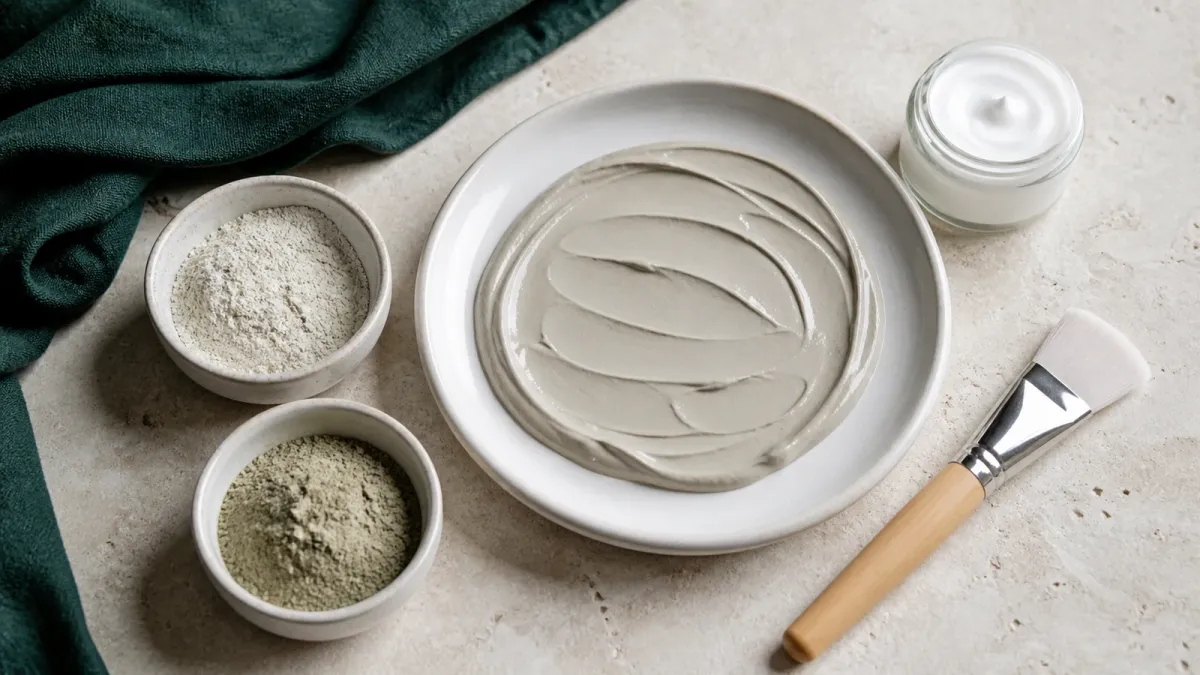
Clay masks can temporarily absorb surface oil, reduce shine and make pores look cleaner. Limited evidence from specific commercial formulas suggests possible support for oily or acne-prone skin, but clay does not detox the body, permanently shrink pores or replace acne treatment. Overuse, harsh removal and overlapping acids or retinoids can cause dryness and barrier irritation.
Quick Summary
- Kaolin and bentonite mainly offer temporary surface oil absorption.
- Evidence from one formula cannot be transferred to every raw clay or DIY recipe.
- Start once weekly, follow contact time and moisturize after rinsing.
- Skip stored water-based DIY mixtures and avoid active-ingredient overlap.
Clay masks create an immediate sensation of oil removal, which makes broad claims about detox, pore shrinking and acne easy to believe. The useful benefit is simpler and more limited: a well-formulated kaolin or bentonite mask can temporarily control shine. This guide reviews the available human evidence, compares formats, explains why tightness is not an efficacy measure and builds a low-irritation weekly schedule.
What Clay Masks Actually Do
Clay masks can absorb surface oil and temporarily reduce shine. Kaolin and bentonite have large surface areas and adsorptive properties, but a cosmetic mask does not pull toxins from the bloodstream, permanently shrink pores or replace acne treatment.
The result depends on the full formula, not clay alone. Humectants, surfactants, acids, fragrance, preservatives and contact time determine whether a mask feels balanced or leaves skin tight and irritated. A ready-made cream mask is not equivalent to raw powder mixed in a bowl.
Masks are optional. A gentle cleanser, moisturizer, sunscreen and targeted leave-on treatment have a larger role in a consistent routine. Use a clay mask only when it solves a specific oil or sensory problem without destabilizing the barrier.
| Claim | Realistic result | Limit |
|---|---|---|
| Absorbs oil | Yes, temporarily | Sebum production continues |
| Makes pores look smaller | Possibly while oil and debris are reduced | Pore structure does not permanently close |
| Treats acne | May support an oily-skin routine | Does not replace proven acne actives |
| Detoxifies | No defined clinical evidence | Skin is not a waste-removal organ for a mask |
| Exfoliates | Some formulas add acids or particles | Friction and overlap can irritate |
| Hydrates | Only if the formula includes suitable moisturizers | Plain drying clay can worsen tightness |
What the Clinical Evidence Shows
A 2023 four-week study of a kaolin and bentonite mask enrolled 75 adults with oily or combination skin. Twice-weekly use was associated with improvements in oiliness, acne measures, hydration and barrier measurements.
The study tested one commercial formula, had no separate control group and included researchers affiliated with the manufacturer. Those limitations matter. The result supports the possibility that a well-formulated mask can help oily skin, not that every clay powder cures acne.
The AAD's current facial-mask guidance describes kaolin and bentonite as oil-absorbing options. It also warns that masks cannot replace treatment for acne or eczema and that overlapping active ingredients can cause dryness or irritation.
Kaolin, Bentonite and Other Clays
Kaolin is often positioned as a gentler absorbent and is used in many creamy rinse-off products. Bentonite swells in water and can create a stronger pulling or drying sensation. The real experience still depends on particle size, concentration and the other ingredients.
French green clay, rhassoul and multani mitti are marketing or mineral-source terms rather than standardized skin outcomes. Mineral composition can vary by deposit and processing. Color does not reveal purity, safety or oil-control strength.
Choose a product with a complete ingredient list and clear directions. Raw powders sold for crafts, industrial use or ingestion are not automatically cosmetic-grade. "Food grade" does not mean tested for leave-on facial use.
| Format | Potential advantage | Main caution |
|---|---|---|
| Creamy kaolin mask | Easier spread and often less drying | Fragrance or added acids may irritate |
| Bentonite mask | Strong oil absorption | Can become excessively tight or drying |
| Pre-mixed clay-acid mask | Oil control plus exfoliation | Do not stack with retinoid or acid nights |
| Single-use powder | Freshly mixed and simple | Water ratio and hygiene are inconsistent |
| Stored DIY wet mask | Convenient only in appearance | No validated preservation; avoid |
| Spot application | Limits exposure to oily zones | Still not a cystic-acne treatment |
Who May Benefit From a Clay Mask?
Oily or combination skin that becomes visibly shiny may appreciate short-contact oil absorption. A mask can also help before makeup or during humid weather when a less reflective surface is desired. The benefit is cosmetic and temporary.
Acne-prone skin can use clay as an optional support if the formula is non-comedogenic and not irritating. Blackheads and inflamed lesions usually need leave-on ingredients that affect follicular plugging or inflammation. See the acne cleanser guide and benzoyl peroxide guide.
Combination skin may need the mask only on the forehead, nose or chin. Applying a strong clay evenly over dry cheeks creates a problem where none existed. Multi-masking can be useful when it means less product, not more products everywhere.
Who Should Skip or Modify Clay Masks?
Very dry, eczema-prone, rosacea-prone or actively irritated skin may become tighter and more inflamed. Skip masks during a flare, after sunburn or when bland moisturizer stings. Use the skin-barrier reset first.
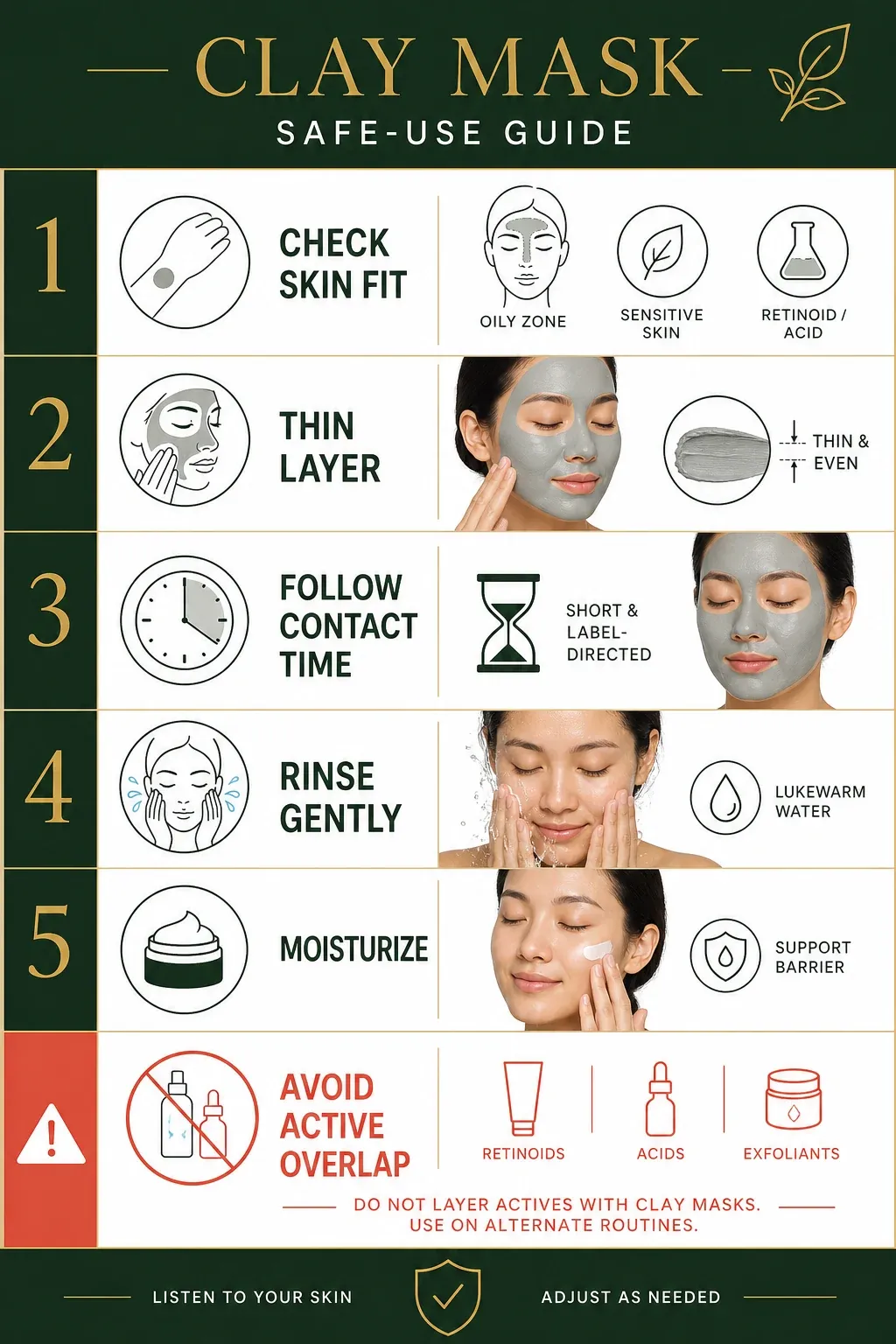
People using retinoids, benzoyl peroxide, exfoliating acids or prescription acne therapy should check for overlap. A mask containing salicylic or glycolic acid adds another treatment step even if the label emphasizes clay. Reduce frequency or choose a plain, short-contact formula.
Open lesions, picked pimples and infection are not appropriate surfaces for a drying mask. Friction during removal can reopen skin and spread contamination. Persistent painful acne deserves medical treatment rather than increasingly aggressive masks.
How to Use a Clay Mask Without Overdrying
- Cleanse gently and pat the skin dry.
- Apply a thin, even layer to oily areas without scrubbing.
- Follow the label's contact time; longer is not better.
- Rinse with lukewarm water and fingertips, not a rough cloth.
- Apply a fragrance-free moisturizer while skin is slightly damp.
- Use sunscreen the next morning, especially if acids are included.
Start once weekly. If the skin remains comfortable and the result is useful, increase only within the label directions. Twice weekly was the schedule in the commercial-mask study, but that does not establish twice weekly for every formula.
Do not wait for the mask to crack completely unless the manufacturer specifically directs it. Cracking is a drying stage, not an efficacy endpoint. Rinse immediately for burning, intense itching or swelling.
Clay Masks and Active Ingredients
Salicylic acid can enter oily follicles and has a clearer acne role than clay alone. A clay-salicylic formula may be useful, but it should count as an exfoliation step. Do not use it on the same night as another acid peel until tolerance is established.
Retinoids normalize follicular cell turnover and require consistent use. A harsh mask that repeatedly forces retinoid breaks may reduce the overall benefit of the routine. The layering guide helps keep supportive steps simple.
Niacinamide and humectants can make a clay formula feel less stripping. Fragrance and essential oils add no necessary oil-control function and may increase allergy risk. Read the complete list rather than choosing by color or scent.
DIY Clay Mask Safety
A freshly mixed single-use powder is less risky than storing a wet mixture, but raw-material purity and skin suitability remain unknown. Use clean hands, a clean bowl and the amount needed once. Discard leftovers rather than refrigerating a preservative-free paste.
The FDA microbiological safety page explains that contaminated water, raw materials, storage and finger dipping can introduce harmful organisms. Adding water can also dilute preservatives in a finished cosmetic.
The FDA's homemade cosmetics fact sheet makes clear that natural ingredients still require safety and contamination control. Avoid kitchen recipes with lemon juice, vinegar, essential oils or unknown powders on facial skin.
Clay Masks for Blackheads and Pores
Removing surface oil can make pore openings look cleaner and temporarily less visible. It does not change the inherited size of the follicle or permanently close it. Blackheads are open comedones, not dirt trapped because a person failed to cleanse.
Salicylic acid, topical retinoids and consistent gentle cleansing address follicular buildup more directly. Read the blackhead treatment guide for a routine that avoids squeezing and repeated extraction.
Do not follow a clay mask with pore strips, a scrub and an acid toner. The temporary smoothness comes at the cost of irritation, which can make pores and redness look more obvious over time.
Clay Masks for Sensitive Skin
Sensitive skin is not automatically excluded, but the formula and frequency need tighter control. Choose fragrance-free products without essential oils or added exfoliating acids. Test a small area and use a shorter labeled contact time at first.
Apply only to oily zones and moisturize afterward. The sensitive-skin routine guide shows why comfort and consistency matter more than achieving a squeaky-clean finish.
If redness lasts into the next day, the mask is not a good fit at that frequency. Repeatedly "building tolerance" to a nonessential mask has little value. Remove it from the routine instead.
How to Judge Whether It Works
Define one outcome: less midday shine, more comfortable makeup wear or fewer clogged-looking areas. Photograph or rate that outcome once weekly. Do not use immediate tightness as the success measure.
After four weeks, compare benefit with cost, time and irritation. If the mask only creates dryness that requires extra products, it has not optimized the routine. A leave-on niacinamide or salicylic acid product may be a more efficient test.
For a broader weekly schedule, see the weekly clear-skin routine. Keep recovery nights available when prescription or exfoliating products are already doing the main work.
How to Read a Clay Mask Ingredient List
Kaolin, bentonite or another clay near the top suggests a substantial absorbent role, but order alone does not reveal exact percentage. Glycerin, propanediol, panthenol and other humectants can reduce the stripped feeling. Fatty alcohols and emollients can make the mask easier to spread and rinse.
Salicylic, glycolic, lactic or mandelic acid turns the mask into an exfoliating treatment. Sulfur can add an acne-focused effect and odor, while fragrance and essential oils add sensitization potential without being necessary for oil control. Menthol or high alcohol can create a cooling sensation that is not the same as reduced inflammation.
Preservatives are a safety feature in a water-based formula, not an ingredient category to fear automatically. Jar packaging requires clean hands and careful closure. A tube or pump can reduce repeated finger contact.
Routine Examples by Skin Type
Oily but comfortable skin: use a gentle cleanser, a thin clay mask once weekly, a light moisturizer and sunscreen. Keep leave-on salicylic acid on a different night until tolerance is clear.
Combination skin: apply clay only to the forehead, nose and chin. Use a hydrating mask or plain moisturizer on dry areas instead of forcing one product across the entire face.
Acne treatment routine: prioritize the retinoid, benzoyl peroxide or prescription plan. Add clay only if temporary shine control is useful and it does not cause treatment breaks. A mask is the first step to remove when irritation appears.
Sensitive or rosacea-prone skin: skip fragrance, essential oils and added acids. Use a short-contact patch-tested product infrequently, or omit clay completely if redness lasts beyond rinsing.
Seasonal adjustment
A mask tolerated in humid summer may become too drying during winter heating or after travel. Frequency should respond to current skin, not remain fixed because the jar says twice weekly. Reduce use when cheeks feel tight or moisturizer begins to sting.
Likewise, increased summer shine does not always require stronger clay. A lighter moisturizer, less occlusive makeup or blotting paper may solve the cosmetic issue with less barrier disruption. Choose the least disruptive tool that meets the goal.
Common Clay Mask Mistakes
- Waiting for painful cracking: dryness is not a deeper cleanse.
- Using it daily: oil rebound language is simplistic, but barrier damage is real.
- Adding acids and essential oils: DIY complexity increases irritation risk.
- Storing a wet recipe: contamination control is unknown.
- Scrubbing it off: friction adds unnecessary injury.
- Replacing acne care: clay does not normalize every acne mechanism.
The Bottom Line
Clay masks can temporarily absorb oil, reduce shine and support an oily-skin routine. Evidence for acne improvement comes from limited studies of specific formulas, and it does not prove detoxification, permanent pore shrinking or a cure.
Choose a preserved product, use it sparingly, avoid active overlap and moisturize after rinsing. If a mask repeatedly causes tightness or forces breaks from proven treatment, it is not helping the routine.
Frequently Asked Questions About Clay Mask Benefits
Do clay masks help acne?
They may support an oily-skin routine by absorbing surface oil, and one limited study of a specific commercial formula found improvement. They do not replace retinoids, benzoyl peroxide or other proven acne treatment.
How often should I use a clay mask?
Start once weekly and stay within the product directions. Some oily skin may tolerate twice weekly, but more frequent use can create tightness, irritation and active-treatment overlap.
Should a clay mask dry and crack completely?
Not necessarily. Painful tightness and cracking mainly show that water and oil have been removed. Follow the label's contact time and rinse sooner for burning or intense itching.
Are DIY bentonite clay masks safe?
A fresh single-use mixture still has uncertain raw-material quality and can irritate. Do not store a wet preservative-free paste, add acids or essential oils, or use non-cosmetic powders on facial skin.
Can clay masks permanently shrink pores?
No. Oil removal can make pore openings look temporarily cleaner or less noticeable, but a rinse-off mask does not permanently change follicle structure.
This article is for informational purposes only and does not replace professional dermatological advice.