Peptides in Skincare: What Works, What to Expect and How to Use Them
Understand peptides in skincare, what human studies show, how copper peptides differ and how to choose a formula that fits your routine without the hype.
In this guide
Quick Answer
Peptides in skincare may improve the appearance of fine lines, but the evidence belongs to particular ingredients and finished formulas. They are an optional addition to a routine built around gentle cleansing, moisturizer and sun protection.
Choose by the named peptide, the whole formula and its instructions. A high percentage, blue color or expensive bottle cannot tell you how well a product will work.
Quick Summary
- Different peptides do different jobs. Signal peptides, copper peptides and expression-line peptides have different evidence.
- Some human trials are encouraging. Small samples, limited populations and different formulas prevent a universal promise.
- Follow the exact product label. Mixing restrictions can differ even between copper-peptide products.
- Stop if your skin becomes irritated. Worsening skin is not proof that collagen is being rebuilt.
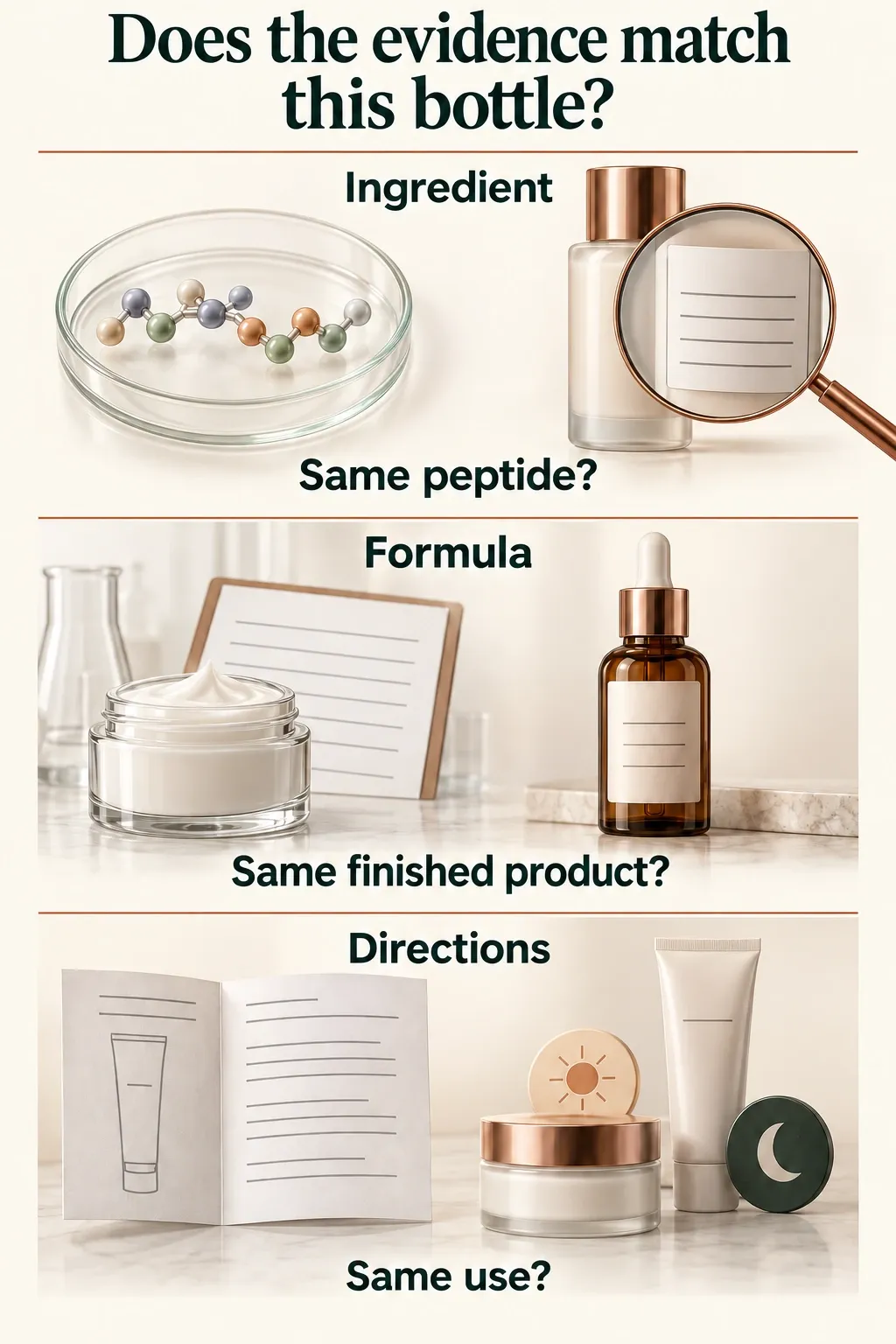
Three checks before choosing a peptide product
Editorial Note
SkinOptimizer reviews published research, medical guidance and current manufacturer instructions. This is a research-led guide, not a clinical test or individual diagnosis.
Peptides in skincare can sound more complicated than the decision you actually face: will this extra serum add enough value to your routine? We think the useful answer starts with the formula and your goal, rather than a promise to make skin behave younger.
A moisturizer can make dry lines look softer because it hydrates skin. A peptide-containing product might also offer a more specific cosmetic benefit, but seeing both effects together does not tell you which ingredient did what.
A laboratory experiment and the bottle on your shelf may mention peptides while using different molecules, concentrations and delivery systems.
Check whether the research matches the product before deciding whether an extra serum is worth buying.
The Skin Insider
“Contains peptides” is a description, not a clinical result. The strongest useful evidence compares the exact finished formula with a suitable control; ingredient research alone cannot establish how every retail product performs.
What are peptides in skincare?
Peptides are short chains of amino acids. Some naturally occurring peptides help cells communicate, while cosmetic formulators use selected or modified peptides for particular skin-appearance goals.
They are not all interchangeable pieces of collagen. A peptide's sequence, chemical modifications and surroundings affect what it can do and whether it remains stable in a product.
For example, a palmitoyl group is a fatty-acid attachment used in some cosmetic peptides. It can affect interaction with the skin's outer layer, but its presence does not prove a serum reaches the dermis or produces visible results.
A topical peptide serum is also different from an oral collagen supplement or a prescription peptide medicine. Findings from swallowing a supplement or injecting a medicine cannot be used as evidence for a cosmetic applied to intact skin.
If you are comparing ingredient trends, PDRN skincare uses DNA-fragment materials, rather than amino-acid peptide chains. Similar marketing language does not make them the same ingredient.
Peptides in skincare: names worth recognizing
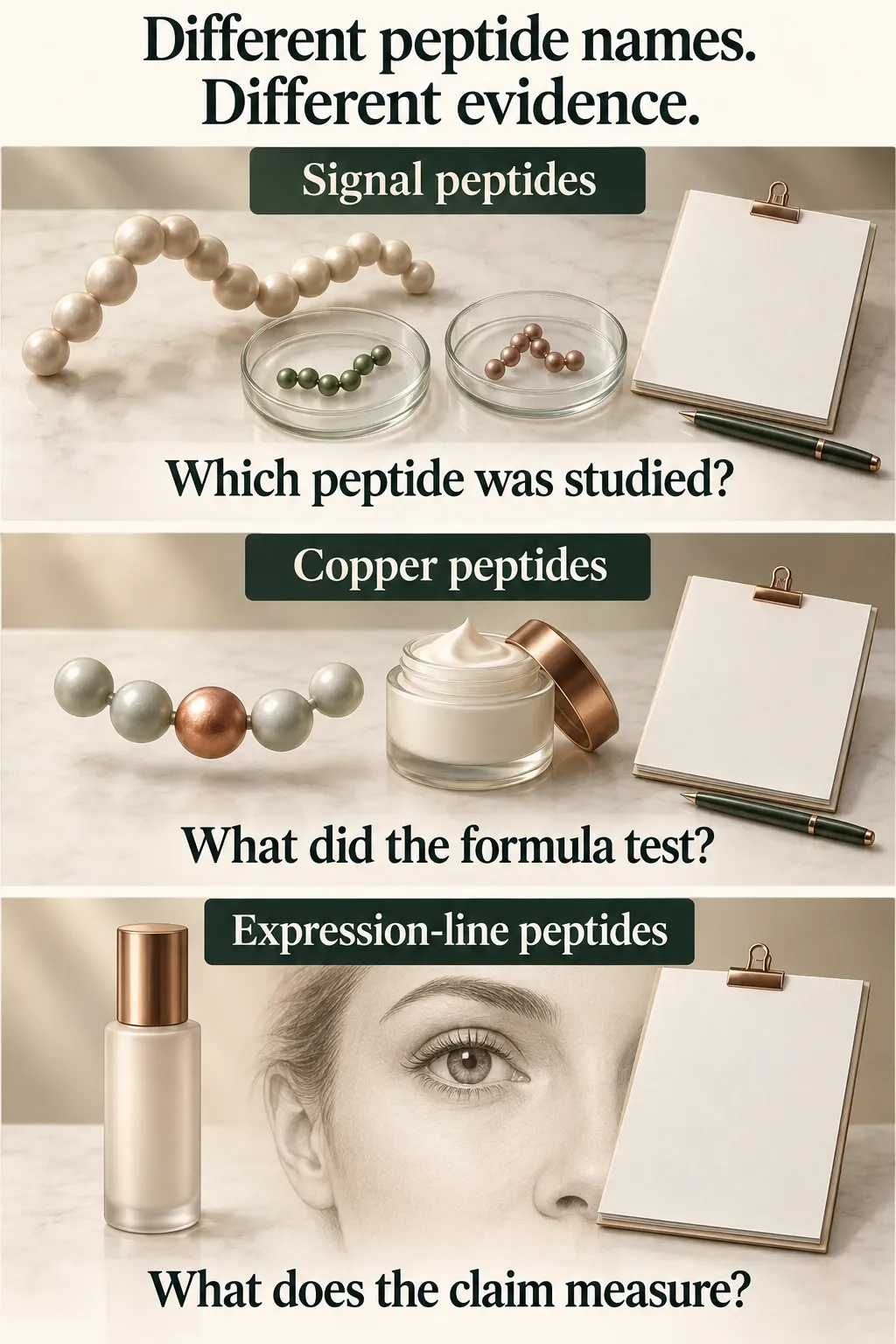
You do not need to memorize a long ingredient list. Recognizing a few names helps you ask better questions about a product instead of treating the word “peptide” as one universal active.
| Category | Label examples | What to keep in perspective |
|---|---|---|
| Signal peptides | Palmitoyl pentapeptide-4; selected palmitoyl tripeptides | Studied for appearance-related effects; one peptide's trial does not validate another. |
| Copper-associated peptides | Copper tripeptide-1; GHK-Cu | Interesting repair-related research, with more limited human cosmetic evidence than marketing can suggest. |
| Expression-line peptides | Acetyl hexapeptide-8 | Cosmetic wrinkle claims do not establish injectable-style muscle relaxation. |
These are useful broad categories, not a complete classification system. A product can contain several peptides alongside glycerin, hyaluronic acid, emollients and other ingredients that influence how your skin looks and feels.
Trade names can also refer to ingredient blends rather than a single pure molecule. Check the ingredient names and supporting information before comparing two products that both advertise a branded peptide complex.
Do peptides work? What human studies show
There is evidence that certain topical peptide formulas can improve assessed signs of aging. The careful conclusion is narrower than “peptides rebuild everyone's collagen” or “peptides are just expensive water.”
In a 12-week randomized, double-blind split-face study, 93 white women aged 35 to 55 used a moisturizer with 3 ppm palmitoyl pentapeptide and the same moisturizer without it on opposite sides of the face.
The peptide formula improved assessed fine lines and wrinkles compared with the control.
That is useful because the moisturizer base was controlled. It remains a study of one preparation in one population, with industry-affiliated authors; it is not a result for every peptide product.
A smaller 2023 trial involving 21 Indonesian women compared acetylhexapeptide-3 cream, palmitoyl pentapeptide-4 cream and placebo over eight weeks. Some participants improved, but the authors called for stronger study designs before firm superiority claims.
Read these results as support for further testing and realistic cosmetic expectations. They cannot tell you that one ingredient category always wins, that a particular percentage is ideal, or that your own formula will reproduce the findings.
| Evidence you see | What it can establish | What it cannot establish |
|---|---|---|
| Controlled trial of a named formula | Measured changes in that trial's users, conditions and time frame | Equal results from another bottle with similar marketing |
| Ingredient or laboratory study | A possible mechanism or a reason to investigate | Visible improvement from your finished cosmetic |
| Consumer survey or before/after photo | Reported experience or an illustrated observation | The peptide's isolated effect or a guaranteed result |
When a brand says “clinically tested,” look for the number of participants, duration, comparator and actual outcome. A hydration reading, an opinion survey and a measured wrinkle change answer different questions.
It is also worth checking who funded the work and whether the researchers were connected to the manufacturer. Industry involvement does not automatically invalidate a study, but transparent reporting and independent replication make the evidence easier to assess.
Why delivery and the whole formula matter
Your skin barrier limits what enters skin. Peptide size, charge, affinity for water or oil, stability and the product's vehicle can affect delivery.
This is more complicated than checking whether a molecule falls below a single size threshold. A promising delivery method in a skin model still needs appropriate testing in the finished formula and, ideally, in people.
Words such as “encapsulated,” “bio-identical” and “advanced delivery” describe a formulation approach or marketing claim. They do not tell you how much active peptide reaches its intended site or whether that creates a worthwhile cosmetic change.
Likewise, sticky texture does not prove that a peptide serum is effective or poorly absorbed. Thickeners, solvents and film-forming ingredients can influence feel without telling you anything reliable about clinical performance.
A useful evidence check
- Can you identify the peptide rather than only the trade name?
- Was the finished product tested, or only an ingredient?
- Was there a meaningful comparison, and how long did testing last?
- Does the claim match the measured outcome?
“10% peptide complex” may refer to a supplier blend that also contains water and other components. It should not automatically be read as 10% pure peptide or compared directly with a study reported in parts per million.
Ingredient order alone cannot reveal the exact active concentration. Nor can a blue color prove the strength, authenticity or effectiveness of a copper-peptide serum.
How to use a peptide serum in a simple routine
Start by deciding whether you need another product at all. If your current routine is comfortable, affordable and meets your goals, adding peptides is optional.
For a leave-on serum, follow the product's directions after cleansing and before a heavier moisturizer when the label recommends that order. Different textures and formulas may need a different sequence.
Try one new product at a time so that irritation or unwanted breakouts are easier to trace. Avoid introducing a peptide serum on the same day as several new exfoliants, retinoids or fragranced products.
You do not need to make your skin especially wet to activate peptides. Use the application conditions on the label, and remember that layering several generous serum amounts can increase tackiness or pilling.
Example: a straightforward morning
- Cleanse gently if needed.
- Apply your optional peptide product as directed.
- Use a moisturizer if your skin needs it.
- Finish with appropriate broad-spectrum sunscreen.
The morning sequence is only an example, not proof that peptides work better at that time. Some formulas are directed for morning and evening, while others have more specific instructions.
At night, keep any prescribed treatment instructions first. A peptide product should fit around that plan rather than prompt you to change or stop a medicine without your clinician's advice.
Our retinol guide explains gradual introduction and tolerance. If your skin is already irritated, adding a new optional serum is usually a poor way to find out what is causing the problem.
Can peptides mix with vitamin C, retinol or acids?
The most useful answer comes from the exact products, not a universal mixing chart. Peptide formulas differ, and manufacturer restrictions may reflect formulation stability, tolerance or the combination being untested.
For example, The Ordinary's Multi-Peptide + Copper Peptides 1% instructions advise against pairing that serum with direct acids, direct vitamin C, retinoids and strong antioxidants. Those are directions for that particular formula.
By contrast, the Biossance copper-peptide serum FAQ permits use alongside a retinol product and advises a small patch test. This difference is a good reason to read each label rather than assume all copper-peptide products behave identically.
| Other routine step | Practical approach | Boundary |
|---|---|---|
| Vitamin C or exfoliating acids | Check both labels; use different routines if the peptide formula advises separation. | No universal rule that all combinations instantly destroy either ingredient. |
| Retinol or a prescription retinoid | Respect product restrictions and prescription directions; introduce optional products separately. | Do not ignore a formula's explicit restriction because another brand permits a pairing. |
| Hydrating serum or moisturizer | Use only the layers you need and check for comfortable texture. | More products do not necessarily improve delivery or results. |
Separating a vitamin C product into the morning and an optional peptide into another routine can be convenient when labels call for it. It is a practical scheduling choice, not proof that a dangerous reaction would otherwise occur.
There is no established universal 20-minute waiting period that makes an incompatible pairing suitable. Waiting cannot replace following the product's directions.
If your main aim is pigment support, our vitamin C evidence guide can help you assess that separate goal. Avoid adding peptides simply because you feel every ingredient category must be represented.
The Optimizer's Edge
Do not “push through” burning, persistent redness or worsening irritation on the assumption that copper peptides are clearing damaged collagen. Stop the new product and seek professional advice if symptoms persist; severe swelling or breathing difficulty needs urgent medical attention.
What copper peptides cannot promise
GHK-Cu has attracted research interest because of repair-related activity in laboratory and animal work. That is not the same as proving an over-the-counter serum removes acne scars, heals wounds or speeds recovery after a cosmetic procedure.
Freshly treated skin needs the aftercare plan supplied by the treating professional. Do not use ordinary cosmetic serum as an injectable product or apply it into fresh needle channels to force penetration.
“Botox in a bottle” is also a misleading expectation for cosmetic peptides. A serum has not been shown equivalent to a licensed injected treatment simply because its ingredient has a proposed effect on signaling.
For irritated skin, begin with a simpler routine and appropriate barrier-supporting moisturizers. An expensive active should not be the price of basic skin comfort.
Choosing a formula without buying the hype
Choose a product whose full formula suits your skin and whose claims stay within the evidence. Consider texture, fragrance preferences, packaging, directions and whether you can afford continued use without displacing sunscreen or moisturizer.
For exact product comparisons, use our separate best peptide serums guide. This explainer focuses on how to read the evidence rather than declaring another ingredient-based ranking.
A peptide product may fit if
- Your basic routine is already comfortable and consistent.
- You want to try an optional cosmetic step for fine-line appearance.
- The formula's directions fit the treatments you already use.
- You accept that results may be modest or absent.
Consider skipping it if
- Your skin is currently burning, peeling or reacting to products.
- The purchase would squeeze out daily sun protection.
- You expect scar removal, a lift or injectable-style results.
- The seller cannot explain what its headline percentage means.
A “medical grade” label does not answer those questions for you. Our guide to medical-grade skincare claims explains why evidence, ingredients and the relevant regulatory category deserve closer attention than a prestige label.
Moisturizers containing peptides can be a reasonable way to avoid adding a separate layer. There is no universal rule that a serum is always better; the formulation and the evidence matter more than the product category.
How to judge whether a product is worth keeping
Decide on a specific goal before opening the bottle. Less tightness, smoother makeup application and softer-looking fine lines are different outcomes, and a product may help one without changing the others.
Keep the rest of your routine reasonably stable and note comfort, unwanted reactions and ease of use. Lighting, facial expression, hydration and camera settings can change photographs, so casual before/after pictures are not clinical proof.
Several human studies assess changes over weeks rather than overnight. Their durations are a guide to how researchers measured those formulas, not a requirement to continue an irritating product or a guarantee that yours will work by week twelve.
If the label permits use, your skin tolerates it and you see enough value to justify the cost, keeping it is reasonable. If not, you can stop without treating the decision as a failed anti-aging strategy.
Your Clear Skin Checklist
- Identify the peptide and distinguish ingredient evidence from formula evidence.
- Check exact mixing directions rather than relying on a universal chart.
- Add one product at a time and stop if irritation develops.
- Keep moisturizer and daily sun protection ahead of optional extras.
- Review comfort, usefulness and cost before repurchasing.
Frequently Asked Questions About Peptides in Skincare
Questions were informed by community discussions about whether peptides add value, vitamin C compatibility and unexpected skin changes. These threads identify reader concerns; the answers use the evidence and qualifications discussed above.
Do I need peptides if I already use retinol?
No. Peptides are optional, and there is no universal requirement to add them to a comfortable routine; follow your existing treatment instructions and assess whether another product addresses a specific unmet goal.
Can I use peptides with vitamin C?
Check the exact peptide formula and vitamin C product directions. Some manufacturers advise separation, particularly for certain copper-peptide formulas, so use different routines when directed rather than assuming one mixing rule fits every product.
Are copper peptides better than other peptides?
Not universally. Copper peptides have interesting research behind them, but a particular formula's evidence, tolerance and routine fit matter more than placing an entire ingredient category above another.
Are “copper peptide uglies” a normal adjustment phase?
There is no established evidence that worsening skin proves a beneficial collagen-remodeling phase. Stop a product that causes persistent irritation and seek advice rather than continuing because an online explanation calls the reaction progress.
How long should I wait to judge a peptide product?
Follow the label and judge comfort from the start. Studies of particular formulas often run for several weeks, but they do not establish a guaranteed timeline for every serum or justify continuing through irritation.
Is a peptide serum worth it?
It can be worth trying when the formula fits your skin, your expectations and your budget. Treat it as an optional cosmetic experiment with sensible limits, rather than a necessary route to rebuilding skin.
For broader priorities, compare the evidence for anti-aging ingredients and choose daily sun protection you will actually use. A simple routine you can maintain is a useful outcome in its own right.
This article is for informational purposes only and does not replace professional dermatological advice.