Dermal Fillers for Volume Loss: Results, Risks and Choices
Dermal fillers can restore selected facial volume, but material, anatomy and injector skill determine the result. Compare benefits, duration and serious risks.

In this guide

Dermal fillers can restore selected facial volume, soften particular folds and improve contour when the material, area and dose are matched to the anatomy. They cannot tighten every form of loose skin or stop aging. Common effects are swelling and bruising, while rare vascular occlusion can cause skin death, blindness or stroke, so injector skill and an emergency plan are essential.
Quick Summary
- Identify volume loss, laxity, pigment and dynamic lines before choosing an injectable.
- Hyaluronic acid, biostimulatory and permanent fillers are not interchangeable.
- Start conservatively and reassess after swelling settles.
- Choose a medical injector with a documented vascular-occlusion response.
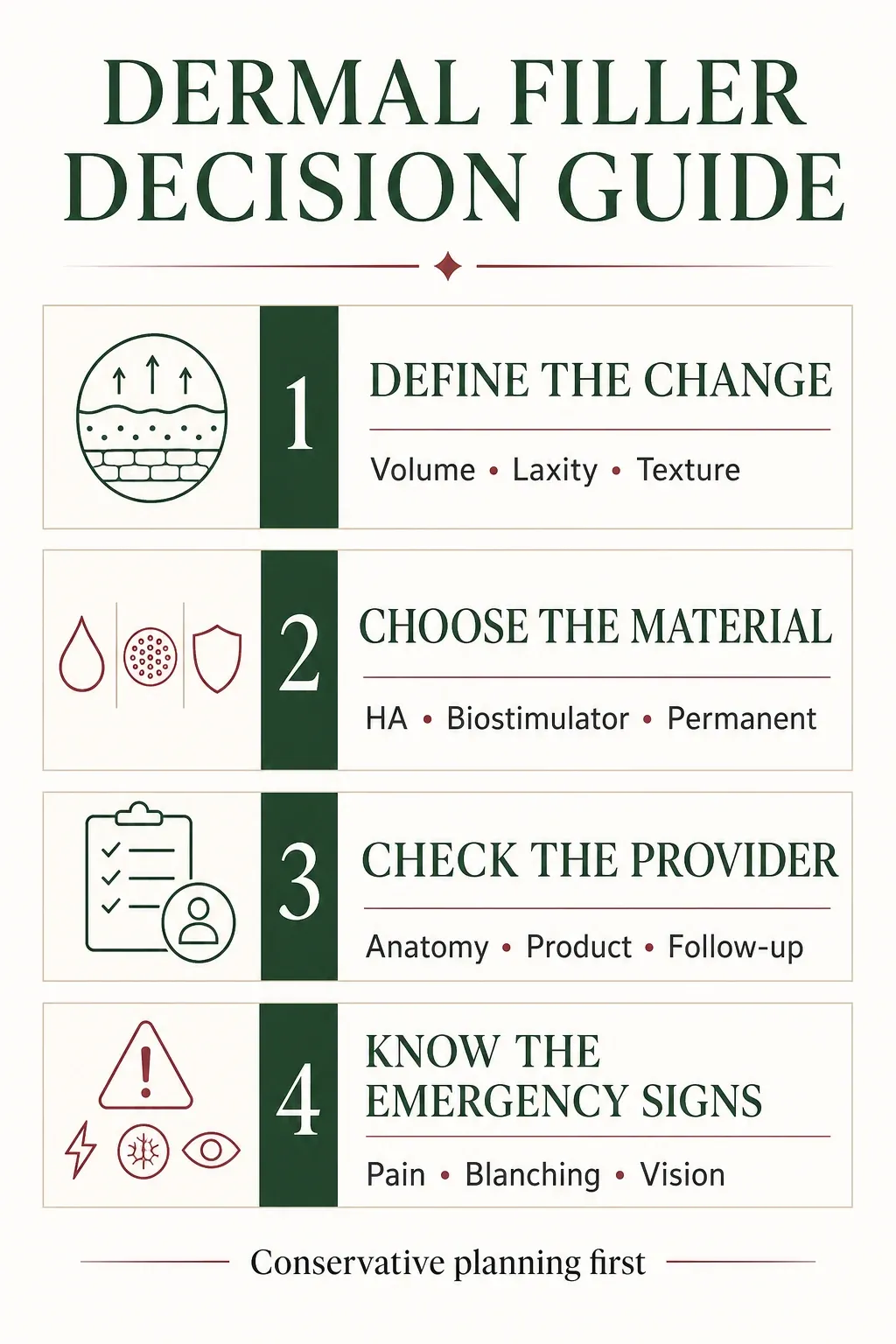
Dermal fillers are often presented as a quick answer to looking tired or older, but facial volume is only one part of the decision. A responsible plan distinguishes actual tissue loss from laxity, bone structure, muscle movement and surface damage. This guide compares materials, realistic duration, provider questions and the rare emergency signs that should be understood before any injection.
What Dermal Fillers Actually Change
Dermal fillers place material beneath or within the skin to support a selected contour, fold or area of volume loss. They can replace some lost projection in the cheeks or chin, soften a transition such as a nasolabial fold, or add lip volume. They do not stop facial aging or tighten every form of loose skin.
The FDA classifies dermal fillers as medical device implants. Approved indications depend on the exact product, age group and anatomical area. A filler approved for cheek augmentation is not automatically approved or appropriate for the nose, forehead, under-eye area or body.
Volume loss is only one part of facial aging. Bone remodeling, shifting fat compartments, ligament changes, muscle activity, skin thinning and sun damage can all alter appearance. Adding volume without identifying the dominant cause can create puffiness without correcting the concern.
| Concern | What filler may do | What it cannot reliably do |
|---|---|---|
| Cheek volume loss | Restore selected projection and support | Tighten marked lower-face laxity |
| Deep fold | Soften the transition or support nearby structure | Erase every line at rest |
| Thin lips | Add volume or refine border in selected adults | Fix irritation or repeated swelling |
| Chin imbalance | Increase projection with an approved product | Correct every skeletal or bite problem |
| Acne scar | Lift selected depressed scars with technique-specific use | Treat active acne or all scar types |
| Crepey surface texture | Offer limited indirect support | Replace resurfacing or daily photoprotection |
Filler Types and Why Material Choice Matters
Hyaluronic acid, calcium hydroxylapatite, poly-L-lactic acid and polymethylmethacrylate are not interchangeable. They differ in how quickly results appear, where they are used, how they stimulate tissue and whether removal is possible. Product choice should follow the approved indication and the injector's plan.
Hyaluronic acid fillers are common because they offer immediate support and can often be reduced with hyaluronidase if an appropriate clinician decides that is necessary. Dissolving is still a medical intervention with allergy, swelling and incomplete-correction risks. It is not an undo button that makes poor placement harmless.
Calcium hydroxylapatite can provide support and collagen stimulation in selected areas. Poly-L-lactic acid works gradually across a planned series because the visible change depends partly on collagen response. Permanent or very long-lasting materials are harder to manage when preferences, anatomy or complications change.
| Material category | Typical behavior | Decision point |
|---|---|---|
| Hyaluronic acid | Immediate volume; temporary; potentially reducible | Product, plane, area and emergency access |
| Calcium hydroxylapatite | Immediate support plus biostimulatory effect | Not managed like an HA filler |
| Poly-L-lactic acid | Gradual collagen-related change over sessions | Results are delayed and technique dependent |
| PMMA or permanent filler | Long-lasting structural effect | Removal can be difficult or impossible |
| Autologous fat | Surgical harvesting and transfer | Different recovery and predictability |
The FDA's approved dermal filler list is product specific. Ask the injector to show the sealed package, product name, lot number and patient labeling. “FDA registered” or “medical grade” is not a substitute for an approved product used for an appropriate indication.
Needle-free hyaluron pens are not approved for injecting filler. Pressure devices can cause uncontrolled placement and serious injury. The AAD warning on needle-free fillers explains why an apparently easier route can produce permanent damage.
Who May Be a Reasonable Candidate?
A reasonable candidate is a healthy adult with a specific contour concern, realistic expectations and willingness to accept both temporary reactions and rare serious complications. The injector should examine facial movement, asymmetry, skin quality, prior procedures and medical history before recommending material or volume.
Age alone does not determine candidacy. The FDA's approved aesthetic uses generally apply to adults aged 22 or older, but each product has its own labeling. A younger adult seeking trend-driven reshaping needs the same medical assessment as someone addressing age-related volume loss.
Active skin infection, untreated dental infection, inflammatory flare, pregnancy, breastfeeding, bleeding risk, immune conditions, severe allergies or recent procedures can alter timing. Do not stop anticoagulants, aspirin or prescriptions on your own. The prescribing clinician and injector should coordinate when bleeding or medication risk is relevant.
The AAD preparation guide recommends disclosing medical conditions, previous cosmetic treatments, medicines and supplements. Bring a written list. Memory is unreliable when the consultation is short.
When filler is unlikely to solve the main problem
Marked skin laxity may need a tightening or surgical discussion rather than repeated volume. Dynamic expression lines may respond better to a different treatment category. Surface pigment and roughness need a skin-care or resurfacing plan rather than deeper filler.
Compare the broader options in the non-surgical anti-aging treatment guide. The collagen-support guide also separates what topical care can prevent from what an injectable may temporarily replace.
What Results Look Like and How Long They Last
Most traditional fillers create visible volume immediately, but swelling can exaggerate the early result. The final assessment should wait until expected swelling settles. Poly-L-lactic acid and other biostimulatory approaches develop more gradually.
Duration varies by material, product, area, movement, dose and individual metabolism. The AAD notes approximate ranges rather than guarantees. Lips often require maintenance sooner than less mobile structural areas.
A 2024 systematic review of hyaluronic-acid cheek augmentation found that six randomized trials involving 579 participants supported mid-face improvement, while comparative evidence between products remained limited. That supports a product-specific conversation, not a claim that one brand is universally best.
Plan conservatively. It is easier to add a measured amount after reassessment than to manage overfilling, migration or a result that ignores normal facial movement. Standardized photographs at rest and in expression make changes easier to evaluate.
Dermal Filler Risks and Emergency Signs
Common effects include swelling, bruising, redness, tenderness, itching and temporary firmness. Nodules, infection, delayed inflammation, asymmetry, migration and granulomas can require treatment weeks, months or years later. Permanent fillers can be particularly difficult to remove.
The most serious risk is accidental injection into a blood vessel. The FDA warns that vascular occlusion can cause skin necrosis, vision abnormalities including blindness, stroke and death. Although rare, the consequence can be permanent and the response must be immediate.
Seek urgent medical attention for unusual or escalating pain, blanching or dusky mottled skin, a cool area, new visual symptoms, severe headache, weakness, facial droop, speech difficulty or confusion. Do not wait for the next business day or rely on social-media advice. The treating clinic should provide an emergency number and written pathway before injection.
The FDA's current dermal filler safety page tells clinicians to stop injection immediately when vascular signs appear and maintain an updated treatment or referral plan. Ask who holds hyaluronidase, who can assess the eye and where you would be transferred.
A 2025 systematic review of filler vascular occlusion found that anatomy, rapid recognition and timely treatment influenced recovery. This does not let a reader calculate personal risk from a clinic brochure. It strengthens the case for an experienced medical injector with an emergency protocol.
How to Compare Injectors and Clinics
- Medical assessment: the provider reviews anatomy, health history, medicines and previous filler.
- Product transparency: you see the sealed package, indication and lot information.
- Relevant experience: the injector regularly treats your requested area and manages complications.
- Conservative plan: the proposal explains why each area and amount is needed.
- Emergency readiness: the clinic has supplies, protocols and referral access.
- Follow-up: a planned review is included rather than offered only after a complaint.
Licensing rules vary by location, so verify the provider's current credentials with the relevant board or regulator. Training in facial anatomy and complication management matters more than a short brand course. Do not receive filler at a home, party, salon or temporary hotel event.
Ask to see consistent before-and-after photographs from the provider, not manufacturer images. Lighting, angle, expression and time after treatment should match. A smiling “after” image can falsely make the cheeks look fuller.
Preparing for a Filler Appointment
Bring your medical and procedure history, including cold sores, dental work, allergies, autoimmune conditions, bleeding problems, prior filler and any reaction after vaccination or illness. Tell the injector about all medicines and supplements. Do not hide a recent procedure to keep an appointment.
Avoid active irritation and new aggressive skincare before treatment. If retinoids or exfoliating acids have left the area raw, use the skin-barrier restoration guide and postpone elective injections until the skin is assessed. Filler does not need to be performed on a fixed social deadline.
Discuss dental procedures and infection timing because bacteria and inflammation can complicate filler. Follow the clinic's evidence-based instructions rather than stopping medicines or taking prophylactic drugs without the relevant prescriber's advice.
Aftercare and Follow-Up
Follow product- and injector-specific instructions. Temporary swelling and bruising can be managed conservatively, but do not massage unless told to do so for that exact material and area. Avoid strenuous exercise and heat for the interval your clinician specifies.
Do not judge symmetry while swelling is uneven. Photograph unexpected color change or rapidly increasing swelling and call the clinic. Breathing difficulty, widespread hives, neurologic symptoms or visual change require emergency care.
Return for the planned review before adding more volume. A natural result should fit the face at rest and in motion. Long-term maintenance should be optional, paced and reassessed rather than automatically booked as a subscription.
Fillers Compared With Other Options
Fillers replace or redistribute selected volume. Neuromodulators reduce particular muscle movement, resurfacing procedures address surface texture, and surgery can reposition lax tissues more directly. Combining treatments can be appropriate, but it also combines cost, recovery and risk.
For etched mouth lines, read the lines-around-the-mouth guide. For depressed scars, the acne-scar treatment guide explains why subcision, resurfacing and filler may be chosen by scar architecture.
For texture-dominant concerns, compare microdermabrasion and dermabrasion or the fractional laser guide. No single “anti-aging package” is automatically coherent.
Common Dermal Filler Mistakes
- Treating every shadow as volume loss: pigment, laxity and anatomy can create similar concerns.
- Choosing by price per syringe: product authenticity, placement and emergency capacity matter.
- Using an unapproved area casually: risk changes by anatomy and product indication.
- Assuming HA is fully reversible: dissolving can be incomplete and carries its own risks.
- Chasing symmetry: normal faces are asymmetric and repeated correction can create distortion.
- Ignoring delayed reactions: nodules and inflammation can appear well after the appointment.
Budget for reassessment, not automatic refilling
Request a total estimate that includes product, injector fee, follow-up and the likely maintenance range. Cost per syringe is difficult to compare when products, areas and skill differ. A conservative first treatment with a scheduled review is more informative than a discounted high-volume package.
Keep a record of the product, lot, date, area and amount. Future clinicians need that history if a delayed reaction or new treatment is considered. Do not let normal fading turn into pressure for progressively larger corrections.
The Bottom Line
Dermal fillers can restore selected facial volume and soften specific contours, often with immediate results. They cannot tighten every form of laxity, stop aging or erase all lines. Material, anatomy and injector judgment determine both benefit and risk.
Choose the clinician before the product or package. Favor conservative correction, authentic approved material, standardized photographs and a clear vascular-occlusion response. A good consultation makes saying “not today” an acceptable outcome.
Frequently Asked Questions About Dermal Fillers for Volume Loss
How long do dermal fillers last for volume loss?
Duration varies by product, material, area, movement and metabolism. Some hyaluronic-acid fillers last roughly six to eighteen months, while biostimulatory or permanent materials behave differently; product labeling and your injector's plan matter.
Can dermal filler be completely dissolved?
Hyaluronic-acid filler can often be reduced with hyaluronidase, but dissolving may be incomplete and can cause swelling or allergic reactions. Non-HA and permanent fillers are not dissolved the same way.
What are emergency signs after filler?
Seek urgent medical care for unusual severe pain, blanching or dusky skin, visual change, severe headache, weakness, facial droop, speech difficulty or confusion. These may indicate vascular occlusion or another serious event.
Is filler better than a facelift for volume loss?
They solve different problems. Filler can replace selected volume with less downtime, while surgery can reposition lax tissue more directly; marked laxity may not improve through added volume alone.
How do I choose a safe filler injector?
Choose a currently licensed medical professional with area-specific anatomy training, authentic approved products, conservative planning, consistent results and a written complication pathway that includes vascular and visual emergencies.
This article is for informational purposes only and does not replace professional dermatological advice.