Avocado for Skin: Benefits, Risks and How to Use It Safely
Avocado oil may soften dry skin, but it is not right for every face. Learn the evidence, risks, patch-test steps, and safer ways to use it on skin.
In this guide
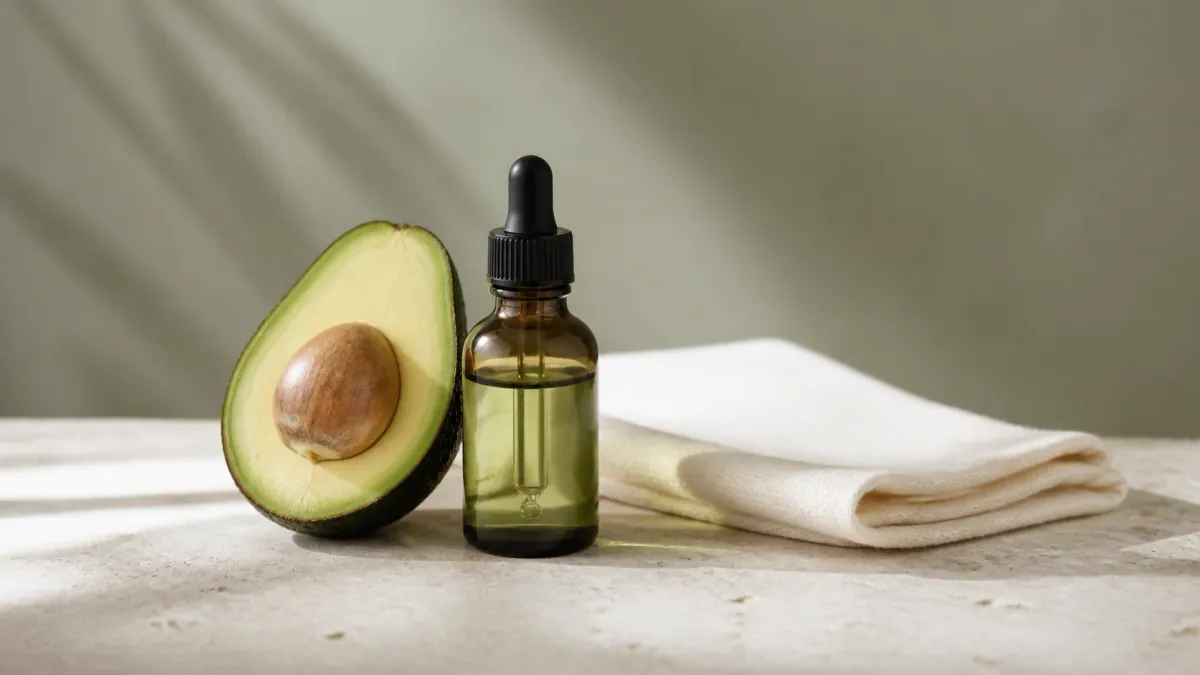
Avocado oil can work as a rich emollient for dry body skin, but it is not a proven acne treatment, collagen booster, burn remedy, or sunscreen. Pure oil may feel too heavy for an acne-prone face, so a formulated moisturizer and a slow patch test are usually the safer starting points.
- Fresh avocado, pure avocado oil, and a cosmetic containing avocado oil are not interchangeable.
- Human evidence for dramatic anti-aging or healing claims is limited.
- Body skin often tolerates a richer oil better than facial skin.
- Stop for itching, swelling, burning, rash, or worsening breakouts.
- Avocado oil never replaces moisturizer's water phase or broad-spectrum sunscreen.
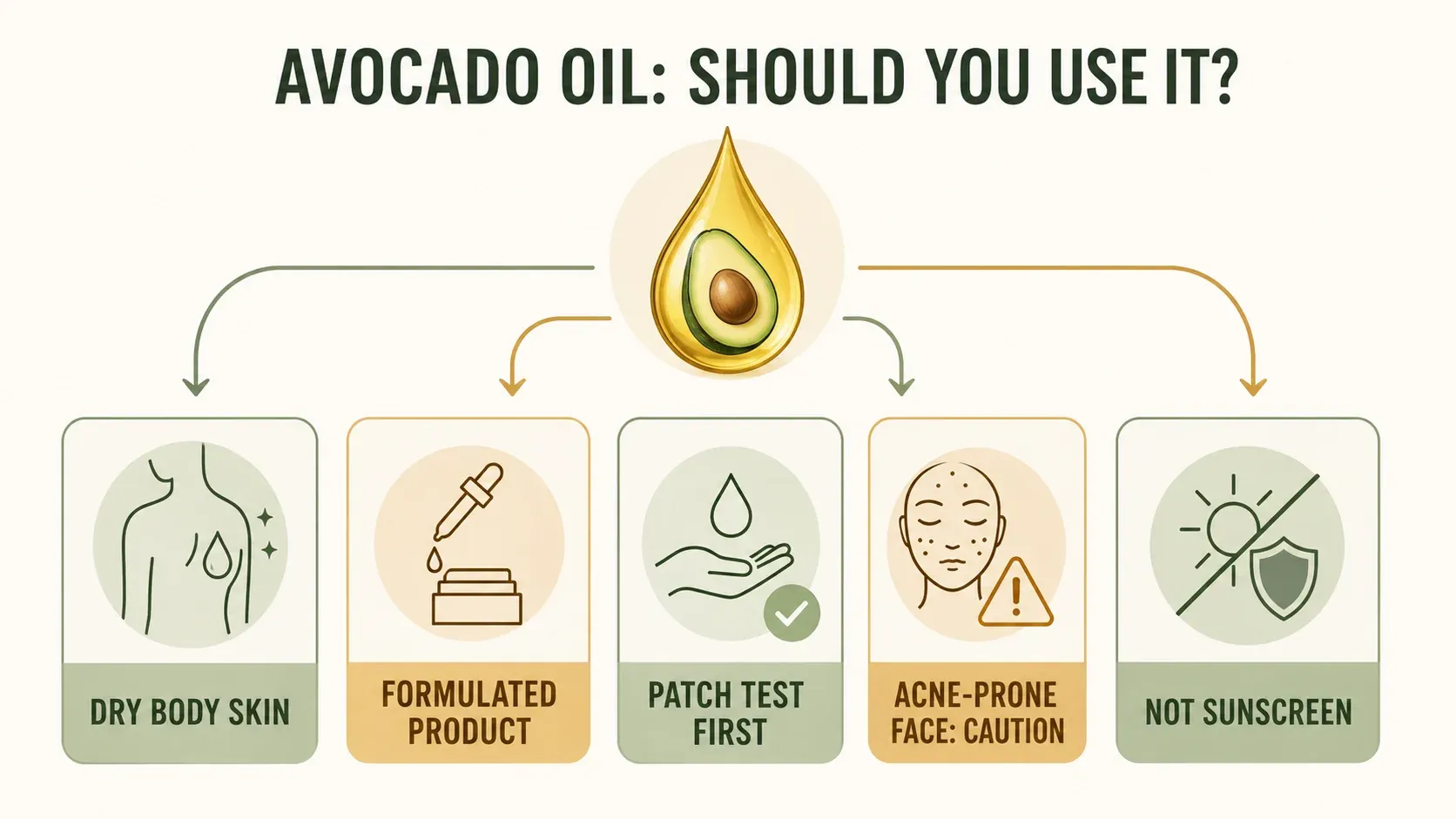
Avocado for skin sounds simple because the fruit is familiar and the oil feels rich. The useful answer is more specific: avocado oil can soften the surface of dry skin and help reduce moisture loss, but the result depends on the formula, the area you apply it to, and your tendency toward irritation or clogged pores.
The original version of this guide treated vitamins, fatty acids, DIY masks, acne, collagen, and sunburn as one optimistic story. That approach blurs important evidence boundaries. This update separates what a plant oil can reasonably do from claims that require a drug, a preserved cosmetic, or much stronger human research.
Avocado for Skin: The Fast Decision
| Your situation | Best starting choice | Main watch-out |
|---|---|---|
| Dry arms, legs, hands, or feet | A few drops over damp skin or body lotion | Slippery feel and fabric transfer |
| Dry but acne-prone face | A fragrance-free formulated moisturizer | Pure oil may feel heavy or worsen congestion |
| Very reactive or eczema-prone skin | Established bland emollient and clinician guidance | Botanical oils can still irritate |
| Known latex or avocado allergy | Avoid experimentation until medically advised | Possible cross-reactivity or contact symptoms |
| Active acne, wound, burn, or infection | Use condition-appropriate care | Oil is not a treatment |
| UV protection | Broad-spectrum SPF 30 or higher | Avocado oil has no reliable labeled SPF |
Dry body skin is the clearest low-stakes use case because a rich oil can sit over damp skin or lotion and reduce the rough feel. Facial use requires more restraint, especially when breakouts, seborrheic dermatitis, rosacea, or several active ingredients already complicate the routine.
If your goal is simply a calmer, less crowded routine, start with the minimalist skincare routine. An extra oil should earn a specific job rather than become another layer added for a vague promise of glow.
What the Evidence Actually Supports
A 2022 review of clinical studies on vegetable oils found a growing scientific rationale for some dermal uses, while emphasizing that mechanisms and clinical evidence remain incomplete. The review also notes that fatty-acid composition matters and that oils rich in oleic acid may not behave helpfully on every inflamed or barrier-impaired skin condition. See the peer-reviewed clinical review.
Avocado oil contains oleic, palmitic, and linoleic fatty acids, plus minor compounds that vary with cultivar, processing, storage, and refinement. A composition chart can explain why the oil feels rich, but it cannot predict whether your face will remain clear or whether a specific product will improve a condition.
Some often-cited wound-healing findings come from animal models or multi-ingredient formulations rather than ordinary human facial use. Those studies can justify further research; they do not justify telling a reader to treat a wound, burn, acne lesion, or scar with kitchen oil.
Moisturizing is the most defensible benefit
As an emollient, avocado oil can fill spaces between surface skin cells and reduce a rough feel. Its richer texture may suit elbows, heels, hands, or dry limbs better than a shiny or congestion-prone T-zone.
That is a comfort and barrier-support role, not proof of rebuilding collagen or reversing wrinkles. For evidence-led age-support basics, daily sunscreen and a tolerable routine remain more important than rotating trendy oils; our anti-aging ingredient guide explains the hierarchy.
Antioxidant content does not equal sunscreen
Laboratory antioxidant activity is not the same as measured protection from UVA and UVB exposure. A plant oil without standardized SPF testing cannot replace a labeled sunscreen, and it should not be used to stretch or dilute one.
Use our sunscreen mistakes guide to check amount, timing, missed areas, and reapplication. Those behaviors matter far more than adding avocado oil beneath an inadequate sunscreen layer.
Fresh Avocado, Pure Oil, and Formulated Products
Fresh avocado contains water, proteins, carbohydrates, fats, pigments, and plant material. Once mashed and mixed in a bowl, it has no cosmetic preservation system, standardized concentration, stability testing, or validated instruction for repeated facial use.
Pure avocado oil is simpler, but “pure” does not mean universally gentle. Refining, pressing, age, light exposure, heat, packaging, and contamination can change odor, color, stability, and the user experience.
A formulated lotion or cream may combine avocado oil with water-binding humectants, barrier-supporting lipids, preservatives, and a controlled texture. That often makes a finished cosmetic easier to spread, dose, and evaluate than applying culinary ingredients directly.
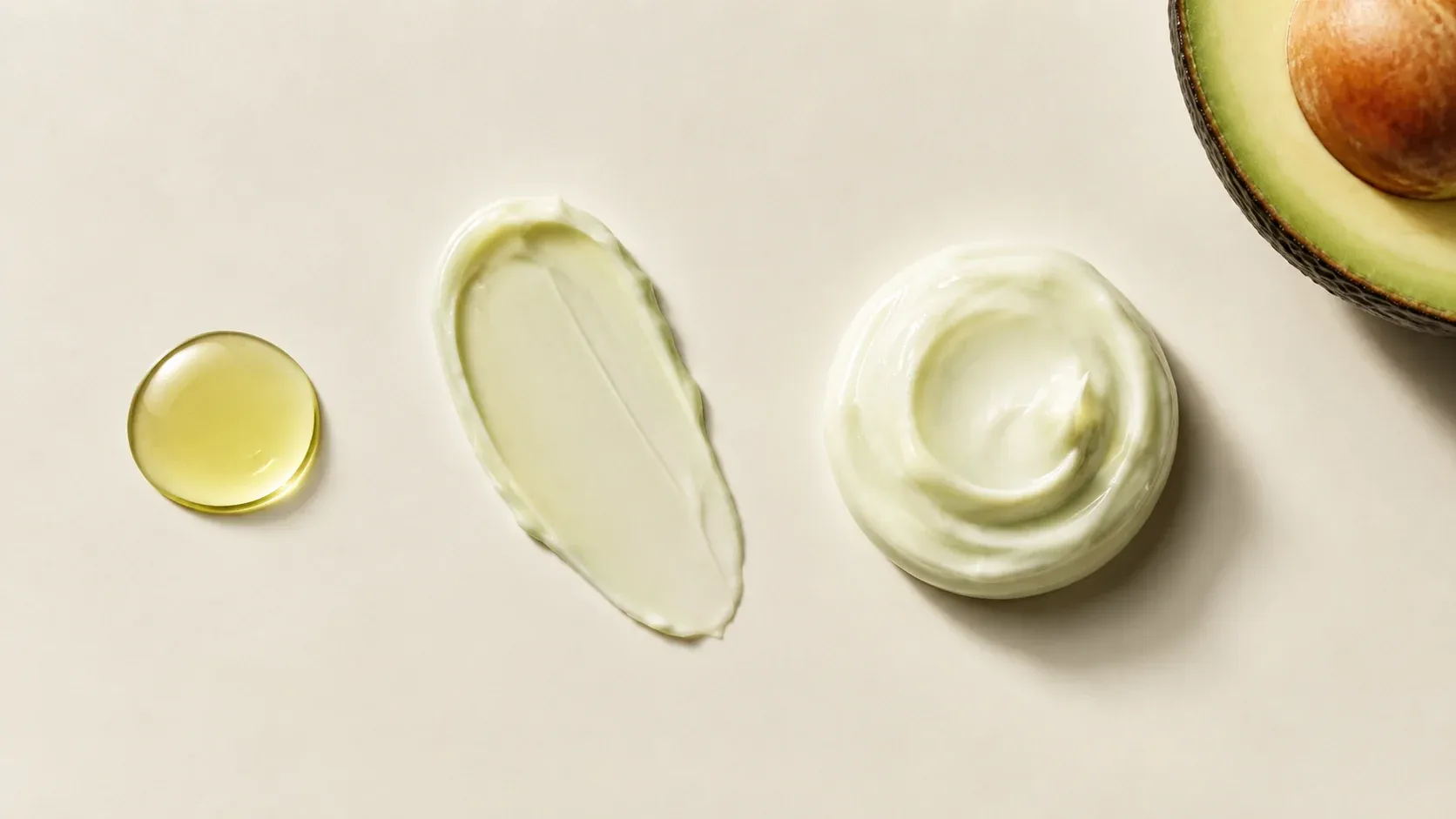
| Form | What it offers | What it cannot prove |
|---|---|---|
| Fresh avocado | Short-contact sensory DIY experience | Stability, preservation, consistent dose, or treatment |
| Pure avocado oil | Rich emollient layer with a simple ingredient list | Non-comedogenicity for every user or disease treatment |
| Avocado-oil lotion | Water plus emollients in a preserved system | That avocado is the ingredient producing every result |
| Multi-active face cream | Convenient routine step and controlled texture | That more ingredients automatically mean better tolerance |
Why kitchen DIY is not the safer default
Homemade masks are not automatically dangerous, but they add variables without clear benefit. Fresh food changes quickly, bowls and fingers introduce contamination, and recipes commonly add lemon juice, essential oils, baking soda, or rough particles that raise irritation risk.
Never add citrus juice for “brightening,” and do not add undiluted essential oil for scent. Our essential-oil safety guide explains why fragrance-active ingredients need a separate risk assessment.
If the appeal is a gentle weekly ritual, choose a preserved rinse-off product with clear instructions. The DIY face-mask guide gives safer substitutions and stop rules.
Who May Benefit Most
Someone with dry, rough body skin who already tolerates plant oils is the strongest candidate. Apply a small amount to damp skin or over a fragrance-free lotion, then judge softness, comfort, residue, and any new bumps over one to two weeks.
Hands, cuticles, elbows, lower legs, and feet are practical test areas. Keep oil off slippery floors, avoid broken skin, and reduce the amount if clothing or bedding remains greasy.
For dry facial skin without acne, pure avocado oil may still be optional rather than necessary. A well-formulated moisturizer offers water, humectants, and emollients in one step; see the dry-skin routine before adding another product.

NOW Solutions Avocado Oil, 16 fl oz
This single-ingredient oil is a straightforward option for adults who want to test avocado oil on dry body areas. The 16-ounce bottle is better suited to body or scalp use than to a tentative facial trial.
You already tolerate plant oils and want a simple, fragrance-free-feeling body emollient.
You need an acne treatment, facial moisturizer with a water phase, or a product for broken or actively irritated skin.
Check the exact 16 oz product on Amazon
As an Amazon Associate, we earn from qualifying purchases. Product image is exact-product retailer photography, not AI-generated. Check the current label and seller before ordering.
Who Should Be More Cautious
- Acne-prone facial skin: a rich oil can feel occlusive and may coincide with closed bumps or inflamed breakouts.
- Very reactive skin: a botanical ingredient can still trigger stinging, redness, itching, or contact dermatitis.
- Active eczema flare: use the treatment and emollient plan recommended for the condition instead of experimenting on inflamed skin.
- Latex or avocado allergy: avocado is associated with latex-fruit cross-reactivity, so obtain medical advice before topical experiments.
- Open wounds or burns: consumer avocado oil is not a sterile wound product and should not replace appropriate care.
MedlinePlus lists avocado among foods associated with latex-fruit syndrome. A food allergy does not map perfectly onto every refined cosmetic, but a history of serious reaction is a reason for caution rather than a home challenge.
Stop immediately for swelling, hives, breathing symptoms, or rapidly spreading rash and seek appropriate medical care. For slower irritation or new congestion, stop the oil and return to the last routine your skin tolerated.
There is no universal comedogenic score
Online ingredient charts often assign oils a pore-clogging number, but those scales do not reproduce an individual's formula, dose, cleansing habits, climate, or acne biology. “Non-comedogenic” is useful product language, not a guarantee that pure avocado oil will suit every face.
The American Academy of Dermatology recommends oil-free and non-comedogenic products for oily skin and warns that harsh or oil-based routines can irritate some users. Review the AAD guidance for oily skin and keep active acne treatment separate from an optional oil experiment.
How to Introduce Avocado Oil Safely
Step 1: Choose one use case
Decide whether you are testing dry body skin, a dry facial patch, makeup removal, or a finished moisturizer. Do not test all uses at once, because you will not know which dose or placement caused a reaction.
Step 2: Patch test repeatedly
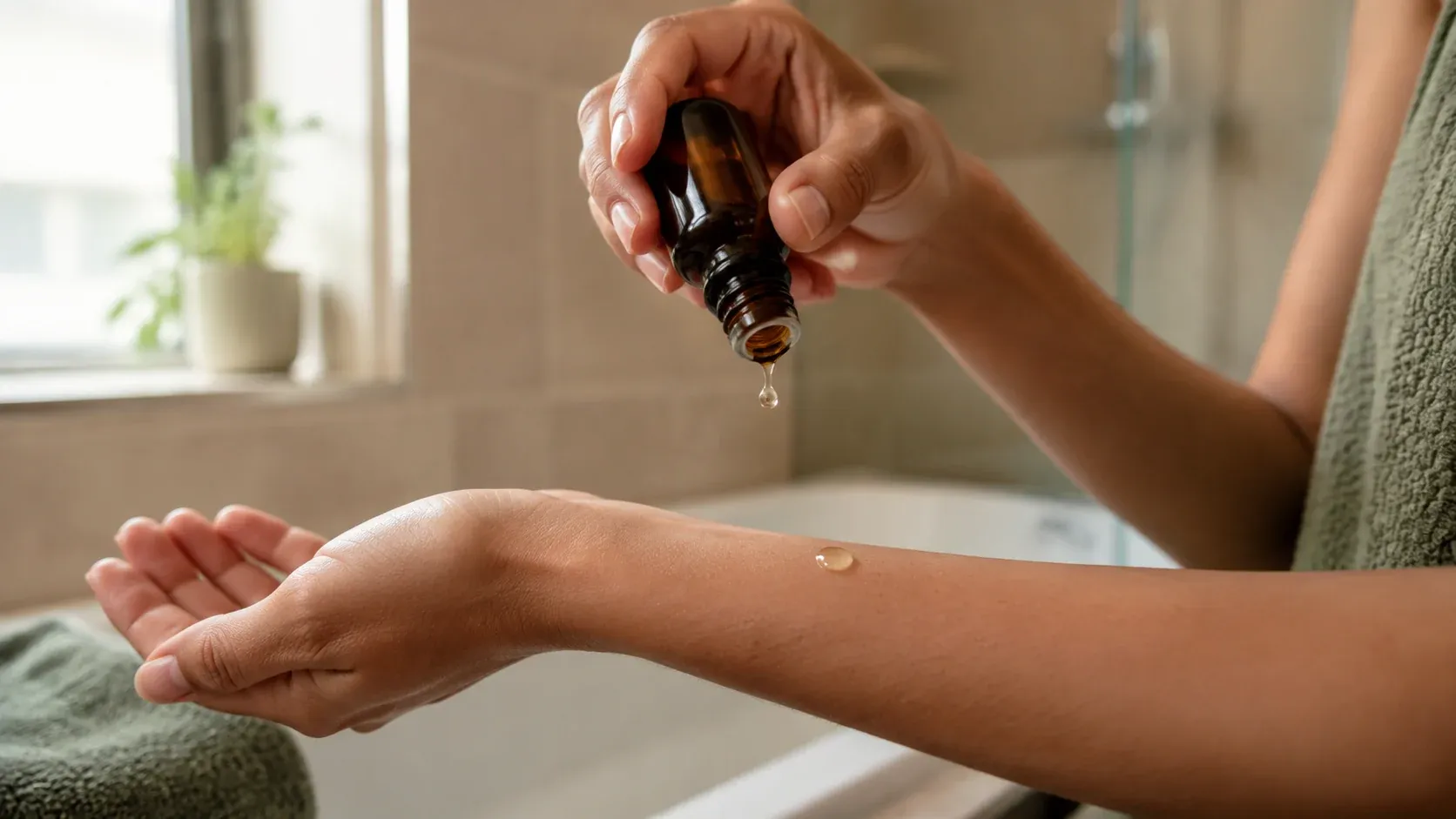
Apply a small amount to the same discreet area once daily for several days. Watch for itching, burning, swelling, rash, or bumps; remember that a quiet patch test reduces risk but cannot guarantee full-face tolerance.
Step 3: Use less than you expect
For a forearm or lower leg, begin with one or two drops spread over damp skin. For the face, if you choose to proceed, press one drop over moisturizer instead of coating the skin in a thick layer.
Step 4: Keep everything else stable
Do not start avocado oil during the same week as a retinoid, exfoliating acid, benzoyl peroxide, or several new products. A stable baseline lets you identify whether the oil changes comfort, shine, texture, or breakouts.
Step 5: Review at days 3, 7, and 14
At each check, record dryness, tightness, stinging, itch, closed bumps, inflamed spots, and residue. Stop early for clear irritation; a skincare experiment does not need to be completed when the trend is unfavorable.
Avocado Oil Compared With Common Alternatives
| Option | Best fit | Main trade-off |
|---|---|---|
| Avocado oil | Rich body emollient for someone who tolerates it | Can feel heavy; limited direct facial-outcome evidence |
| Squalane | Lighter oil step for many facial routines | Still optional and can irritate an individual |
| Jojoba oil | Wax-ester texture and targeted dryness | “Similar to sebum” does not guarantee acne compatibility |
| Sunflower seed oil | Barrier-support context in some evidence reviews | Quality and formulation still matter |
| Petrolatum | Strong reduction of water loss on dry intact skin | Occlusive feel and cosmetic heaviness |
| Fragrance-free cream | Most complete everyday dry-skin step | Longer ingredient list and preservative exposure |
No oil wins every category. Choose by the job: a cream for water plus emollience, petrolatum for a strong sealing layer on intact dry areas, or a small amount of oil when texture and simplicity genuinely improve adherence.
For breakout-prone skin, follow the natural acne-care guide rather than treating “natural” as a synonym for non-comedogenic. Acne outcomes deserve controlled changes and proven treatment options.
Storage, Oxidation, and Label Checks
Light, heat, oxygen, and repeated contamination can degrade plant oils. Store the bottle tightly closed in a cool, dark place, and do not keep it in a steamy shower or sunny window.
Discard an oil that develops a clearly rancid, paint-like, stale-nut odor or an unexpected texture change. A naturally colored oil can vary, so compare it with the product's original state and follow the manufacturer's storage and period-after-opening instructions.
On an ingredient list, avocado oil commonly appears as Persea Gratissima (Avocado) Oil. Check the full formula for fragrance, essential oils, and other actives; our skincare storage guide covers light, heat, bathroom storage, and contamination in more detail.
A Better 14-Day Avocado-Oil Test
- Day 0: photograph the test area in consistent light and record the current routine.
- Days 1–3: patch test a tiny amount and stop for allergy or irritation signs.
- Days 4–7: use one or two drops on one dry body area over damp skin or lotion.
- Days 8–14: keep dose and routine stable; compare softness, comfort, residue, and bumps.
- Day 14: continue only if the oil adds a clear benefit without a meaningful downside.
A trial is successful when it answers a decision, not when it produces a dramatic photo. If lotion alone performs as well, avocado oil has not earned an extra routine step.
The Bottom Line
Avocado oil can be a useful rich emollient, especially for dry body areas, but the strongest claims online run ahead of the human evidence. It does not automatically hydrate better than a cream, suit acne-prone facial skin, stimulate meaningful collagen, heal wounds, or protect against UV radiation.
Choose the form that matches the job, patch test slowly, and judge the outcome against a simpler baseline. When a bland moisturizer already keeps skin comfortable, avocado oil is an option rather than an upgrade.
Frequently Asked Questions About Avocado for Skin
Community discussions helped identify these practical questions; they are question-discovery sources, not evidence. The answers below use dermatology guidance and published reviews rather than Reddit anecdotes.
Is avocado oil good for your face?
It can soften dry skin, but pure avocado oil is relatively rich and may feel heavy or contribute to congestion for some people. A formulated moisturizer is usually easier to dose and evaluate, especially for acne-prone or reactive facial skin.
Can avocado oil clog pores or cause acne?
No comedogenic rating can predict every person's response. If you are acne-prone, test a small area, use a tiny amount, keep the rest of the routine stable, and stop if closed bumps or inflamed breakouts increase.
Is fresh avocado safe to use as a face mask?
Fresh avocado is food, not a preserved cosmetic. It can be messy, variable, and irritating, and mixtures with lemon juice, essential oils, or rough scrubs add avoidable risk. A tested cosmetic formula is the safer default.
How should you patch test avocado oil?
Apply a small amount to the same discreet area once daily for several days and watch for itching, swelling, burning, rash, or new bumps. Patch testing reduces risk but cannot guarantee that full-face use will be tolerated.
Can avocado oil replace moisturizer or sunscreen?
Oil can reduce moisture loss but does not add water to the skin, so it may work best over a moisturizer. It has no reliable labeled SPF and must never replace broad-spectrum sunscreen.
This article is for informational purposes only and does not replace professional dermatological advice.