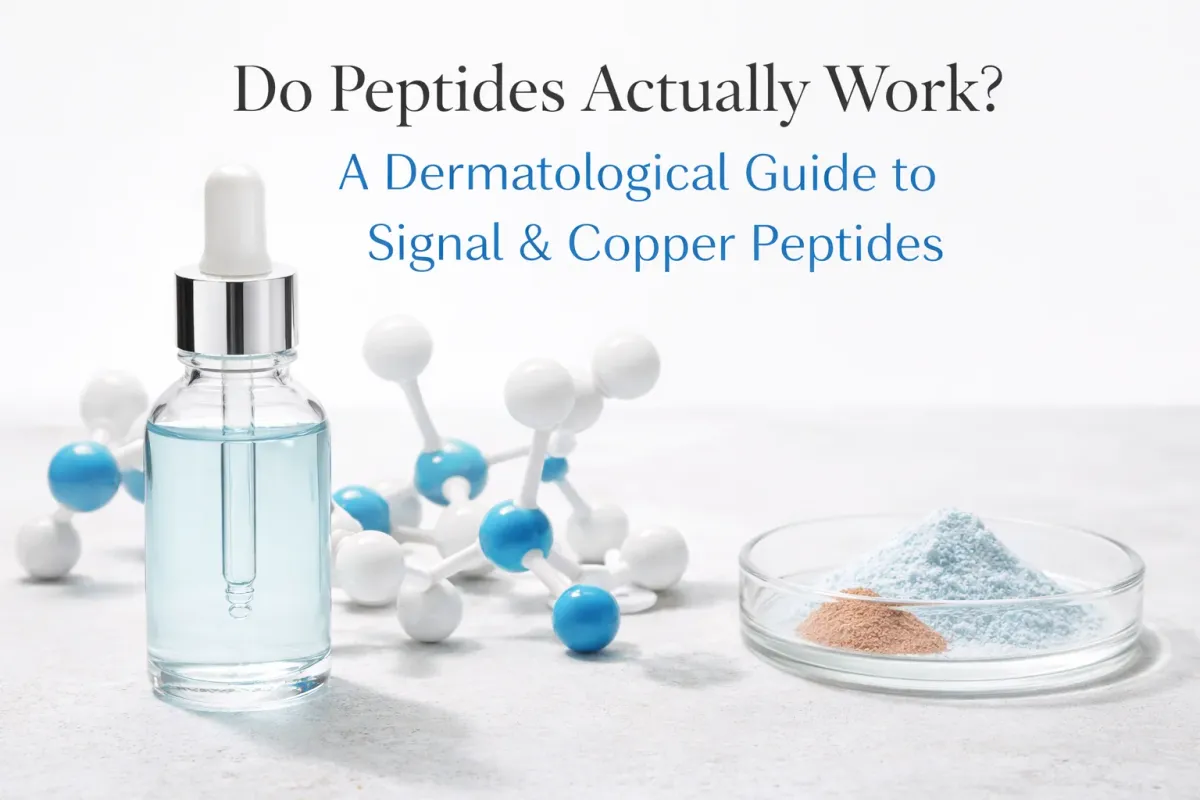
Do Peptides Actually Work? | A Dermatological Guide to Signal & Copper Peptides
Do peptides really work or are they just marketing hype? We break down the science of Signal vs. Copper peptides, how to layer them correctly, and why delivery systems matter more than percentage.

Let’s be honest: "Peptides" is the buzzword that brands use when they want to charge you $80 for a moisturizer but can’t legally claim it acts like a drug. If you walk down the skincare aisle today, you are promised "Botox in a bottle" and "instant firming."
I have spent years analyzing formulations and speaking with chemists, and here is the reality check: Peptides are builders, not freezers. They cannot paralyze a muscle like a neurotoxin. If a brand promises you 'instant freezing' from a topical cream, they are marketing a fantasy, not science.
📋 The 30-Second Brief (TL;DR)
- They are Messengers, Not Fillers: Peptides signal your skin to produce collagen; they don't replace it directly.
- The "Dalton" Rule: Most generic peptides are too large to penetrate the skin barrier. Look for "bio-identical" or encapsulated delivery systems.
- Copper is Volatile: Copper peptides are potent wound healers but destroy themselves if mixed with Vitamin C (L-Ascorbic Acid) or strong AHAs.
- Patience is Mandatory: Unlike acids (instant glow), peptides require 12+ weeks of daily use to show structural changes.
However, peptides are arguably the most sophisticated form of skin communication we have. While Retinol is the bulldozer that forces skin to renew, peptides are the project managers.
They whisper instructions to your cells to behave younger, repair faster, and construct collagen more efficiently. But—and this is the critical "but" that most articles miss—they are incredibly fragile.
If you pick the wrong molecular weight or mix them with the wrong acid, you are essentially applying expensive water to your face.
This guide is not about hype. It is about the chemistry of connection. Here is how to actually use peptides to rebuild your skin matrix.
The Biology: What Are Peptides, Really?
To understand why your serum works (or doesn’t), you have to look at the structure. Proteins, like collagen and elastin, are the scaffolding of your skin.
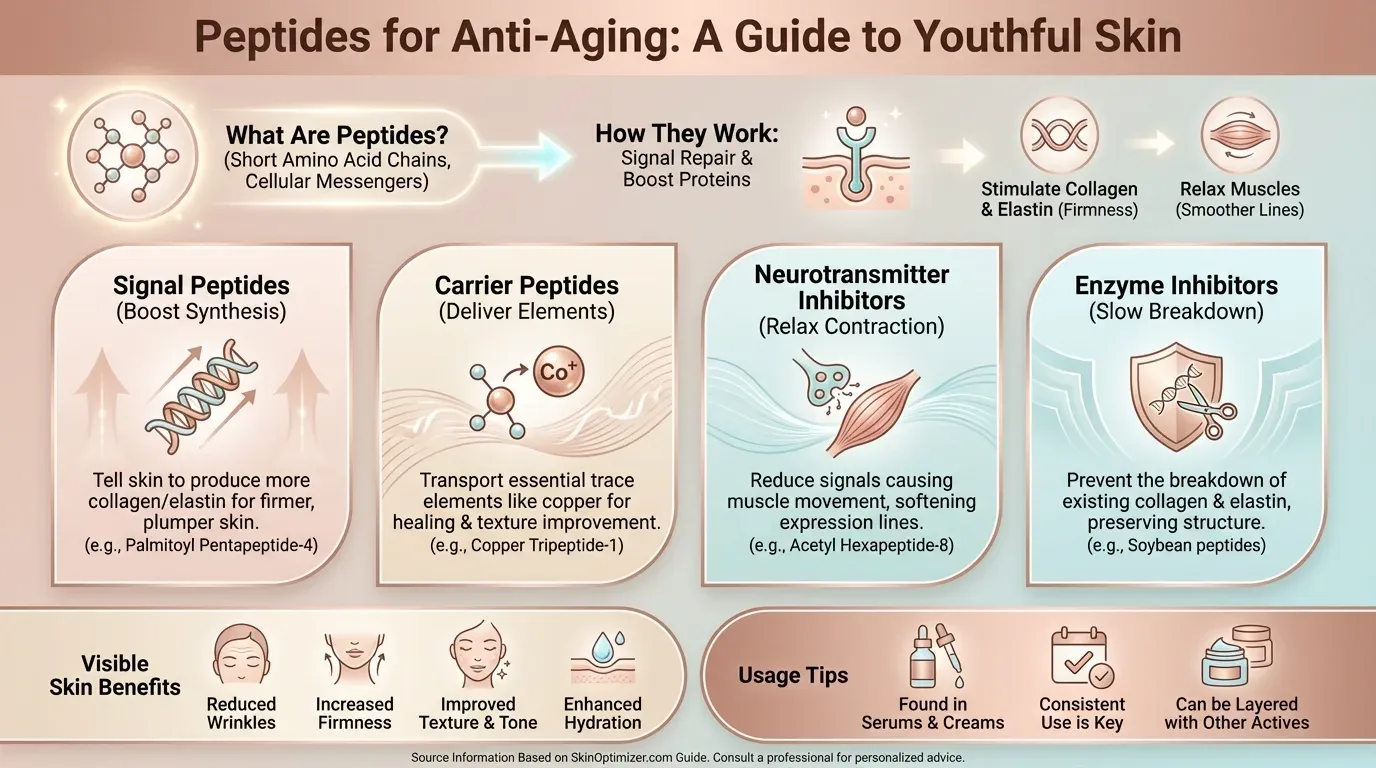
If you imagine collagen as a brick wall, peptides are the individual broken bricks or mortar fragments.
When collagen breaks down (due to UV damage or age), it releases these peptide fragments. Your skin cells contain receptors that detect these floating fragments.
When they sense a high number of peptides, they interpret it as a distress signal: "The wall is falling down! We need to build more collagen immediately!"
Applying topical peptides is essentially a biological "hack." You are flooding the skin with these false distress signals, tricking your body into ramping up collagen production even if the damage hasn't occurred yet.
The Delivery Problem (Why Most Serums Fail)
This is the part 90% of beauty marketing leaves out. Your skin barrier is designed to keep things out. It is lipid-based and tough.
Peptides are water-loving (hydrophilic) and often have a high molecular weight. In plain English? They are too big and too watery to pass through the oily, tight surface of your skin.
If you buy a cheap peptide serum without a delivery system, it sits on top of your face and hydrates you, but it will never signal a single cell to produce collagen.
Effective formulas use:
- Palmitoyl chains: Fatty acids attached to the peptide to help it slide through the skin’s lipid layer.
- Liposomal encapsulation: Think of this as a Trojan Horse—a bubble of oil that hides the water-soluble peptide inside, sneaking it past the skin's lipid barrier before releasing it deep in the dermis.
- Copper carriers: Using metal ions to drive the ingredient deeper.
🧪 The Skin Insider
In my editorial testing, I’ve noticed that "sticky" peptide serums often perform better than watery ones. That stickiness often comes from the solvent base or the high concentration of signaling proteins. If a peptide product feels exactly like water and costs $10, be skeptical of its penetration capability.
The 3 Classes of Peptides You Need to Know
Not all peptides do the same thing. In dermatology, we categorize them into three primary distinct buckets. A well-rounded anti-aging routine might use a combination of these.
1. Signal Peptides (The Builders)
- Famous Names: Matrixyl 3000, Matrixyl Synthe'6, Palmitoyl Pentapeptide-4.
- Function: These generate the "repair" signal. They specifically target the production of Collagen I, III, and IV, as well as fibronectin (which stiffens the skin).
- Best For: General prevention, fine lines, and skin barrier repair.
2. Neurotransmitter Inhibitor Peptides (The Relaxers)
- Famous Names: Argireline (Acetyl Hexapeptide-8), Syn-Ake.
- Function: Often called "Botox in a jar." They work by inhibiting the release of acetylcholine, the chemical that tells your muscles to contract.
- Reality Check: They cannot freeze a muscle like a needle can. They can, however, soften the intensity of the contraction known as 'expression lines' over time. They are best used on the forehead and in your eye care routine to delay dynamic wrinkles.
3. Carrier Peptides (The Transporters)
- Famous Names: Copper Tripeptide-1 (GHK-Cu), Manganese Tripeptide-1.
- Function: These deliver trace elements (like Copper) required for enzymatic processes. Copper is unique because it also acts as a potent anti-inflammatory and can actually break down damaged collagen (scar tissue) to replace it with healthy collagen.
- Best For: Acne scars, wound healing, and significant textural issues.
Recommended Product: The Clinical Standard
If you are looking for a formula that combines delivery systems with high-potency signal peptides, this is a staple in aesthetician offices.
The Conflict: How to Layer Peptides Correctly
This is where 90% of home routines go wrong. Peptides are fragile chains of amino acids. Their bonds are held together by specific pH levels.
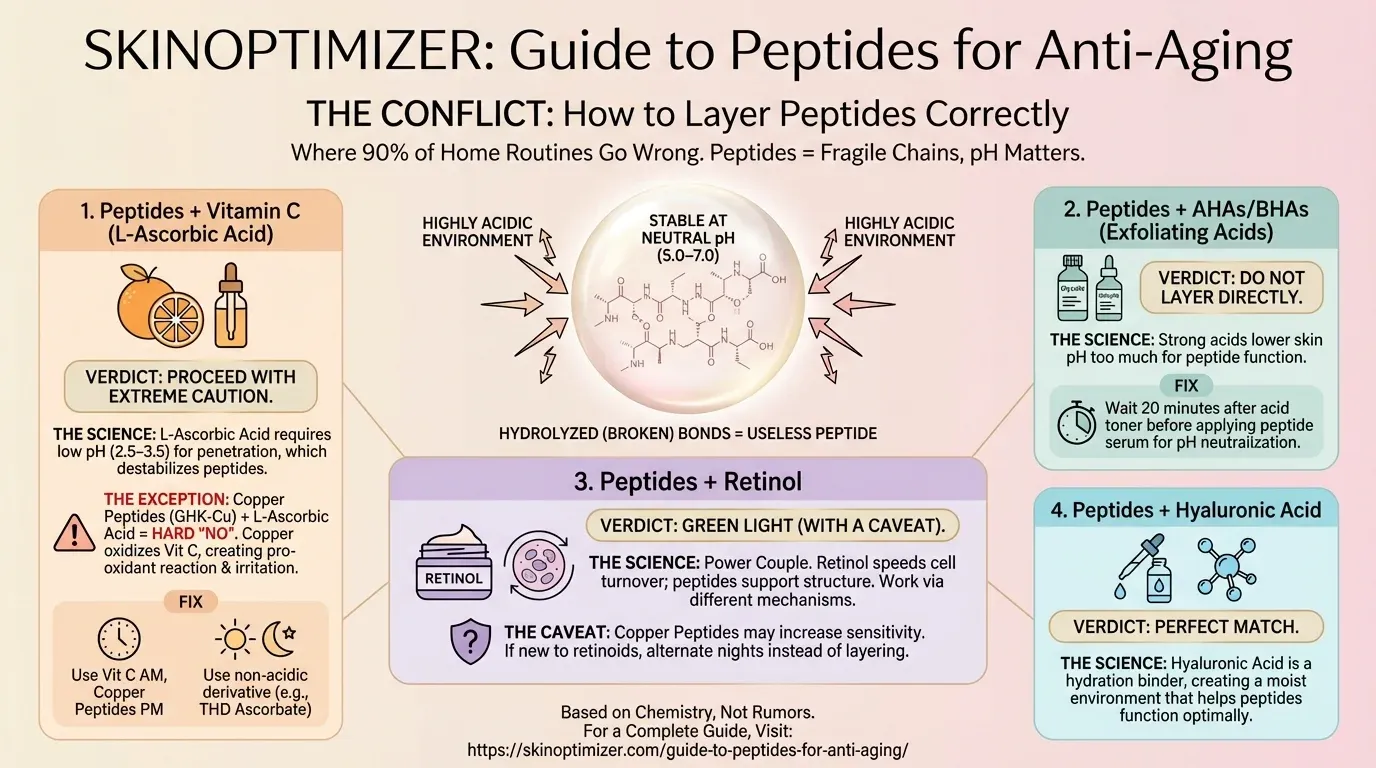
If you introduce a highly acidic environment, you can hydrolyze (break) these bonds, rendering the peptide useless.
Here is the definitive guide to mixing, based on chemistry, not internet rumors.
1. Peptides + Vitamin C (L-Ascorbic Acid)
- The Verdict: Proceed with Extreme Caution.
- The Science: L-Ascorbic Acid requires a low pH (usually 2.5–3.5) to penetrate. Most peptides are stable at a neutral pH (5.0–7.0). If you mix them, the acidity can destabilize the peptide.
- The Exception: Copper Peptides (GHK-Cu) and L-Ascorbic Acid are a hard 'No.' The copper ions can oxidize the Vitamin C rapidly, potentially creating a pro-oxidant reaction on the skin. This renders the Vitamin C useless and may cause temporary irritation.
- The Fix: Use Vitamin C in the morning and Copper Peptides at night. Alternatively, use a non-acidic Vitamin C derivative (like THD Ascorbate) which plays nicely with peptides.
2. Peptides + AHAs/BHAs (Exfoliating Acids)
- The Verdict: Do Not Layer Directly.
- The Science: Similar to Vitamin C, strong acids (Glycolic, Salicylic) lower the skin's pH too much for peptides to function optimally.
- The Fix: Wait 20 minutes after applying your acid toner before applying your peptide serum. This allows the skin's pH to neutralize slightly.
3. Peptides + Retinol
- The Verdict: Green Light (With a Caveat).
- The Science: This is a power couple. Retinol speeds up cell turnover; peptides support the structure. They work via different mechanisms.
- The Caveat: Copper Peptides can increase skin sensitivity. If you are new to retinoids, alternating nights is safer than layering them immediately to avoid "retinol uglies."
4. Peptides + Hyaluronic Acid
- The Verdict: Perfect Match.
- The Science: Hyaluronic Acid is a hydration binder. It creates a moist environment that helps peptides function. Many serums combine both.
💡 The Optimizer’s Edge
Most people stop using Copper Peptides because their skin looks "worse" after week 2. This is often due to enzyme activation that clears out damaged collagen before laying down new fibers. It is a remodeling phase. Push through the first month unless you see genuine allergic irritation (hives/swelling).
Copper Peptides: The Advanced Tier
If Matrixyl is the safe, steady construction worker, Copper Peptide (GHK-Cu) is the demolition crew and the architect combined.
It is naturally found in human plasma, but concentrations drop significantly as we age (from 200ng/ml at age 20 to 80ng/ml at age 60).
Why choose Copper over standard peptides?
- Wound Healing: It was originally discovered to help heal ulcers and deep wounds. It is incredible for recovering from microneedling or lasers.
- Antioxidant Power: It neutralizes free radicals better than many traditional antioxidants.
- DNA Repair: Studies suggest it can reset human genes to a healthier state.
The "Blue" Warning:
Real GHK-Cu is distinctively bright blue (royal blue, not pale baby blue). If a product claims to have 'maximum strength' copper peptides but is clear, white, or very faintly blue, the concentration is likely negligible (<1%).
Genuine formulations will also often have a very slight metallic scent.
Strategic Routine Integration
You do not need peptides in every step of your routine. In fact, peptide cleansers are a waste of money because the ingredients are washed off before they can signal the cells.
Peptide moisturizers are good, but peptide serums are best because they are the first leave-on step.
Here is how to structure your regimen for maximum absorption.
✅ Your Clear Skin Checklist
- Step 1: Apply Peptide Serum to damp skin immediately after cleansing (or essence).
- Step 2: If using Copper Peptides, ensure your toner was NOT an exfoliating acid.
- Step 3: Lock it in with an occlusive moisturizer. Peptides need a hydrated environment to signal effectively.
Recommended Product: The Copper Powerhouse
For those ready to introduce Copper Peptides, this serum focuses on skin health and barrier support without the irritation of retinoids.
Conclusion: Are Peptides Worth the Money?
Yes, but only if you have the patience for them.
If you are looking for overnight gratification, buy an exfoliating acid or book a Botox appointment. Peptides are for the long game. They are for the person who wants to maintain skin density and slow down the thinning of the dermis that happens in our 30s, 40s, and 50s.
Think of Retinol as your gym workout (breaking down muscle to build it) and Peptides as your protein shake (giving the body the blocks to build with). You get the best results when you use both, consistently, over a lifetime.
Frequently Asked Questions About Peptides for Anti-Aging
Can I use peptides if I have sensitive skin?
Absolutely. Unlike retinoids or acids, signal peptides are generally non-irritating and anti-inflammatory. They are often the best anti-aging choice for sensitive skin types who cannot tolerate Vitamin A.
Do I need to use peptides twice a day?
Ideally, yes. Because peptides work by signaling, keeping that signal "active" with twice-daily application (AM and PM) yields faster results. However, if you must choose one, use them in the PM when your skin is in repair mode.
At what age should I start using peptides?
You can start in your mid-20s. This is "pre-juvenation." Since natural collagen production begins to dip by 1% per year starting at age 25, introducing peptides then can help maintain your baseline levels for longer.
Can I mix Niacinamide with Peptides?
Yes, Niacinamide and Peptides generally play very well together. Both are stable at neutral pH levels and both support barrier health. Many serums actually contain both ingredients.
Will stopping peptides make my skin sag immediately?
No. Your skin will simply return to its normal rate of aging. The collagen you built while using the peptides remains until natural degradation breaks it down. You do not lose your progress overnight.
This article is for informational purposes only and does not replace professional dermatological advice. If you have specific skin conditions, consult a board-certified dermatologist.