Does Chocolate Cause Acne? What the Evidence Really Says
Chocolate may worsen acne for some acne-prone people, but it is not a universal cause. Learn what studies found and how to test your own pattern.
In this guide

Chocolate does not cause acne in everyone, but small controlled and crossover studies suggest that cocoa or frequent dark-chocolate intake can worsen lesions in some acne-prone people. Researchers still cannot identify one universal component or predict who responds. Use a time-limited, one-variable test while keeping proven acne treatment stable instead of permanently banning chocolate after one breakout.
Quick Summary
- Several small intervention studies found acne worsening after chocolate or cocoa exposure.
- Chocolate type, dose, sugar, milk and overall diet make a universal answer impossible.
- Visible pimples begin developing before the meal you may blame.
- Test one defined exposure for four weeks without stopping evidence-based acne care.
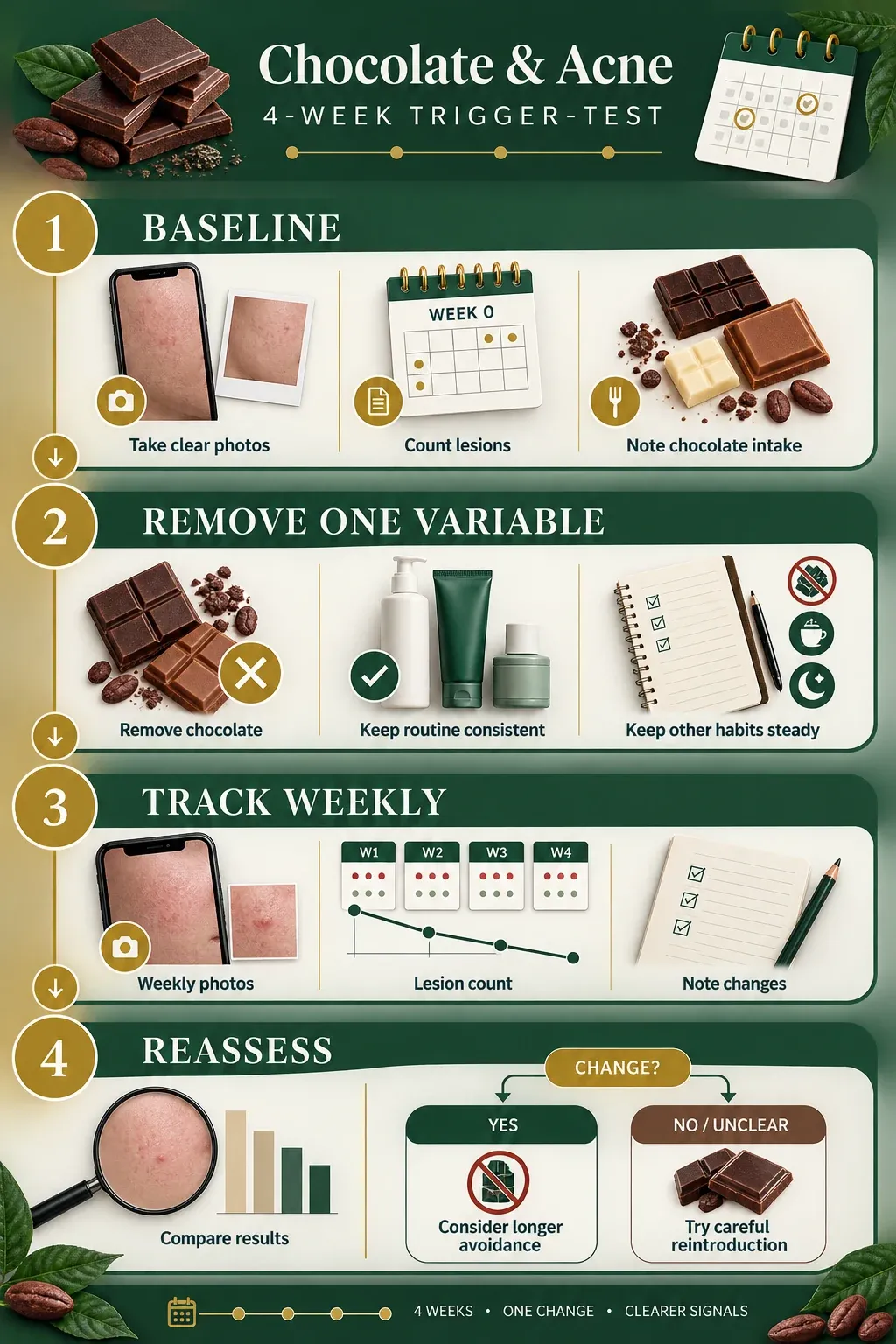
Chocolate and acne is one of skincare's longest-running arguments, usually reduced to either an old myth or an absolute trigger. Newer studies make both extremes too simple. This guide examines what cocoa and dark-chocolate trials actually measured, separates chocolate from glycemic load and dairy, and shows how to test an individual pattern without replacing treatment or creating unnecessary food fear.
Does Chocolate Cause Acne?
Chocolate does not cause acne in every person, but several small intervention studies suggest that frequent cocoa or dark-chocolate intake can worsen lesions in some acne-prone people. The evidence does not identify one universal culprit and does not justify telling everyone with acne to avoid chocolate permanently.
Acne is driven by follicular plugging, sebum, inflammation, hormones and genetics. Diet may modify that background, but a breakout after one dessert cannot prove causation because lesions begin developing before they become visible. Stress, menstrual timing, sleep and skincare changes can occur at the same time.
A practical answer is to test the pattern rather than accept a myth. Keep treatment stable, record amount and product type, and observe lesion counts over several weeks. Restrictive dieting based on one bad day produces more confusion than evidence.
| Question | Current answer | What remains uncertain |
|---|---|---|
| Can chocolate worsen acne? | Possibly in some acne-prone people | Who responds and which component matters |
| Is cocoa the cause? | Small cocoa trials suggest a signal | Dose, population and replication are limited |
| Is sugar the cause? | High-glycemic patterns may worsen acne | One chocolate serving does not define the whole diet |
| Is milk chocolate worse? | Milk and sugar are plausible contributors | Direct product comparisons are scarce |
| Does dark chocolate prevent acne? | No | Antioxidant content does not make it acne treatment |
| Should everyone stop chocolate? | No | Use an individual, time-limited test |
What Chocolate Studies Actually Found
A 2024 crossover study of 92 participants with acne reported higher severity after four weeks of eating 50 grams of 85% chocolate daily while following an anti-inflammatory diet. The study suggests a possible effect in that group, but it did not identify whether cocoa, fat, sugar, calories or another factor caused the change.
A 2014 double-blind cocoa capsule trial found more acneiform lesions after exposure. Only 14 men were enrolled and 13 completed the study, so the result cannot establish the response in women, teenagers or the general population.
A 2016 randomized crossover study in college students also reported a chocolate-related increase. These trials challenge the claim that chocolate can never matter, but their size, short duration and differing products prevent a universal rule.
Why the old yes-or-no debate fails
"Chocolate" can mean unsweetened cocoa, 85% dark chocolate, milk chocolate, a sugar-heavy candy bar or a dessert containing dairy and refined flour. Each has a different nutrient profile. Grouping them together hides the ingredient or dietary pattern that might matter.
A 2021 review of diet and acne evidence concluded that the role of specific chocolate components remains unresolved. It also found broader signals around high glycemic load and some dairy exposures, while emphasizing limitations in the literature.
Plausible Mechanisms Without Overclaiming
High-glycemic foods raise blood glucose and insulin more rapidly. Insulin and insulin-like growth factor pathways may influence sebum, keratinization and inflammation. That makes the overall dietary pattern more biologically coherent than blaming the oil on the surface of a chocolate bar.
Milk proteins and hormones have also been investigated in acne. Observational studies often find associations with cow's milk, particularly skim milk, but association does not prove that milk causes acne in each person. Yogurt and cheese have not shown the same consistent pattern.
The AAD diet and acne guidance describes modest evidence for low-glycemic eating and possible milk associations. It explicitly notes that effective acne care still includes appropriate skincare and medication.
| Possible factor | Why researchers study it | What not to conclude |
|---|---|---|
| Cocoa solids | Small challenge trials found lesion increases | Every amount triggers every person |
| Added sugar | Contributes to glycemic load | Sugar alone explains all acne |
| Milk ingredients | Some dairy associations exist | All dairy products have the same effect |
| Saturated fat | May relate to dietary pattern | Surface oil comes directly from food fat |
| Calories and pattern | Frequent sweets may displace balanced foods | One serving diagnoses a trigger |
| Stress and sleep | Can change alongside cravings and acne | Chocolate is the only variable |
A Four-Week Chocolate and Acne Test
First establish a two-week baseline. Record chocolate type, grams or portions, menstrual timing if relevant, sleep, major stress and new skincare. Photograph the same facial areas once weekly in the same light rather than checking after every snack.
Then remove only the suspected chocolate product for four weeks while keeping proven acne treatment stable. Do not simultaneously stop dairy, sugar, gluten and seed oils. If multiple variables change, the experiment cannot identify a trigger.
If lesions improve, reintroduction can test whether the pattern repeats, provided the acne is mild and the person is comfortable doing so. Severe, painful or scarring acne should not be used for food experiments. Seek dermatological treatment promptly.
What to measure
- Inflamed lesions: count new papules, pustules and nodules weekly.
- Comedones: record blackheads and whiteheads separately.
- Severity: note pain, depth and whether marks are forming.
- Exposure: record product, portion and frequency.
- Confounders: track treatment changes, cycle, stress and sleep.
- Decision: define in advance what change would be meaningful.
Do not count every red mark as active acne. Post-acne redness and hyperpigmentation can remain after the lesion has flattened. The post-acne redness guide explains how to separate active lesions from healing marks.
Chocolate, Teenagers and Restrictive Eating
Teen acne occurs during a period of hormonal change, growth and increasing independence around food. Blaming sweets can create shame without controlling acne. Parents should avoid turning every breakout into surveillance of one food.
Start with a gentle routine from the sensitive teenage skincare guide or the teen cleanser comparison. Add one evidence-based acne treatment and allow enough time to work.
Anyone with a history of disordered eating, intense food anxiety or medically necessary dietary restrictions should not start an elimination test without professional guidance. Skin improvement is not worth destabilizing nutrition or mental health.
What Proven Acne Care Looks Like
The 2024 AAD acne guideline strongly recommends benzoyl peroxide, topical retinoids and combinations with complementary mechanisms. Salicylic acid and azelaic acid are also supported options. Diet can be adjunctive, not the entire plan.
A gentle cleanser, non-comedogenic moisturizer and broad-spectrum sunscreen reduce routine instability. The acne cleanser guide helps match a wash to sensitivity, while the breakout prevention guide covers leave-on treatment and habits.
Give a consistent routine at least eight to twelve weeks unless it causes significant irritation. Constantly changing products and foods makes natural acne fluctuation look like cause and effect.
When Diet Deserves More Attention
A broader dietary review can make sense when acne worsens alongside frequent high-glycemic meals, large amounts of milk, whey protein supplements or a highly restricted routine. The goal is a sustainable pattern, not a list of forbidden ingredients. Replace foods thoughtfully so protein, calcium, energy and enjoyment remain adequate.
Read the diet and acne guide for the evidence on glycemic load, dairy and supplements. The clear-skin food guide should be used as a testing framework, not a universal blacklist.
Whey protein is a distinct exposure from an occasional chocolate dessert and has been linked to acne in case reports and observational settings. If breakouts began after a supplement, test that variable separately rather than assuming cocoa is responsible.
How to Compare Chocolate Products in a Trigger Test
Write down cocoa percentage, serving size, added sugar, milk ingredients and frequency. A few squares of dark chocolate after a meal create a different exposure from a large milk-chocolate dessert or daily cocoa supplement. Without those details, "I stopped chocolate" is too vague to repeat or interpret.
Keep the usual meal context stable. Eating chocolate during a stressful week with less sleep and more takeout changes several variables at once. A diary should capture the pattern without turning every meal into a moral score.
If the suspected product is a protein bar, examine whey or milk protein separately. If it is a milkshake, liquid sugar and dairy may matter more than the cocoa flavor. Test the actual recurring exposure rather than the ingredient named on the front label.
What a meaningful response looks like
Natural acne variation means one or two lesions are rarely decisive. A repeated rise in new inflammatory lesions during exposure and improvement during removal is more persuasive. The pattern should occur while treatment, cycle timing and major stress are reasonably comparable.
Even a repeatable response does not mean chocolate is toxic or that complete lifelong avoidance is required. Portion, frequency and product type may offer a workable threshold. The decision should balance skin benefit with nutrition, enjoyment and sustainability.
Build a Low-Glycemic Pattern Without Chasing Perfection
Lower-glycemic eating emphasizes vegetables, legumes, intact grains, protein and minimally processed carbohydrate sources. It does not require removing every dessert. Pairing carbohydrate with protein, fiber and fat can make meals more satisfying and reduce rapid glucose swings.
Change the repeat pattern before targeting rare events. Daily sugary drinks, frequent refined snacks or a whey shake may contribute more exposure than occasional chocolate. This approach also provides a clearer experiment because the highest-frequency variable is addressed first.
Do not use the glycemic index as a purity system. Portion, mixed meals and the person's health all matter. A registered dietitian can help when acne concerns collide with diabetes, athletic nutrition, pregnancy, food allergy or restrictive eating.
Restaurant desserts and seasonal treats are especially difficult to classify because recipes and portions vary. Do not use them as the only reintroduction test. A packaged product with a known serving produces a clearer observation, after which the person can decide whether occasional less-controlled foods are worth any possible skin tradeoff.
Keep the conclusion proportional. A mild repeatable increase may justify reducing frequency, while a strong response may justify avoidance of that exact product. Neither result proves that chocolate caused the person's acne overall.
Write the result down before memory reshapes it.
Common Chocolate and Acne Mistakes
- Blaming yesterday's dessert: visible lesions began developing earlier.
- Calling all chocolate identical: cocoa, milk, sugar and portion differ.
- Changing five foods at once: the trigger cannot be isolated.
- Stopping acne medication: diet has weaker and less predictable effects.
- Judging red marks as new acne: healing lesions can remain visible.
- Restricting indefinitely: a test needs a defined endpoint and re-evaluation.
When to See a Dermatologist
Seek care for painful nodules, cysts, scars, rapidly worsening acne or significant emotional distress. Early control reduces the chance of permanent marks. A clinician can also identify folliculitis, perioral dermatitis or rosacea that may resemble acne.
Bring a list of products, medicines, supplements and any structured food observations. A concise record is more useful than a long memory-based list of suspected triggers. Do not delay treatment while waiting for the perfect diet.
The Bottom Line
Chocolate may worsen acne in a subset of acne-prone people, and newer intervention studies make a universal "no connection" answer too confident. The studies still cannot tell us that every chocolate product, portion or person will respond the same way.
Use a controlled personal test if the pattern seems repeatable, but keep proven acne care in place. Judge the full dietary pattern, avoid shame and seek treatment early when acne is painful, scarring or persistent.
Frequently Asked Questions About Does Chocolate Cause Acne? What the Evidence Really Says
Does dark chocolate cause acne?
Dark chocolate may worsen acne in some acne-prone people. A 2024 crossover study found worsening with 50 grams daily, but it did not identify which component caused the change or prove that every person responds.
How quickly can chocolate affect acne?
Small challenge studies reported lesion changes within days, but visible pimples begin developing before they surface. One breakout after one serving cannot establish cause.
Is milk chocolate worse for acne than dark chocolate?
Milk chocolate contains dairy and usually more sugar, but direct comparisons are limited. Dark-chocolate and cocoa studies also found signals, so no single ingredient has been confirmed as the universal cause.
Should teenagers stop eating chocolate for acne?
Not automatically. Start with consistent evidence-based skincare and use a structured, time-limited trigger test only if a repeatable pattern exists, while avoiding shame or broad restriction.
Can diet alone clear acne?
Diet may influence acne for some people, especially through glycemic load or selected dairy exposure, but proven skincare and medication usually remain necessary for persistent, painful or scarring acne.
This article is for informational purposes only and does not replace professional dermatological advice.