When to Use Face Oil in Your Skincare Routine
Face oil is an optional sealing step, not hydration or SPF. Learn when to use it, how to layer it and when skin is better without it.

In this guide
Use face oil after water-based products and moisturizer when dry, comfortable skin needs extra sealing or softness. It does not add water, treat acne or replace sunscreen; sunscreen stays the final morning step, and oil should not be applied over it. Start with one drop on one zone, choose a simple fragrance-free formula and stop if congestion, pilling, eye irritation or rash develops.
Not every oil belongs in every routine, and raw coconut oil is especially easy to overapply. Use our coconut oil decision guide to compare body use, facial congestion risk, and a safer small-area test.
Quick Summary
- Face oil seals and softens; it does not add water to dehydrated skin.
- Layer oil after moisturizer and never over the final sunscreen film.
- Choose a simple formula and distinguish carrier oils from essential oils.
- Test one drop on one zone before expanding to the full face.
Face oils are often placed at the end of a routine without explaining the job they perform. This guide treats oil as a formulation choice rather than a glow ritual, compares it with moisturizer, and gives a controlled layering test that protects sunscreen performance and acne tracking.
What Face Oil Does in a Routine
Face oil mainly softens the surface and can reduce water loss by adding lipids or an occlusive film. It does not add water to dehydrated skin, replace every moisturizer or provide reliable sun protection. Its value depends on the exact oil, formula, skin condition and products underneath.
A review of natural oils and barrier repair notes that fatty-acid profile and processing affect performance. Oils richer in oleic acid can behave differently from linoleic-rich oils. "Plant oil" is therefore not one uniform ingredient class.
Face oils can be single carrier oils, blends or finished cosmetics with fragrance, essential oils and antioxidants. Read the complete ingredient list. A familiar plain oil and a perfumed botanical blend have different allergy and irritation risks.
| Skin need | Oil may help | Oil is not the main answer |
|---|---|---|
| Dry, comfortable surface | Seal and soften after moisturizer | Add missing water by itself |
| Dehydrated but oily skin | Small amount on dry zones | Replace light moisturizer |
| Acne-prone skin | Only if personally tolerated | Treat clogged pores or inflammation |
| Eczema-prone patches | Support a clinician-approved barrier plan | Replace anti-inflammatory treatment |
| Daytime outdoor routine | Optional under sunscreen if compatible | Provide SPF |
The Correct Layering Order
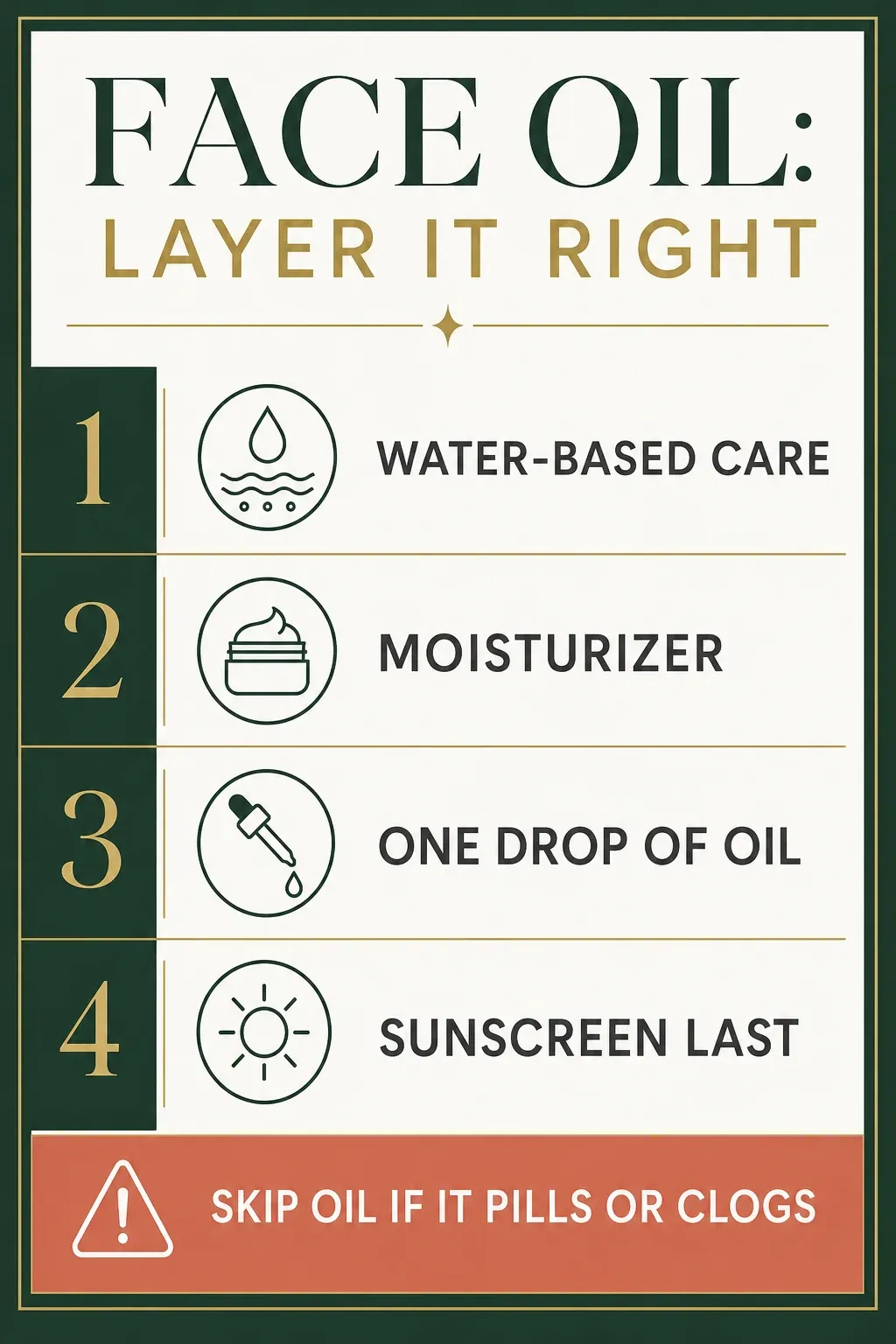
Apply cleanser first, then water-based treatment, moisturizer and finally oil when the goal is sealing the routine. Sunscreen remains the last morning skincare step. Oil placed on top of sunscreen can disturb the protective film and should be avoided unless the sunscreen maker explicitly supports it.
There is no rule that every product must be used from thinnest to thickest. Function matters more. Prescription directions, pH-dependent products and film-forming sunscreen can change the order.
For dry skin, apply moisturizer while the face is slightly damp and press one or two drops of oil onto the driest areas. The hydration versus moisturization guide explains why water-binding and oil sealing are separate jobs.
How to Choose a Face Oil
Start with a defined problem and a simple formula. Fragrance-free squalane, jojoba or another well-tolerated cosmetic oil can be easier to evaluate than a blend of twelve botanicals. Processing, oxidation stability and packaging matter as much as the plant story.
A 2024 review of coconut, olive, argan and jojoba oils describes different chemistry and applications. That does not make one oil universally best. Human outcome data and complete formulations remain uneven.
Choose a dark or opaque container when the oil is oxidation-prone, keep the cap closed and follow the period-after-opening guidance. A rancid smell or changed texture is a reason to discard. Do not decant into an unclean dropper.
Face Oil by Skin Type and Treatment
Dry skin may enjoy a small amount after cream, especially in cold or low-humidity weather. Oily skin may prefer no oil or use it only on dry zones. Skin type can also change with season, medication and body site.
Acne treatment with adapalene, tretinoin, salicylic acid or benzoyl peroxide can cause dryness. A non-comedogenic moisturizer has a clearer support role than oil alone. The facial oils and breakouts guide explains why individual formula testing matters.
Eczema, rosacea and perioral dermatitis need condition-specific plans. Fragranced oil can worsen contact dermatitis, and heavy occlusion can be uncomfortable. Ask a clinician before placing a new oil over prescription medication.
Morning Versus Night Use
Night is usually easier because there is no sunscreen film to protect and shine is less important. Apply after moisturizer and before bed, allowing time to settle. Protect pillowcases if the formula stains.
In the morning, use the smallest amount needed and allow it to absorb before sunscreen. If sunscreen pills, separates or slides, remove the oil from the morning routine. A reliable SPF film is more important than the glow finish.
Do not mix oil into sunscreen or foundation unless the manufacturer instructs it. Dilution changes how evenly a film forms. The sensitive-skin sunscreen guide helps find a more comfortable base.
Can Face Oil Replace Moisturizer?
A pure oil supplies emollient or occlusive lipids but usually lacks water, humectants and barrier ingredients present in a balanced moisturizer. It may be enough for someone whose skin is already comfortable, but it is not automatically a complete hydration strategy.
Humectants such as glycerin bind water, emollients smooth gaps and occlusives reduce evaporation. Creams combine these roles in a controlled emulsion. Use the facial moisturizing oil guide to compare formats.
If oil leaves the surface shiny while tightness continues, add a water-containing moisturizer rather than more drops. Tightness after cleansing may also signal an overly harsh cleanser. Fix the cause before increasing occlusion.
Acne, Comedogenicity and Patch Testing
Comedogenic ratings from rabbit ears or informal lists do not predict every finished formula on every person. Concentration, blend, cleansing and acne treatment all matter. "Non-comedogenic" reduces risk but is not a guarantee.
Test a small facial area for seven to ten days, then use on half or one zone before full-face application. Track clogged pores and inflammatory lesions over several weeks. A reaction within minutes suggests irritation, while acne changes can take longer.
Use one new oil at a time. Do not begin a retinoid, rich cream and oil together. The slow skincare method creates a cleaner test.
Olive, Coconut, Jojoba, Squalane and Rosehip
Olive oil is rich in oleic acid and can be a poor barrier choice for some sensitive skin despite its culinary reputation. Coconut oil is more occlusive and has selected body-skin evidence, but can feel heavy on acne-prone faces. Neither should be treated as universally gentle.
Jojoba is technically a liquid wax and often has a lighter feel. Squalane is a stable emollient used in simple formulas. Rosehip oils vary in composition and oxidation stability; evidence does not support calling them a guaranteed scar eraser.
The review of natural oils and contact dermatitis emphasizes that oils and essential oils have different fatty acids and allergy profiles. Patch testing the exact product matters more than copying a ranking.
How Much Oil to Use
Start with one drop for the face or one drop per dry zone. Warm it between clean fingertips and press rather than rub. Add a second drop only when the first amount leaves persistent roughness without congestion.
Using enough oil to create a wet layer increases migration into eyes, hairline and pillowcases. More does not accelerate barrier repair. The finish should feel comfortable, not slippery for hours.
For beard areas, apply carefully to skin rather than only coating hair. For body dryness, a cream or ointment is usually more efficient than facial dropper products. Match format to area size.
A Two-Week Introduction Plan
| Time | Action | Continue only if |
|---|---|---|
| Days 1 to 7 | Small-area test at night | No itch, swelling or persistent burning |
| Days 8 to 10 | One drop over moisturizer on one zone | Comfort improves without new bumps |
| Days 11 to 14 | Expand only if needed | No pilling, congestion or morning tightness |
| After two weeks | Compare with moisturizer alone | Oil adds a measurable benefit |
| Any day | Stop and simplify | Required for rash, eye irritation or worsening acne |
Common Face-Oil Mistakes
- Applying oil to dry tight skin alone: it does not add missing water.
- Putting oil over sunscreen: this can disturb the protective film.
- Using essential oils as carrier oils: aromatic concentrates have higher reaction risk.
- Trusting a universal comedogenic chart: formula and personal response matter.
- Adding many drops: more shine is not more repair.
- Using oxidized oil: storage and opening date are part of quality.
When to Stop or Seek Care
Stop for persistent burning, itch, swelling, eyelid irritation, rash or a clear increase in clogged pores. Wash gently and return to familiar products. Do not add exfoliation to remove oil-related bumps immediately.
Oozing, crusting, severe eczema, painful acne or a rapidly spreading reaction needs medical advice. The barrier recovery guide is appropriate for mild over-treatment, not severe disease.
Breathing difficulty, throat tightness or rapid facial swelling requires urgent care. Keep the bottle and ingredient list. Botanical origin does not rule out allergy.
Face Oil With Makeup and Tinted Products
Oil can change how foundation and concealer grip, spread and oxidize. Use one drop over moisturizer, allow it to settle and apply makeup in thin layers. If base products separate around the nose or slide by midday, remove the oil instead of adding powder.
Tinted sunscreen must still form an even film. Apply the full sunscreen amount after oil has settled, then wait before makeup. Do not blend oil into tinted SPF to create a dewier finish because that changes coverage uniformity.
For a glow effect, a luminous foundation or strategic highlighter may be more controllable than altering skincare. Separate cosmetic finish from barrier need. The skin should not require extra cleansing to remove an overly oily makeup layer.
Oxidation, Antioxidants and Shelf Life
Unsaturated oils can oxidize with air, heat and light. Added tocopherol may slow oxidation but does not make an opened product permanent. Follow the label and discard a sour, paint-like or otherwise changed smell.
Keep the dropper from touching skin and close the bottle promptly. Store it outside a steamy, sunlit bathroom when directed. A refrigerator is not automatically appropriate because some oils cloud or thicken.
Oxidized lipids can increase irritation and undermine a fair product test. Note the opening date and use an amount you can finish within the recommended period. Large food-oil containers are not designed for repeated cosmetic dispensing.
Face Oil During Acne Treatment
Use moisturizer as the primary support step when benzoyl peroxide, salicylic acid or a retinoid causes dryness. The AAD acne moisturizer guidance supports non-comedogenic moisturizer for treatment tolerance. Oil can be added only if a dry zone remains.
Do not use oil to dilute a prescription dose unless the prescriber approves. Mixing changes how evenly the medication spreads. Apply medication and moisturizer in the instructed order, then use a tiny amount of oil away from congestion-prone zones.
The oily-skin moisturizer guide may solve treatment dryness with less occlusion. Stop oil first when new closed comedones appear, then keep the rest of the routine stable while observing.
Pregnancy, Fragrance and Essential-Oil Claims
Pregnancy does not make every botanical blend appropriate. Essential oils contain many aromatic compounds and safety depends on ingredient, concentration and exposure. Ask a clinician about medicated or highly fragranced products rather than relying on a natural label.
Carrier oils without fragrance are easier to assess, but contact allergy remains possible. Do not apply unknown oils over a pregnancy-related rash or melasma treatment. Sunscreen and clinician-approved care remain the priorities.
Stop any product that causes headache, nausea, respiratory symptoms or a skin reaction. Cosmetics are optional during pregnancy. A simpler moisturizer can provide barrier support without a complex aromatic mixture.
Face Oil for Neck, Eyes and Lips
The eye area is prone to migration and irritation. Keep oil away from the lash line and stop if vision blurs or eyelids swell. A product tolerated on cheeks may not fit eyelids.
The neck can be more reactive than the face, especially with fragrance. Test separately and avoid layering oil over several actives. For lips, use a product specifically suitable for lip contact rather than a facial essential-oil blend.
Body oil can be efficient after bathing, but cream usually offers more complete hydration. Apply to damp skin or over lotion. Use slip carefully around showers and floors to prevent falls.
The Bottom Line
Face oil is an optional finishing step that can soften dry skin and reduce surface water loss. It does not add water, treat acne or replace sunscreen. Use it after moisturizer, start with one drop and keep it out of the final sunscreen film.
Choose by complete formula and tolerance rather than plant prestige. A simple oil that improves comfort can earn a place; an oil that adds shine, pilling or congestion should be removed.
Frequently Asked Questions About When to Use Face Oil in Your Skincare Routine
Should face oil go before or after moisturizer?
Usually after moisturizer, because oil can add emollience and reduce water loss. Prescription directions and specific formulas can change the order.
Can face oil replace moisturizer?
Sometimes comfortable skin needs only an emollient, but pure oil lacks the water and humectants of a balanced moisturizer. Tight skin often needs moisturizer first.
Can face oil cause acne?
Any oil or finished blend can contribute to congestion in an individual. Patch test one zone, use a small amount and monitor for several weeks rather than trusting universal comedogenic charts.
Can I use face oil under sunscreen?
A very small amount may work if it fully settles, but sunscreen must remain the final morning step. Remove oil if it causes pilling, sliding or uneven film.
How many drops of face oil should I use?
Start with one drop for the face or one drop per dry zone. Add more only when it improves comfort without leaving persistent slip or new bumps.
This article is for informational purposes only and does not replace professional dermatological advice.