The Skincare Graveyard | How to Safely Repurpose, Donate, or Recycle Unused Products
Discover what to do with skincare products you don't use. From repurposing acids for body care to ethical donation and technical recycling tips.

We have all been there. You spent weeks researching the "perfect" serum, waited for it to arrive, and integrated it into your routine with high hopes, only to find that three days later, your skin is reacting with redness, tiny bumps, or an unwelcome oil slick.
Perhaps you simply found a better alternative and the previous bottle now sits at the back of your cabinet, gathering dust.
This "skincare graveyard" is more than just a clutter problem; it represents a significant waste of investment and a potential environmental hazard if disposed of incorrectly.
The TL;DR
- The 60-Second Audit: Check the PAO (Period After Opening) symbol. If the product has been open for 12+ months and contains actives like Vitamin C or Retinol, it belongs in the recycling bin, not on your skin.
- Strategic Body-Mapping: Face acids (AHAs/BHAs) are powerful tools for treating rough heels, underarm odor, and "strawberry legs" (Keratosis Pilaris).
- The Donation Protocol: Only unopened or pump-dispensed products should be gifted or donated. Never share jars to avoid bacterial cross-contamination.
- Advanced Disposal: Rinse all containers and use specialized programs like TerraCycle for non-recyclable components like pumps and droppers.
Understanding what to do with skincare products you don't use is a vital skill for the modern consumer who values both skin health and sustainability.
At SkinOptimizer, we believe in a logical, systematic approach to skincare. Instead of letting products expire or tossing them mindlessly into the trash, we can apply a "Product Lifecycle Strategy."
This involves auditing the safety of the formula, determining why it failed your facial skin, and finding a secondary purpose that respects the chemistry of the ingredients.
Whether a product can be demoted to body care, gifted to a friend with a different skin type, or must be sent to a specialized recycling facility, every bottle deserves an intentional exit strategy.
The Audit: Safety First, Aesthetics Second
Before we decide how to give a product a second life, we must perform a clinical audit. Skincare is not a static substance; it is a complex chemical formulation that begins to change the moment it is exposed to the environment.
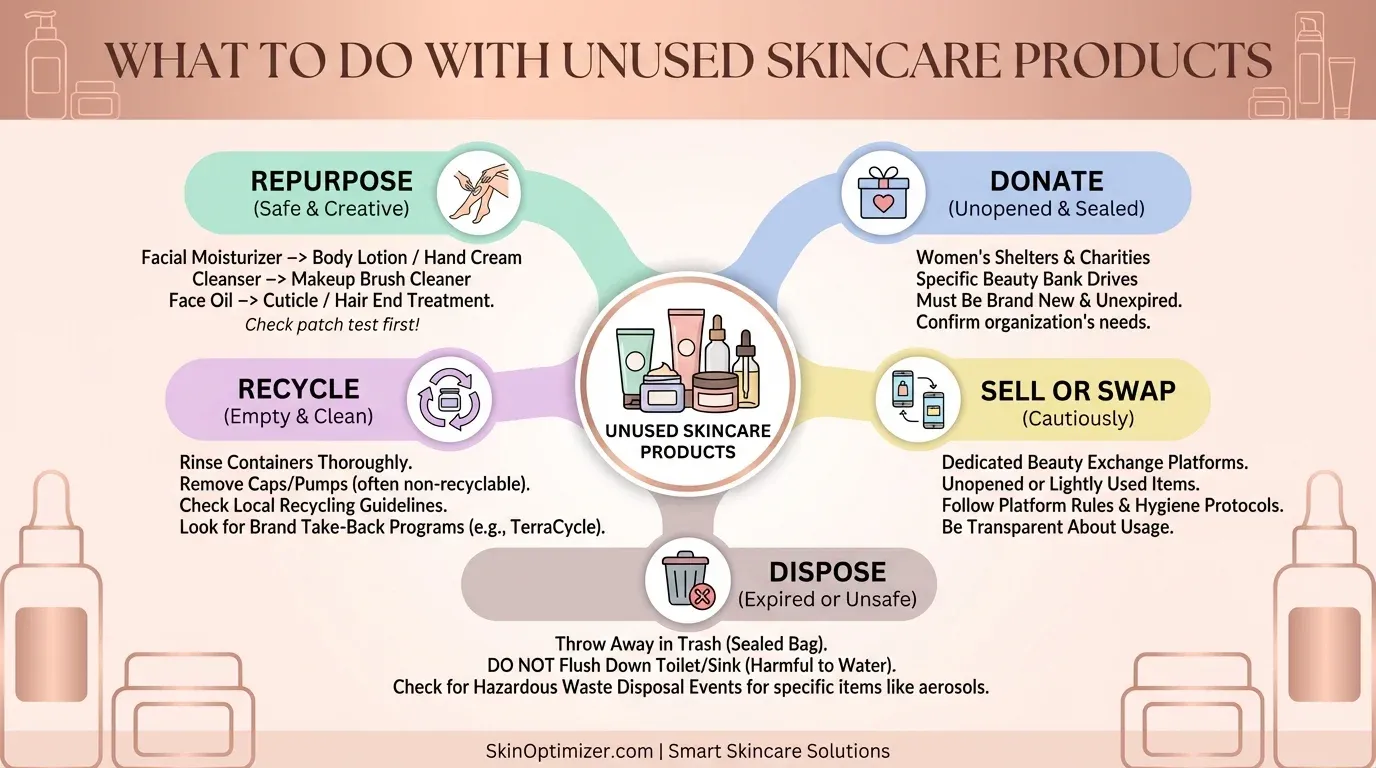
The Chemistry of Expiration vs. PAO
Most consumers mistakenly look only for a stamped expiration date.
However, according to the FDA’s guidelines on shelf life, cosmetic manufacturers are responsible for ensuring the safety of their products, though "expiration dates" are not strictly mandated by law for all cosmetics.
Instead, the beauty industry uses the Period After Opening (PAO) symbol as the "gold standard" for consumer safety. This icon looks like a small open jar with a number followed by an "M" (e.g., 6M, 12M, 24M).
This icon looks like a small open jar with a number followed by an "M" (e.g., 6M, 12M, 24M).
When you break the seal on a product, you introduce:
- Oxygen: Triggers oxidation, particularly in antioxidants like Vitamin C.
- UV Light: Can destabilize photo-sensitive ingredients like Retinoids.
- Microorganisms: Even with robust preservative systems, the introduction of bacteria from your fingers (in jar packaging) or the air can eventually overwhelm the formula.
If you opened a serum 18 months ago and the PAO is 12M, the preservative system may have failed. At this point, applying the product—even to your body—could lead to contact dermatitis or infection.
Proper storage of skincare products can extend their life, but it cannot stop the biological clock.
Signs of Chemical Degradation
If the product meets any of the following clinical indicators, skip the repurposing and move straight to the recycling phase:
- Emulsion Breakdown: When a cream "splits" into a watery layer and an oily layer, it means the emulsifiers have failed.
- Oxidative Rancidity: A sharp, vinegary, or "metallic" smell in face oils or Vitamin C serums.
- Color Transformation: Ascorbic acid turning from clear/champagne to a deep, dark amber indicates it has become a pro-oxidant, which can actually damage your skin.
- Texture Anomalies: Any new grittiness, "beading," or crystallization.
🧪 The Skin Insider
In my editorial work with clinical formulators, I've learned that 'clean' beauty products without synthetic preservatives often have a much shorter PAO—sometimes as little as 3 months. If you’re transitioning to natural skincare, your graveyard will grow faster if you don't use products strictly within their window.
Why Did the Product Fail Your Face?
Determining why a product was relegated to the graveyard is essential for deciding its next destination. Skincare failure is rarely about a "bad" product and usually about a "bad match."
1. The Barrier Conflict
If a product caused stinging, redness, or a "tight" feeling, it likely compromised your skin barrier. This often happens with high-percentage AHAs or Retinoids.
While your face may be too sensitive for these concentrations, the skin on your back or heels is much thicker and may benefit from the high potency.
2. The Comedogenic Factor
If a rich cream caused clogged pores or acne, it likely contains occlusives (like Shea Butter or certain oils) that are too heavy for your facial sebum levels.
These same ingredients are "gold" for the shins and elbows, where the skin has fewer sebaceous glands and is prone to extreme dryness.
3. Texture and Finish
Sometimes a product is technically sound but aesthetically unpleasant. It might be too sticky, cause skincare pilling, or leave a white cast.
These are purely cosmetic issues that don't affect the product's efficacy on other parts of the body.
| Product Category | Why It Failed (Face) | New Mission (Body) |
Exfoliating Toners | Stinging/Irritation | Heel smoothing, Underarm odor control |
Facial Oils | Breakouts/Greasy feel | Cuticle repair, Shaving oil, Leg hydration |
Heavy Moisturizers | Milia/Congestion | Neck and Décolletage firming, Elbow softening |
Foaming Cleansers | Stripping/Dryness | Makeup brush shampoo, Gentle hand soap |
Eye Creams | Didn't see results | Lip area treatment, Smile line hydration |
The Repurpose Matrix: A Body-Mapping Guide
The "Optimizer’s Edge" lies in realizing that the body is not a monolith. Different zones have different skin thicknesses and needs.
Using Acids for "Body Smoothing"
Facial acids (Glycolic, Lactic, Salicylic) are some of the most versatile items to repurpose.
- For Rough Heels: Apply an unused AHA toner to a cotton pad and wrap it around your heel for 5 minutes before bed. Follow with a thick balm.
- For Keratosis Pilaris (KP): Those tiny bumps on the back of arms respond excellently to BHA (Salicylic acid) products that were perhaps too drying for your face.
- For Back Acne: If your face cleanser was too harsh, use it to clear back acne where the skin is more resilient.
Face Oils for Barrier Support
The skin on our shins and forearms is notoriously poor at retaining moisture. If a face oil felt too "suffocating" on your face, it is likely the perfect occlusive for your body.
- The "Shower Method": Apply unused oil to damp skin immediately after showering to lock in hydration.
- Cuticle Care: High-quality facial oils (like Rosehip or Argan) are often superior to dedicated cuticle oils.
💡 The Optimizer’s Edge
One of the best-kept secrets in the industry is using unused AHA toners on your underarms. The low pH of the acid creates an environment where odor-causing bacteria cannot thrive, effectively acting as a 'pre-deodorant' treatment for smoother, brighter skin.
Organizing for Long-Term Sustainability
The "graveyard" is usually a symptom of poor visibility. If you can't see your products, you won't use them before they expire.
The Ethics of Gifting and Donation
If a product is safe but simply not for you, gifting is the most environmentally friendly option. However, hygiene is non-negotiable.
The "Golden Rule" of Sharing
- Jars are a No-Go: Unless you used a clean spatula for every single application, never gift a jar-packaged product. The risk of passing on bacteria, mold, or fungal spores is too high.
- Pumps and Tubes are Safe: These delivery systems prevent air and skin contact with the bulk of the product.
- Active Ingredients: Be cautious when gifting high-potency items like Retinoids. Ensure the recipient knows how to use them safely to avoid burning their skin.
Where to Donate Unopened Products
Many organizations accept unopened, unexpired skincare:
- Project Beauty Share: Collects personal care products for marginalized women.
- Family Shelters: Basic items like moisturizers, sunscreens, and cleansers are always in high demand.
- Hospitals: Sometimes accept unopened, fragrance-free lotions for patients with skin-drying treatments.
The Technical Guide to Disposal (The End of Life)
When a product is truly past its prime, we must return the packaging to the circular economy. This is a technical process.
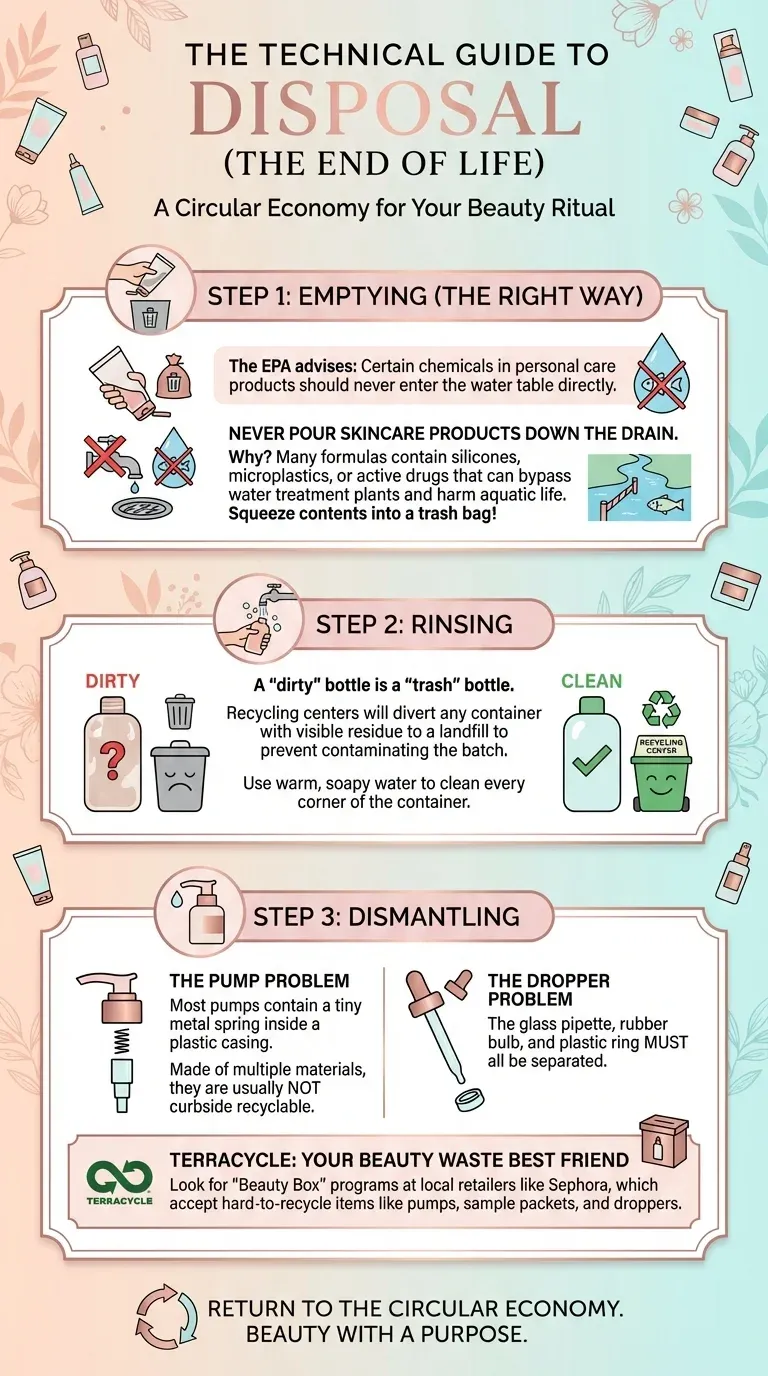
Step 1: Emptying (The Right Way)
The Environmental Protection Agency (EPA) advises that certain chemicals found in personal care products should never be disposed of in a way that allows them to enter the water table directly.
Never pour skincare products down the drain. Many formulas contain silicones, microplastics, or active drugs that can bypass water treatment plants and harm aquatic life. Squeeze the contents into a trash b
Step 2: Rinsing
A "dirty" bottle is a "trash" bottle. Recycling centers will divert any container with visible residue to a landfill to prevent contaminating the batch. Use warm, soapy water to clean every corner of the container.
Step 3: Dismantling
- The Pump Problem: Most pumps contain a tiny metal spring inside a plastic casing. Because they are made of multiple materials, they are usually not curbside recyclable.
- The Dropper Problem: The glass pipette, rubber bulb, and plastic ring must all be separated.
- TerraCycle: This is your best friend for beauty waste. Look for "Beauty Box" programs at local retailers like Sephora, which accept all those "hard-to-recycle" items like pumps, sample packets, and droppers.
| Packaging Material | Curbside Recyclable? | Preparation Required |
Clear Glass Bottles | Yes | Remove labels; rinse thoroughly. |
Colored Glass | Yes | Blue/Green glass is accepted in most areas. |
PET Plastic (#1, #2) | Usually | Check local size requirements (some too small). |
Airless Pumps | No | Send to TerraCycle. |
Aluminum Tubes | Yes | Ensure 100% empty and rinsed. |
✅ Your Clear Skin Checklist
- Step 1: Perform a 'Graveyard Audit' tonight. Check every PAO icon and smell your oils.
- Step 2: Move failing face-acids to the bathroom cabinet to use on heels and underarms after your next shower.
- Step 3: Set aside unopened products for a local shelter and wash out empty containers for recycling.
- Step 4: Before your next purchase, ask: 'Is this a gap in my routine, or just an impulse buy?'
Summary: The Optimizer’s Path
Managing a skincare graveyard is not about being "perfect"—it’s about being intentional. By understanding the chemistry of your products, you can turn a financial loss into a biological win for your body. The most sustainable product is the one you actually use.
Before you toss that serum, remember: your heels, elbows, and shins are waiting for their turn to glow.
Frequently Asked Questions About Unused Skincare
Can I use expired eye cream on my face?
Generally, yes—if it’s not past its PAO. Eye creams are often just more concentrated, fragrance-free versions of face creams. They are excellent for fine lines around the mouth or on the neck. See our eye care guide for more on why these formulas are special.
How do I know if my sunscreen is still effective?
Sunscreen is an OTC drug. If it is past its stamped expiration date, you must throw it away. UV filters degrade over time, and using an expired SPF can lead to severe sun damage.
What should I do with a face wash that leaves me feeling "squeaky clean"?
This is usually a sign of a high-pH cleanser that is stripping your barrier. Use it to wash your makeup sponges or as a gentle hand wash for delicate fabrics.
Can I mix my unused serum into my body lotion?
Only if you do it in your palm right before application. Never mix them inside the bottle, as you may destabilize the preservatives and cause bacterial growth.
Is it safe to share a lip balm that I didn't like?
Only if it's in a squeeze tube. Never share a stick or tin lip balm, as they are direct vectors for bacteria and viruses.
Disclaimer: This article is for informational purposes only and does not replace professional dermatological advice.