Beyond the Filler: The Science of Waterless Skincare for Resilient Skin
Discover the science of waterless skincare. Learn how anhydrous formulas increase potency, stabilize Vitamin C, and repair the skin barrier.


In the landscape of modern dermatology, we are witnessing a tectonic shift away from the "volume-first" philosophy that has dominated skincare for decades. For years, the industry standard for a moisturizer or serum has been a formula comprised of 70% to 90% water (aqua).
TL;DR: The Waterless Essentials
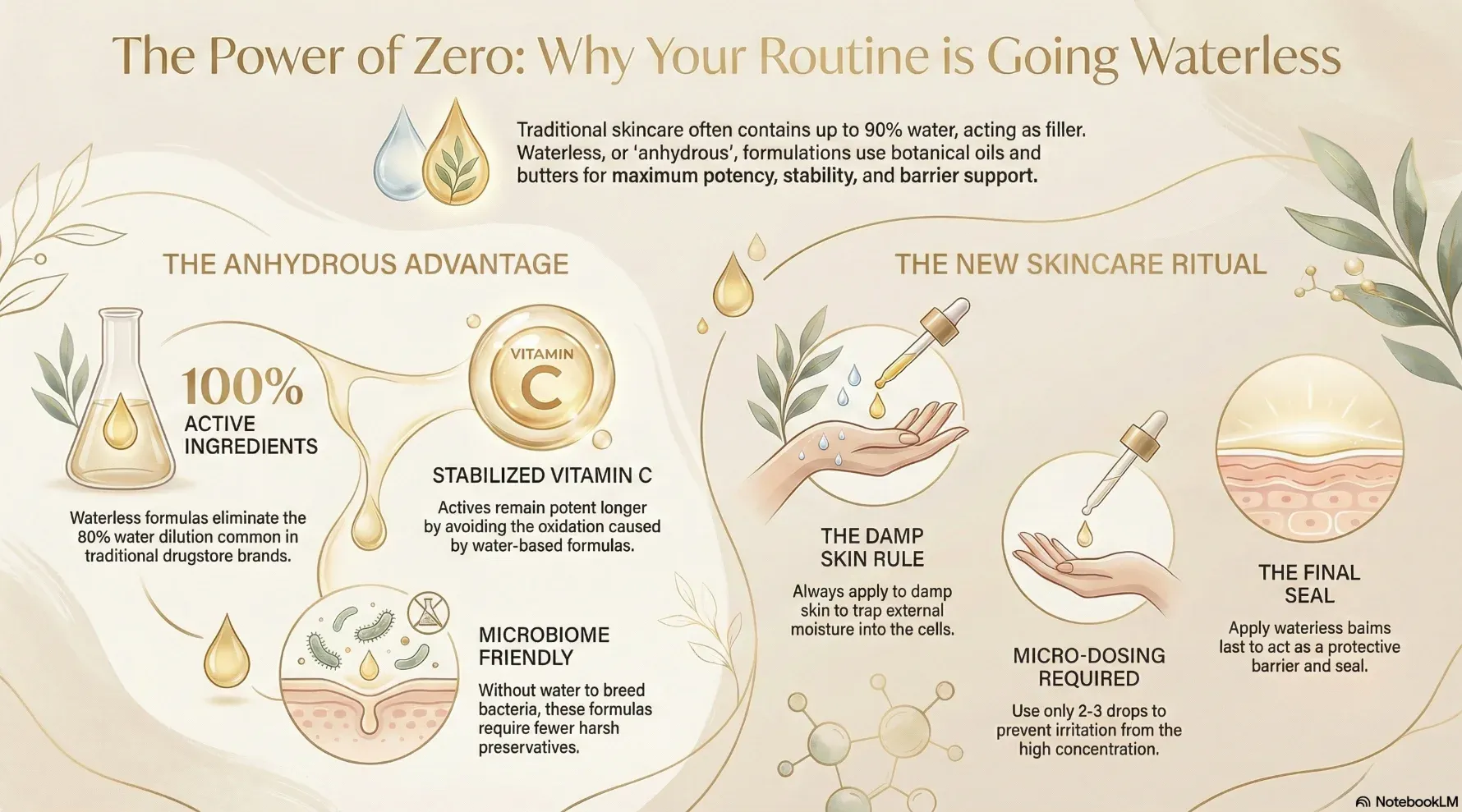
- Maximum Potency: Anhydrous formulas avoid the 80% water dilution common in drugstore brands.
- Stabilized Actives: Ingredients like Vitamin C remain potent longer without water-induced oxidation.
- Barrier Support: Ideal for skin barrier repair for sensitive skin by avoiding drying alcohols and harsh preservatives.
- The Damp Skin Rule: Always apply to damp skin to trap moisture since the product doesn't provide its own.
- Microbiome Friendly: Because water breeds bacteria, waterless formulas require fewer preservatives, keeping your acid mantle intact.
While water serves as a cheap, effective solvent, it often acts as a literal filler, diluting the active ingredients you actually paid for. As we navigate 2026, waterless skincare—or anhydrous formulation—has emerged not just as a sustainability trend, but as a clinical necessity for those seeking maximum potency and skin barrier resilience.
The transition to waterless products requires a fundamental recalibration of how we perceive "hydration." Many consumers mistakenly equate the wet, cooling sensation of a water-based cream with true physiological hydration.
In reality, water-heavy products can sometimes lead to a "wicking" effect where the evaporation of surface water actually pulls moisture out of the deeper layers of the stratum corneum.
To truly address skin health, we must understand the difference between hydration and moisturization—a distinction that anhydrous products handle with far more precision.
🧪 The Skin Insider
In my years of reviewing formulations, the most common "pilling" issues I've seen stem from water-based serums that use too much high-molecular-weight hyaluronic acid. Waterless balms and oils bypass this entirely. When you remove water, you remove the "slip" agents that usually cause skincare pilling, leading to a much more seamless integration with your natural lipids.
The Chemistry of Anhydrous Formulations
To understand why waterless skincare is superior for specific skin concerns, we must look at the molecular level. Traditional skincare is an emulsion—a mix of water and oil held together by surfactants.
In a waterless formula, the "carrier" is usually a botanical oil, a butter like Shea Butter, or a dry powder.
1. Stability of Actives and the Oxidation Crisis
Certain ingredients are notoriously "water-shy." The moment Vitamin C hits water, it begins to oxidize, losing its brightening efficacy. By suspending these actives in an anhydrous base, the ingredient remains "dormant" until it touches the moisture in your skin.
This is also why many retinoids for acne are now moving toward anhydrous systems to prevent degradation.
2. The Preservative Paradox
Water is the primary breeding ground for mold and bacteria. To keep a water-based cream shelf-stable, formulators must include a robust cocktail of preservatives.
Waterless products lack the "fuel" for microbial growth, allowing for cleaner, more minimalist ingredient lists that are far better for sensitive skin.
Editor's Pick: The Ultimate Anhydrous Balm
Experience the potency of a 100% waterless concentrate. Perfect for skin barrier repair and deep overnight hydration without the fillers.
Shop on Amazon →✦ As an Amazon Associate, we earn from qualifying purchases. This supports our editorial work at no extra cost to you.
Is Waterless Right for Your Skin Type?
While the benefits are clear, anhydrous skincare is not a "one size fits all" solution. Its high lipid content means that application techniques must vary based on your specific skin concerns.
For Aging and Mature Skin
Aging skin often suffers from a thinned barrier. Using moisturizers for aging skin that are waterless provides a protective "second skin" that traditional lotions cannot match. The dense concentration of antioxidant-rich ingredients in waterless formulas also fights free radicals more effectively.
For Oily and Acne-Prone Skin
There is a common myth that oils cause breakouts. However, many moisturizers for oily skin utilize anhydrous Squalane to help regulate sebum production. The key is choosing non-comedogenic products that won't clog pores.
💡 The Optimizer’s Edge
The hidden benefit of waterless skincare is the pH Factor. Water-based products must be pH-balanced to avoid stinging. Waterless products have no pH. This allows the skin's natural "Acid Mantle" to remain undisturbed, preventing the sudden breakouts or "tightness" often caused by alkaline cleansers.
How to Build a Waterless Routine: The 2026 Strategy
Transitioning to a waterless routine requires a strategic approach. You cannot simply swap one for one without adjusting your technique to avoid common skincare mistakes.
Step 1: The "Damp Start"
Because anhydrous products don't contain water, you must provide the hydration source. After cleansing, leave your face slightly wet. This "trapped water" is what your waterless balm will lock into your cells.
Step 2: Micro-Dosing
If you are using a waterless serum or oil, use only 2-3 drops. Over-application is one of the biggest reasons for skin irritation.
Step 3: Layering Logic
Always apply your "waterless" products last in the serum phase. Because oils and waxes have a larger molecular size than water-based essences, they act as a "seal". Learn how to layer moisturizer and serum properly to ensure maximum efficacy.
✅ Your Waterless Transition Checklist
- Step 1: Identify your "filler" products—check for 'Aqua' as the first ingredient.
- Step 2: Always apply anhydrous balms to damp skin to ensure hydration is trapped.
- Step 3: Reduce your volume by 50% to prevent over-doing skincare.
- Step 4: Monitor your barrier for 2 weeks for increased "bounce" and reduced tightness.
Frequently Asked Questions About Waterless Skincare
Does waterless skincare expire faster since it has no preservatives?
Actually, the opposite is true. Because water is the primary cause of bacterial growth, waterless products are often more stable and have a longer shelf life.
Can I use waterless products if I have oily skin?
Yes, provided you choose non-comedogenic oils like Squalane. These help balance natural oil production.
Why are waterless products more expensive?
You are paying for 100% active ingredients rather than 80% water. While the price per ounce is higher, the cost per application is often lower because you use significantly less.
Do I still need a separate moisturizer if I use a waterless face oil?
For many, a high-quality waterless oil is the moisturizer. If your skin is extremely dry, you can layer a waterless balm over your oil for extra protection.
YMYL Disclaimer: This article is for informational purposes only and does not replace professional dermatological advice.